Team Leadership Development
Strengths Spotting in One-on-Ones: Questions Leaders Ask

Your one-on-ones may be too focused on what is blocked.
That is understandable. Most leaders use one-on-ones to clear blockers, review priorities, and make sure work is moving. Those things matter. But if every conversation starts with problems, you can miss something important sitting right in front of you.
You can miss how someone naturally thinks.
Strengths-based one-on-one questions help you spot the work that gives a person energy, the problems they solve quickly, and the contribution they make without forcing it. This is not about cheerleading. It is about noticing useful patterns so you can coach people with more accuracy.
This fits real leadership because you do not need a retreat, a new tool, or a personality label to start. You need a better conversation.
Strengths Spotting Is Not Flattery
Some leaders hear "strengths" and think it means being positive all the time.
It does not.
Strengths spotting means paying close attention to when someone is doing work in a way that looks natural, useful, and repeatable. It asks a better question than "What are you bad at?" It asks, "Where are you already showing capability that we can build from?"
That distinction matters.
Gallup has found that people who use their strengths every day are much more likely to be engaged at work. Its strengths research also points to a practical manager habit: people need meaningful conversations about their strengths rather than only annual reviews or generic encouragement.
One Gallup item is especially useful for leaders: "In the last three months, my supervisor and I have had a meaningful discussion about my strengths." That is a high bar. It is also a clear invitation. If you lead people, your job is not only to correct performance. Your job is to help people recognize what works and use it with more intention.
The one-on-one is the best place to do it.
Why This Belongs in Regular One-on-Ones
Most teams do not need more formal development language. They need a better weekly rhythm.
Gallup's strengths conversation guidance says only 16% of employees describe their last manager conversation as extremely meaningful. The same guidance points to one meaningful conversation per employee per week as a major driver of strong manager-employee relationships.
That does not mean every one-on-one needs to become a deep career session. It means the conversation should help the person leave with more clarity than they came in with.
For a busy owner or manager, this is good news. You can make a one-on-one more developmental without making it longer. Add one strengths question. Listen for evidence. Connect the answer to work that is already on the table.
That is often enough to change the tone.
Instead of:
- What is behind?
- What needs my approval?
- What went wrong?
You add:
- What part of the work gave you energy this week?
- Where did you feel most useful?
- What did you do that someone else relied on?
The first set keeps work moving. The second set helps people grow.
You need both.
Four Signals of Natural Talent
Many people cannot name their own strengths clearly.
Ask someone "What are your strengths?" and you often get a resume answer. Hard worker. Good communicator. Team player. Those may be true, but they are too broad to coach from.
Strengths spotting works better when you listen for signals.
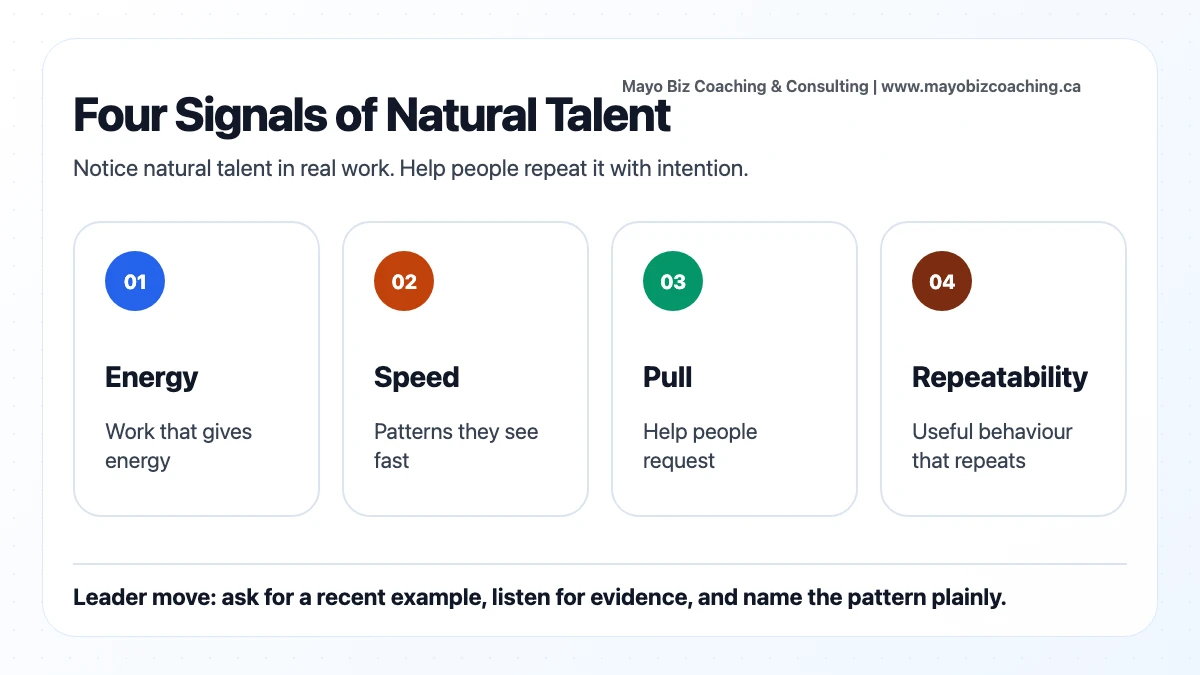
1. Energy
Some work takes effort but still leaves a person feeling more awake.
Listen for the projects they talk about with more detail. Notice when their voice picks up. Watch which tasks they volunteer for before anyone asks. Energy is not the same as ease. A task can be challenging and still fit someone well.
A good one-on-one question:
"What part of your work this week gave you more energy than it took?"
2. Speed
Natural talent often shows up as faster pattern recognition.
One person can look at a messy client issue and quickly see the relationship risk. Another can scan a process and spot the missing step. Another can turn scattered ideas into a useful plan.
They may assume everyone sees what they see. Usually, they do not.
Ask:
"What felt obvious to you this week that seemed less obvious to others?"
3. Pull
Strengths often attract requests.
People become known for something before they have language for it. The calm person gets brought into tense conversations. The detail person gets asked to review handoffs. The connector gets pulled into cross-team issues because they understand people and context.
Ask:
"What do people come to you for help with again and again?"
That question tells you how the team already experiences the person.
4. Repeatability
A strength is not a lucky moment. It shows up more than once.
Broad praise falls short for the same reason. "Great job" feels good for a few seconds, but it does not teach the person what to repeat. Specific noticing does.
Marcus Buckingham and Ashley Goodall made this point in Harvard Business Review's "The Feedback Fallacy." Their argument is not that leaders should avoid standards. It is that excellence is individual, and people learn more when someone helps them notice what worked in a specific moment.
A leader could say:
"When you slowed the conversation down and summarized both sides, the room settled. Did you notice that?"
That sentence is more useful than "You're good with people."
It gives the person a pattern they can use again.
Strengths-Based One-on-One Questions
Use these questions as a menu, not a script.
Pick one or two per conversation. Ask them naturally. Then listen long enough to get a real answer.
Questions About Energy
- What work gave you energy this week?
- What task did you keep thinking about because you enjoyed solving it?
- What felt heavy at first but satisfying once you got into it?
- What kind of work would you like a little more of next month?
Energy questions help you see fit. They also reveal the difference between work someone can do and work that helps them grow.
Questions About Ease and Speed
- What came easier to you than expected?
- Where did you move faster because the pattern made sense to you?
- What did you understand quickly that others needed more time to process?
- What part of the work felt natural, even if it was still demanding?
These questions are especially useful for quiet performers. Some people do excellent work without drawing attention to it. A good manager helps make that talent visible.
Questions About Contribution
- What did someone rely on you for this week?
- Where did your work make another person's work easier?
- What did you notice that helped the team avoid confusion?
- What strength of yours helped the team most this week?
Contribution questions connect strengths to the team. That prevents strengths work from becoming self-focused. The point is not "what am I good at?" The point is "how does what I do well help the people around me?"
Questions About Growth
- What strength would you like to use more deliberately?
- What current project could use more of your best work?
- What support would help you bring that strength forward?
- What is one small experiment we could try before our next check-in?
Growth questions turn the conversation into action. Without action, strengths talk becomes pleasant but thin.
Listen for Evidence, Not Labels
The strongest one-on-one move is the follow-up question.
When someone says, "I think I am good at organizing," do not stop there. Ask for the moment.
"Where did that show up recently?"
"What did you do that made the work easier?"
"What changed because you handled it that way?"
Now you have evidence.
Maybe the strength is not organization. Maybe it is sequencing. Maybe it is calming a group by creating order. Maybe it is seeing dependencies before they become delays.
The label matters less than the pattern.
Active listening becomes practical here. You are not listening to be polite. You are listening to understand how the person creates value.
Once you hear the pattern, reflect it back in plain language:
"I notice that when work is scattered, you naturally create the next three steps. That seems to help the team move without overcomplicating things."
That kind of reflection builds self-awareness. It also gives the person language they can use in future conversations.
Turn Strengths Into a Small Work Experiment
Strengths only matter at work if they touch the work.
After you spot a strength, connect it to something real. Keep the experiment small enough to try before the next one-on-one.
Use this simple sequence:
- Name the strength pattern.
- Pick one current task where it could help.
- Agree on how the person will use it.
- Check what happened next time.
For example:
"You seem to spot client confusion early. This week, could you review the onboarding email from that lens and mark where a new client might get stuck?"
Or:
"You are good at getting quieter people into the conversation. In Thursday's planning meeting, could you help us hear from the two people who have not weighed in yet?"
That is strengths-based development in real work. No big program. No label required. Just better attention, a clearer assignment, and follow-through.
If you are deciding whether to coach or direct, the distinction in coaching versus managing helps. Strengths spotting is usually a coaching move. But if the work has high risk or the person is new, give clearer direction first.
Where Strengths-First Leadership Goes Wrong
Strengths-first does not mean weakness-blind.
There are a few traps to avoid.
Turning Strengths Into Excuses
"That is not my strength" should not become a way to dodge responsibility. Everyone still has standards to meet. A strength gives you a better route to performance. It does not remove the need for performance.
If someone struggles with follow-through, you still address it. But you can ask whether they need a different system, partner, or rhythm to do the work well.
Typecasting People
Once you name a strength, do not trap the person inside it.
The organized person may still want creative work. The relationship builder may want more analytical responsibility. The calm person may not want to be assigned every tense conversation.
Strengths should create opportunity, not a smaller box.
Ask:
"Do you want to use this strength more, or is this something people overuse you for?"
That question protects trust.
Praising Without Precision
"You are amazing" is kind, but vague.
Specific praise is more useful:
"The way you clarified the decision saved us from rework."
"Your summary helped the client feel heard and helped the team know the next step."
"You noticed the handoff gap before it became a customer issue."
Now the person knows what to repeat.
Skipping Accountability
Strengths and accountability belong together.
If a commitment is missed, talk about the missed commitment. Then ask which strength could help the person recover and prevent the pattern next time.
Support without standards becomes softness. Standards without support becomes pressure. Good leadership needs both.
A 30-Minute Strengths Spotting One-on-One
Here is a simple structure you can use this week.
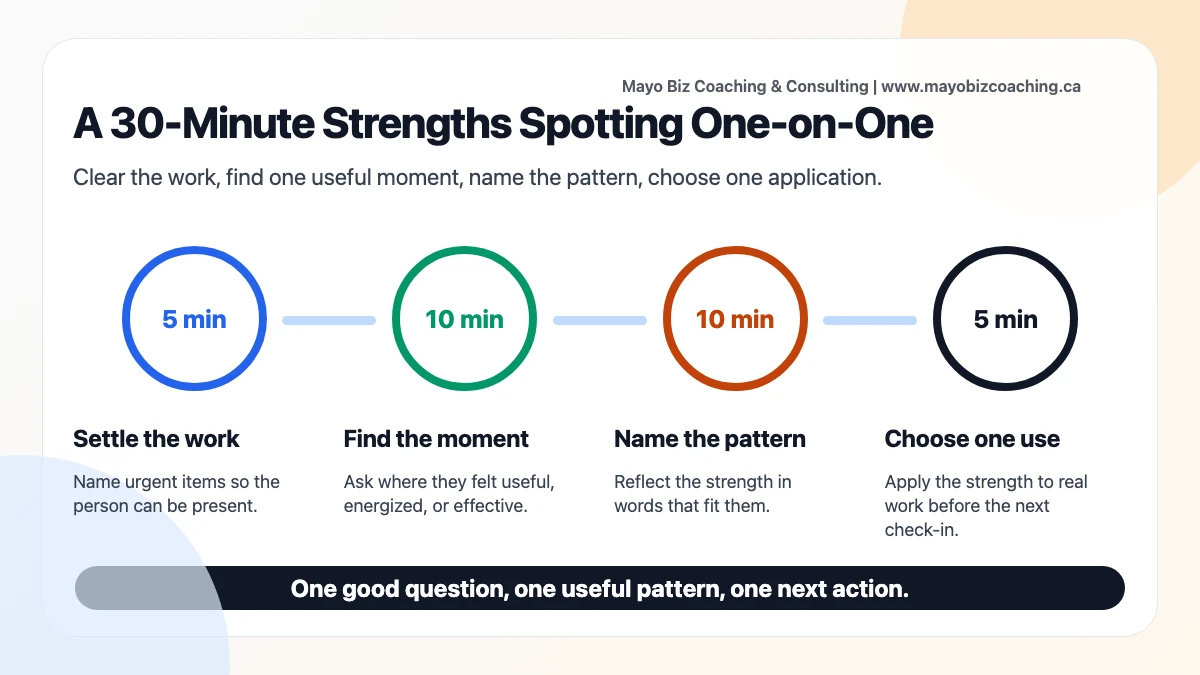
First 5 minutes: Settle the work
Ask what needs attention today. Clear the urgent items quickly enough that the person can be present.
Good question:
"What needs to be named before we talk about development?"
Next 10 minutes: Find the moment
Ask for a recent example where the person felt useful, energized, or effective.
Good questions:
- What worked well this week?
- What did you do that helped the team?
- Where did you feel like yourself in the work?
Stay with one example long enough to understand it.
Next 10 minutes: Name the pattern
Reflect what you heard.
"It sounds like you are strong at turning vague ideas into a practical next step."
"It sounds like you notice tension early and help people stay in conversation."
"It sounds like you are good at making complex details easier for others to act on."
Then ask:
"Does that feel accurate?"
Let them correct the language. The wording should fit them, not you.
Final 5 minutes: Choose one application
Pick one place to use the strength before the next check-in.
Good questions:
- Where could this strength help us this week?
- What would using it deliberately look like?
- What should we check next time?
End with one action. Keep it small. Follow up.
What Changes When Leaders Do This Well
The first change is usually confidence.
People start to see their own contribution more clearly. They stop treating natural talent as luck. They can explain what they bring to the team.
The second change is better work assignment.
You start matching work to talent with more care. Not perfectly. Not every task can fit someone's strengths. But more of the work starts to fit more of the people, more of the time.
The third change is trust.
People can tell when a leader sees them accurately. Gallup's strengths research has found that managers who focus on strengths can sharply reduce active disengagement. That makes sense. Being seen for useful contribution tells people they matter.
I would keep the expectation practical. One conversation will not change a team overnight. A repeated habit can change how people experience work.
Ask one better question this week. Notice one useful pattern. Reflect it back with enough detail that the person can repeat it.
That is a good start.
Let's Build Brilliance Together
Strengths spotting helps leaders develop people from what is already true, not from a generic idea of what a good employee should be. When one-on-ones help people see and use their natural talent, confidence and follow-through both get stronger.
If you want support building stronger one-on-ones, reach out for a free consultation. No sales pitch, just an honest conversation about where you are and what you're working on.
Category & Tags
Frequently Asked Questions
What are strengths-based one-on-one questions?
Strengths-based one-on-one questions help a leader notice where someone has natural energy, judgment, speed, and repeatable contribution. They turn a check-in into a coaching conversation about how the person works best.
How can I identify employee strengths without an assessment?
Watch for repeated patterns: work that gives energy, problems people solve quickly, help coworkers request often, and moments where good results come naturally. Then ask for specific examples in one-on-ones.
Should one-on-ones focus only on strengths?
No. Strengths do not remove accountability. Use strengths to understand how someone can do better work, then still address gaps, standards, and follow-through clearly.
How often should managers discuss strengths?
Gallup recommends regular strengths conversations, including quick connects and check-ins. A practical rhythm is one strengths question in each weekly one-on-one and a deeper review once a month.
About the Author

About the Author
Mark Mayo
Head Coach, MBC
We get up each morning excited about sharing our 20-plus years of business acumen with small business owners and their teams. Collaborating with hard-working owners to achieve their personal and business goals brings rewards. When we develop you and grow your leaders, we create the momentum that moves you and your business forward. It starts with a first step. Then we can build brilliance together.
Related Articles

Build a Team Strengths Map: Turn Talent Into Advantage
A team strengths map helps leaders see talent patterns, reduce bottlenecks, pair people well, and turn individual strengths into clearer team work.
Read Build a Team Strengths Map: Turn Talent Into Advantage
Strengths-Based Work Assignment: Match Talent to Growth
Strengths based work assignment helps leaders match real work to talent, growth, and team needs without turning development into another program.
Read Strengths-Based Work Assignment: Match Talent to Growth
Coaching vs. Managing: Why Great Leaders Master Both
Learn when to coach and when to manage. Research shows managers who master both approaches build more engaged teams and drive better results.
Read Coaching vs. Managing: Why Great Leaders Master Both