Team Leadership Development
Strengths-Based Work Assignment: Match Talent to Growth
You have a real piece of work to assign and a capable person who could probably take it. That is the easy part.
The harder part is deciding whether the assignment will help them grow or simply move one more task off your desk. Most leaders are not short on tasks. They are short on thoughtful matches between work, talent, timing, and support.
Strengths based work assignment asks a better question than "who has capacity?"
It asks, "Who is built for this kind of contribution, and what could this assignment help them become?"
That question changes the quality of the handoff. It keeps development close to the work instead of turning it into another program, course, or annual conversation. It also keeps strengths practical because a strength only matters at work when it touches real work.
Strengths-Based Work Assignment Is Not Favouritism
Some leaders worry that assigning work by strengths will look unfair.
That concern is worth taking seriously. If strengths language becomes a private shortcut for giving the best projects to the same few people, trust will erode. People will hear "strengths" and think "preferences."
That is not the work. A strengths-based assignment is not a reward for being liked. It is a clear match between the work in front of the team and the way a person naturally creates value.
It should be explainable in plain language.
You should be able to say:
"I am asking you to lead this client review because you notice patterns in messy information, and this project needs that."
Or:
"I want you close to this handoff because you slow conversations down in a useful way, and the team needs clarity before we move."
That kind of sentence tells the person why they were chosen, and it teaches the team what useful contribution looks like.
Gallup's strengths research 1 is helpful here because it keeps the focus on application. Their guidance includes assigning team projects based on employees' strengths and helping people align their talents to role expectations. In other words, strengths work is not meant to sit in a report. It is meant to shape how work gets done.
Your job as the leader is to make the match visible, fair, and connected to team needs.
Start With the Work, Not the Person
It is tempting to start with the person.
"She needs a stretch."
"He wants more ownership."
"They are ready for something bigger."
Those may all be true, but if you start there, you may hand someone a task that sounds developmental and feels random. The work comes first.
Before assigning anything, slow down and name what the assignment actually requires. Not the job title. Not the department. The real work.
Ask:
- Does this need careful sequencing?
- Does it need relationship trust?
- Does it need quick problem diagnosis?
- Does it need someone who can calm a room?
- Does it need follow-through across several moving parts?
- Does it need comfort with ambiguity?
Now you are looking at the assignment with more accuracy before you ask someone else to carry it.
This is the same listening discipline that helps in strengths-spotting one-on-ones. You are not looking for a label. You are looking for evidence. Where has this person already shown the kind of contribution the work needs?
The assignment gets better when you can name that evidence before the handoff.
Gallup's strengths conversation guidance 2 is a useful reminder that strengths work needs conversation, not assumption. People need language for what they bring before they can apply it with intention.
A Strengths Based Work Assignment Filter
Use this filter before the next meaningful task lands on someone's desk.
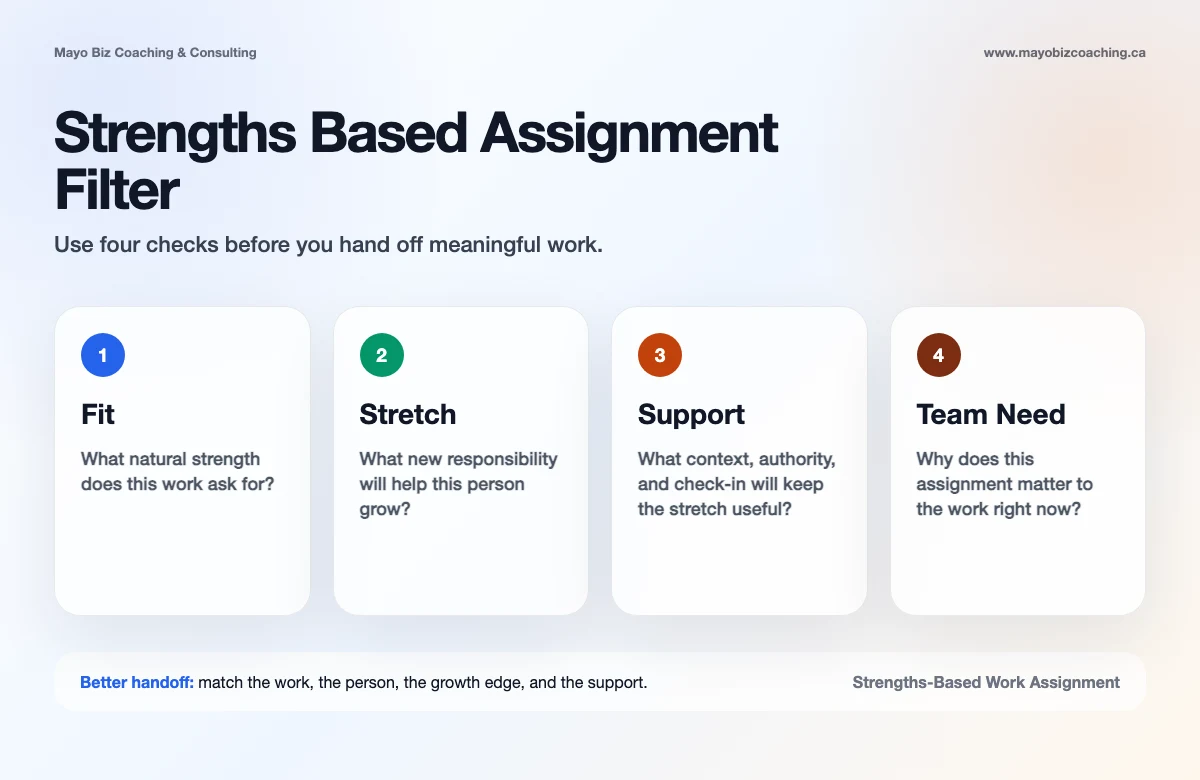
1. Fit: What strength does the work ask for?
Every assignment has a hidden strength requirement.
A customer recovery issue may need empathy, patience, and steady judgement. A process cleanup may need sequencing, focus, and comfort with detail. A new initiative may need imagination, influence, and tolerance for uncertainty.
The question is not, "Who is available?"
The question is, "Who has shown natural energy for this type of problem?"
Energy matters because people often have more capacity for work that fits how they think and contribute. That does not make the work easy. It makes the work more alive and more sustainable.
2. Stretch: What growth edge will this create?
A good assignment should not only fit. It should stretch.
Fit without stretch can become a rut. Stretch without fit can become discouragement. The best development assignments usually sit between the two. They use something the person already does well, then ask that strength to carry a new level of responsibility.
For example, someone who naturally builds trust with customers may be ready to lead a customer recovery conversation. The stretch may not be empathy. The stretch may be setting a firmer boundary while keeping the relationship intact.
That is development. You are not asking the person to become someone else. You are asking them to use what they do well at a higher standard.
3. Support: What guardrails will help them carry it?
Calling something a stretch assignment does not make it development.
The support around the assignment matters. What information does the person need? Which decisions can they make? Where should they check in before moving forward? What does "done well" look like?
This is where strengths based assignment and delegation without abdication meet, but they are not the same thing. Delegation clarifies ownership, while strengths based assignment clarifies fit and growth.
You need both if the work matters.
Support is not hovering. Support is the structure that lets someone take a real step without guessing what you meant.
4. Team Need: Why does this matter now?
Development cannot be disconnected from the business.
If the assignment only serves the person's growth and does not serve the team, it will feel like extra work. If it only serves the business and does not help the person grow, it may still be useful, but do not call it development.
The best assignment can answer both questions:
- What does the team need from this work?
- What can this person learn by carrying it?
When those answers line up, the assignment has energy.
Do Not Confuse Strengths With Comfort
Strengths-based leadership is sometimes misunderstood as "give people only what they already like."
A kinder sentence can still carry a weak standard, and that is not how people grow.
A strength is not the same as comfort. A person may be strong in relationship-building and still need to practise harder conversations. Someone may be strong in analysis and still need to present a recommendation before it feels perfect. Someone may be strong in execution and still need to step back and ask whether the plan is the right one.
The Center for Creative Leadership's 70-20-10 framework 3 points to challenging assignments as a primary source of leadership learning. The practical lesson is simple: people grow through real experiences, especially when the challenge is paired with relationships and reflection.
So do not remove challenge from the assignment. Aim it better.
If a person has a relationship strength, let that strength carry a harder influence conversation. If a person has a planning strength, let that strength carry a messier cross-functional project. If a person has a teaching strength, let that strength carry a peer coaching moment with higher stakes.
The stretch should feel demanding, not random, and the person should understand the difference.
What to Say When You Assign the Work
A strengths-based assignment conversation does not need to be long. It needs to be clear.
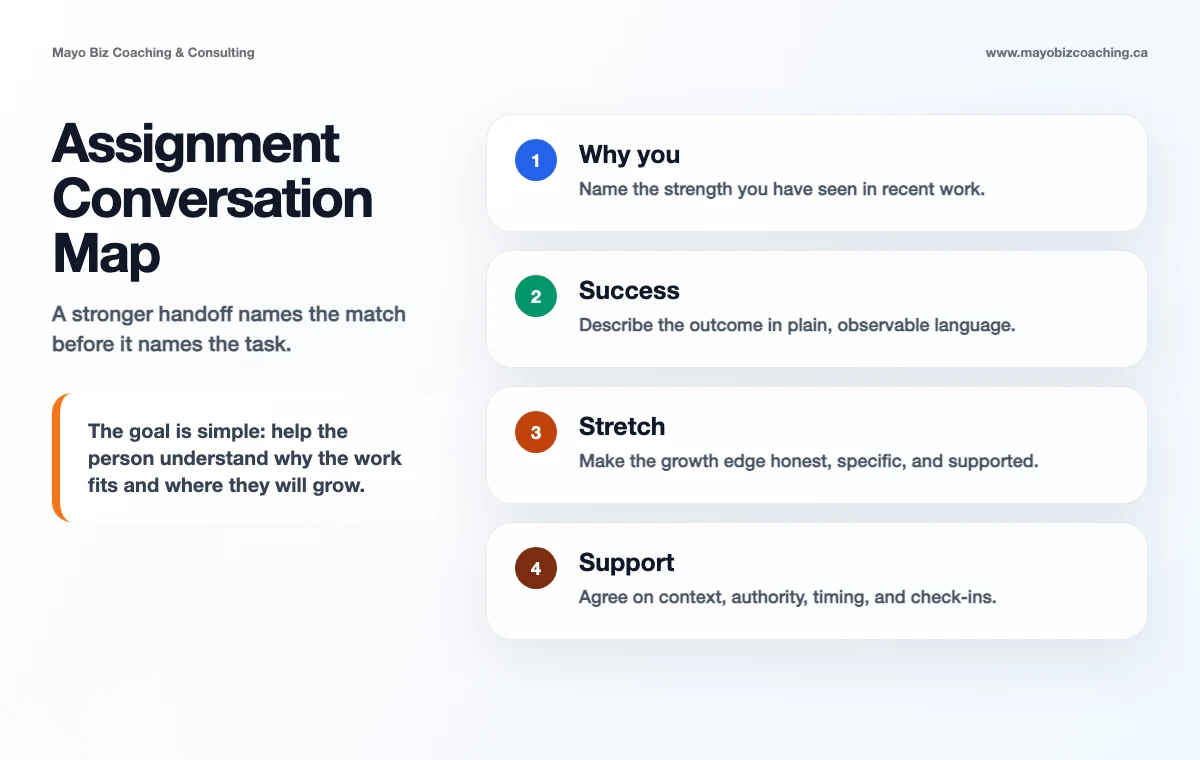
Here is a simple structure:
Why you. "I am asking you because I have seen you bring order to scattered work."
What success looks like. "The outcome we need is a clean handoff process that the team can follow without extra explanation."
Where the stretch is. "The stretch is that you will need to get input from people who see the problem differently."
How I will support you. "Let's check in after you have the first draft. I will help you test the questions before you bring it to the group."
Notice what is happening in that conversation. The leader is naming capability, defining the work, setting a standard, and staying close enough for learning.
This fits the coaching side of leadership. The International Coaching Federation's 2025 Core Competencies 4 include helping clients translate insight into action steps and accountability. Inside a team, a strong leader does something similar. You help a person see what they can bring, then connect it to a clear next action.
That is more useful than saying, "I think this would be good development for you." Tell them why.
Where Strengths-Based Assignment Goes Wrong
The mistakes are predictable.
You keep picking the same strong person. If the calm, capable person gets every difficult assignment, you are not developing the team. You are creating a bottleneck around your most reliable contributor.
You label people too tightly. A strength should open possibilities, not shrink the person. "You are the detail person" can become a box. Better language is, "You notice details that help the team avoid rework. Let's use that here."
You make the stretch too large. A person can be talented and still not ready for a high-risk assignment without support. Development should build confidence and judgement, not expose someone for sport.
You hide urgency under development language. Sometimes you are assigning work because it needs to get done. That is fine. Just be honest. Do not dress a rushed task up as growth if there is no time to coach it properly.
You skip the debrief. The learning happens after the work as much as during the work. If you never ask what happened, what was learned, and what should change next time, you have turned development into task completion.
Marcus Buckingham and Ashley Goodall make a useful point in Harvard Business Review's The Feedback Fallacy 5: leaders help people grow when they notice what helps them thrive and excel. That matters after an assignment. Do not only review gaps. Name the moment where the person's strength made a difference.
People repeat what they can recognize, especially when the leader names it clearly.
A One-Week Assignment Reset
You do not need a full talent review to start.
Use one week. Pick one piece of meaningful work that is already on the table, and before you assign it, write four short notes:
- What does this work need?
- Who has shown a strength that fits that need?
- What growth edge would make this assignment worthwhile?
- What support will prevent the stretch from becoming guesswork?
Then have the assignment conversation in plain language.
"I am asking you to take this because I have seen you do this kind of thinking well. The stretch is this new part. Here is what success looks like. Here is where I will stay close."
After the work, debrief with three questions:
- What part of this assignment used your strengths well?
- Where did the stretch feel useful?
- What support would make the next assignment stronger?
That is a small rhythm, but it is how leaders turn everyday work into development.
The Leadership Move
A strengths based work assignment is one of the most practical ways to develop people without adding another meeting to the calendar.
It asks the leader to see the person clearly, see the work clearly, and make a thoughtful match between the two. That takes a little more attention at the front end, but it often saves confusion later.
There is a tradeoff. The fastest assignment is usually the one you hand to whoever is free or whoever has done it before.
The better assignment may take five more minutes of thinking. It may require a clearer explanation. It may ask you to support the person differently.
That extra attention is where development lives.
If you want people to grow, do not wait for a formal development plan to do all the work. Look at the work already moving through your team. Then ask who could use that work to become more capable, more confident, and more useful to the people around them.
That is a leadership habit worth practising.
Let's Build Brilliance Together
Strengths-based work assignment helps you develop people through the work they are already doing. When leaders match talent to meaningful growth, the team gets better work and the person gets a clearer sense of contribution.
If you are curious where your current assignments are building capability and where they may be creating bottlenecks, reach out for a free consultation. No sales pitch, just an honest conversation about where you are and what you're working on.
Research Notes & Sources
If you want to go deeper, these are the studies and reports behind the key points in this post.
- How Employees Strengths Make Your Company Stronger (gallup.com)
- How to Have Strengths Conversations (gallup.com)
- The 70-20-10 Rule for Leadership Development (ccl.org)
- 2025 ICF Core Competencies (coachingfederation.org)
- The Feedback Fallacy (hbr.org)
Category & Tags
Frequently Asked Questions
What is strengths based work assignment?
Strengths based work assignment is the practice of matching real work to what a person naturally does well, what they need to develop, and what the team needs now. It turns everyday assignments into practical development opportunities.
How do I match work to employee strengths?
Start with the work, name the kind of thinking or relationship skill it needs, then compare that need with the person who has shown energy, speed, and repeatable contribution in that area. Add the right support before handing it off.
Is strengths based work assignment the same as delegation?
No. Delegation defines ownership, authority, and checkpoints. Strengths based work assignment asks who is well matched to the work and what growth edge the assignment can create.
What if someone needs to grow outside their strengths?
Growth can stretch beyond current comfort, but it should not ignore natural talent. The best stretch assignment uses a strength as the entry point, then adds support for the harder skill the person needs to build.
About the Author

About the Author
Mark Mayo
Head Coach, MBC
We get up each morning excited about sharing our 20-plus years of business acumen with small business owners and their teams. Collaborating with hard-working owners to achieve their personal and business goals brings rewards. When we develop you and grow your leaders, we create the momentum that moves you and your business forward. It starts with a first step. Then we can build brilliance together.
Related Articles

Build a Team Strengths Map: Turn Talent Into Advantage
A team strengths map helps leaders see talent patterns, reduce bottlenecks, pair people well, and turn individual strengths into clearer team work.
Read Build a Team Strengths Map: Turn Talent Into Advantage
Strengths Spotting in One-on-Ones: Questions Leaders Ask
Use strengths-based one-on-one questions to spot natural talent, improve coaching conversations, and help people do more of their best work each week.
Read Strengths Spotting in One-on-Ones: Questions Leaders Ask
Coaching vs. Managing: Why Great Leaders Master Both
Learn when to coach and when to manage. Research shows managers who master both approaches build more engaged teams and drive better results.
Read Coaching vs. Managing: Why Great Leaders Master Both