Team Leadership Development
Why Your Best People Aren't Speaking Up
You have someone on your team who used to challenge your thinking. They brought ideas to meetings. They flagged problems before they became emergencies. They pushed back when a plan had holes.
Now they just nod along. They still deliver. They still hit deadlines. But the spark is gone. The questions stopped. The pushback disappeared.
Most leaders see that shift and think: good, they've settled in. They're more aligned now.
That's not what's happening. Your best person did the math. They weighed the cost of speaking up against the cost of staying quiet, and quiet won. That's not alignment. That's withdrawal. And it's the most expensive kind of silence your business will ever face.
The price of a conversation that never happens
Silence has a dollar figure. Research from Crucial Learning 1 found that every avoided conversation costs organizations $7,500 or more, plus at least eight wasted work days. One in three employees said their silence had cost at least $25,000. Nearly one in five put the number at $50,000 or higher.
Those numbers come from enterprise surveys. For a small team of eight or ten people, the math hits differently. You can't spread the cost across hundreds of employees. When your strongest contributor stops flagging a quality issue, a client risk, or a process that's bleeding time, the damage lands directly on your bottom line.
But the dollar cost isn't even the worst part. The real cost is what happens next. Your best person starts updating their resume. Not because they're unhappy with the work. Because they've lost faith that their voice matters. In Canada, only 29% of professionals feel comfortable raising psychological safety concerns with their manager 2. Seventy percent have concerns. Most just keep them to themselves.
The takeaway here is simple: if nobody on your team is pushing back, that's not a sign of alignment. It's a warning.
Silence is rational (and that's the problem)
Here is what makes high-performer silence different from general disengagement. Your disengaged employee has checked out. They're coasting. Your high performer hasn't checked out at all. They're making a deliberate calculation every time they decide not to speak.
They remember the last time they raised a concern. Maybe the meeting ran an extra forty minutes because the leader got defensive. Maybe their idea was dismissed in front of the group. Maybe nothing visible happened, but the next project assignment felt like a subtle demotion. Smart people learn fast. One bad outcome is enough to teach them that the safest play is compliance.
Amy Edmondson, the Harvard researcher who coined the term "psychological safety," has studied this pattern for over twenty-five years. In her book The Fearless Organization 3, she lays out a finding that should trouble every leader: the best hospital teams in her original study reported more errors, not fewer. The errors were happening everywhere. Only some teams felt safe enough to talk about them.
That's the high-performer parallel. Your best people see the problems. Every single one. The only question is whether they tell you.
When I work with leaders on this, the first reaction is usually surprise. They assumed silence meant satisfaction. In practice, silence from your strongest contributors almost always means one thing: they've decided the risk of speaking up outweighs the reward.
The four zones: a diagnostic you can use this week
Edmondson maps team dynamics on two axes: psychological safety and performance standards. The result is four zones that describe how your team actually operates.
| Low Standards | High Standards | |
|---|---|---|
| High Safety | Comfort Zone: people feel safe but nobody pushes for results | Learning Zone: the target, where people take smart risks and deliver |
| Low Safety | Apathy Zone: nobody cares, minimal effort all around | Anxiety Zone: people fear punishment, stay quiet, and burn out |
Most high-performing teams that lose their best voices are stuck in the Anxiety Zone. Standards are high. Expectations are clear. But safety is low. People deliver because the consequences of not delivering are obvious. They stop contributing beyond their job description because the consequences of speaking up are also obvious, just less visible.
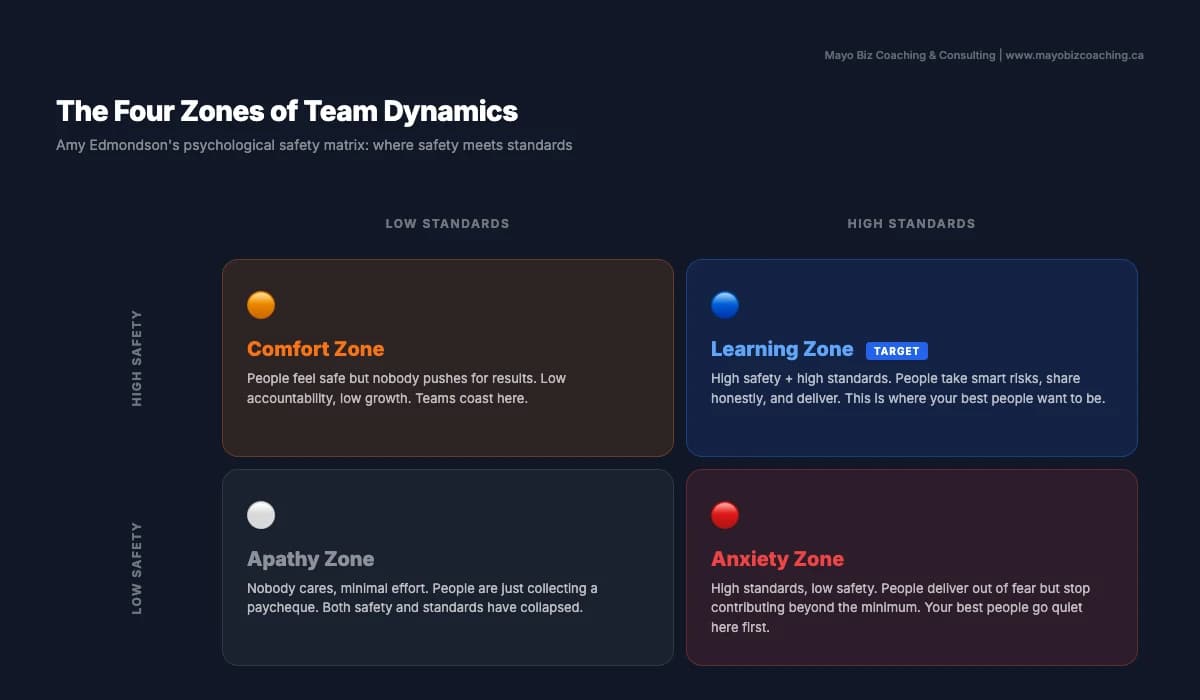
Your best people want to be in the Learning Zone. They want high standards and the freedom to be honest about what's working and what isn't. When they find themselves in the Anxiety Zone instead, they don't become apathetic. They go strategically quiet. They still hit their numbers. They stop mentoring the junior person. They stop volunteering for the hard project. They stop saying "I think there's a problem with this plan."
That's the zone where you lose people without realizing it. On paper, everything looks fine. Under the surface, your strongest contributors are already halfway out the door.
Here is how to figure out which zone your team is in. Ask yourself: when was the last time someone told me I was wrong? If you can't remember, you're probably not in the Learning Zone.
What your best people's silence actually looks like
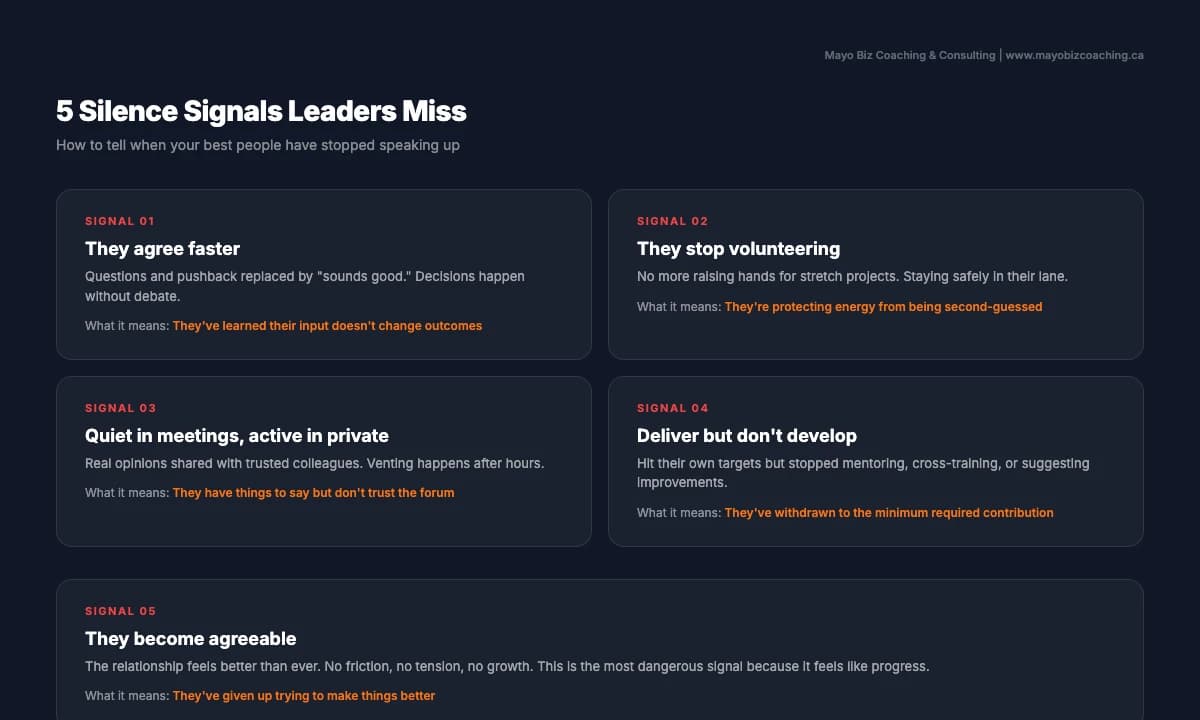
The tricky part about high-performer withdrawal is that it doesn't look like a problem. It looks like maturity. Here are the signals most leaders miss:
They agree faster. People who used to ask probing questions now just say "sounds good." The questions didn't stop because they ran out of questions. They stopped because the answers didn't change anything.
They stop volunteering. The person who used to raise their hand for stretch projects now stays in their lane. They're not less capable. They're protecting their energy for work that won't get second-guessed.
They go quiet in meetings but active in private. They tell a trusted colleague what they really think. They vent after hours. They post on LinkedIn about "leadership that listens" with just enough ambiguity that you don't realize it's about you.
They deliver but don't develop. They hit their own targets but stop investing in the team. No more mentoring, no more cross-training, no more bringing up process improvements.
They become agreeable. This is the most dangerous signal. You think the relationship has never been better. In reality, they've given up trying to make it better.
If you're noticing any of these patterns, the place to start is with a question. Not "is everything okay?" which invites a polite deflection. Try: "What's something you've stopped bringing up because it didn't seem worth the conversation?" Then wait. Don't fill the silence. The fact that you're willing to sit with discomfort tells them more than any open-door policy ever will. That's active listening in action: staying present when it gets uncomfortable.
Three moves that bring voices back
Edmondson's research points to three specific leadership behaviours that rebuild the conditions for candour. None of them require a program, a budget, or a consultant. They require you to change how you show up.
1. Name the uncertainty
Most leaders frame their work as execution problems. Here's the plan, go do it. High performers know that plans have blind spots. When you acknowledge that openly, you give people a reason to speak. "I don't have full visibility on how this will land with the team. What am I missing?" is more powerful than any suggestion box.
This connects directly to how multiplier leaders operate. They don't pretend to have all the answers. They create space for the team's intelligence to surface.
2. Go first with honesty
The leader sets the ceiling for vulnerability on any team. If you want people to admit mistakes, you have to admit yours first. Not a rehearsed story about a lesson you learned ten years ago. A real admission about something recent. "I should have caught that earlier" or "I made the wrong call on that hire" tells your team that honesty is safe here.
I've worked with leaders who struggle with this. They worry it undermines their authority. The opposite is true. Teams trust leaders who can say "I got that wrong" far more than leaders who never seem to make mistakes. If your team won't give you honest feedback, look at what you're modelling.
3. Make it worth their time
This is where most leaders fail. They ask for honesty, someone speaks up, and then nothing changes. Or worse: the person who spoke up gets a longer explanation about why the current approach is actually correct.
When someone brings you bad news or challenges your thinking, two things need to happen. First, thank them. Not performatively. Genuinely. Second, do something with what they said. If someone raises a concern and the outcome is always "thanks for the input, we're keeping the current approach"? They learn that speaking up is a waste of time.
The accountability conversation works both ways. You're asking your team to be accountable for speaking up. That only works if you're accountable for listening.
The Canadian gap: awareness without action
The pattern playing out in your team isn't unique to you. Across Canada, there's a striking disconnect between what people know matters and what organizations actually do about it.
Two-thirds of Canadian professionals 4 recognize the link between psychological safety and engagement. That's the awareness part. But more than half of Canadian organizations have no written policy or practice around it. That's the action gap.
The APA's 2024 Work in America survey 5 puts a finer point on it. Workers in low-safety environments are 1.4 times more likely to report feeling tense or stressed during the workday. Stress doesn't make people quit on the spot. It makes them withdraw. Slowly, quietly, and starting with the contributions that aren't required by their job description. The extra effort goes first. Then the loyalty.
For small business owners in Guelph and across Ontario, this matters more than the enterprise research might suggest. When your strongest person on a team of eight leaves, you don't lose one-eighth of your capacity. You lose the person who held institutional knowledge, mentored the newer staff, and flagged problems before they became crises. The quiet cracking pattern is real, and it hits small teams harder.
What this isn't about
Psychological safety isn't about being nice. It isn't about avoiding hard conversations or lowering your standards. Edmondson is clear on this: high safety with low standards creates complacency, not performance. That's the Comfort Zone in the matrix above, and it's a failure state too.
What safety means is that your team can disagree with you, report a mistake, or challenge a decision without worrying it will cost them. Standards stay high. Expectations stay clear. But the people meeting those standards also trust that honesty won't be punished.
The teams that do this well, the ones sitting in the Learning Zone, show significantly higher rates of innovation 6 compared to teams without that foundation. Not because they're smarter. Because they use more of what their people already know.
If your team has trust at the foundation, the rest of this becomes much easier. If it doesn't, that's where the work starts.
Let's Build Brilliance Together
The silence on your team isn't random. It's information.
If you're noticing that your strongest people have gone quiet, reach out for a free consultation. No sales pitch, just an honest conversation about where you are and what you're working on.
Research Notes & Sources
If you want to go deeper, these are the studies and reports behind the key points in this post.
- Costly Conversations: How Lack of Communication is Costing Organizations Thousands in Revenue | Crucial Learning(cruciallearning.com)
- Psychological health and safety statistics(workplacestrategiesformentalhealth.com)
- Books – Amy C. Edmondson(amycedmondson.com)
- Two-thirds of workforce ties psychological safety to engagement, yet half of companies lack policies(talentcanada.ca)
- APA's 2024 Work in America survey(apa.org)
- Frontiers | How Psychological Safety Affects Team Performance: Mediating Role of Efficacy and Learning Behavior(frontiersin.org)
Category & Tags
Frequently Asked Questions
Why do high performers stop speaking up at work?
High performers calculate risk before speaking. If past pushback led to defensiveness, longer meetings, or subtle consequences, they learn that silence is safer than honesty. They still deliver results but stop contributing ideas, flagging risks, or mentoring others.
What does employee silence cost a business?
Crucial Learning research found that every avoided conversation costs organizations $7,500 or more and wastes at least eight work days. One in three employees estimates their silence cost at least $25,000. For small teams, that compounds fast.
How do you get employees to speak up again?
Start by asking genuine questions where you want the real answer, not confirmation. Acknowledge your own mistakes openly. When someone does speak up, thank them and act on what you hear. If people speak up and nothing changes, they learn silence is the rational choice.
What is the difference between disengagement and strategic silence?
Disengaged employees check out across the board. Strategically silent employees still deliver strong work but stop contributing beyond their job description. They stop pushing back, volunteering ideas, or flagging problems. That withdrawal is a decision, not apathy.
About the Author

About the Author
Mark Mayo
Head Coach, MBC
We get up each morning excited about sharing our 20-plus years of business acumen with small business owners and their teams. Collaborating with hard-working owners to achieve their personal and business goals brings rewards. When we develop you and grow your leaders, we create the momentum that moves you and your business forward. It starts with a first step. Then we can build brilliance together.
Related Articles

FOBO: When Your Team Fears Becoming Obsolete
52% of workers fear AI will reshape their role. Coaching frameworks for leaders to recognize FOBO on their teams and turn anxiety into growth.
Read FOBO: When Your Team Fears Becoming Obsolete
The Five Dysfunctions Hiding in Your Team
Patrick Lencioni's Five Dysfunctions model shows why capable teams underperform. Here is how to spot each dysfunction and what to do about it this week.
Read The Five Dysfunctions Hiding in Your Team
Conscious Unbossing: Why Gen Z Doesn't Want to Manage
Over half of Gen Z workers don't want management roles. That's not entitlement. It's a rational response to how most organizations have designed the job.
Read Conscious Unbossing: Why Gen Z Doesn't Want to Manage