Executive Leadership & Career Coaching
What Skills Should a Business Coach Have?
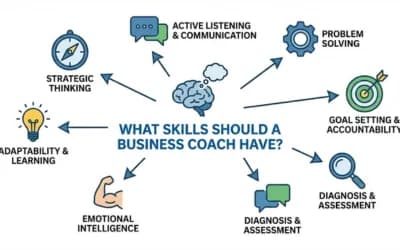
Choosing a business coach is a high-stakes decision. The right coach can accelerate growth and improve leadership behavior for you and your team. The wrong coach can waste time, money, and trust.
Most people ask about credentials first, but credentials alone are not enough.
The better question is skill quality in real conversations, real decisions, and real follow-through.
What Skills Should a Business Coach Have?
Strong business coaches combine relational skill with practical business judgment. They can build trust and still challenge weak thinking.
These are the core skills to look for in discovery calls, real sessions, and follow-up work.
1. Deep Listening
Great coaches listen for facts, assumptions, and emotion at the same time. They hear what you say, and what you avoid saying.
Listening is not passive, it is how a coach gathers accurate data before giving direction.
If your coach interrupts often or jumps to answers early, results will likely stay shallow. If you want a benchmark for this skill, this guide on active listening is a useful reference.
2. High-Quality Questioning
Strong coaches ask questions that improve your thinking, not questions that show their knowledge.
Harvard Business Review's coaching guidance 1 emphasizes that development happens when leaders use questions to build capability instead of giving quick answers.
Good questions expose hidden assumptions, clarify trade-offs, and force specificity.
If questions are generic, coaching stays generic.
3. Practical Business Judgment
A business coach should understand how businesses actually run. They do not need your exact industry background, but they need credible operating judgment.
This includes understanding cash pressure, hiring trade-offs, role clarity, and execution risk. Advice that ignores these realities does not hold under pressure.
Center for Creative Leadership 2 highlights credibility as a core factor in coaching effectiveness. Clients must trust that the coach can understand context rather than abstract concepts.
4. Clear Communication Under Pressure
A strong coach can simplify complex issues into clear next steps. They do not hide behind jargon.
They can also deliver tough feedback without blame. That balance keeps progress moving in difficult moments.
You should leave sessions with plain language: what changed, what matters now, and what you will do next.
5. Accountability Design
Many coaches talk about accountability. The best coaches design it.
Design means specific commitments, defined owners, and clear review cadence. It also means consequences for drift, such as scope reset or priority reduction.
If sessions end with motivation but no commitments, the coaching is weak.
6. Adaptability to Client Context
One-size coaching does not work. Different leaders need different pace, challenge style, and structure.
A strong coach adapts method while keeping standards high. They can move between strategic framing, tactical action, and behavioral coaching as needed.
Adaptability is especially important in transitions. The same leader may need a different coaching style at each growth stage.
7. Systems Thinking
Business problems are usually connected. A sales issue may be a role issue. A culture issue may be a decision-rights issue.
Good coaches see these links and help you choose the highest-impact point. Poor coaches treat symptoms in isolation.
Systems thinking is what turns coaching from pleasant conversation into business impact.
8. Candor With Care
The best coaches tell the truth early. They do it respectfully, but they do not dilute the message.
You need this candor when stakes are high. Your team, peers, or family may not tell you what you most need to hear.
A strong coach will, and they will help you act on it instead of stopping at insight.
Skills You Can Test in a Discovery Call
You can evaluate coaching skill quality before you sign and compare options with far less guesswork.
Ask one real problem from your week. Watch how they respond.
Do they ask clarifying questions before offering ideas? Do they restate your issue accurately? Do they challenge assumptions in a useful way?
Ask how they run accountability between sessions. Ask how they measure progress in behavior and business outcomes.
Ask how they handle missed commitments. The answer reveals standards.
Ask for one example of a failed engagement and what they learned. This reveals maturity and honesty when pressure is high and outcomes are uncertain.
Real Scenarios: Skill in Action
In one client team of 12, the leader believed the issue was low motivation. Team interviews showed the real issue was unclear priorities and mixed signals.
The coach used three skills in sequence: listening for pattern, clarifying trade-offs, and accountability design. Within five weeks, meeting quality improved and project delays dropped.
In another coaching engagement with a founder, growth had stalled after rapid expansion. The founder kept solving every issue personally and managers waited for approvals.
The coach used direct candor, delegation design, and weekly decision review. Within two months, managers owned more decisions and the founder regained strategic focus.
These outcomes did not come from motivational speeches. They came from repeatable coaching skill applied with discipline.
Coach Red Flags
Watch for early advice, no clear goals process, vague claims, chemistry bias, and refusal to discuss scope or limits.
Any one red flag may be manageable. Several together usually signal poor fit.
A Simple Scorecard for Selection
Use a short scorecard to compare coaches consistently.
Rate each coach from 1 to 5 on listening depth, question quality, practical judgment, accountability approach, communication clarity, and fit with your leadership style.
Keep notes for each rating. Discuss the scores with one trusted advisor before deciding.
This process lowers decision bias and helps you choose based on evidence when emotions, urgency, and personal chemistry are all in play.
How Skills Map to Your Current Need
If your issue is execution drift, prioritize accountability design and systems thinking.
If your issue is team friction, prioritize listening depth and communication clarity.
If your issue is founder bottleneck, prioritize candor, delegation coaching, and practical judgment.
If your issue is role transition, prioritize adaptability and question quality.
You do not need a perfect coach for every scenario. You need a strong match for the bottleneck that matters now.
If you are still deciding on timing, this post on do I need a business coach can help you decide.
If you want to understand day-to-day coaching scope, this guide on what a business coach does outlines the working model clearly.
Interview Questions That Reveal Real Skill
A discovery call should test coaching skill, not personality fit alone. Use a short question set and score each answer.
Ask one current issue that is costing you time or money. Then watch whether the coach asks clarifying questions before giving advice.
Ask how they define goals in the first month. Strong coaches name outcome, metric, owner, and review date.
Ask how they run accountability when progress slips. Weak coaches give vague motivation. Strong coaches describe a concrete reset process.
Ask what they do when coaching is not the right tool. Mature coaches will say when consulting or technical support is the better move.
Ask for an example where coaching failed and what changed after that. This shows whether they learn from hard cases.
Ask how they protect trust while giving direct feedback. You need honesty with care, not harshness or avoidance.
What Good Answers Sound Like
Strong answers are specific and operational. You should hear real actions, not abstract philosophy.
A good coach might say: we start with one bottleneck, one metric, and one weekly commitment loop for 30 days.
They should explain how they measure behavior change alongside business outcomes. Behavior is what drives outcomes over time.
They should also show range in approach. Different clients need different pace, pressure, and structure.
Good coaches usually mention boundaries too. They define scope clearly and avoid becoming a permanent crutch.
If answers stay generic after follow-up questions, treat that as a fit risk.
What the First Four Weeks Should Look Like
Week 1 should produce clarity. You should leave with a priority outcome, baseline, and first commitment.
Week 2 should test one behavior shift in real work, not a hypothetical exercise.
Week 3 should include feedback on what changed and what stayed stuck. This is where coaching quality becomes visible.
Week 4 should close with evidence. You should see one measurable gain, one unresolved gap, and one next-cycle focus.
If four weeks pass without clear commitments and measurable movement, stop and reassess fit.
In one client team, this month-one structure exposed unclear ownership in less than two weeks and prevented months of repeated rework.
In another coaching engagement, early scorecard review showed the real issue was decision quality, not effort. The focus shifted fast, and progress followed.
Let's Build Brilliance Together
The best business coach combines deep listening, strong questioning, practical judgment, and consistent accountability. These skills create real change in leadership behavior and business outcomes across teams, decisions, and day-to-day execution.
If you want structured support from that skill set, Executive Leadership & Career Coaching can help you improve decisions, delegation, and team performance.
If you want to evaluate fit before committing, reach out for a free consultation. No pressure, just a practical conversation about your goals and what support would help most.
Research Notes & Sources
If you want to go deeper, these are the studies and reports behind the key points in this post.
- The Leader as Coach(hbr.org)
- How to Coach People(ccl.org)
Category & Tags
Frequently Asked Questions
What skills should a business coach have?
A strong business coach needs deep listening, clear questioning, practical business judgment, accountability skill, and the ability to challenge respectfully. They should also adapt their approach to your context and goals.
Why is real business experience important in a coach?
Real experience builds credibility and practical judgment. A coach who has led teams and managed pressure can spot blind spots faster and give guidance that works in real business conditions.
How do I find the right business coach for me?
Run a real discovery call, ask for a clear process, and check how they listen. Ask for examples of similar client outcomes and how they handle accountability when progress stalls.
About the Author

About the Author
Mark Mayo
Head Coach, MBC
We get up each morning excited about sharing our 20-plus years of business acumen with small business owners and their teams. Collaborating with hard-working owners to achieve their personal and business goals brings rewards. When we develop you and grow your leaders, we create the momentum that moves you and your business forward. It starts with a first step. Then we can build brilliance together.
Related Articles
Coaching Conversations: A Practical Framework for Leaders
A coaching conversation changes who does the thinking. The GROW framework, the neuroscience of self-generated insight, and four traps to avoid.
Read Coaching Conversations: A Practical Framework for Leaders
Beyond IQ and EQ: Leadership Intelligences Nobody Taught You
IQ EQ XQ AQ leadership is not about choosing one quotient. Learn what each predicts, where each breaks down, and how small business leaders build all four.
Read Beyond IQ and EQ: Leadership Intelligences Nobody Taught You
Experience Intelligence: Why Your Best Leaders Design Experiences, Not Manage Outcomes
Experience intelligence is the leadership skill of designing how people feel at work. Learn why listening is the foundation and how to start this week.
Read Experience Intelligence: Why Your Best Leaders Design Experiences, Not Manage Outcomes