Executive Leadership & Career Coaching
Coaching Conversations: A Practical Framework for Leaders
You talk to your team every day. Status updates, problem-solving, feedback, quick check-ins between meetings. Dozens of conversations a week.
But here's a question worth sitting with: how often does someone leave one of those conversations thinking better than when they walked in?
Most leadership conversations are transactional. You exchange information. You give direction. You solve a problem. The other person leaves with a task, not with better thinking. A coaching conversation works differently. Not because you learn a special technique. Because you change who does the thinking.
Where Coaching Actually Came From
The modern coaching conversation started on a tennis court, not in a boardroom.
In the early 1970s, Timothy Gallwey was teaching tennis at a club in California. He noticed something that changed how he worked forever. When he stopped giving technical instruction and started asking players to simply observe, to notice where the ball was when they hit it, to feel the weight of the racket, their performance improved faster than when he taught them technique.
Gallwey wrote about this in The Inner Game of Tennis 1 (1974). His core insight: performance equals potential minus interference. The obstacle wasn't ability. It was the noise inside the player's head: self-criticism, overthinking, fear of getting it wrong. When Gallwey stopped adding more instruction and started removing interference, people got better on their own.
Sir John Whitmore saw the same principle at work in organizations. In the fifth edition of Coaching for Performance 2 (originally 1992, updated 2017), he framed coaching as "unlocking people's potential to maximize their own performance. It is helping them to learn rather than teaching them." Whitmore brought Gallwey's insight into the workplace and built a framework around it that millions of leaders have used since.
The lesson from both: the most powerful thing you can do for someone isn't giving them your answer. It's creating the conditions where they find their own.
What Makes It Different
A coaching conversation isn't a performance review, a mentoring session, or a problem-solving discussion. Each of those has its place. But they work differently.
In mentoring, you share your experience. "Here's what I did when I faced that." In advising, you diagnose and prescribe. "The issue is X. Do Y." In a performance conversation, you evaluate. "Here's where you stand."
In coaching, you ask. And then you listen while the other person thinks.
That distinction sounds simple. In practice, it goes against every instinct you have as a leader who built your reputation on having good answers. The manager-as-coach shift is hard precisely because the old reflex, solving, feels more productive than the new one, asking.
There's a time for each approach. Coaching doesn't fit every situation. New hires often need direct instruction. Crises need decisions, not questions. And some people find the approach frustrating until they see the results. If you're working through when coaching fits and when directing is the right call, the coaching vs managing framework covers that decision in detail.
But when development is the goal, coaching is the conversation that does the work.
The Framework That Keeps It Simple
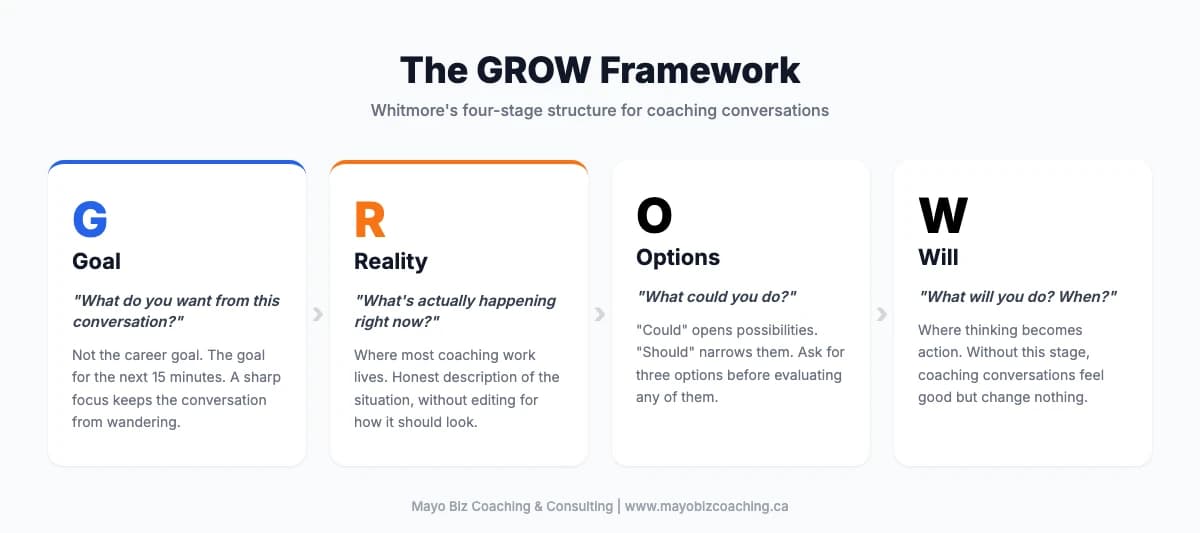
Whitmore's GROW model gives a coaching conversation shape without turning it into a script. Four stages, each built around a question.
Goal: What do you want from this conversation? Not what you want from your career or your quarter. What do you want to walk away with in the next 15 minutes? A sharp goal keeps the conversation focused.
Reality: What's actually happening right now? This is where most of the coaching work lives. When someone describes their situation honestly, without editing for how they think it should look, the path forward often becomes obvious. Your job here is to listen and ask follow-up questions. Not to diagnose.
Options: What could you do? Not what should you do. "Could" opens possibilities. "Should" narrows them. Ask for three options before letting them evaluate any of them. The first idea is rarely the best one. It's the safest one.
Will: What will you do? When? How will you know it worked? This is where thinking becomes action. Without this stage, coaching conversations feel good but change nothing.
The GROW model works because it follows how people naturally think through problems when given space. You don't need to memorize it. You need to trust that the other person can think, and then give them the structure to do it.
Why Your Attention Matters More Than Your Questions
You can ask perfect coaching questions and still have a terrible coaching conversation. The difference is attention.
Nancy Kline spent decades studying what helps people think well. In Time to Think 3 (1999), she made a claim that sounds obvious until you test it: the quality of your attention determines the quality of the other person's thinking.
Most leaders listen to respond. They're already forming their next question or their rebuttal while the other person is still talking. That's not attention. That's waiting for your turn.
In a coaching conversation, you listen so the other person can think. That means sitting with silence. It means resisting the urge to fill the pause with your perspective. It means trusting that the silence is productive, even when it feels uncomfortable.
I've watched this happen hundreds of times in coaching sessions. A leader asks a good question, the other person pauses, and the leader jumps in with a suggestion before the pause reaches five seconds. That suggestion usually kills whatever the person was about to discover on their own.
I worked with a director last year who was certain she was coaching her team. In our first session together, I asked her to walk me through a recent conversation with one of her reports. She'd asked a great opening question. But when the silence hit three seconds, she offered two possible solutions, recommended the second one, and wrapped the conversation in under four minutes. She'd never noticed. Once she started counting to ten before speaking, her team began bringing solutions instead of problems. Within two months, she told me her one-on-ones had become the most productive part of her week.
Active listening is the engine of every coaching conversation. It's the operating system, not a soft skill tacked on top. When you listen with genuine attention, people think at a level they can't reach alone. When you interrupt that thinking with your answer, you get compliance instead of commitment.
The best coaching conversations have more silence than you expect.
The Neuroscience of Why It Works
There's a neurological reason coaching conversations produce different results than advice.
David Rock, in Quiet Leadership 4 (2006), explored what happens in the brain during moments of insight. Rock observed that when someone arrives at their own understanding, the brain responds differently than when they're given the same information. Self-generated insight appears to create stronger neural connections, which helps explain why people remember what they discover far longer than what they're told, and why they act on it with more conviction.
This matches a pattern I see in every coaching engagement: the breakthroughs never come from my observations. They come when the other person says something they didn't know they knew. The coaching conversation creates the conditions for that moment. Your best advice, delivered perfectly, simply can't do the same thing.
The ICF Global Coaching Study 5 (2023) surveyed over 14,000 respondents across 157 countries. It found that 86% of organizations report recouping their coaching investment, and coached individuals report improvements in self-confidence, communication, and performance. But the finding that matters most for daily leadership isn't the ROI number. It's that the conversation itself is the development tool.
What Kills a Coaching Conversation
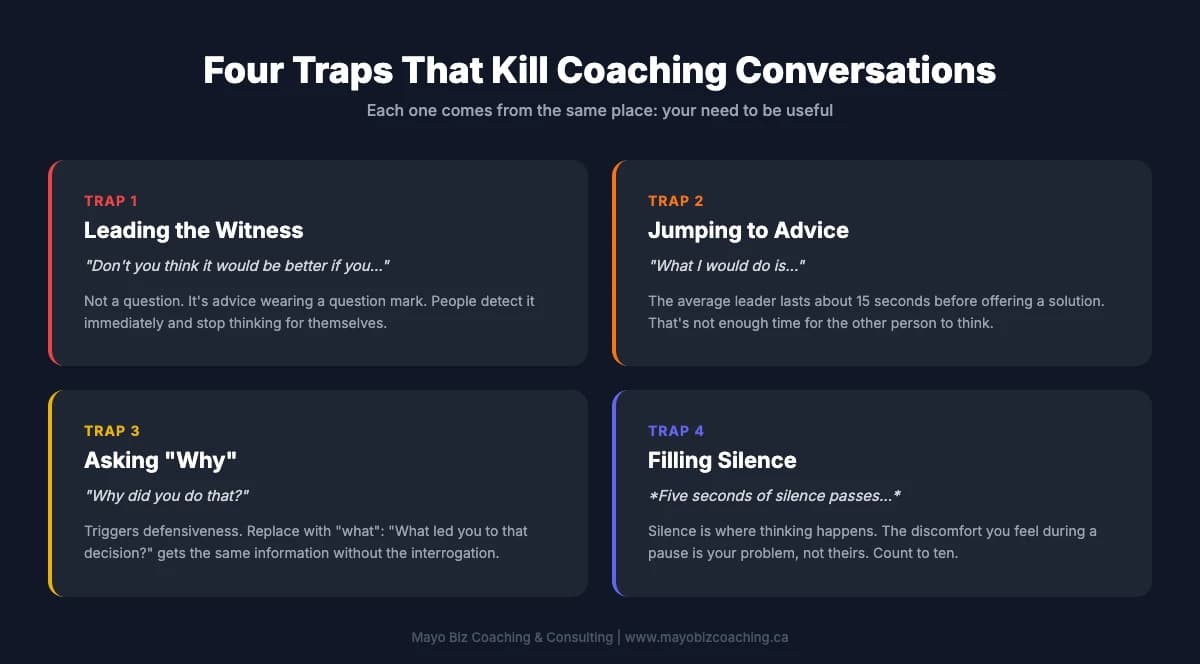
Four habits destroy coaching conversations before they start.
Leading the witness
Asking questions where you already know the answer you want. "Don't you think it would be better if you..." isn't a question. It's advice wearing a question mark. People detect this immediately. It breaks trust and teaches them to guess what you're thinking instead of doing their own thinking.
Jumping to advice
The average leader, in my experience, lasts about 15 seconds before offering a solution. That's not enough time for the other person to think. If you catch yourself starting with "What I would do is..." you've already left the coaching conversation.
Asking "why"
"Why did you do that?" triggers defensiveness. It sounds like an interrogation, even when you don't mean it that way. Replace "why" with "what." "What led you to that decision?" gets the same information without the emotional charge. If navigating these moments feels risky, the difficult conversations framework can help.
Filling silence
Silence in a coaching conversation isn't a void. It's where thinking happens. When you fill it, you steal the other person's processing time. The discomfort you feel during a pause is your problem, not theirs. Let it sit. What comes after the silence is almost always more valuable than what came before it.
Every one of these habits comes from the same place: your need to be useful. In a coaching conversation, the most useful thing you can do is stay out of the way.
How to Start This Week
You don't need training to have a coaching conversation. You need one conversation and three commitments.
- Pick one person and one topic. Choose a team member who has a challenge they're working through. Not a crisis. Something they're capable of solving but haven't yet.
- Ask three questions before offering anything. Try these: "What's the real challenge here for you?" "What have you already considered?" "What would happen if you tried that?" Then listen. Actually listen.
- Sit with one silence. When they pause to think, count to ten before you speak. Notice what they say when you give them the space. It will be different from what they would have said if you'd jumped in.
One conversation. Three questions. One silence. See what happens.
The coaching conversation isn't a leadership luxury. It's the most practical development tool you have, and it costs nothing but your attention.
Let's Build Brilliance Together
If your team waits for your answers instead of developing their own, that's a pattern worth looking at. The reflex shift takes practice, and it goes faster with someone who can see what you can't from the inside.
Reach out for a free consultation. No sales pitch, just an honest conversation about where you are and what you're working on.
You can also explore Executive Leadership Development for structured support in building coaching skills into your daily leadership practice.
Research Notes & Sources
If you want to go deeper, these are the studies and reports behind the key points in this post.
- The Inner Game of Tennis(amazon.com)
- Coaching for Performance(amazon.com)
- Time to Think(amazon.com)
- Quiet Leadership(amazon.com)
- ICF Global Coaching Study | Insights on Professional Coaching(coachingfederation.org)
Category & Tags
Frequently Asked Questions
What is a coaching conversation?
A coaching conversation is a structured dialogue where the leader asks questions instead of giving answers. The goal is to help the other person think through their own challenge and arrive at their own solution. It develops judgment and ownership in ways that advice cannot.
What is the difference between coaching and mentoring?
In mentoring, you share your experience and guide someone based on what worked for you. In coaching, you ask questions that help the other person think for themselves. Mentoring transfers knowledge. Coaching builds the ability to generate knowledge independently.
How long should a coaching conversation be?
Effective coaching conversations can happen in as little as 10 minutes. They don't require a formal session or a meeting room. The best coaching happens in daily check-ins, quick debriefs, and hallway conversations where you ask one good question instead of giving an answer.
Do you need training to have coaching conversations?
You don't need certification to start coaching. You need one conversation, three questions before offering your perspective, and the discipline to sit with silence while the other person thinks. Formal training deepens the skill, but the fundamentals are accessible to any leader willing to practise.
About the Author

About the Author
Mark Mayo
Head Coach, MBC
We get up each morning excited about sharing our 20-plus years of business acumen with small business owners and their teams. Collaborating with hard-working owners to achieve their personal and business goals brings rewards. When we develop you and grow your leaders, we create the momentum that moves you and your business forward. It starts with a first step. Then we can build brilliance together.
Related Articles
Experience Intelligence: Why Your Best Leaders Design Experiences, Not Manage Outcomes
Experience intelligence is the leadership skill of designing how people feel at work. Learn why listening is the foundation and how to start this week.
Read Experience Intelligence: Why Your Best Leaders Design Experiences, Not Manage Outcomes
When "Do More With Less" Becomes the Only Strategy
When cost-cutting becomes your only leadership lever, it quietly trades the conditions that make your team effective. Here is what to do instead.
Read When "Do More With Less" Becomes the Only Strategy
Learning Agility: Why the Fastest Learners Lead Best
Learning agility predicts leadership success better than experience alone. Here is what it means for small business leaders and how to build it this month.
Read Learning Agility: Why the Fastest Learners Lead Best