Team Leadership Development
The Multiplier Effect: Are You Making Your Team Smarter or Smaller?

You've built a good team. You trust them. You hired them because they're smart.
So why does it feel like you're still doing most of the thinking?
Meetings are quiet until you speak. Problems land on your desk that your team could handle. People check in before making decisions you've already delegated. You're not micromanaging or being difficult. But somehow, the people around you seem to operate at half capacity.
If that sounds familiar, you might be what Liz Wiseman calls a diminisher. And the multiplier effect you're looking for starts with recognizing it.
The 2x gap
Wiseman spent two years studying more than 150 leaders across four continents 1 for her book Multipliers (2017). She wanted to understand why some leaders get more from their teams than others.
Based on her proprietary assessment methodology, here is what she found. Leaders she classified as Multipliers accessed an average of 95% of their people's capability and intelligence. Diminishers got 48%. Multipliers got roughly twice the capability from the same people.
The average manager sits at about 66%. A third of your team's brainpower, sitting unused. People aren't lazy or disengaged. It comes down to the leader's daily habits.
It's a hard number to ignore. Gallup's 2025 data 2 backs this up: only 28% of employees strongly agree their opinions count at work. That means nearly three quarters of people have learned to hold back. The development numbers are similar: just 31% feel someone encourages their growth.
What multipliers actually do
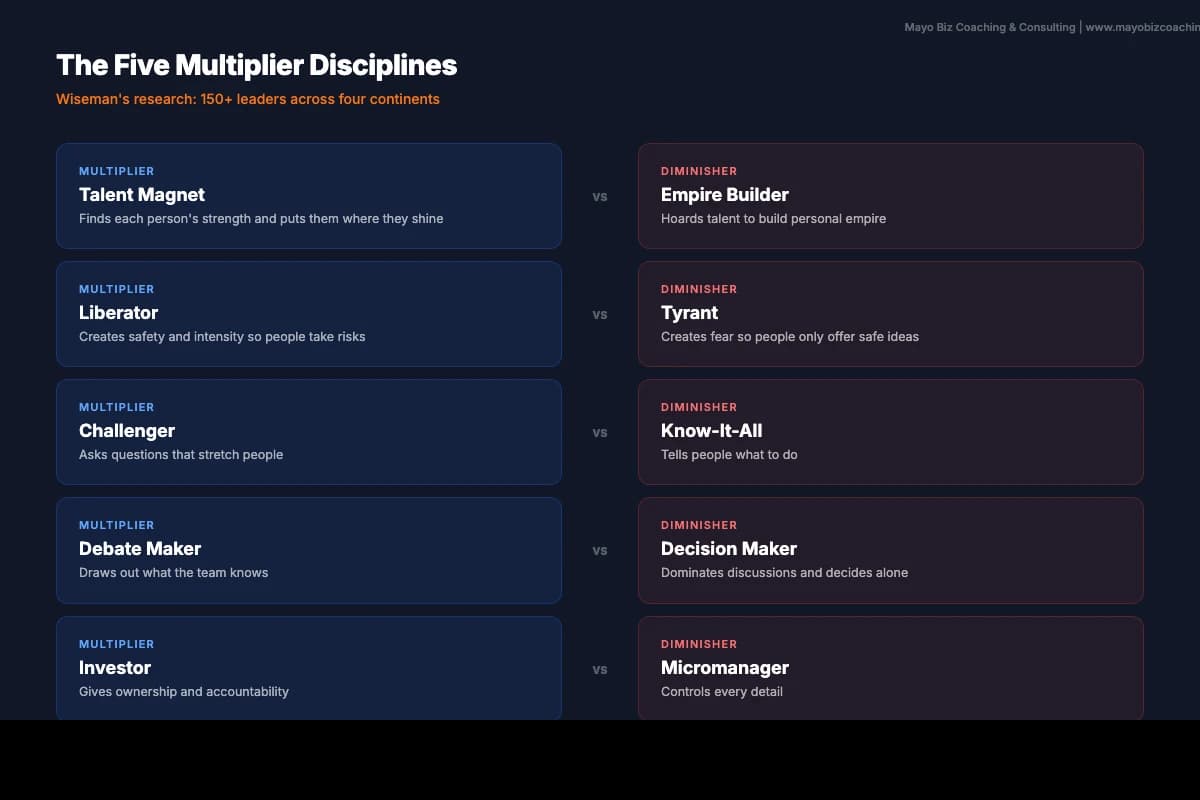
Wiseman identified five disciplines that separate Multipliers from Diminishers. They're behaviours, not personality traits. Learnable and observable. You don't need a personality transplant. You need a few habit shifts.
| Multiplier Discipline | Diminisher Counterpart | The Difference |
|---|---|---|
| Talent Magnet | Empire Builder | Finds each person's strength and puts them where they shine vs. hoards talent to build personal empire |
| Liberator | Tyrant | Creates safety and intensity so people take risks vs. creates fear so people only offer safe ideas |
| Challenger | Know-It-All | Asks questions that stretch people vs. tells people what to do |
| Debate Maker | Decision Maker | Draws out what the team knows vs. dominates discussions and decides alone |
| Investor | Micromanager | Gives ownership and accountability vs. controls every detail |
They find the genius in each person
Multipliers are what Wiseman calls Talent Magnets. They look for each person's unique strength, name it, and put them where it matters most. The opposite is the Empire Builder, who hoards talent and positions themselves as the only person who can integrate everyone's work.
I see this in small businesses constantly. An owner hires capable people, then funnels every decision through themselves because "nobody else understands the full picture." The team stops trying to see the full picture. Why would they? You've made it clear that's your job.
They create safety and intensity at the same time
Wiseman calls this the Liberator. It's the leader who builds an environment where people feel safe enough to take risks and speak candidly, but where the standards are high enough that coasting isn't an option. The Diminisher equivalent is the Tyrant, whose team only offers safe ideas the boss already agrees with.
This connects directly to psychological safety. People contribute more when they feel safe and grow when they feel challenged. You need both.
They ask instead of tell
The Challenger stretches people beyond what they think they can do. The Know-It-All tells people what to do and shows off their own expertise.
This is where active listening stops being a soft skill and becomes a leadership discipline. The Multiplier asks a genuine question and waits for the answer. The Diminisher asks a question they've already answered in their head and gets frustrated when the team doesn't arrive at the "right" answer fast enough. If you're working on this shift, the coaching vs managing framework covers the timing in detail.
They make space for real debate
Debate Makers draw out what the team knows and encourage honest disagreement. Decision Makers dominate discussions and make snap calls without explaining their reasoning.
In my experience, skipping the debate might save 20 minutes in a meeting, but it costs weeks of buy-in. People put more energy into decisions they helped shape.
They invest ownership in others
The Investor gives people real accountability and real authority. The Micromanager controls every detail, and the team stops taking initiative because they've learned it doesn't matter.
If you've worked through delegation without abdication, you already know this discipline. True delegation means transferring the thinking along with the task.
The part nobody wants to hear
Here's what makes Wiseman's research different from most leadership books: she found that most diminishing is accidental 3. The leaders draining their teams aren't tyrants or narcissists. They're well-meaning people with blind spots.
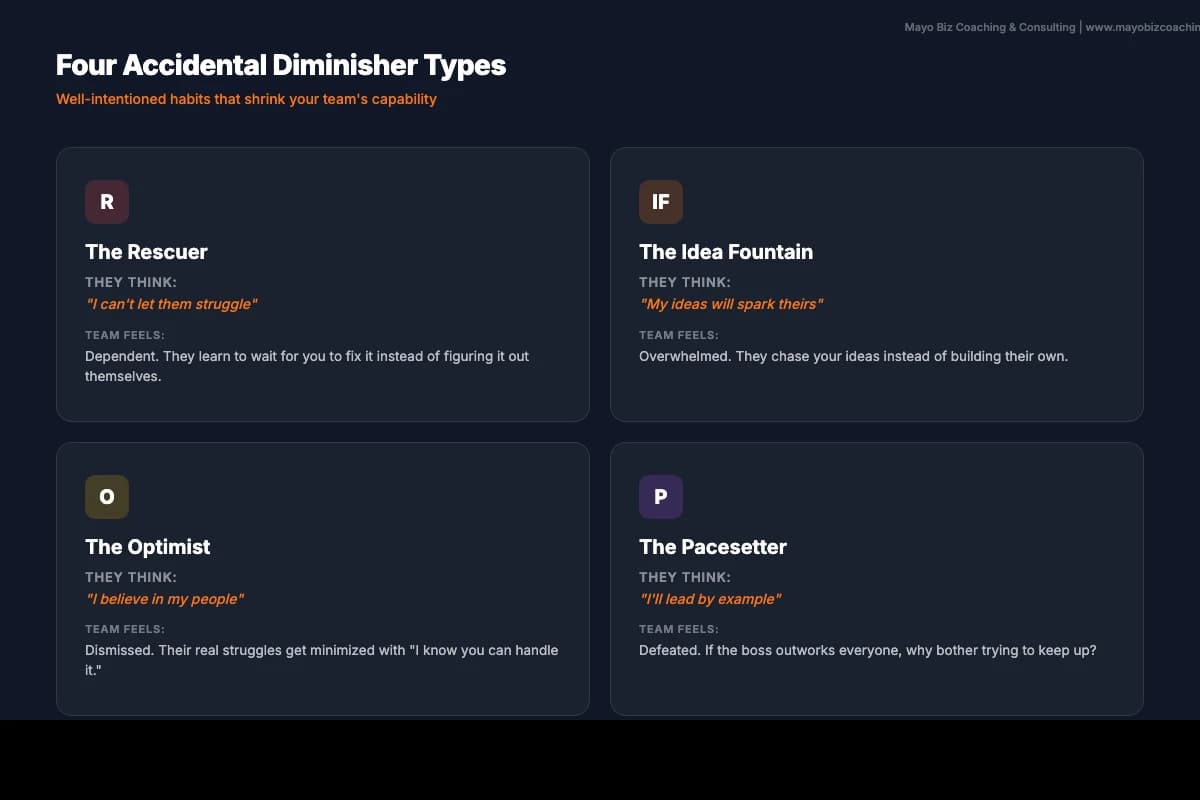
Wiseman identified nine accidental diminisher types. I want to focus on the four I see most often in the business owners and leaders I coach.
The Rescuer
The Rescuer can't stand watching people struggle. When a team member hits a wall, they jump in and fix it. They mean well, but they create dependency. Your team learns that if they wait long enough or look stuck enough, you'll do the hard work for them. Every rescue steals a learning opportunity.
If you care deeply about your people, this one probably hits close to home. There's a difference between support and rescue. Support means staying close while they work through it. Rescue means taking it away from them. The Rescuer pattern is also a fast track to leader burnout because you end up carrying work your team could handle.
The Idea Fountain
The Idea Fountain is constantly generating ideas, thinking it will spark creativity in others. The opposite happens. When you're the person with 10 new ideas every morning, your team spends their energy chasing your ideas instead of building their own. They end up executing your vision instead of adding to it.
The Optimist
The Optimist believes deeply in their people. That sounds like a strength, and it is, until it becomes a blind spot. When you always see the upside, you dismiss the real struggle. Someone tells you they're overwhelmed, and you respond with "I know you can handle it." They heard: you don't understand how hard this is.
The Pacesetter
The Pacesetter leads by example, working harder and faster than everyone else. They assume the team will follow the pace. Instead, the team watches from behind and stops trying to keep up. If the boss is going to outwork everyone anyway, why bother?
Which of these sounds like you on your busiest day? Not on your best day, when you're present and patient. On the Tuesday when three things went wrong before lunch and you defaulted to whatever gets you through the afternoon. That default is where you start.
A quick honest check
You don't need a 360-degree assessment to start. Ask yourself three questions and answer them honestly.
When someone brings me a problem, do I ask a question or give an answer? Track this for one day. Count the ratio. You'll probably be surprised by how often you jump straight to solving. Years of being rewarded for quick answers turned it into a reflex.
In my last three meetings, who did most of the talking? If it was you, your team is performing for an audience of one. They have ideas. They've just learned that your voice fills the room first.
When was the last time someone on my team surprised me with a solution I hadn't considered? If you can't remember, it's worth asking why. Either they're not capable (unlikely, since you hired them) or they've learned that your ideas take priority.
Honest diagnostic questions. Sit with them for a day. You'll probably find at least one pattern worth changing.
Five shifts you can start this week
You don't need to overhaul your leadership style. You need to adjust a few daily reflexes. Each of these is small enough to try tomorrow.
1. Lead one meeting with only questions
Wiseman calls this the Extreme Question Challenge 4. Pick one meeting this week and commit to speaking only in questions. No statements, no solutions, no "what I would do is..." Just questions.
Notice what your team produces when you stop filling the space. You'll hear ideas that never would have surfaced if you'd spoken first.
2. Name each person's genius
Think about each person on your team. What is the thing they do better than anyone else? Not their job title. Their specific, observable strength. Maybe they spot problems before anyone else notices. Maybe they're the one who keeps the team connected when things get stressful.
Name it. Say it to them directly. Then look at whether their current work actually uses that strength. If it doesn't, that's wasted capability you can recover this month.
3. Pause 30 seconds before solving
When someone brings you a problem, pause. Physically wait. Let someone else speak first. That pause says: I trust you to think about this.
4. Ask "Who helped you?"
When someone shares a win, resist the urge to congratulate and move on. Ask who else was involved. Who contributed? Who made it possible? Then recognize those people publicly.
Over time, this question nudges the culture away from individual performance toward collective thinking. That's the multiplier effect in practice. People notice and credit each other, and collaboration turns into a habit.
5. Pick your accidental diminisher type
Go back to the four types above. Pick the one that fits you most. Not the one you like least. The one that sounds like your default when you're stressed, rushed, or overloaded.
That's your starting point. You don't need to fix everything. Notice one pattern and work on it for the next 30 days. When it starts to shift, pick the next one.
When multiplier mode isn't the right call
A quick caveat. There are moments that call for direct, decisive leadership: a safety issue, a hard deadline, a new hire who needs clear direction while they're learning. Daniel Goleman's research on leadership styles 5 found that effective leaders move between styles depending on the situation. Coaching and challenging are strong defaults, but they're not the only tools.
The goal is to make multiplier behaviours your default, not your only move. If you're directing 80% of the time, that's worth examining. If you're directing when the situation genuinely calls for it and coaching the rest of the time, you're in good shape.
The real multiplier question
Wiseman's research comes down to one question every leader should sit with: are the people around you getting smarter because of you, or are they getting quieter?
The answer changes based on what you do tomorrow, and the day after that. These behaviours shift with practice. The leaders who get the most from their teams make everyone else smarter. Try asking one more question and giving one fewer answer in your next meeting. Count how many ideas come from someone other than you.
Let's Build Brilliance Together
If you're noticing that your team waits for you more than they should, or that capable people seem to underperform around you, that's worth exploring.
Reach out for a free consultation. No sales pitch, just an honest conversation about where you are and what might need to shift.
Research Notes & Sources
If you want to go deeper, these are the studies and reports behind the key points in this post.
- 150 leaders across four continents(thewisemangroup.com)
- Anemic Employee Engagement Points to Leadership Challenges(gallup.com)
- New Insights into Multipliers and Diminishers(globalleadership.org)
- #multipliers #impactplayers #questions #leadership | Liz Wiseman | 19 comments(linkedin.com)
- Leadership That Gets Results(hbr.org)
Category & Tags
Frequently Asked Questions
What is the multiplier effect in leadership?
The multiplier effect is a concept from Liz Wiseman's research on 150+ leaders across four continents. Multiplier leaders access 95% of their people's capability and intelligence. Diminisher leaders get roughly 48%. The difference comes from five learnable behaviours, not personality traits.
What is an accidental diminisher?
An accidental diminisher is a well-intentioned leader whose habits shrink their team's capability without realizing it. Wiseman identified nine types including the Rescuer who jumps in too quickly, the Idea Fountain who overwhelms with ideas, and the Optimist who dismisses real struggles. Most diminishing is accidental, not malicious.
How do I know if I am a diminisher?
Track one day honestly: when someone brings you a problem, do you ask a question or give an answer? In your last three meetings, who did most of the talking? When was the last time a team member surprised you with a solution you had not considered? If you are doing most of the thinking, your team has learned to let you.
What are the five disciplines of multiplier leadership?
Wiseman identified five disciplines: Talent Magnet (find each person's unique strength), Liberator (create safety and high standards together), Challenger (ask instead of tell), Debate Maker (draw out what the team knows), and Investor (give real ownership). Each has a diminisher counterpart that drains capability.
About the Author

About the Author
Mark Mayo
Head Coach, MBC
We get up each morning excited about sharing our 20-plus years of business acumen with small business owners and their teams. Collaborating with hard-working owners to achieve their personal and business goals brings rewards. When we develop you and grow your leaders, we create the momentum that moves you and your business forward. It starts with a first step. Then we can build brilliance together.
Related Articles

How to Build a Feedback Culture That Actually Works
Build a feedback culture where honest input is normal, not an event. Five practical rituals, backed by Gallup research, to make feedback a daily team habit.
Read How to Build a Feedback Culture That Actually Works
The Manager-as-Coach Shift: From Solving to Asking
The manager-as-coach shift means changing a daily reflex, not learning a skill set. Five practical moves to stop solving and start developing your people.
Read The Manager-as-Coach Shift: From Solving to Asking
Coaching vs. Managing: Why Great Leaders Master Both
Learn when to coach and when to manage. Research shows managers who master both approaches build more engaged teams and drive better results.
Read Coaching vs. Managing: Why Great Leaders Master Both