Team Leadership Development
The Manager-as-Coach Shift: From Solving to Asking
You got promoted because you were the best problem-solver on the team. Every tough situation landed on your desk, and you delivered. That track record earned you the title.
Now the job has quietly changed. Your value doesn't come from having the answers anymore. It comes from developing the people who find them. That's the manager-as-coach shift, and almost every leader I work with finds it harder than they expected.
The knowledge isn't the problem. The old reflex runs deep. You know you should ask more questions. You know you should let your team figure things out. And then someone walks in with a problem, and you solve it before they finish their second sentence.
Why the Shift Is So Hard
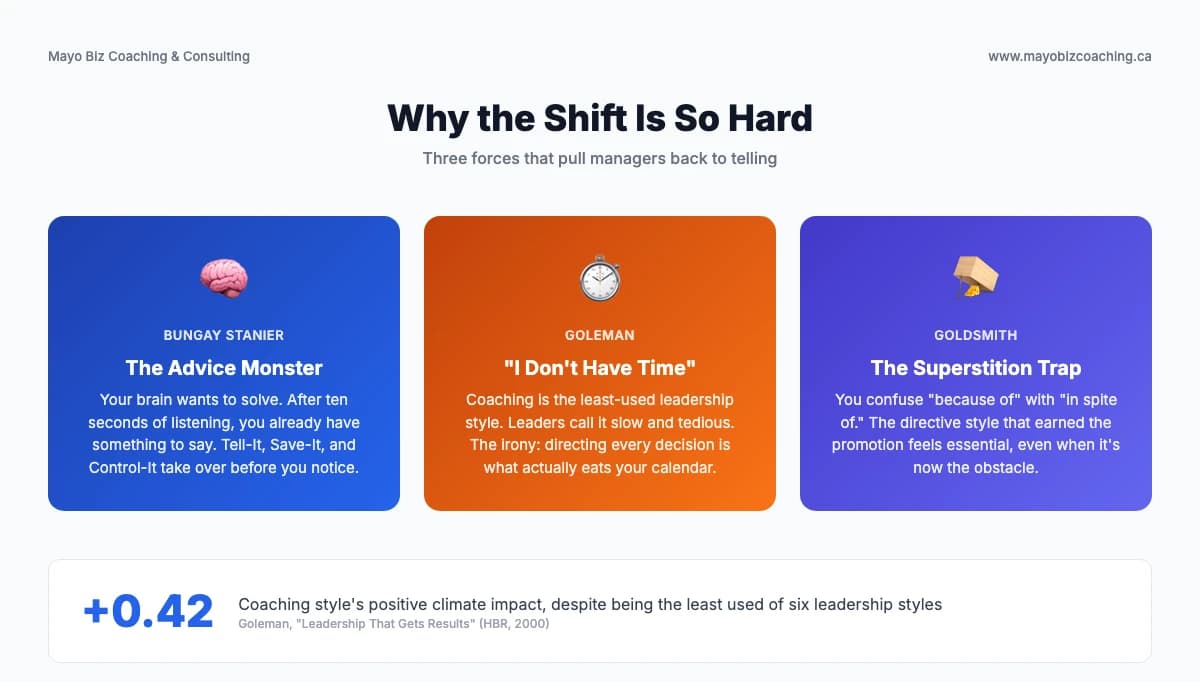
Three forces work against you every time someone walks into your office with a problem.
Your brain wants to solve. Michael Bungay Stanier, in The Advice Trap (2020), calls this the advice monster. It shows up in three flavours: Tell-It wants to be the expert, Save-It wants to rescue, and Control-It wants to hold the reins. After about ten seconds of listening, you already have something to say. That impulse feels helpful. It's actually the obstacle. The advice monster doesn't announce itself. It just talks, and you don't realize you've been solving until you're halfway through giving the answer.
I see this in almost every coaching engagement. A manager who genuinely wants to listen solves the problem before the other person finishes talking. They don't even notice it happened.
You believe you don't have time. Daniel Goleman's landmark 2000 study on leadership styles found that coaching is the least used of six styles 1, despite having a measurably positive impact on team climate. Leaders told researchers they couldn't afford "the slow and tedious work of teaching people and helping them grow." Here's the irony: directing every decision is what actually eats your calendar. Coaching saves time over weeks, even when it costs minutes today. That quick answer you gave? It guarantees they'll be back tomorrow with the same type of problem.
You confuse "because of" with "in spite of." Marshall Goldsmith, in What Got You Here Won't Get You There 2 (2007), calls this the superstition trap. The directive behaviour that earned your promotion feels essential, even when it's now the thing holding your team back. You succeeded with that style once. Your brain assumes it's still the reason, not the obstacle. Separating identity from old habits is genuinely difficult.
The shift feels threatening because your identity is built on being the person with answers. Letting go of that role takes more courage than most leadership books admit. And nobody warns you about this part when you get promoted.
What Actually Changes
This is not about learning a technique. It's about changing a reflex. Four things shift when a manager starts coaching.
From telling to asking
Edgar Schein described humble inquiry as "the fine art of drawing someone out." It means asking questions to which you genuinely don't know the answer. Telling assumes the other person doesn't know. That creates resistance. Asking empowers them and builds trust through vulnerability 3. The difference between "here's the answer" and "what are you seeing?" is small in words and massive in effect. One closes the conversation. The other opens it.
From solving to developing
In What Got You Here Won't Get You There (2007), Goldsmith identified a pattern he calls "adding too much value." A leader improves a team member's idea by 5% but reduces their commitment to executing it by 50%. The math never works in your favour. Your small edit costs you their ownership.
Active listening is the skill that makes this possible. When you listen without jumping to fix, people feel heard. When people feel heard, they commit to the work at a level your advice could never produce.
From speed to compound returns
The 30-second answer gets them through today. The 10-minute coaching conversation means they handle it themselves next time. And the time after that. And when they start coaching their own direct reports, the return multiplies again. Bungay Stanier describes this as drip irrigation: small, steady deposits that produce far more growth than a flash flood of advice. The first few weeks feel slower. By month three, you'll wonder why you ever did all the thinking yourself.
Identity follows behaviour
Herminia Ibarra's research shows that you don't think your way into a new leadership style. You start behaving like a coach, clumsily at first, and the identity catches up.
The transition is messy. You try on what Ibarra calls "possible selves" before one fits. Some days you'll coach well. Other days you'll catch yourself solving before you even realize it. That's normal. The direction matters more than the consistency.
Coaching is a reflex change, not a knowledge gap. You already know the right questions. The challenge is asking them before your advice monster speaks first.
The Intention-Execution Gap
Most managers already believe they should coach more. The problem isn't intention. It's execution.
Herminia Ibarra and Anne Scoular tested this directly. In a leadership exercise, 9 out of 10 executives 4 who intellectually chose coaching reverted to telling during a live role-play. The pattern was consistent: they opened with a good question, got an unexpected answer, grew frustrated, and defaulted to directing. The gap between "I should coach" and "I am coaching" closed in under two minutes. These weren't bad leaders. They were experienced professionals whose reflexes overrode their intentions.
The numbers back this up at scale. Gallup's research 5 (2020) found that only 2 in 10 managers instinctively know how to coach employees. The other 8 can learn, but they need deliberate practice, not just good intentions.
Here's what that looks like in real work: you resolve to ask more questions on Monday morning. By Tuesday lunch, you've already solved three problems that your team could have handled. Nobody learns to coach by deciding to coach. You learn by doing it badly, noticing what happened, and adjusting.
In Canada, the training gap is even wider. A CFIB study 6 (2023) found that 91% of Canadian small and medium businesses rely on informal, on-the-job training. Structured coaching skills are virtually absent from small business budgets. Most managers learn by copying whoever managed them. That usually means more telling, more solving, and less developing. The pattern repeats across generations of managers until someone decides to break it on purpose.
If you're working through when to coach and when to direct, the coaching vs managing framework covers that timing decision in detail.
Knowing you should coach and actually coaching are different skills entirely.
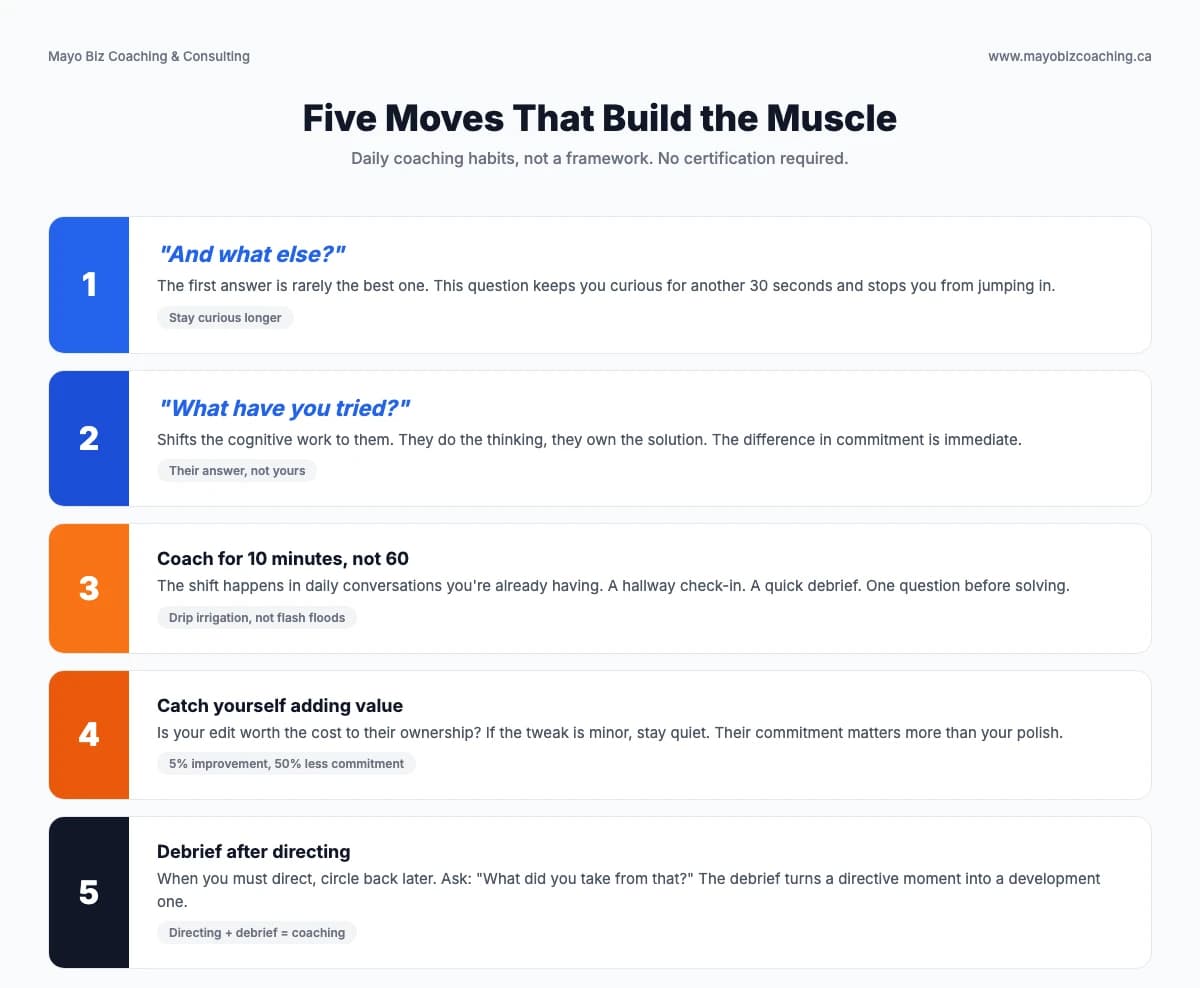
Five Moves That Build the Muscle
These are daily practices, not a framework. Each one is a behaviour shift you can try this week. No certification required.
1. Ask "And what else?" before responding
The first answer someone gives you is rarely the best one. It's the safest one. "And what else?" is the simplest coaching question that exists. It keeps you curious for another 30 seconds and stops you from jumping in with your own idea. Try it three times in your next conversation and notice what surfaces. Most people report that the real issue shows up on the second or third answer, not the first. This one question does more coaching work than any model or framework.
2. Replace "Here's what I'd do" with "What have you tried?"
This one sentence shifts the cognitive work to the other person. They do the thinking. They own the solution.
You still get to guide the conversation, but you're guiding it toward their answer, not yours. The difference in commitment is immediate. People fight for their own ideas in ways they never fight for yours. And if they come up with a good approach, they don't need you to remind them to follow through. It's already theirs.
3. Coach for 10 minutes, not 60
The shift doesn't happen in scheduled coaching sessions. It happens in the daily conversations you're already having. A hallway check-in. A quick Slack exchange. A two-minute debrief after a meeting.
You don't need a coaching certification. You need the discipline to pause and ask one question before solving. Ten minutes of real coaching, spread across a day, changes more behaviour than a monthly one-hour session.
4. Catch yourself adding value
When someone brings you an idea, notice the urge to improve it. Ask yourself honestly: is my edit worth the cost to their ownership? If your tweak is minor, stay quiet. Their commitment matters more than your polish. This is the hardest move on the list because it feels like withholding help. It's actually the most generous thing you can do. You're giving them the space to own something fully.
5. Debrief after directing
Sometimes you need to direct. Emergencies, new hires, high-stakes deadlines. That's fine. Directing isn't a failure of coaching.
But after the moment passes, circle back. Ask: "What did you take from that? What would you do differently?" The debrief turns a directive moment into a development one. It teaches even when you can't coach in real time. Over months, these debriefs build judgment that reduces the need to direct at all.
Coaching isn't one big transformation. It's five small habits practised until they become your default.
How to Know It's Working
You'll know it's working when people stop lining up at your door with questions they could answer themselves. The signals are quiet at first. No congratulations email. Just small shifts in how your team operates:
- In meetings, you talk less. Your team talks more.
- Someone solves a problem you didn't know about until it was already handled.
- A team member starts coaching a peer without being asked.
- You feel less essential and more effective.
That last one is the real indicator. When you feel less needed but your team performs better, the shift is taking hold. Leaders who are used to being the go-to person sometimes mistake that feeling for being sidelined. It's the opposite. You've built something that works without you in the middle of every decision.
The shift doesn't just develop your team. It develops you. Your conversations get sharper and your questions improve. Your emotional intelligence grows because you're practising it daily instead of reading about it. Gallup's research (2020) found that teams led by coaching-trained managers 5 see measurable gains in engagement and performance. The investment changes both sides of the relationship.
Watch for this sign too: when you stop taking credit for your team's wins and start feeling proud of problems they solved without you. That's when the reflex has changed for good.
Let's Build Brilliance Together
The manager-as-coach shift is uncomfortable because it asks you to let go of the thing that got you promoted. That takes practice, and it goes faster when someone in your corner can see the patterns you can't.
If you're noticing that your team waits for your answers instead of finding their own, reach out for a free consultation. No sales pitch, just an honest conversation about where you are and what you're working on.
You can also explore Team Leadership Development for structured support in building coaching skills across your leadership team.
Research Notes & Sources
If you want to go deeper, these are the studies and reports behind the key points in this post.
- Leadership That Gets Results(hbr.org)
- What Got You Here Won't Get You There(amazon.com)
- Edgar Schein's Humble Inquiry(psychsafety.com)
- The Leader as Coach(hbr.org)
- Give Up Bossing, Take Up Coaching: You'll Like the Results(gallup.com)
- Canada’s Training Ground: How Small Businesses are Building Tomorrow’s Workforce(cfib-fcei.ca)
Category & Tags
Frequently Asked Questions
What is the manager-as-coach approach?
The manager-as-coach approach means leading through questions instead of answers. Rather than solving problems for your team, you ask questions that help them think, build ownership, and develop judgment they can apply next time without you.
Why do managers struggle to coach their team?
Most managers were promoted for solving problems fast. That reflex works against coaching, which requires slowing down and letting others think. Ibarra and Scoular found that 9 out of 10 executives who chose coaching in theory reverted to telling in practice within minutes.
How do you shift from managing to coaching?
Start with small daily habits. Ask "And what else?" before responding, replace "Here is what I would do" with "What have you tried?", and coach in 10-minute conversations rather than formal sessions. The shift happens in ordinary moments, not workshops.
How long does it take to become a coaching manager?
Most managers start noticing a difference within 60 to 90 days of consistent practice. The shift is gradual. Early signs include fewer people lining up with questions and team members solving problems without escalating to you.
About the Author

About the Author
Mark Mayo
Head Coach, MBC
We get up each morning excited about sharing our 20-plus years of business acumen with small business owners and their teams. Collaborating with hard-working owners to achieve their personal and business goals brings rewards. When we develop you and grow your leaders, we create the momentum that moves you and your business forward. It starts with a first step. Then we can build brilliance together.
Related Articles
How to Build a Feedback Culture That Actually Works
Build a feedback culture where honest input is normal, not an event. Five practical rituals, backed by Gallup research, to make feedback a daily team habit.
Read How to Build a Feedback Culture That Actually Works
Conscious Unbossing: Why Gen Z Doesn't Want to Manage
Over half of Gen Z workers don't want management roles. That's not entitlement. It's a rational response to how most organizations have designed the job.
Read Conscious Unbossing: Why Gen Z Doesn't Want to Manage
Workplace Loneliness Is a Leadership Problem, Not an HR One
One in five workers feel lonely at work, including 16% who come in every day. The research points to leaders, not HR programmes, as the real solution.
Read Workplace Loneliness Is a Leadership Problem, Not an HR One