Team Leadership Development
The Accountability Conversation: How to Hold People to Standards and Keep Their Trust

Something isn't getting done. You've noticed it twice. Maybe three times. Each time, you told yourself you'd say something. Each time, you didn't.
Maybe you dropped a hint in a meeting. Maybe you just did the work yourself because it was faster than having the conversation.
You already know this pattern doesn't end well.
The Conversation Nobody Wants to Have
Most leaders I work with aren't bad at accountability. They're avoiding it.
That tracks with what the research shows. A Workplace Accountability Study from Partners in Leadership 1 surveyed 40,000 people and found that 82% either try and fail or avoid holding others accountable altogether. Not sometimes. As their default. And 84% said leader behaviour is the single biggest factor in whether accountability exists on a team.
If accountability is missing on your team, start by looking at what you've been avoiding.
Why You're Avoiding It
Kim Scott's Radical Candor framework 2 names the most common trap: Ruinous Empathy. You care about the person. You don't want to damage the relationship. So you soften the message, drop hints, or let it slide entirely.
The intent is good. The impact isn't.
In coaching, I see this play out the same way almost every time. A leader tells me, "I don't want to demoralize them." Meanwhile, the rest of the team watches the pattern continue and quietly recalibrates what "acceptable" means. The person who isn't delivering gets protected. The people who are delivering get frustrated. Trust erodes in both directions.
Brene Brown put it plainly 3: clear is kind, unclear is unkind. When you avoid telling someone where they stand, you're not protecting them. You're leaving them without the information they need to improve. And you're telling your team that standards are optional.
This is different from having a difficult conversation. Difficult conversations cover a wide range of uncomfortable topics. Accountability is more specific. It's the gap between what was expected and what was delivered. And it demands a different approach.
Safety and Accountability Aren't Opposites
Here's where most leaders get stuck. They think creating psychological safety means going easy on people. It doesn't.
Amy Edmondson has studied psychological safety 4 at Harvard for decades, and her framework puts it on a simple grid. One axis is psychological safety. The other is performance standards. When both are low, you get apathy. When safety is high but standards are low, you get a comfortable team that doesn't push itself. When standards are high but safety is low, you get anxiety and fear.
The sweet spot is what Edmondson calls the Learning Zone: high safety and high standards. That's where people feel safe enough to hear hard feedback and motivated enough to act on it.
I've written before about why teams won't tell you what's wrong when safety is missing. The accountability conversation is the other half of that equation. Safety without standards is just comfort. Standards without safety is just pressure. You need both.
If you've been building psychological safety on your team, the accountability conversation isn't a threat to that work. It's proof that your culture can handle adult conversations.
Deciding What You're Actually Addressing
Before you sit down, get clear on what the real issue is. This is where most accountability conversations go sideways.
I see leaders address the surface event when the real problem is a pattern. Someone misses a deadline, they apologize, and the leader moves on. Then it happens again two weeks later. Same conversation, same apology, same result.
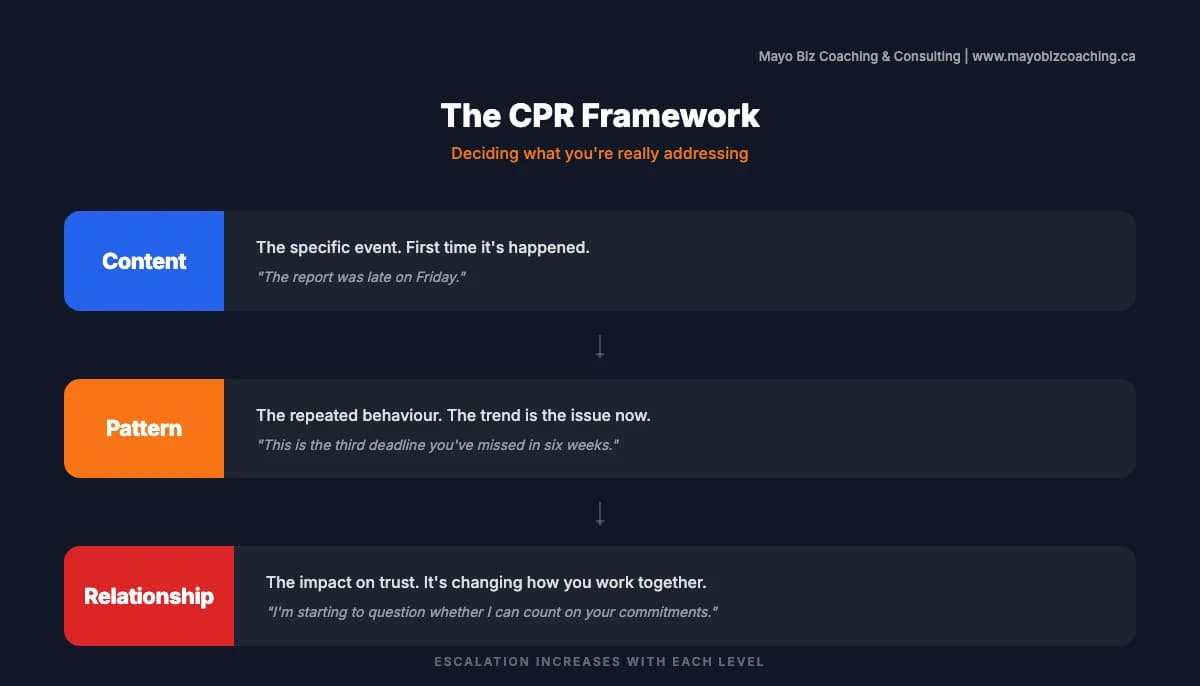
Kerry Patterson and his co-authors captured this in a framework called CPR 5 in their book Crucial Accountability:
Content is the specific event. First time it's happened, or you're addressing one instance. "The report was late on Friday."
Pattern is the repeated behaviour. The trend itself is the issue now. "This is the third deadline you've missed in six weeks."
Relationship is the impact on trust. The behaviour is changing how you work together. "I'm starting to question whether I can count on the commitments you make."
Most leaders stay at Content when they should be at Pattern or Relationship. They address the surface event, the other person apologizes, and nothing changes. If you're having the same conversation for the third time, you're not having an accountability conversation. You're having a Content conversation on repeat.
Before you walk in, ask yourself: is this about the event, the trend, or what it's doing to our working relationship? That answer changes everything about how the conversation should go.
The Accountability Dial
Once you know what you're addressing, you need to know how much weight to put behind it.
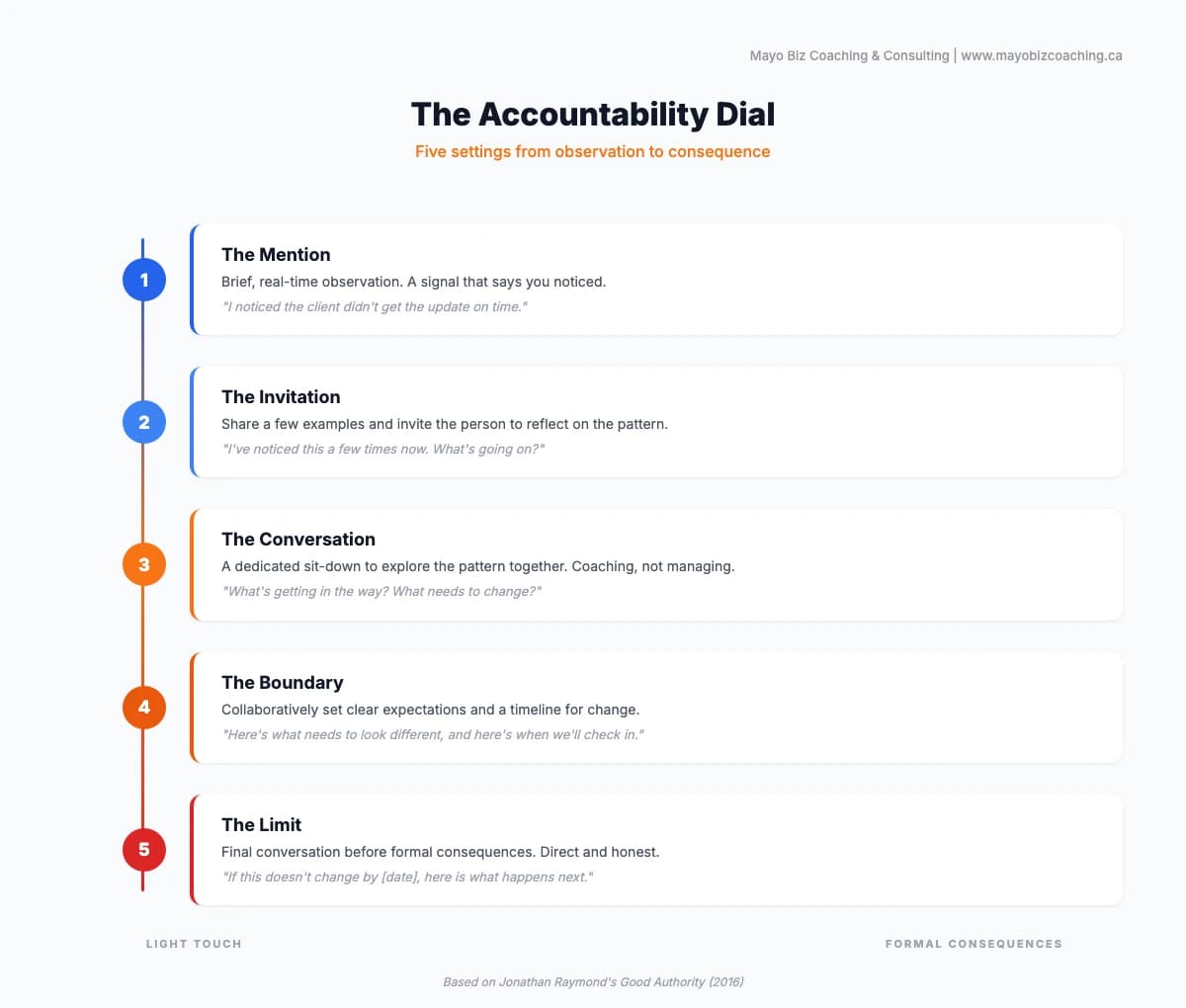
Jonathan Raymond, in his book Good Authority, offers a way to think about escalation 6 that doesn't jump straight to consequences. He calls it the Accountability Dial, and it has five settings:
-
The Mention is a brief, real-time observation. "I noticed the client didn't get the update on time." No lecture. No performance-review tone. Just a signal that says I saw this, and it matters.
-
The Invitation comes after a few mentions haven't landed. You share two or three examples and invite reflection. "I've noticed this a few times now. What's going on?"
-
The Conversation is a dedicated sit-down. You explore the pattern together. What's getting in the way? What needs to change? This is coaching, not managing.
-
The Boundary is where you collaboratively set clear expectations and a timeline. "Here's what needs to look different, and here's when we'll check in."
-
The Limit is the final conversation before formal consequences. Direct and honest about what happens next if things don't change.
The dial isn't strictly linear. A serious issue might start at The Conversation. A small pattern might stay at The Mention for a while. The point is to give people a chance to course-correct before you reach consequences nobody wants.
What I find useful about this framework is that it treats accountability as an investment in someone's growth, not a punishment for their failure. That's the mindset shift most leaders need to make.
What the Conversation Actually Sounds Like
Say you have a team member who keeps missing deadlines on client deliverables. You've mentioned it casually twice. Nothing changed. Time for The Conversation.
Start by describing the gap between what was expected and what happened: "We agreed the quarterly report would go to the client by Thursday. It went out Monday. This is the third time in two months that a deliverable has been late."
Then get curious instead of accusatory: "I want to understand what's happening. Talk me through what got in the way."
Maybe they're overloaded or stuck on something they haven't asked for help with. You won't know until you ask. And they won't tell you unless they feel safe enough to be honest.
From there, work together on what needs to change: "What would help you hit these dates consistently? What do you need from me?"
Close with a clear next step: "Let's check in next Friday on how this week's deliverables are tracking."
No lecture. No blame. No vague "let's do better." A clear gap, genuine curiosity, a collaborative solution, and a follow-up date. The pattern works the same whether you're addressing a missed deadline or a behaviour that's affecting the whole team.
Following Through Is the Conversation
The accountability conversation doesn't end when you leave the room. It ends when you follow up.
This is where most leaders fall short. They have the hard conversation, feel relieved it's over, and move on. Two weeks later, the same pattern resurfaces and they're back at square one, wondering why nothing changed.
Following up isn't micromanaging. It's honouring the commitment you both made. When you said "let's check in Friday," that became a promise. Keep it.
If things improved, say so. Recognition reinforces the change and tells the person their effort was noticed. If they didn't improve, you now have clear data for the next setting on the Accountability Dial. Either way, the follow-up is where the real work happens.
The teams with the strongest accountability cultures aren't the ones with the toughest leaders. They're the ones where leaders follow through consistently. When your team knows that commitments are tracked and conversations have follow-up, accountability stops being something you impose. It becomes how the team operates.
Let's Build Brilliance Together
Accountability conversations are simpler than most leaders make them. Tell people the truth. Help them figure out what's next.
If you're recognizing that these conversations keep getting put off, or that they happen but nothing changes afterward, reach out for a free consultation. No sales pitch, just an honest conversation about where you are and what you're working on.
Research Notes & Sources
If you want to go deeper, these are the studies and reports behind the key points in this post.
- Workplace Study Reveals Crisis of Accountability - Culture Partners(culturepartners.com)
- Our Approach: Kim Scott(radicalcandor.com)
- Brene Brown put it plainly(brenebrown.com)
- What Is Psychological Safety?(hbr.org)
- CPR in Crucial Accountability | Crucial Learning(cruciallearning.com)
- Five Steps to Hold People Accountable – Coaching for Leaders(coachingforleaders.com)
Category & Tags
Frequently Asked Questions
Why do leaders avoid accountability conversations?
Kim Scott calls the most common pattern Ruinous Empathy. Leaders care about their people and do not want to damage the relationship, so they soften the message or avoid it entirely. Research from Partners in Leadership found that 82% of people either try and fail or avoid holding others accountable.
What is the CPR framework for accountability?
CPR stands for Content, Pattern, and Relationship. Content addresses a single event. Pattern addresses repeated behaviour. Relationship addresses the impact on trust. Most leaders stay at Content when they should be addressing Pattern or Relationship, which is why the same conversations keep repeating.
How are psychological safety and accountability connected?
Amy Edmondson at Harvard found that high-performing teams need both psychological safety and high standards. Safety without standards creates comfort zones. Standards without safety create anxiety. The best teams combine both so people feel safe enough to hear honest feedback and motivated to act on it.
What is the Accountability Dial?
Jonathan Raymond created the Accountability Dial in his book Good Authority. It has five settings: Mention, Invitation, Conversation, Boundary, and Limit. Each step gives someone a chance to course-correct before formal consequences, treating accountability as an investment in growth rather than punishment.
About the Author

About the Author
Mark Mayo
Head Coach, MBC
We get up each morning excited about sharing our 20-plus years of business acumen with small business owners and their teams. Collaborating with hard-working owners to achieve their personal and business goals brings rewards. When we develop you and grow your leaders, we create the momentum that moves you and your business forward. It starts with a first step. Then we can build brilliance together.
Related Articles

How to Build a Feedback Culture That Actually Works
Build a feedback culture where honest input is normal, not an event. Five practical rituals, backed by Gallup research, to make feedback a daily team habit.
Read How to Build a Feedback Culture That Actually Works
How to Have Difficult Conversations Without Destroying Trust
Difficult conversations do not need to damage trust. Use evidence-based frameworks to give clear feedback, improve accountability, and protect relationships.
Read How to Have Difficult Conversations Without Destroying Trust
Psychological Safety: Why Your Team Won't Tell You What's Wrong
Psychological safety predicts team performance more than talent or experience. Learn why your people stay silent and how to build a culture of honest dialogue.
Read Psychological Safety: Why Your Team Won't Tell You What's Wrong