Team Leadership Development
Synergy Without Meeting Overload: Design Collaboration That Produces Better Ideas
Your team does not need another standing meeting just because a decision touches more than one person.
That is where meeting overload usually starts. A leader wants better ideas, broader input, and stronger buy-in. The intention is good. Then the calendar fills. The same people talk first. The quiet people prepare their real thoughts for the hallway after the meeting. Everyone leaves with more context, but not always with a better decision.
Team collaboration design is the discipline of deciding how people should work together before you invite them into the room. It asks a plain question: what kind of collaboration does this work actually need?
Sometimes the answer is a meeting. Sometimes it is a written question. Sometimes it is five minutes of input from the right person. Sometimes it is solo thinking before group discussion. Sometimes it is one leader making the decision after hearing the risks.
More collaboration is not the goal. Better collaboration is.
Collaboration fails when it becomes a default
Most leaders do not create meeting overload on purpose. They create it by avoiding a harder choice.
It feels safer to invite everyone. It feels more inclusive to let every topic become a discussion. It feels respectful to ask for input one more time. But after a while, the team pays for that politeness with focus, energy, and decision speed.
Rob Cross has written in Harvard Business Review that many people already spend 85% or more of their time in collaborative work 1, including email, messaging, meetings, and other team tools. That number should stop a leader for a moment. If collaboration already takes most of the week, adding more of it is not automatically generous. It may be taking away the time people need to think.
I see this pattern in leadership work often. A leader says, "We need more collaboration." When we look closer, the team does not need more people in more meetings. They need cleaner questions, clearer ownership, and fewer conversations that never close.
The leadership move is to stop treating collaboration as a value statement and start treating it as a design choice.
A better question than "Who should be in the meeting?"
The first question should not be who gets invited.
The first question should be: what work are we asking collaboration to do?
That question changes the whole design. If the goal is awareness, you do not need a meeting. If the goal is input, you may not need everyone together. If the goal is decision quality, you need the right facts and the right dissenting views. If the goal is commitment, you need people to understand the decision and their part in it.
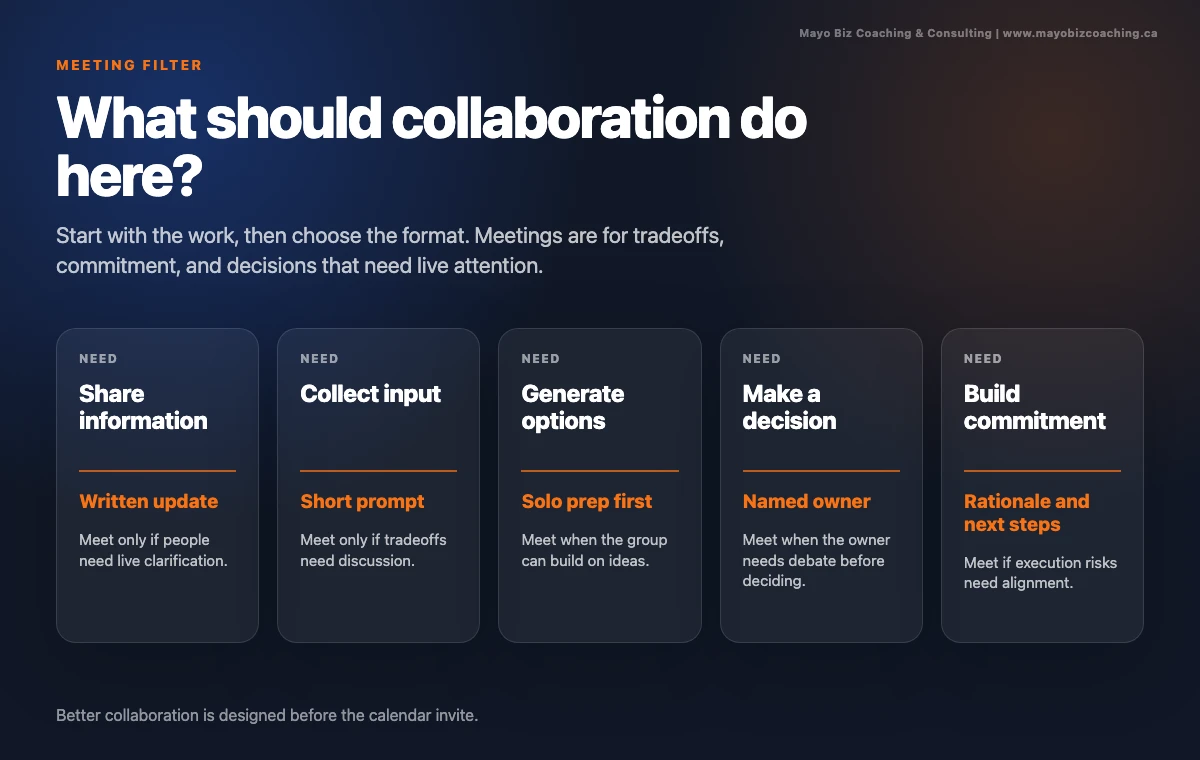
Here is a simple way to separate the work:
| Collaboration need | Better default | Meeting only if |
|---|---|---|
| Share information | Written update | People need to ask clarifying questions live |
| Collect input | Short written prompt | Input conflicts and tradeoffs need discussion |
| Generate options | Solo prep, then group discussion | The group can build on each other's thinking |
| Make a decision | Named decision owner | The owner needs debate before deciding |
| Build commitment | Clear rationale and next steps | People need to align on execution risks |
This is not about being anti-meeting. Some meetings matter. A good decision meeting can save weeks of rework. A strong coaching conversation can change a person's confidence. A serious conflict conversation should not be pushed into email.
The problem is not meetings. The problem is meetings doing work they are poorly designed to do.
Protect thinking before you ask for teamwork
One mistake leaders make is gathering people before anyone has had time to think.
That creates a predictable result. The quickest processors shape the conversation. The most confident voices create the early frame. The more reflective people spend the first half of the meeting catching up to the discussion, then bring their best insight after the decision has already started to harden.
If you want better ideas, protect thinking time first.
Send the question ahead of the meeting. Ask people to bring one risk, one option, and one tradeoff. Give them a place to add written input before the meeting starts. Then use the live time to compare the ideas, not to discover the problem from scratch.
This helps the leader too. You get cleaner input, less performance speaking, and fewer comments made just because the room went quiet. You also make it easier for introverts, newer employees, and technical experts to contribute without having to fight for air time.
The prompt can be simple:
- What do you see that I may be missing?
- What would make this plan harder to execute than it looks?
- What option should we consider before we choose?
- What is the cost of doing nothing?
- What would you need from me to make this work?
Those questions do not require a long process. They require a leader who respects thinking enough to ask before the meeting.
Keep psychological safety practical
Collaboration breaks when people do not feel safe telling the truth.
Google's research on five dynamics of effective teams 2 found that who is on a team matters less than how team members interact, structure work, and view their contribution. The most important dynamic was psychological safety: people feeling able to admit mistakes, ask questions, and offer ideas without fear of being embarrassed or punished.
That does not mean every meeting needs to become a feelings circle. It means leaders have to notice the conditions they create.
If the leader always speaks first, people adjust. If bad news gets cross-examined, people soften it. If every concern turns into a defence of the original plan, concerns disappear. If someone offers a half-formed idea and gets corrected publicly, the room learns not to think out loud.
Better collaboration starts with the leader going last more often.
Try this in your next discussion. Before you share your opinion, ask each person for one risk or one missing piece. If someone raises a concern, do not answer it immediately. Say, "Stay with that for a minute. What are you seeing that makes you name it?" You are not promising to agree. You are showing the room that useful tension is welcome.
That is the difference between collaboration as performance and collaboration as learning.
Name the decision owner before the debate
Teams waste a lot of energy because nobody knows who actually decides.
When decision rights are vague, meetings drift. People keep adding input because no one has permission to close the loop. Strong voices sound like authority. Senior people accidentally turn comments into decisions. The team leaves thinking there was alignment, then discovers later that everyone heard a different outcome.
Bain's RAPID decision-making work 3 makes a useful point: clear roles reduce ambiguity and help teams decide at the right pace. Their model separates roles such as recommend, input, decide, and perform so people know how they are contributing to the decision.
You do not need to turn every small-team decision into a formal model. But you do need to answer four questions before the meeting starts:
- Who is gathering input?
- Who has useful expertise or context?
- Who makes the final call?
- Who has to act after the decision?
Those answers prevent false consensus. They also reduce frustration. People can accept not being the decider when the process is honest. What wears people down is being asked for input when the decision is already made, or being invited into a debate where nobody has the authority to close it.
A clear sentence helps:
"I want your input because you will see risks I might miss. I will make the final decision by Friday, then I will explain what we chose and why."
That sentence is not controlling. It is respectful. It tells people the rules of the collaboration.
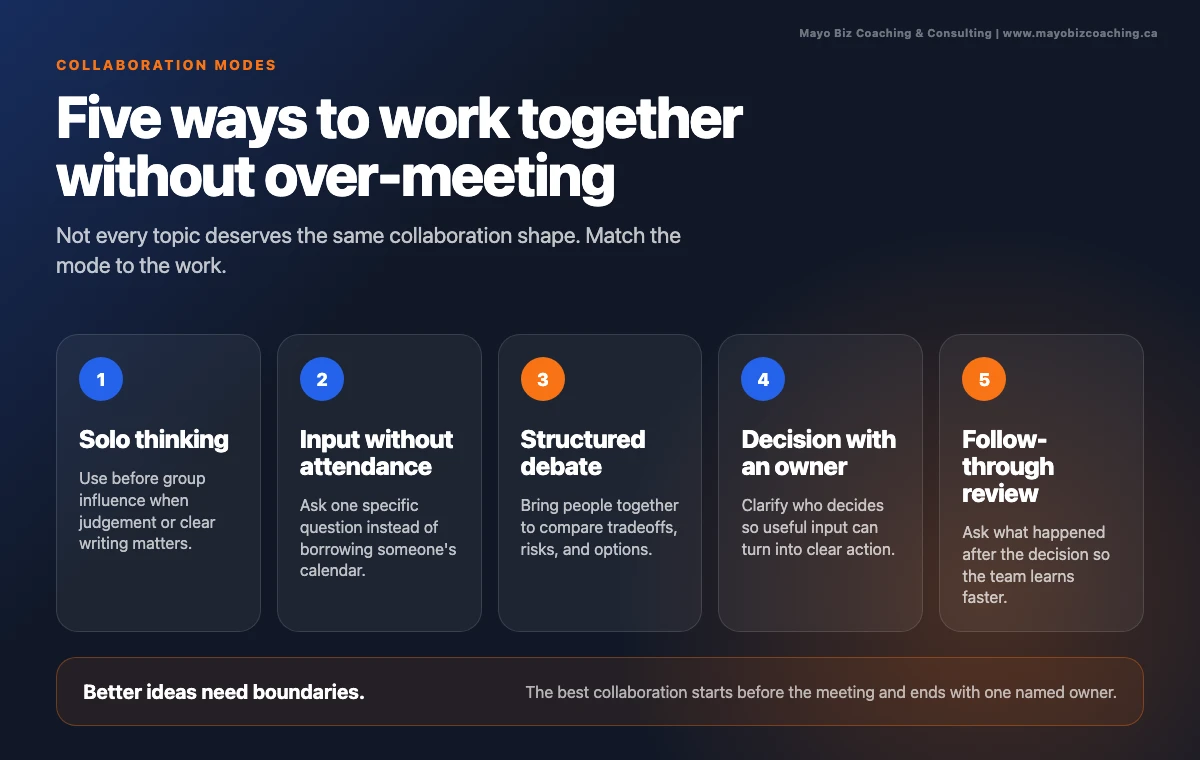
Use five collaboration modes
Not every topic deserves the same collaboration shape. I would use five modes.
1. Solo thinking
Use this when the work needs judgement, reflection, or clear writing before group influence enters.
Good examples: strategy options, hiring concerns, risk assessment, customer feedback themes, performance patterns, and process redesign.
Give people the question and a deadline. Ask for short written input. Do not make people perform fresh thinking in a crowded room when accuracy matters.
2. Input without attendance
Use this when you need someone's expertise but not their calendar.
This is one of the fastest ways to reduce meeting load. A person may have valuable context without needing to sit through the whole discussion. Ask for their answer to a specific question. Then use it.
The courtesy is in being specific. "Any thoughts?" creates vague work. "What risk do you see in this timeline from an operations point of view?" respects their time and gets better input.
3. Structured debate
Use this when the team needs to compare tradeoffs.
Meetings earn their place here. People need to hear where the plan is strong, where it is weak, and what choices carry cost. The leader's job is to keep debate on the decision, not on personal preference.
Useful prompts:
- What are we optimizing for: speed, quality, cost, trust, or learning?
- What tradeoff are we pretending we can avoid?
- What would make each option fail?
- What would we regret six months from now?
Healthy debate is not noise. It is a way of protecting decision quality.
4. Decision with an owner
Use this when the team has enough input and now needs closure.
This is the point where collaboration often gets weak. Leaders keep reopening the conversation because they want everyone to feel heard. But endless reopening can become its own kind of disrespect. It tells the team their time does not lead anywhere.
After input and debate, someone must decide. Then the leader needs to state the decision, the reason, and what happens next.
5. Follow-through review
Use this after the decision has met reality.
Many teams skip the review, then repeat the same collaboration mistakes. A short follow-through review asks:
- What did we decide?
- What happened after we acted?
- What did we miss?
- What would we change next time?
That follow-through turns collaboration into learning. Without it, the team keeps arguing from memory and opinion.
Cut meetings by changing the defaults
Meeting overload rarely improves through willpower. It improves when leaders change defaults.
Microsoft's 2025 Work Trend Index special report 4 described the "infinite workday" as a flood of messages, meetings, and interruptions. It reported that the average worker receives 117 emails and 153 Teams messages daily, and that its highest-volume users are interrupted about every two minutes during core work hours by a meeting, email, or notification.
The point is not that every team has the same numbers. The point is that work is already fragmented. Leaders should not add to that fragmentation casually.
Here are four default changes that help:
- Replace status meetings with written updates.
- Require a decision question before booking a decision meeting.
- Send pre-read material at least 24 hours ahead, or cancel the meeting.
- End every meeting with owner, decision, next step, and date.
One more helps: make 25 minutes the normal meeting length unless there is a clear reason for longer. A shorter meeting forces sharper design. If the topic cannot fit, ask whether it actually needs a better pre-read, a smaller group, or a clearer decision owner.
The goal is not a beautiful calendar. The goal is a team with enough focus left to do good work.
Watch for the hidden cost to your best contributors
Meeting overload does not hit everyone evenly.
The most trusted people get pulled into more conversations. The careful thinkers get asked to review more drafts. The calm problem-solvers become unofficial clearing houses for other people's uncertainty. The leader may see this as collaboration. The person may experience it as a quiet tax on their best work.
This matters because your strongest contributors often say yes too easily. They want to help. They care about quality. They like being useful. Then their actual work starts happening early in the morning, late at night, or in the cracks between everyone else's requests.
If you are a leader, look at the people you invite most often. Ask yourself:
- Am I using this person for expertise, reassurance, or convenience?
- Could I ask for one focused piece of input instead of their attendance?
- Am I protecting their focus as seriously as I value their judgement?
- Does this person have permission to decline meetings where they are not needed?
This connects directly to why your best people stop speaking up. Good people withdraw when their input feels used but their time feels unprotected. They may keep performing, but they stop offering the extra insight that made them so valuable.
Better team collaboration design protects those people instead of consuming them.
A weekly reset you can use immediately
If your team is already overloaded, do not start with a grand meeting overhaul. Start with one weekly reset.
Take 20 minutes on Friday or Monday and review the next five workdays.
Ask:
- Which meetings are only information sharing?
- Which meetings have no decision question?
- Which meetings need input from people who do not need to attend?
- Which decisions are missing an owner?
- Which collaboration moments need solo thinking before group discussion?
Then make three changes:
- Cancel or convert one meeting to a written update.
- Name the decision owner for one unresolved issue.
- Send one pre-meeting question that lets quieter people think before the room.
That is enough to change the pattern this week. Leadership improves through repeated design choices, not one big announcement.
If you want a useful test, ask your team this at the end of the week:
"Where did collaboration help us make better work, and where did it slow us down?"
The answer will tell you what to keep, what to cut, and what to redesign.
Better ideas need boundaries
There is a belief in some teams that better ideas come from more voices, more meetings, and more open discussion.
Sometimes they do. Often they do not.
Better ideas come from the right voices at the right time, enough safety to name risks, enough structure to compare options, and enough discipline to make a decision. That is the leadership work. It is less glamorous than saying, "Let's collaborate more," but it is far more useful.
The best collaboration often starts before the meeting and ends with one named owner. It gives people room to think. It invites honest input. It uses meetings for work that deserves live attention. Then it closes the loop so the team can move.
That is how you get better ideas without building a calendar nobody can survive.
Let's Build Brilliance Together
Team collaboration design helps leaders protect the two things every strong team needs: good thinking and clear action. When those are missing, more meetings will not fix the problem.
If your team is busy, involved, and still slower than it should be, reach out for a free consultation. No sales pitch, just an honest conversation about where you are and what you're working on.
You can also explore Team Leadership Development for structured support in building clearer collaboration habits across your leadership team.
Research Notes & Sources
If you want to go deeper, these are the studies and reports behind the key points in this post.
- Where We Go Wrong with Collaboration (hbr.org)
- Team dynamics: Five keys to building effective teams (business.google.com)
- RAPID Decision Making (bain.com)
- Breaking down the infinite workday (microsoft.com)
Category & Tags
Frequently Asked Questions
What is team collaboration design?
Team collaboration design is the habit of deciding how people should work together before you add a meeting. It clarifies whether the work needs solo thinking, written input, structured debate, a named decision owner, or a follow-up review.
How do leaders reduce meeting overload without hurting collaboration?
Start by removing meetings that only share information, collect status, or invite people who only need to be informed. Protect meetings for decisions, tradeoffs, learning, and issues where live discussion changes the quality of the outcome.
When should collaboration happen in a meeting?
Use a meeting when people need to weigh tradeoffs together, challenge assumptions, resolve conflict, or commit to an action. If the goal is awareness, a short written update is usually better.
How do you get quieter team members into collaboration?
Give people the question before the meeting, collect written input first, and ask for risks or missing information before asking for opinions. Better collaboration is designed so the loudest voice does not automatically become the strongest signal.
About the Author

About the Author
Mark Mayo
Head Coach, MBC
We get up each morning excited about sharing our 20-plus years of business acumen with small business owners and their teams. Collaborating with hard-working owners to achieve their personal and business goals brings rewards. When we develop you and grow your leaders, we create the momentum that moves you and your business forward. It starts with a first step. Then we can build brilliance together.
Related Articles
Think Win-Win in the Real World: Negotiate Without Creating Losers
Win-win negotiation leadership is not being nice or splitting the difference. Learn how to protect standards and build agreements that last.
Read Think Win-Win in the Real World: Negotiate Without Creating Losers
Conscious Unbossing: Why Gen Z Doesn't Want to Manage
Over half of Gen Z workers don't want management roles. That's not entitlement. It's a rational response to how most organizations have designed the job.
Read Conscious Unbossing: Why Gen Z Doesn't Want to Manage
Build a Team Strengths Map: Turn Talent Into Advantage
A team strengths map helps leaders see talent patterns, reduce bottlenecks, pair people well, and turn individual strengths into clearer team work.
Read Build a Team Strengths Map: Turn Talent Into Advantage