Executive Leadership & Career Coaching
Self-Awareness Is a Leadership Skill You Can Build

You probably think you know yourself pretty well.
Most leaders do. You know your strengths. You can name your weaknesses if someone asks. You've had enough hard conversations and late nights to feel like you understand what makes you tick.
Here is the uncomfortable part. Organizational psychologist Tasha Eurich 1 studied nearly 5,000 people and found that most believe they're self-aware. Only 10 to 15% actually are. That gap between what you think you know about yourself and what's actually true is where most leadership problems start.
The gap nobody talks about
I've coached leaders who can recite their personality type and their top five strengths. They've done the assessments. They think the self-awareness box is checked.
Then I ask one question: how does your team experience you when you're stressed?
Silence. Because that's a different kind of knowing. There's a difference between understanding your values in theory and seeing how they hold up in practice. Picture a bad Tuesday: the project is late and someone just missed a deadline.
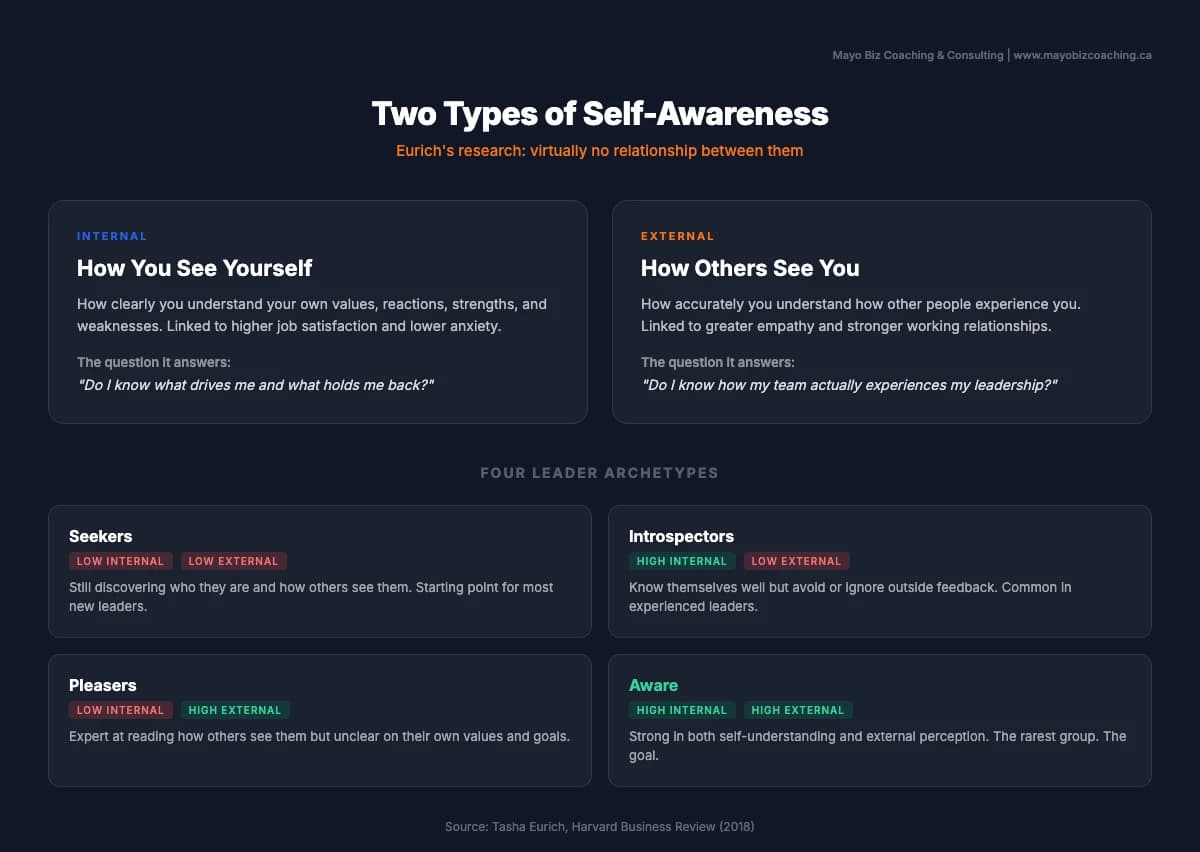
Eurich's research draws a clear line between two types. Internal self-awareness is how well you understand your own values, reactions, strengths, and weaknesses. External self-awareness is how accurately you understand how others see you.
Most leaders assume these go together. They don't. Eurich found virtually no relationship between them. You can know yourself deeply and still have no idea how you come across to the people around you.
You might feel patient and supportive. Your team might experience you as disengaged. You might think you're asking for input. Your team might hear a loaded question with a predetermined answer.
Self-awareness isn't about introspection alone. It's about closing the gap between your intentions and your impact.
You're probably asking the wrong question
When something goes sideways, most people ask themselves "why." Why did that meeting fall apart? Why does this keep happening? Why can't I get through to that person?
It feels like productive reflection. Eurich's data says otherwise. Among 50 people she identified as highly self-aware, the word "what" appeared over 1,000 times in their journals and interviews. "Why" appeared fewer than 150 times.
"Why" questions push your brain toward self-protective stories. You end up rationalizing instead of learning. "Why did I snap at my team?" leads to a justification: "Because they weren't prepared and I was already under pressure." It feels like insight, but nothing changes.
"What" questions open a different door. "What happened in that meeting that didn't work?" "What would I do differently?" "What patterns keep showing up?" These questions aim forward. They produce action instead of explanation.
Try this for one week. Every time you catch yourself asking "why" about a frustrating situation, replace it with "what." The difference in what you learn will surprise you.
What this costs your business
Self-awareness isn't just personal development. It shows up in your financial results.
A Korn Ferry study 2 tracked nearly 7,000 professionals at 486 publicly traded companies. Companies with more self-aware employees consistently outperformed their peers on rate of return. Poor-performing companies had 79% more professionals with low self-awareness. Those same companies had 20% more blind spots: skills the leader counted as strengths that coworkers saw as weaknesses.
Think about what that means for a small business. You don't have 50 managers absorbing one person's blind spots. If you're the owner or the senior leader, your blind spots are the company's blind spots. There's no buffer.
Gallup's research 3 reinforces this. Managers account for at least 70% of the variance in team engagement scores. Your self-awareness, or lack of it, directly shapes whether your people are engaged or checked out.
I see this pattern often. A business owner who's brilliant at the technical work but doesn't see how their communication style creates confusion. A manager who thinks they're approachable but gets crickets every time they ask for honest feedback. The gap between self-image and reality costs real money in turnover, lost ideas, and decisions made with incomplete information.
Blind spots I see most often
After years of coaching business owners and managers, a few patterns come up again and again.
The "open door" illusion
You believe your door is always open. Your team knows it's technically open but functionally closed. They've learned that bringing problems leads to visible frustration, or that their input gets overridden anyway.
If you want to test this, count how many times someone volunteered a dissenting opinion in the last month. If the answer is close to zero, your psychological safety needs attention. And it starts with how you respond when someone tells you something you don't want to hear.
Solving instead of listening
Most leaders built their careers by being the person with answers. That worked when you were the doer. It backfires when you're the leader. Every time you solve a problem your team could handle, you teach them that their thinking doesn't matter.
This is where active listening becomes more than a communication technique. It's how you signal that your team's brains are welcome in the room. The shift from solving to asking is one of the hardest things I coach leaders through, and one of the most rewarding.
Confusing intention with impact
You meant to be direct. They heard dismissive. You thought you were being efficient. They felt rushed. This is the internal-external gap in practice. What you intend and what people experience are often different.
The leader who says "I'm just being honest" without checking how that honesty lands is operating on one half of the self-awareness equation.
The common thread in all three: the leader genuinely doesn't see it. That's what makes blind spots so expensive. You can't fix what you can't see.
Building self-awareness on purpose
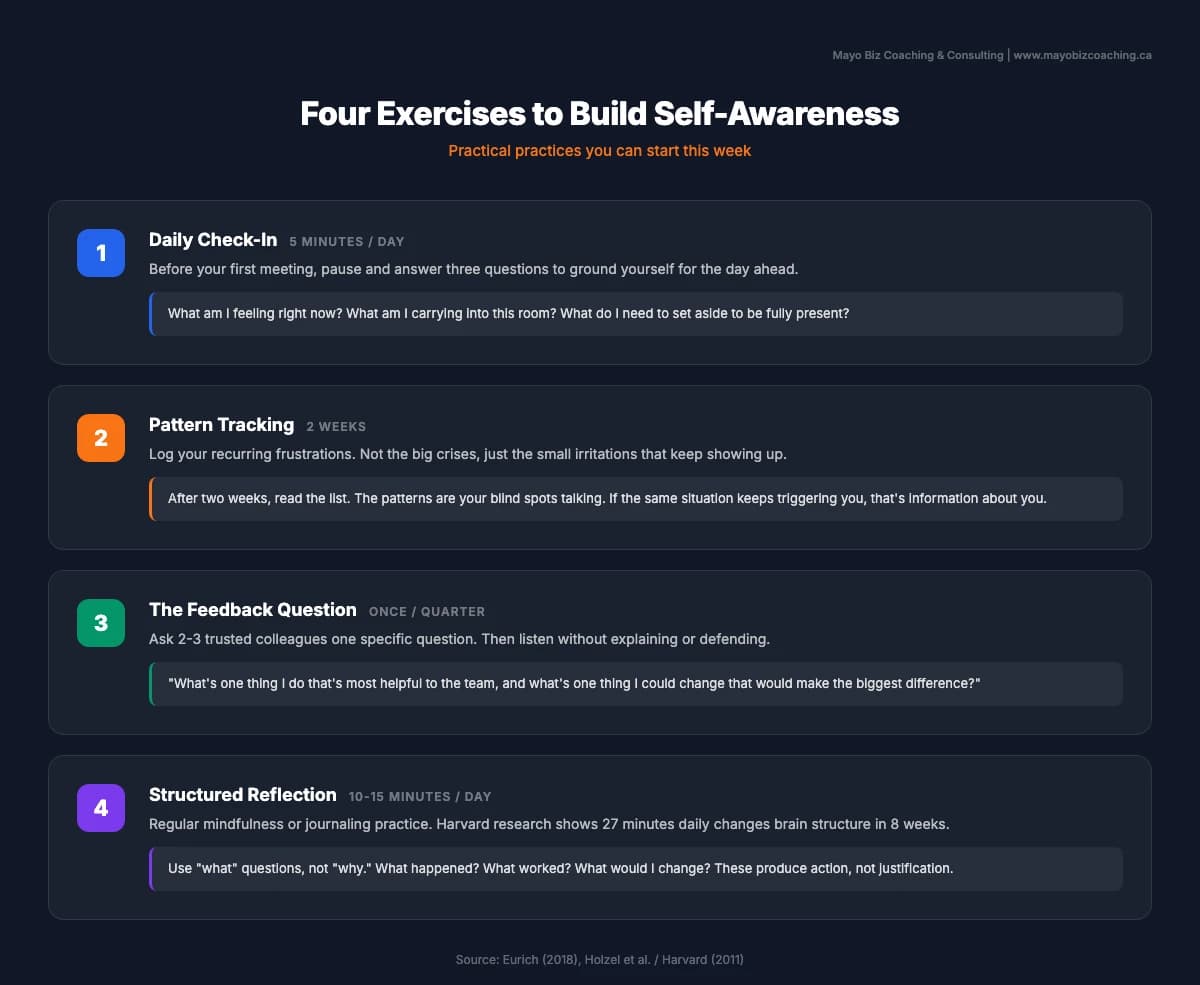
Self-awareness doesn't arrive as a flash of insight. It's a practice. Four exercises that I've seen work consistently.
Daily check-in (5 minutes)
Before your first meeting each day, pause and answer three questions. What am I feeling right now? What am I carrying into this room? What do I need to set aside to be fully present?
This sounds simple. It is. But most leaders haven't checked in with themselves before 4 p.m. By then, the emotional residue of every earlier conversation is colouring everything.
Pattern tracking (2 weeks)
Keep a brief log of your recurring frustrations. Not the big crises. The small irritations that keep showing up. After two weeks, read through the list. The patterns are your blind spots talking.
If the same type of situation keeps triggering you, that's information about you, not about the situation.
The feedback question
Ask two or three people you trust: "What's one thing I do that's most helpful to the team, and what's one thing I could change that would make the biggest difference?" Then listen. Don't explain, justify, or correct. Just take it in.
This is hard. Your brain will want to defend. Let it want to. Write down what you heard and sit with it for a day before deciding what to do.
Structured reflection
Harvard neuroscience research 4 shows that regular reflective practice physically changes the brain. Participants who averaged 27 minutes of daily mindfulness practice showed increased grey-matter density in regions linked to self-awareness and introspection after just eight weeks.
You don't need to meditate for hours. Even 10 to 15 minutes of quiet reflection or journaling builds the neural pathways that support self-awareness over time.
When self-awareness becomes overthinking
A fair question: can you have too much self-awareness?
Yes, if you confuse reflection with rumination. Research on the risks 5 is clear. Too much inward focus can lead to analysis paralysis, destructive self-criticism, and suppressed risk-taking. Leaders who overanalyze every decision slow down their organizations.
The distinction matters. Reflection asks "what can I change?" and moves toward action. Rumination asks "why does this keep happening to me?" and stays stuck. If your self-reflection produces a clear next step, it's working. If it produces anxiety and second-guessing, you've crossed the line.
Set a boundary. Give yourself 10 minutes to reflect on a situation. Write down one thing you'd do differently. Then move on. Self-awareness is a tool for better leadership, not an invitation to spiral.
The point isn't to become perfectly self-aware. It's to be aware enough to notice your patterns, check your assumptions, and adjust before your blind spots cost you talented people and good decisions. If delegation is one of the areas where your blind spots show up, that's a practical place to start.
Let's Build Brilliance Together
Self-awareness is a skill, and like any skill, it develops faster with someone holding up the mirror. A good coach asks the questions you wouldn't think to ask yourself and helps you see the patterns you've been too close to notice.
If you're starting to wonder what your team sees that you don't, reach out for a free consultation. No sales pitch, just an honest conversation about where you are and what you're working on.
Research Notes & Sources
If you want to go deeper, these are the studies and reports behind the key points in this post.
- What Self-Awareness Really Is (and How to Cultivate It)(hbr.org)
- Korn Ferry Institute Study Shows Link between Self-Awareness and Company Financial Performance(ir.kornferry.com)
- Managers Account for 70% of Variance in Employee Engagement(news.gallup.com)
- Eight weeks to a better brain — Harvard Gazette(news.harvard.edu)
- The Double-Edged Sword of Self-Awareness in Leadership(psychologytoday.com)
Category & Tags
Frequently Asked Questions
What percentage of leaders are actually self-aware?
Organizational psychologist Tasha Eurich studied nearly 5,000 participants and found that while most people believe they're self-aware, only 10 to 15% actually are. The gap widens with seniority: higher-level leaders overestimate their skills more than junior ones on 19 out of 20 competencies measured.
What is the difference between internal and external self-awareness?
Internal self-awareness is how clearly you understand your own values, reactions, strengths, and weaknesses. External self-awareness is how accurately you understand how others see you. Research shows virtually no relationship between the two. Being strong in one doesn't predict strength in the other.
How can leaders develop self-awareness?
Start with daily emotional check-ins before meetings and replace "why" questions with "what" questions during reflection. Other approaches: track recurring frustrations over two weeks to spot patterns, ask trusted colleagues for specific feedback, and build a regular mindfulness or journaling habit. Harvard research shows 27 minutes of daily mindfulness changes brain structure in self-awareness regions within eight weeks.
Can you have too much self-awareness?
Yes, when reflection turns into rumination. Productive self-awareness asks "what can I change?" and moves toward action. Rumination asks "why does this keep happening?" and doesn't move forward. Research shows leaders who overanalyze decisions become slower and less effective. The goal is bounded reflection that produces a clear next step, not open-ended spiralling.
About the Author

About the Author
Mark Mayo
Head Coach, MBC
We get up each morning excited about sharing our 20-plus years of business acumen with small business owners and their teams. Collaborating with hard-working owners to achieve their personal and business goals brings rewards. When we develop you and grow your leaders, we create the momentum that moves you and your business forward. It starts with a first step. Then we can build brilliance together.
Related Articles

Beyond IQ and EQ: Leadership Intelligences Nobody Taught You
IQ EQ XQ AQ leadership is not about choosing one quotient. Learn what each predicts, where each breaks down, and how small business leaders build all four.
Read Beyond IQ and EQ: Leadership Intelligences Nobody Taught You
Learning Agility: Why the Fastest Learners Lead Best
Learning agility predicts leadership success better than experience alone. Here is what it means for small business leaders and how to build it this month.
Read Learning Agility: Why the Fastest Learners Lead Best
Experience Intelligence: Why Your Best Leaders Design Experiences, Not Manage Outcomes
Experience intelligence is the leadership skill of designing how people feel at work. Learn why listening is the foundation and how to start this week.
Read Experience Intelligence: Why Your Best Leaders Design Experiences, Not Manage Outcomes