Executive Leadership & Career Coaching
Put First Things First: Protect Leadership Priorities From Urgency Creep
Your week probably does not fall apart all at once.
It usually happens in smaller ways. A meeting gets added because it feels urgent. A coaching conversation gets pushed because there is a client issue. The strategy work stays on the list, but it keeps moving lower. By Friday, you have worked hard, solved a dozen things, and still feel like you missed what mattered.
That is why leadership prioritization matters. Stephen Covey's habit of "put first things first" was never about squeezing more tasks into a day. It was about protecting important work from urgent work. For leaders, that means protecting the things that keep the team healthy and the business pointed in the right direction, even when the week gets loud.
Urgency creep is not a time problem first
Most leaders treat this like a calendar problem. It is usually a decision problem.
Urgency creep starts when everything that arrives gets treated like it deserves equal weight. It does not. Some work is noisy but replaceable. Some work is quiet and load-bearing.
Covey's framing is still useful here. FranklinCovey describes Habit 3 as protecting time for what is important, not just what is urgent. It also argues that the best return on our time often comes from work that is not yet urgent 1. That distinction matters more in leadership than it does in personal productivity.
Leaders are not just managing their own week. They are signalling to everyone else what matters. If your calendar says client panic, internal churn, and nonstop reactive meetings always win, your team will learn the lesson quickly. The stated priorities may still be on the wall, but the real ones are the ones that survive the week.
This is one reason I see so many capable leaders feel busy but misaligned. They are not avoiding important work because they do not care. They are losing it because nothing in the system protects it.
The cost of weak priorities shows up in people first
When priorities are unclear, people do not just get inefficient. They get tired.
Gallup and Workhuman found that employees who strongly agree they know what is expected of them at work are 47% less likely to experience frequent burnout 2. That is not a small lift. It tells us that clarity itself is protective.
Gallup has also reported that only about half of employees strongly agree they know what is expected of them at work. The same research says managers who help employees set work priorities and performance goals create more freedom for people to work with initiative and ownership. That is the heart of leadership prioritization 3. Clear priorities do not restrict good people. They steady them.
Here is what that means for your team this week. If your priorities are fuzzy, your people spend energy sorting signal from noise. They guess what matters. They hedge. They overwork low-value tasks because they do not trust what can safely wait. That is one reason burnout often feels like a workload problem when the deeper issue is priority confusion.
I hear this in coaching all the time. The leader says, "My team needs to be more proactive." Usually the team needs a better answer to one question first: what are we protecting this week no matter what?
Important work is quieter than urgent work
The hardest leadership work rarely screams.
It looks like:
- a one-on-one that would prevent a misunderstanding from growing
- an hour of strategic thinking before the quarter starts slipping
- a conversation that brings two competing priorities back into alignment
- a decision to say no to one more initiative that does not fit the current season
- a coaching conversation that develops someone instead of solving the problem for them
None of that feels as urgent as a red-flag email. But it is often more important.
McKinsey made this point years ago in a way I still find useful. When organizations keep adding initiatives without paying attention to time and role allocation, leaders get buried in tradeoffs that make them less effective. Their advice was blunt: treat leadership capacity with the same seriousness you would treat financial capital, and stop funding new work when the human capacity is gone. That is the practical point of "making time management the organization's priority" 4.
Here is what that means for a small business leader. Every yes has a cost. If you do not decide that cost on purpose, the week decides it for you.
The real leadership test is what survives the week
This is the question I would have you ask, and it is not complicated.
When the week gets pressured, what work still happens?
If coaching conversations always move, but internal reporting never does, that tells you something. If strategy time disappears but everyone still attends meetings that could have been an email, that tells you something too. If your own reflection time gets cut first every time, then you are teaching the business to live without leadership thinking.
That is why I do not love abstract conversations about priorities. I would rather inspect the calendar and the follow-through.
If the most important work is real, it should still show up when things get busy.
This is closely tied to the work in Begin With the End in Mind. When the team has a clear 90-day mission, weekly priorities get easier to defend. When the mission is vague, urgency fills the vacuum.
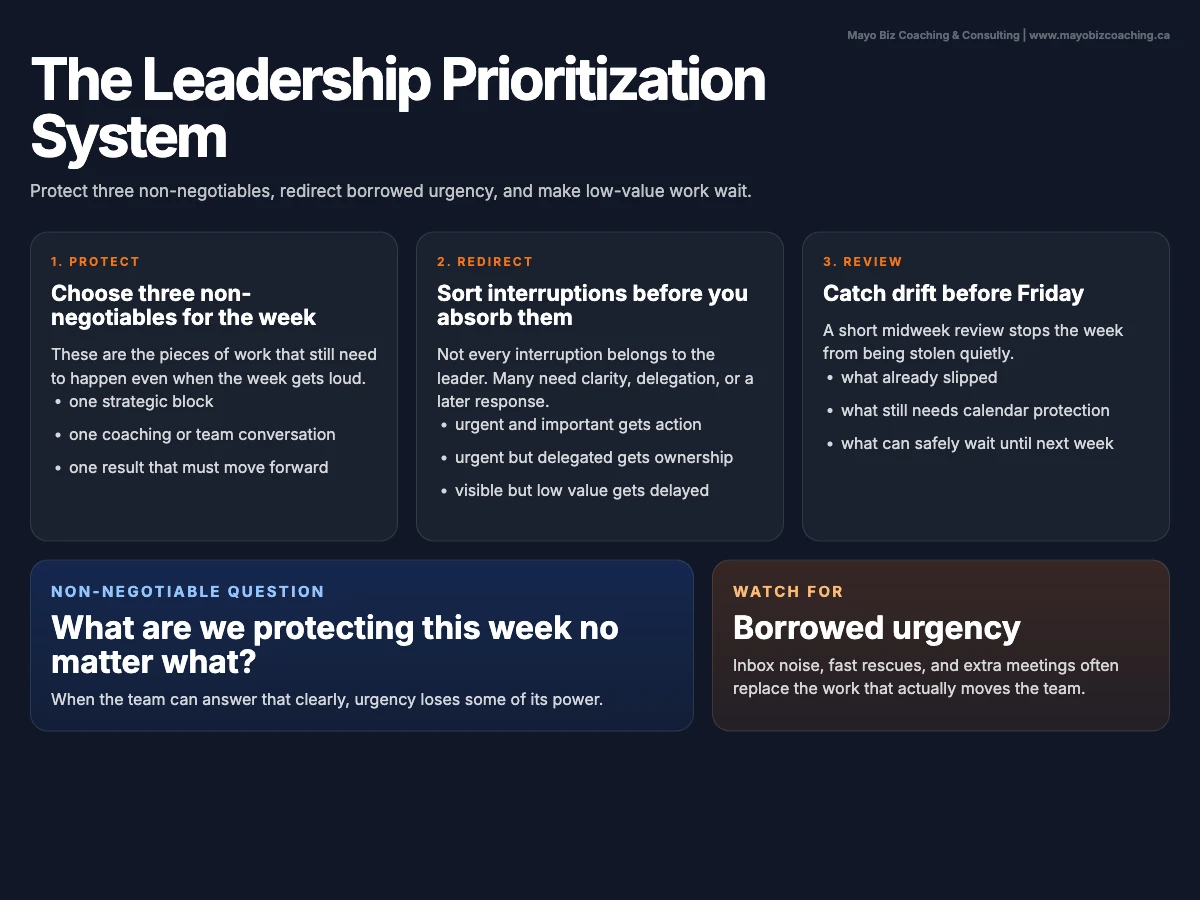
A simple weekly system to protect what matters
You do not need a more elaborate planner. You need a more honest weekly filter.
Here is the structure I recommend.
1. Name three non-negotiables for the week
Not ten. Three.
These are the things that matter even if the week gets messy. They can be strategic, relational, or operational, but they need to be specific enough that you will know by Friday whether you protected them.
Examples:
- finish the hiring decision
- hold all one-on-ones
- block ninety minutes for Q3 planning
If everything is a priority, nothing is protected. Three forces a choice.
2. Separate what is urgent from what is important
This sounds obvious until you try it in real time.
Ask:
- Does this need action now?
- Does this move a key priority, or is it just demanding attention?
- What happens if this waits 24 hours?
You will be surprised how many "urgent" things are really just visible things. Not all urgent work is unimportant. But a lot of it is unresolved noise that became your problem because nobody clarified ownership.
3. Decide who really owns the interruption
Many leaders lose priority work because they assume every interruption belongs to them.
Often it does not.
Sometimes the right move is to coach, not absorb. Sometimes it is to set a boundary. Sometimes it is to ask one more question before taking the work back. The post on The Manager-as-Coach Shift matters here because leaders often create urgency creep by rescuing too fast.
If the team brings every issue upward and you always take it, the calendar fills with borrowed urgency.
4. Put the important work on the calendar first
This is the Covey move people skip.
Most leaders put urgent items on the calendar and hope the important work fits around them. It rarely does.
If a one-on-one matters, book it first. If planning matters, protect the block first. If there is a difficult conversation you know you need to have, put it in the week before smaller tasks crowd it out.
The calendar is not just a logistics tool. It is a values document.
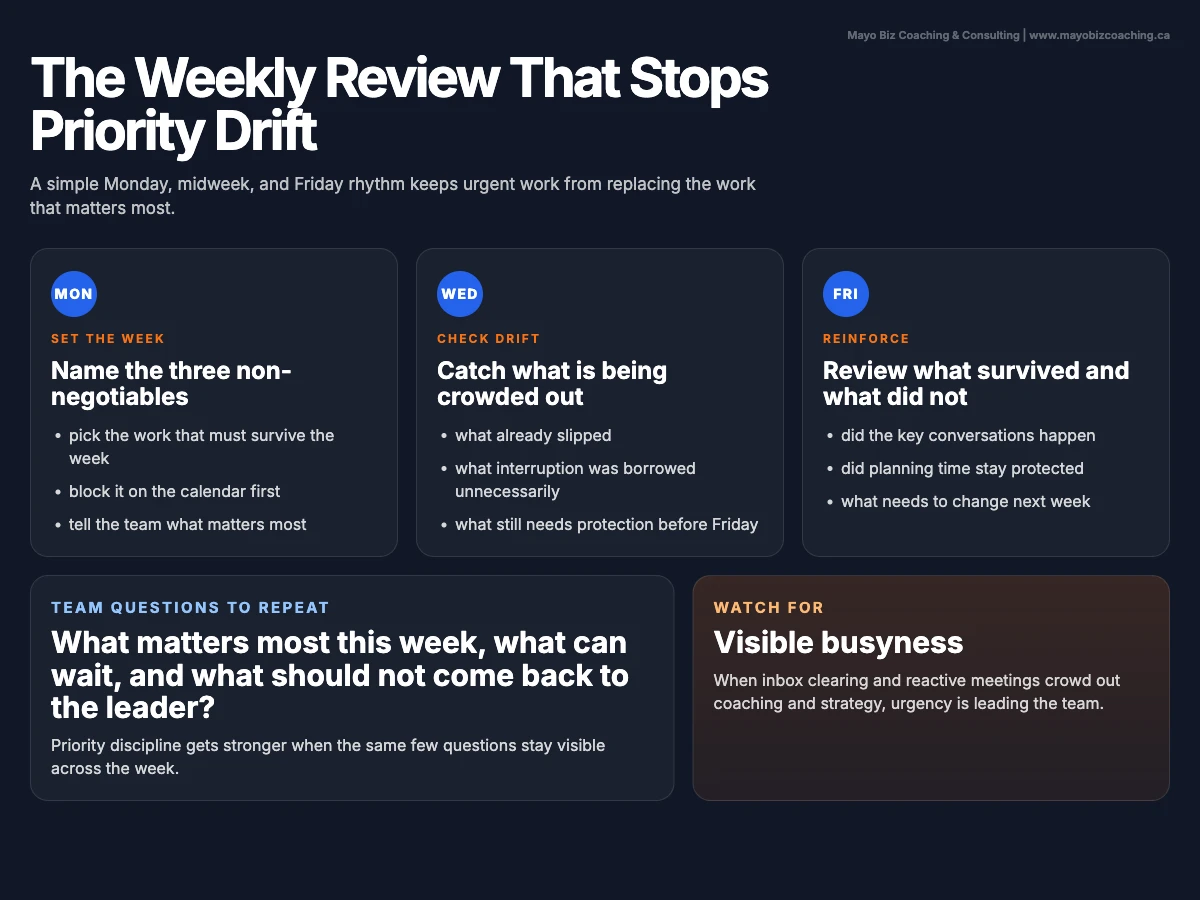
5. Review drift before Friday
Do not wait until the end of the week to discover the week got stolen.
Midweek, ask:
- What have I already let slide?
- What did I protect?
- What is at risk of being crowded out in the next two days?
That small review changes the trajectory. Without it, urgency creep wins quietly.
How this looks with a team, not just on your own calendar
Leadership prioritization is not only personal. It is social.
Your team needs to know:
- what matters most this week
- what can wait
- what to escalate immediately
- what they can decide without you
That means the priority conversation has to be visible.
This is where many leaders fall into mixed messaging. They tell the team to focus, then keep adding new asks midweek. They say people have ownership, then override decisions at the first sign of discomfort. They talk about strategic work, then model nonstop reaction.
Teams pay more attention to what interrupts you than to what inspires you.
If you want the team to put first things first, you have to show them what first actually means.
What to stop doing
There are a few habits that nearly always feed urgency creep.
Stop calling everything urgent
If every request arrives with the same emotional weight, your team will either panic or tune out. Neither helps.
Urgency should mean something. Use it carefully.
Stop adding work without subtracting work
When a new priority arrives, ask what leaves. If nothing leaves, you have not set a priority. You have increased load.
This is one of the clearest leadership disciplines I know. A real priority always displaces something else.
Stop protecting minor tasks and sacrificing major ones
This is more common than leaders realize. The inbox gets cleared. The report gets polished. The hard conversation gets moved. The planning block gets cut.
That is backwards. Protect the major work first and let the lower-value tasks flex around it.
Stop rewarding visible busyness
If the culture celebrates whoever looks the busiest, urgency creep becomes the operating system.
What you want to reward instead is clear judgement, focus, and follow-through on the work that matters most.
The point is not to do less work
This is not soft productivity advice.
Sometimes the right week is still a full week. Sometimes there is real pressure. Sometimes the quarter does need extra effort. The point is not to remove all urgency. The point is to keep urgency from becoming the only thing that leads.
That is why this connects directly to Finite Targets, Infinite Mindset. Short-term demands are real. But if they repeatedly erase the work that builds trust, clarity, and long-term direction, the cost shows up later in ways that are harder to repair.
Strong leaders do not protect priorities because they are rigid. They do it because they understand what the business starts losing when important work keeps moving to next week.
The real question
If I sat with you and looked at your calendar from the last two weeks, what would it tell me your actual priorities are?
Not the stated ones. The defended ones.
That is the real test.
Leadership prioritization is not about having a better list. It is about making sure the most important work still has a place when the week gets noisy. If it never survives contact with reality, it is not a priority yet.
Let's Build Brilliance Together
Priority drift is rarely a motivation problem. It is usually a leadership design problem. The good news is that it can be fixed once you can see where the week is really going.
If you are trying to protect strategic work without losing control of the day-to-day, reach out for a free consultation. No sales pitch, just an honest conversation about where you are and what you're working on.
Research Notes & Sources
If you want to go deeper, these are the studies and reports behind the key points in this post.
- Habit 3: Put First Things First (franklincovey.com)
- Employee Wellbeing Hinges on Management, Not Work Mode (gallup.com)
- Many Employees Don't Know What's Expected of Them at Work (news.gallup.com)
- Making time management the organization's priority (mckinsey.com)
Category & Tags
Frequently Asked Questions
What does put first things first mean for leaders?
It means protecting important work before urgent work crowds it out. For leaders, that usually means making space for strategic thinking, coaching conversations, team clarity, and decision quality before the week fills up with noise.
Why do leadership priorities drift so easily?
Because urgent work is visible and immediate, while important leadership work is quieter. If leaders do not schedule and defend what matters most, the calendar naturally fills with other people’s emergencies.
How do you stop urgency creep on a team?
Start by naming the few priorities that matter this week, then connect meetings, decisions, and delegated work back to them. Urgency creep slows down when people know what should win when everything feels important.
Is this just personal time management?
No. Personal productivity is part of it, but the bigger issue is leadership design. Your team reads your priorities from your calendar, your questions, and what you let interrupt the week.
About the Author

About the Author
Mark Mayo
Head Coach, MBC
We get up each morning excited about sharing our 20-plus years of business acumen with small business owners and their teams. Collaborating with hard-working owners to achieve their personal and business goals brings rewards. When we develop you and grow your leaders, we create the momentum that moves you and your business forward. It starts with a first step. Then we can build brilliance together.
Related Articles
Finite Targets, Infinite Mindset: Lead Without Panic
Infinite mindset leadership lets you hit quarterly targets without burning team trust. A weekly playbook for owners under real quarter-end pressure.
Read Finite Targets, Infinite Mindset: Lead Without Panic
Leading with Vision: How to Turn Direction Into Daily Decisions
Leading with vision means turning purpose into clear priorities and weekly decisions. Learn a practical cadence that aligns teams and improves follow-through.
Read Leading with Vision: How to Turn Direction Into Daily Decisions
How Leaders Build Trust: What Your Team Notices First
How leaders build trust is less about charisma and more about clear, consistent behaviour. Learn the daily actions that make teams speak up and stay.
Read How Leaders Build Trust: What Your Team Notices First