Team Leadership Development
Begin With the End in Mind: Build a 90-Day Team Mission

You can feel when a team has lost the end in mind.
People are busy. Calendars are full. Tasks are moving. But if you ask three people what the team is trying to accomplish this quarter, you get three different answers. One talks about revenue. One talks about shipping faster. One talks about surviving the workload.
That is not a motivation problem. It is a clarity problem.
This is where begin with the end in mind leadership becomes practical. Stephen Covey's point was never just personal planning. It was disciplined design. You decide where you are trying to arrive before the week starts making decisions for you. For a leader, that means giving the team a clear 90-day mission they can actually use.
I like the 90-day frame because it is long enough to matter and short enough to feel real. Annual vision is important, but most teams do not work in one-year increments. They work in weeks. A 90-day team mission translates the bigger purpose into something your people can carry into Monday.
Why Begin With the End in Mind Leadership Needs a 90-Day Mission
Teams rarely lose direction all at once. Drift shows up in smaller ways.
A meeting turns into status updates because nobody is sure what decision the meeting is meant to support. A manager asks for more urgency without defining what matters most. A team says yes to work that looks useful but does not move the quarter forward.
Gallup calls clear expectations the most basic employee need at work 1. On their Q12 measure, the statement "I know what is expected of me at work" predicts performance because people need role clarity before they can offer judgment, initiative, or commitment. If the end state is vague, people fill the gap with personal assumptions, and alignment disappears fast.
That is why mission clarity matters more in busy seasons, not less. Under pressure, people do not rise to the annual strategy deck. They default to whatever seems most urgent in the moment.
The practical takeaway is simple. If you want better weekly decisions, start with a clearer 90-day destination.
What Covey's Habit Means for a Team, Not Just a Person
FranklinCovey describes Habit 2, begin with the end in mind, as starting with a clear understanding of your destination 2. For leaders, that destination cannot stay private. It has to become shared language.
This is where many teams get stuck. The leader has a picture in their head of what a good quarter looks like, but the team has not heard that picture in plain language. So people receive tasks without context. They know what they are doing today, but not what those actions are building toward.
I see this a lot in coaching. The leader thinks they have already communicated the direction because they mentioned it at an offsite or put it in a slide deck. The team remembers parts of it, but not enough to use it when priorities collide.
A 90-day team mission solves a narrower problem than a company mission statement. It is not trying to explain the whole business. It is trying to answer one near-term leadership question: what are we here to make true over the next 90 days, for whom, and what will tell us we are on track? If your team is still working from a broad purpose statement, the post on Start With Why for Teams is the right companion to this one.
That narrower scope is what makes it usable.
What a Strong 90-Day Team Mission Includes
A strong 90-day mission is not a slogan and it is not a list of projects.
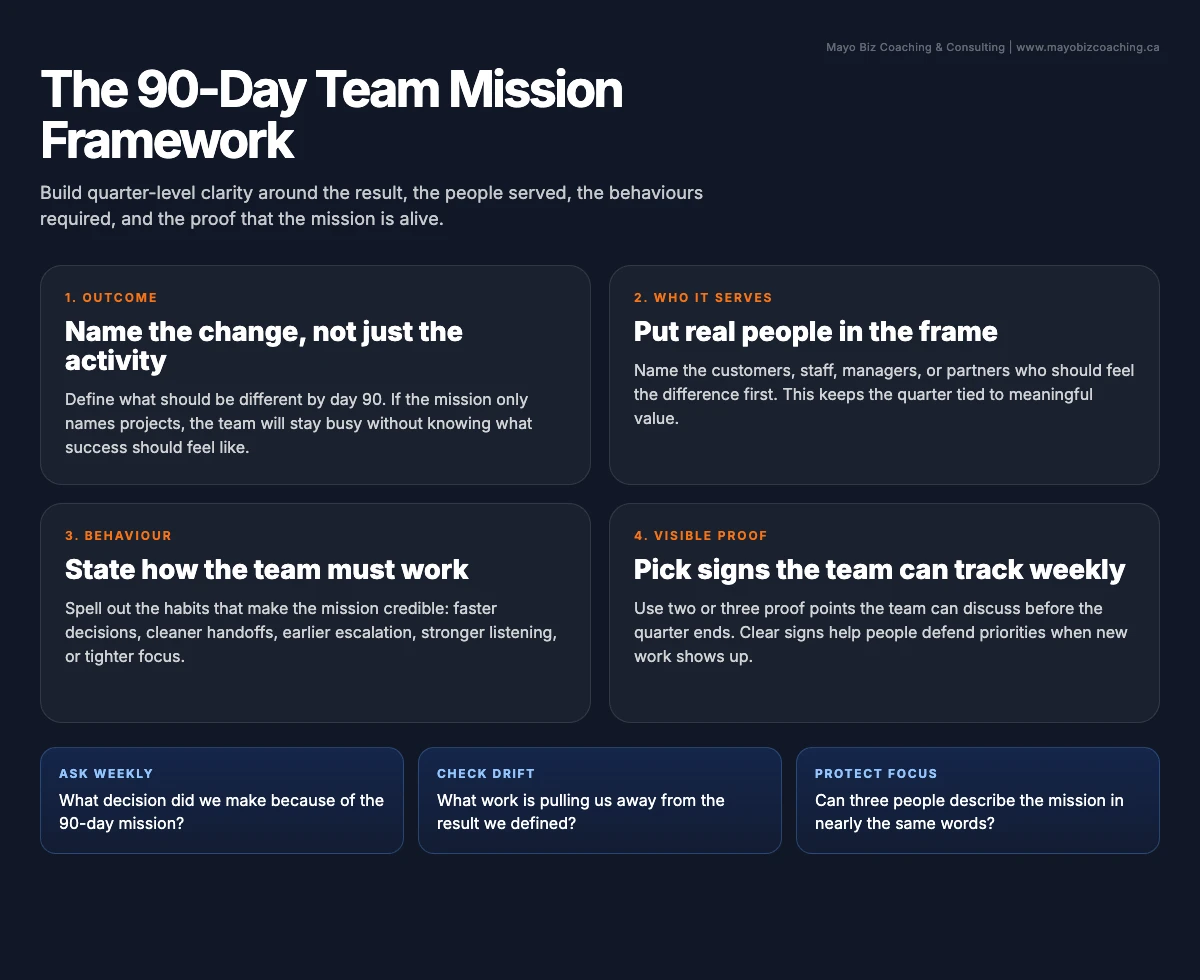
It needs four parts.
1. A clear outcome
Name the change you are trying to create by the end of the 90 days. Not the activity. The change.
"Improve client onboarding" is too loose. "Reduce first-30-day client confusion so new clients know exactly what happens next" is much better.
2. A defined group you serve
Someone should benefit from the work in a way the team can picture. Customers, new hires, branch managers, account teams, patients, members. Pick the real humans involved.
When the beneficiary stays vague, the work gets abstract fast.
3. A few non-negotiable behaviours
This is the part leaders skip. They define the result but not the way the team needs to work to reach it.
If success requires faster decisions, cleaner handoffs, and more honest escalation, say that. If the team must protect trust while moving faster, say that too. The mission should shape behaviour, not just output.
4. Visible proof
How will you know the mission is alive before the quarter ends? You need two or three visible signs. Not a long dashboard. Just enough proof that the team can tell whether progress is real.
That might mean response times are down, rework is lower, customer handoffs are smoother, or weekly planning meetings are staying inside the agreed priorities.
The mission is working when a team member can point to a decision and say, "We did it this way because of the 90-day mission."
The Direction-Alignment-Commitment Test
The Center for Creative Leadership uses a useful three-part lens for leadership: direction, alignment, and commitment 3.
That framework is practical because it reveals where a mission is failing.
Direction means people understand where the team is headed.
Alignment means work, decisions, and resources are organized in support of that direction.
Commitment means people choose to give energy to it, not just comply with it.
If your team has direction without alignment, you get inspiring language and scattered execution. If it has alignment without commitment, you get movement without ownership. If it has commitment without direction, you get a hardworking team burning energy in different directions.
A good 90-day mission should support all three. It should tell people where the team is headed, help them make tradeoffs, and give them a reason to care.
That last part matters. Gallup's 2025 research found that employees with a strong sense of purpose are much more likely to be engaged 4. The point for leaders is not to make work feel sentimental. It is to make the work feel connected. People commit more deeply when they can see why the quarter matters and who benefits when the team gets it right.
A Simple Template You Can Build This Week
If you need a starting point, use this structure:
Over the next 90 days, our team exists to [create what result] for [who we serve] by [how we will work], so that [meaningful payoff]. We will know it is working when [proof point one], [proof point two], and [proof point three].
Here is what that sounds like in plain language:
"Over the next 90 days, our leadership team exists to make weekly priorities clearer for branch managers so they can spend less time guessing and more time coaching their people. We will do that by making decisions faster, escalating blockers earlier, and sticking to the same three priorities each week. We will know it is working when branch managers can name the priorities without prompting, end-of-week surprises drop, and one-on-ones focus more on support than confusion."
That is not poetic. Good. It should be usable.
How to Build the Mission With Your Team
Do not disappear for two hours and come back with a finished sentence.
If you want commitment, involve the team in shaping the mission. You do not need a long retreat. You need one focused conversation.
Step 1: Name the quarter honestly
Start with plain truth. What must be true by the end of the next 90 days? What pressure is real? What matters if you get it right?
This is not the time for polished language. It is the time for accuracy.
Step 2: Ask who needs to feel the difference
Who should experience the benefit first if the team does this well? Customers? Staff? Direct reports? A partner team? Name the real people involved.
That question changes the conversation. It shifts the team from internal activity to meaningful value.
Step 3: Decide the behaviours that make the mission believable
Ask: if we really meant this mission, how would we need to behave differently each week?
You are looking for practical shifts, not values posters. Fewer last-minute escalations. Tighter handoffs. Better listening in one-on-ones. Faster decisions on stuck work.
Step 4: Pick proof points before the quarter starts
Do not wait until day 75 to define success. Pick two or three signals now. Keep them visible and easy to discuss.
Step 5: Repeat it until the team can use it
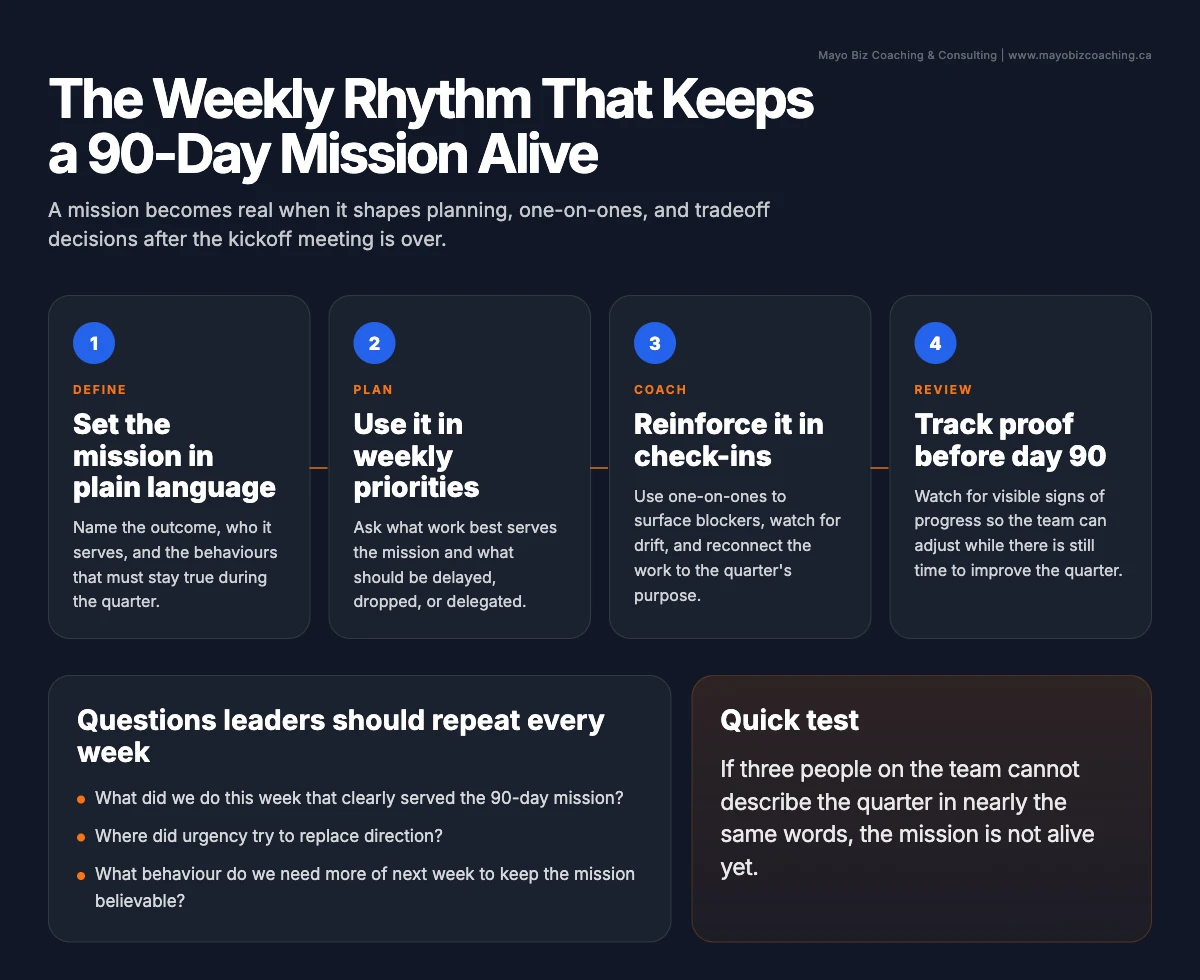
This is the part most leaders underdo. A mission does not become real when you announce it. It becomes real when it shows up in weekly planning, check-ins, and tradeoff conversations.
Ask in meetings: what option best serves our 90-day mission? What are we doing that does not? If the mission never enters a decision, it is still just a sentence. If your team struggles to hold that line once the quarter gets noisy, the follow-through habits in The Accountability Conversation help.
Common Mistakes That Make the Mission Useless
I watch leaders make the same three mistakes here.
Making it too broad
If the mission could apply to the next three years, it is too wide for a 90-day tool.
Making it too private
If only the senior team can explain it, the mission is not shared enough to guide execution.
Making it all outcome and no behaviour
Teams need to know what to achieve and how to work while getting there. Otherwise people hit the number while damaging trust, or protect harmony while missing the result.
The best 90-day missions hold both. They create clearer execution without forcing people into control-heavy behaviour that weakens trust. If that balance feels hard in your team right now, how leaders build trust connects directly to this work.
The Real Test of Mission Clarity
Here is the simplest test I know.
Ask three people on the team, separately, to finish this sentence: "Over the next 90 days, our team is here to..."
If you hear three versions of the same answer in plain language, the mission is probably alive.
If you hear task lists, department goals, or vague words like "support growth," the team still does not have the end in mind.
That is fixable. Most teams do not need a more inspiring leader here. They need a clearer quarter.
Begin with the end in mind leadership is not about sounding visionary. It is about creating a destination that helps real people decide what to do on a busy Tuesday.
Let's Build Brilliance Together
A clear 90-day team mission gives people something they can use when work gets noisy and priorities compete. If your team is busy but not aligned, reach out for a free consultation. No sales pitch, just an honest conversation about where you are and what you are working on.
Research Notes & Sources
If you want to go deeper, these are the studies and reports behind the key points in this post.
- Q12 Question Summary: I know what is expected of me at work (gallup.com)
- Habit 2: Begin With the End in Mind (franklincovey.com)
- How Leadership Works (ccl.org)
- Purposeful Work Boosts Engagement, but Few Experience It (news.gallup.com)
Category & Tags
Frequently Asked Questions
What does begin with the end in mind mean in leadership?
It means deciding what result, behaviour, and team experience you want to create before the quarter gets noisy. Then you lead backward from that destination instead of reacting week to week.
What is a 90-day team mission?
A 90-day team mission is a short statement that defines what your team must achieve, who it serves, and how success should feel by the end of the next quarter. It turns broad purpose into a usable operating direction.
How long should a team mission be?
Short enough that a manager can repeat it from memory and a team can use it in a weekly priority conversation. In practice, one clear sentence plus three proof points is usually enough.
Why does mission clarity matter for team performance?
Teams do better when people know what matters, what good work looks like, and why their effort counts. Clear direction reduces drift, supports accountability, and makes priorities easier to defend under pressure.
About the Author

About the Author
Mark Mayo
Head Coach, MBC
We get up each morning excited about sharing our 20-plus years of business acumen with small business owners and their teams. Collaborating with hard-working owners to achieve their personal and business goals brings rewards. When we develop you and grow your leaders, we create the momentum that moves you and your business forward. It starts with a first step. Then we can build brilliance together.
Related Articles

Just Cause in Real Teams: A Practical Test for Mission Clarity
Test whether your team has a real just cause or just a mission statement. A five-question diagnostic any leader can run this week to close the gap.
Read Just Cause in Real Teams: A Practical Test for Mission Clarity
Start With Why for Teams: Turn Purpose Into Weekly Decisions
Most teams have a purpose statement but no way to use it. Learn a three-question weekly filter that turns your team why into real decisions.
Read Start With Why for Teams: Turn Purpose Into Weekly Decisions
Synergy Without Meeting Overload: Design Collaboration That Produces Better Ideas
Team collaboration design helps leaders get better ideas without adding meetings. Use this model to protect focus, useful input, and clear decisions.
Read Synergy Without Meeting Overload: Design Collaboration That Produces Better Ideas