Executive Leadership & Career Coaching
Learning Agility: Why the Fastest Learners Lead Best
You've been leading for years. You've solved problems nobody else wanted to touch, built a team you trust, and figured things out through trial and error. But lately the approaches that got you here aren't working as well.
Your industry is shifting. Customer expectations are different. The problems landing on your desk look nothing like they did two years ago. And your experience, as valuable as it is, keeps pulling you toward solutions that fit the old version of your business.
This is not a talent problem. It's a learning agility problem.
What Learning Agility Actually Is
Michael Lombardo and Robert Eichinger spent their careers studying why leaders succeed or derail. They defined learning agility as "the willingness and ability to learn from experience and subsequently apply that learning to perform successfully under new or first-time conditions" (Lombardo & Eichinger, 2000 1).
Notice what that definition doesn't include. It doesn't say "the person who knows the most." It says the person who learns fastest from what happens and applies it to what's next.
That distinction matters for small business leaders because your context changes constantly. You might handle a hiring challenge on Monday, a supply chain issue on Wednesday, and a client retention conversation on Friday. Each one demands a different kind of thinking. The leaders who grow fastest aren't the ones with the longest resumes. They're the ones who treat every unfamiliar situation as data.
I see this in coaching all the time. Two business owners with nearly identical experience can respond to the same market shift in completely different ways. One reaches for last year's playbook. The other pauses, asks what's different this time, and adapts. The difference is not intelligence or work ethic. It's learning agility.
Why This Predicts Success Better Than Experience
Kenneth De Meuse, one of the most published researchers on this topic, ran a meta-analysis across 20 field studies 2 and found that learning agility correlates with leader performance at 0.74 and with leader potential at 0.75. In research terms, anything above 0.50 is considered strong. These numbers are exceptional.
In plain terms: if you could measure one quality to predict which leaders will succeed over the next decade, learning agility is the strongest predictor researchers have found. Stronger than IQ. Stronger than years of experience.
Korn Ferry added a business case in 2014. Their research found that companies with the highest rates of learning-agile executives produced 25% higher profit margins 3 compared with peer companies. Individuals with high learning agility were promoted twice as fast over a ten-year period.
Here's what those numbers mean if you run a company of 15 or 50 people. The leader who keeps learning is the leader whose business keeps adapting. And the business that keeps adapting is the one still standing when the market shifts again.
Four Behaviours You Can Build
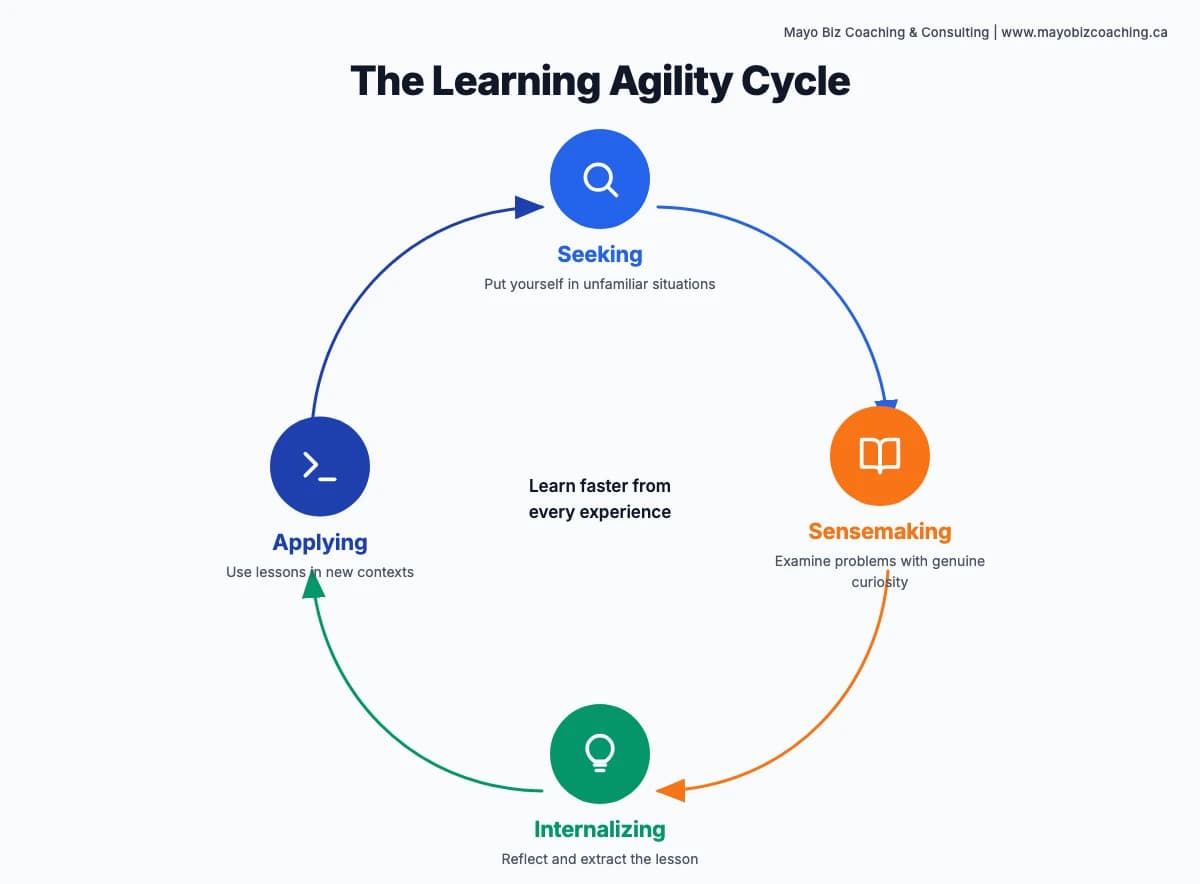
Learning agility is not a personality trait you're born with. George Hallenbeck at the Center for Creative Leadership distilled years of research into four practical behaviours 4. These are habits, not gifts. The goal isn't constant novelty for its own sake. It's knowing when your current approach fits and when the situation demands something different.
Seeking
Intentionally putting yourself in unfamiliar situations. This is the hardest one for experienced leaders because you've earned the right to stay comfortable. But comfort is where learning stops.
For a small business owner, seeking looks like volunteering to solve a problem outside your expertise. Sitting in on a function you don't manage. Hiring someone who thinks differently from everyone on your current team.
I worked with a manufacturing owner in Ontario who had built a solid business over 12 years. Revenue was steady, team was loyal, but growth had flatlined for three years running. When we looked at why, the pattern was clear. Every decision ran through the same filter: "What did we do last time?"
The owner wasn't lacking intelligence or effort. The owner had stopped seeking new inputs. We started with one step: spending two days with a peer in a completely different industry, observing how they handled customer discovery. That single experience changed how the owner thought about their own sales process. Within three months, they'd redesigned their quoting workflow using principles they'd never encountered in their own sector.
Sensemaking
Examining problems with genuine curiosity instead of jumping to the first answer. Most leaders I coach have a strong bias toward action. That's usually a strength. But when you're facing something genuinely new, pausing to ask "what's really happening here?" beats speed every time.
Sensemaking means resisting the urge to pattern-match every problem to something you've solved before. Sometimes the thing that looks like a performance issue is actually a role design issue. Sometimes the thing that looks like a marketing problem is actually a positioning problem. Curiosity before conclusions.
Internalizing
Processing what you've learned through reflection and feedback. This is where most busy leaders lose the thread. You have the experience. You just never stop long enough to extract the lesson.
A simple practice: at the end of each week, write down one thing that surprised you and one thing you'd do differently. Two sentences. That's it. The discipline of writing forces clarity that thinking alone doesn't produce.
Applying
Taking what you've learned and using it in a new situation. Reflection without application is just journaling. Application without reflection is just repeating patterns. The value is in the cycle: seek, make sense, internalize, apply.
When you run this cycle deliberately, you learn faster from every situation you encounter. And when you coach your team rather than direct them, you build learning agility across the whole group. Every stretch assignment you delegate is a chance for someone else to practise these four behaviours themselves.
The Intelligence Stack Connection
We explored the full intelligence stack in our post on the leadership intelligences beyond IQ and EQ. IQ, EQ, XQ, AQ: each one matters. But learning agility is what turns those intelligences into growth.
You can have strong analytical ability, solid emotional intelligence, deep experience, and high adaptability. Without the habit of learning from new situations and applying those lessons forward, those strengths plateau. Learning agility keeps the rest growing.
The World Economic Forum's 2025 Future of Jobs Report 5 projects that 39% of key skills will change by 2030. It ranks resilience, flexibility, and agility as the second most sought-after skill globally. The skills your team needs today are different from two years ago, and they'll be different again in two years. The leader who models continuous learning gives their team permission to do the same.
Build Your Learning Agility This Month
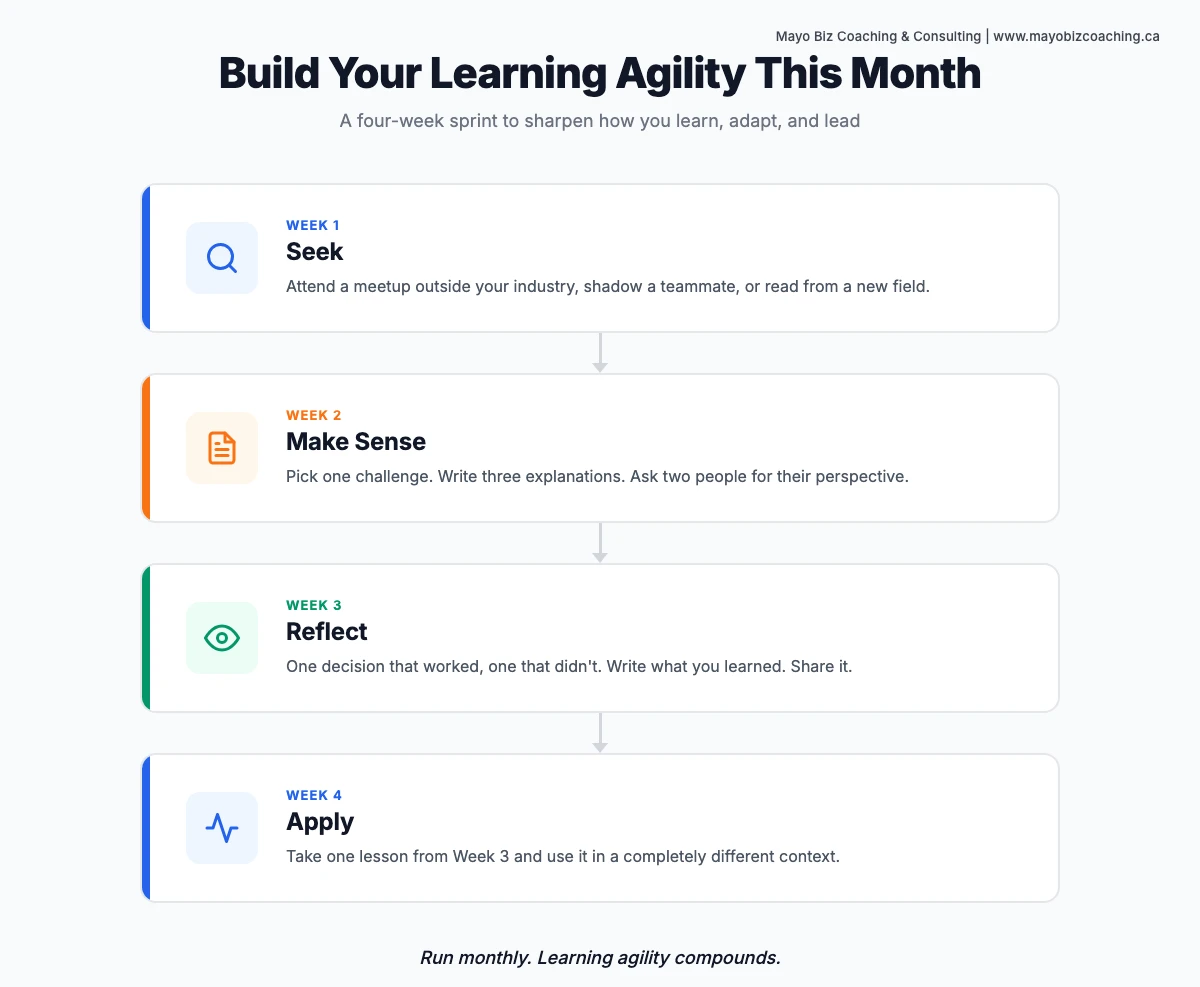
You don't need a formal assessment or a corporate programme. Here's a four-week plan that works at any level.
Week 1: Seek one unfamiliar experience. Attend a meetup outside your industry. Shadow a team member in a role you don't understand well. Read a book from a completely different field. The goal is exposure to a way of thinking you haven't encountered before.
Week 2: Practise sensemaking on one current problem. Pick a challenge you're facing and resist your first instinct. Write down three different explanations for what's causing it. Ask two people with different perspectives for their read. The goal is slowing down your pattern recognition long enough to see something new.
Week 3: Run a reflection exercise. Look back at the last quarter. Identify one decision that went well and one that didn't. For each, write down what you learned and one specific behaviour you'd change. Share it with someone you trust: a peer, a mentor, a coach. The goal is making reflection a habit, not an afterthought.
Week 4: Apply one lesson to a new context. Take a lesson from week 3 and use it in a different situation. If you learned something about communication from a client interaction, apply it in a team meeting. If you learned something about prioritization from a project, apply it to your own calendar. The goal is proving to yourself that lessons transfer.
This mirrors the cycle Hallenbeck describes: seek, make sense, internalize, apply. When you run it monthly, your learning agility compounds.
If you're in the first 90 days of a new leadership role, this cycle matters even more. New roles demand maximum learning agility because everything is unfamiliar at once.
The Coaching Connection
Coaching accelerates learning agility because it builds the reflection and feedback loops that most busy leaders skip on their own. When someone asks you the right questions after a challenging week, you extract three times the learning from the same experience.
Researchers like Veronica Schmidt Harvey have described learning agility as a "metacompetency" 6: a skill that makes you better at building other skills. When you build learning agility, every new experience teaches you faster than the last. That's why I put it at the top of the list.
Let's Build Brilliance Together
The strongest leaders I work with aren't the smartest person in the room every day. They're the most deliberate about learning from what they don't already know. That's learning agility, and it responds to practice just like any other skill.
If you're noticing that your usual approaches aren't producing the results they used to, reach out for a free consultation. No sales pitch, just an honest conversation about where you are and what needs to change.
Research Notes & Sources
If you want to go deeper, these are the studies and reports behind the key points in this post.
- Lombardo & Eichinger, 2000(onlinelibrary.wiley.com)
- A Meta-Analysis of the Relationship between Learning Agility and Leader Success | Journal of Organizational Psychology(articlegateway.com)
- Korn Ferry Study Finds Companies with Highly Agile Executives Have 25 Percent Higher Profit Margins(ir.kornferry.com)
- Tips for Improving Your Learning Agility(ccl.org)
- The Future of Jobs Report 2025(weforum.org)
- "metacompetency"(researchgate.net)
Category & Tags
Frequently Asked Questions
What is learning agility in leadership?
Learning agility is the willingness and ability to learn from experience and apply those lessons in new situations. Michael Lombardo and Robert Eichinger coined the term in 2000. Research shows it predicts leadership success more strongly than IQ or years of experience.
Can learning agility be developed?
Yes. Research consistently shows learning agility is a set of behaviours, not a fixed trait. The four key habits are seeking new experiences, making sense of them, internalizing lessons through reflection, and applying those lessons in unfamiliar contexts.
Why does learning agility matter for small business owners?
Small business leaders face constant context-switching across strategy, operations, people management, and sales. Learning agility helps you adapt to each situation quickly instead of defaulting to approaches that worked in the past but may not fit today.
How is learning agility different from experience?
Experience is what happens to you. Learning agility is how effectively you extract lessons from that experience and apply them in new situations. Two leaders can have identical experience but very different learning agility based on how deliberately they reflect and adapt.
About the Author

About the Author
Mark Mayo
Head Coach, MBC
We get up each morning excited about sharing our 20-plus years of business acumen with small business owners and their teams. Collaborating with hard-working owners to achieve their personal and business goals brings rewards. When we develop you and grow your leaders, we create the momentum that moves you and your business forward. It starts with a first step. Then we can build brilliance together.
Related Articles
Beyond IQ and EQ: Leadership Intelligences Nobody Taught You
IQ EQ XQ AQ leadership is not about choosing one quotient. Learn what each predicts, where each breaks down, and how small business leaders build all four.
Read Beyond IQ and EQ: Leadership Intelligences Nobody Taught You
Experience Intelligence: Why Your Best Leaders Design Experiences, Not Manage Outcomes
Experience intelligence is the leadership skill of designing how people feel at work. Learn why listening is the foundation and how to start this week.
Read Experience Intelligence: Why Your Best Leaders Design Experiences, Not Manage Outcomes
Decision Paralysis: Why Leaders Freeze and How to Start Moving Again
Fast decisions are nearly 2x more likely to be good ones. Five practical frameworks help leaders break decision paralysis and lead with clarity.
Read Decision Paralysis: Why Leaders Freeze and How to Start Moving Again