Executive Leadership & Career Coaching
Leading Without Certainty: Why Grounded Beats Confident
You're in a meeting. Someone asks a question you don't have an answer for. Your stomach tightens. You say something confident anyway, because that's what leaders do.
Most business owners I work with carry this weight. They believe the team needs them to be certain. Decisive. Unshakeable. And most of the time, they're performing a confidence they don't actually feel. There's a better foundation than certainty. Brené Brown calls it grounded confidence, and it changes how you lead.
That performance has a cost. It's higher than you think.
The cost of faking it
Your team probably knows.
Only 21% of employees strongly trust their organization's leadership, according to Gallup's 2024 workplace data 1. That number has been trending down since 2019. It's not that leaders are less competent. It's that people can tell when you're performing certainty you don't feel.
The specific behaviours that erode trust are telling. When leaders conceal information, trust drops by 20% 2. Blame-shifting cuts it by 30%. Flip-flopping on decisions lands somewhere in between. People can forgive not knowing. They struggle with pretending.
Here's the encouraging part: leaders who explain the reasoning behind their decisions are 4.3 times more likely to be trusted. Leaders who show genuine concern for what employees are actually dealing with? 6.5 times more likely. What builds trust isn't certainty. It's honesty.
What grounded confidence actually is
In her 2025 book Strong Ground 3, Brené Brown draws a distinction that matters for anyone leading a team. She defines grounded confidence with a specific formula:
Grounded confidence = curiosity + willingness to sit with discomfort + practice.
Not personality. Not charisma. Just three things you can work on starting today.
The book's central metaphor comes from a physical injury. Brown hurt herself playing pickleball, and her trainer told her she "didn't have a core" and was compensating with weaker muscle groups. The trainer called it a compensatory injury. The principle that emerged: we will not build on dysfunction.
Applied to your business: when you push change onto a team that's emotionally disconnected or distrusting, you're building on dysfunction. The ground has to come first. Strategy built on a team that doesn't trust each other isn't strategy. It's wishful thinking.
Brown borrows a concept from the Buddhist teacher Joan Halifax: "strong back, soft front, wild heart." Real strength comes from openness, not armour. Too many leaders walk around with a defended front and a weak spine, projecting toughness to mask insecurity. Grounded confidence flips that. Solid core. Open front. Willing to be seen.
You don't need to have all the answers to lead well. You need the willingness to stay present when you don't.
What the difference sounds like
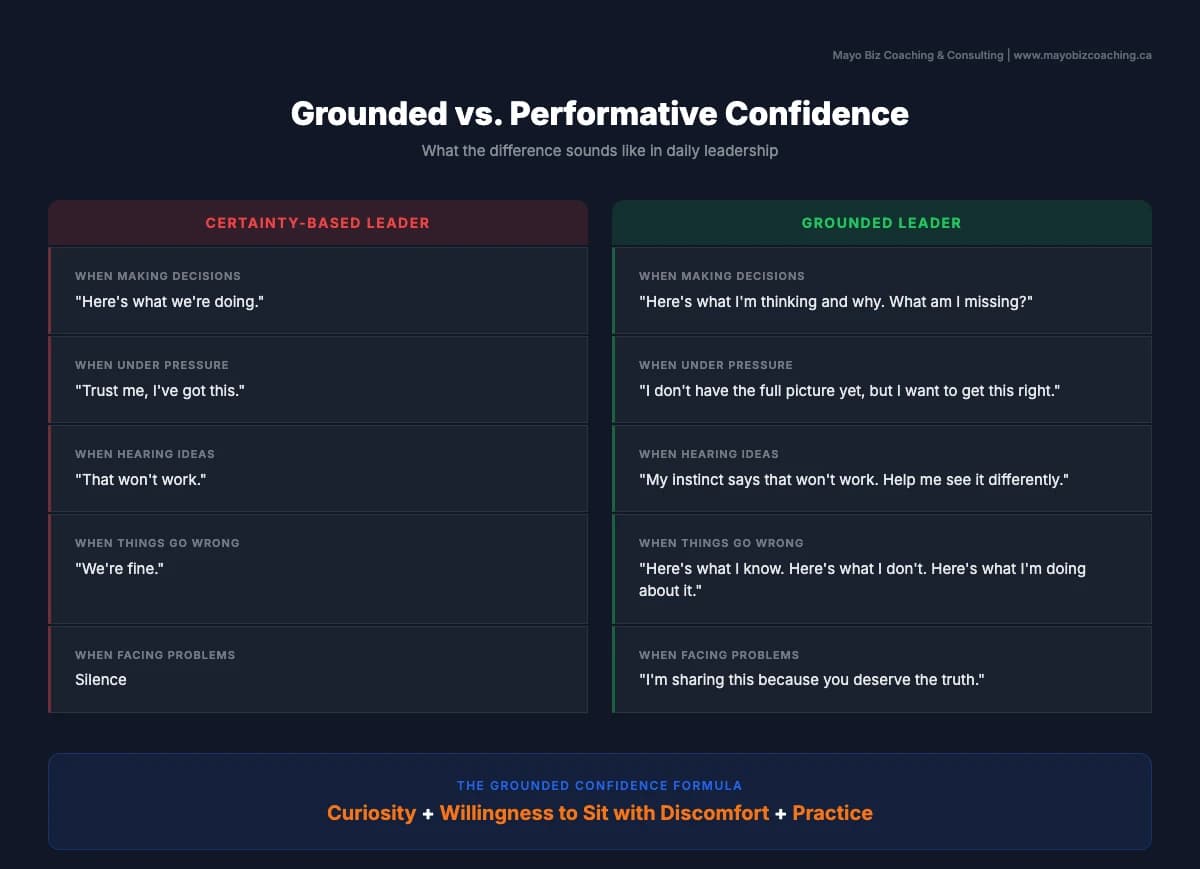
The gap between performative and grounded confidence shows up in everyday conversations. Here's what it sounds like in practice:
| Certainty-based leader | Grounded leader |
|---|---|
| "Here's what we're doing." | "Here's what I'm thinking and why. What am I missing?" |
| "Trust me, I've got this." | "I don't have the full picture yet, but I want to get this right." |
| "That won't work." | "My instinct says that won't work. Help me see it differently." |
| "We're fine." | "Here's what I know. Here's what I don't know yet. Here's what I'm doing about it." |
| Silence about problems | "I'm sharing this because you deserve the truth." |
The grounded leader doesn't have less confidence. They have more honesty. They name what they know, what they don't, and what they're doing about the gap. That four-part approach (what I know, what I don't, what I'm doing, what I need from you) is something I explored in leading through economic uncertainty. It works just as well on a calm Tuesday as it does during a crisis.
The pattern is simple: name what you know, name what you don't, and invite your team into the gap.
Why owners default to certainty
This is where it gets personal for business owners.
When you're both the owner and the leader, you carry a double burden. The business has to survive (that's the owner's job) and the people have to develop (that's the leader's job). Those pressures push in opposite directions. Survival pressure makes you close up. Development requires you to open up.
There's also no buffer. In a large company, a VP can be uncertain and lean on their executive team for support. In a 15-person business, you're often the only person who sees the full picture. That isolation feeds the certainty trap. With fewer people to confide in, you default to projecting confidence because the alternative feels risky.
If you've been working through the shift from operator to leader, you've already felt this tension. The operator identity ("I built this, I know how everything works") is one of the strongest drivers of certainty-based leadership. Letting go of that identity is uncomfortable. But it's where grounded leadership begins. If you notice yourself reaching for certainty when you feel exposed, that's the signal to pause instead.
Three tools you can use this week
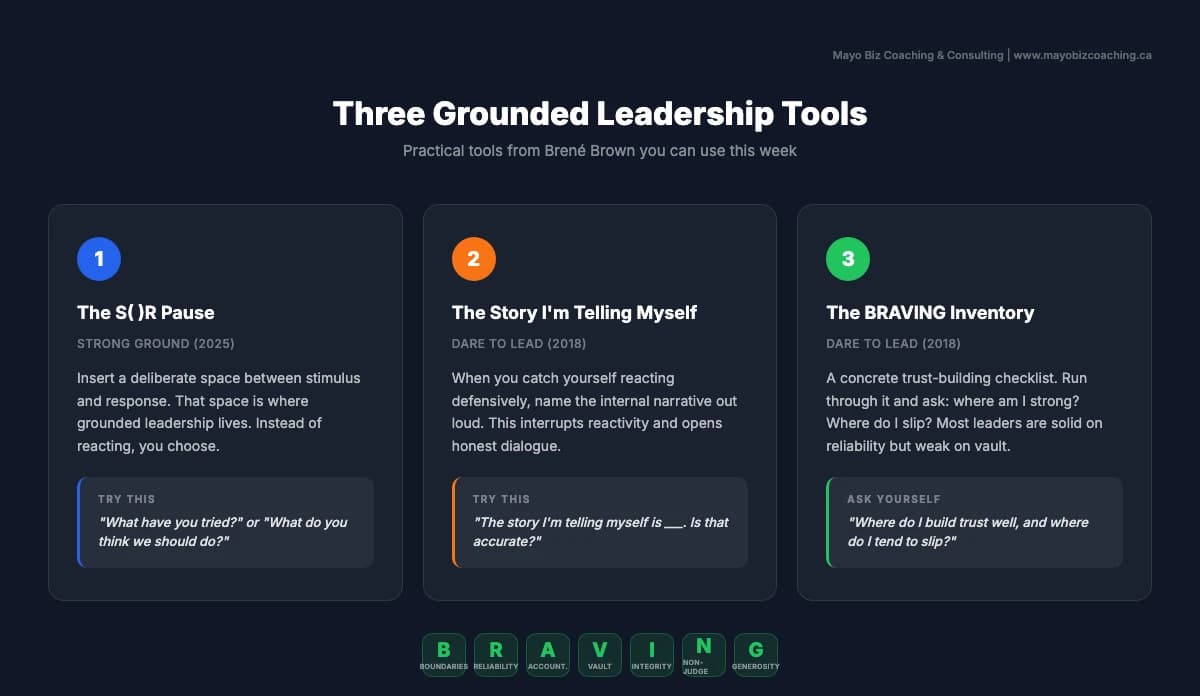
Brown's work is full of frameworks. Here are three that translate directly into daily leadership.
1. The pause between stimulus and response
Brown calls this the S( )R formula. Something happens (stimulus), and before you react (response), you insert a deliberate space. That space is where grounded leadership lives.
In practice: someone brings you a problem. Instead of solving it immediately, you pause. You ask, "What have you tried?" or "What do you think we should do?" That pause communicates two things: I trust you to think about this, and your thinking matters here.
This connects directly to active listening. The pause is where listening begins. Without it, you're just waiting for your turn to solve.
2. "The story I'm telling myself"
This is one of the most practical tools in Brown's Dare to Lead 4 framework. When you catch yourself reacting defensively, name the internal narrative out loud: "The story I'm telling myself is ___. Is that accurate?"
A team member pushes back on a decision you made. You feel your chest tighten. Instead of defending the decision, you say: "The story I'm telling myself is that you don't trust my judgment. Is that what's happening?" Nine times out of ten, that's not what's happening. They had a practical concern. But your defensive reaction would have shut the conversation down before they could explain.
This tool interrupts reactivity and opens honest dialogue. It also models vulnerability paired with competence.
3. The BRAVING inventory for trust
Brown's BRAVING framework (also from Dare to Lead) gives you a concrete checklist for building trust:
- Boundaries: Respect them. Ask when you're unsure.
- Reliability: Do what you say you will.
- Accountability: Own your mistakes. Apologize and make amends.
- Vault: Keep confidences. Don't share what isn't yours to share.
- Integrity: Choose courage over comfort. Live your values, don't just name them.
- Non-judgment: Let people ask for what they need without making them feel weak for asking.
- Generosity: Assume the most generous interpretation of someone's intentions.
Run through this list and ask: where am I strong? Where do I slip? Most leaders I work with are solid on reliability and accountability but weak on vault or non-judgment. They keep commitments but struggle to hold space for someone else's difficulty without jumping to a solution.
Why this isn't weakness
There's a distinction here that matters, especially for owners who worry that vulnerability means looking incompetent.
Jacob Morgan spent two years interviewing more than 100 CEOs and surveying 14,000 employees with DDI 5. He found that only 16% of employees reported ever having a leader who showed vulnerability, asked for help, or acknowledged mistakes. Sixteen percent.
His core finding: vulnerability alone makes leaders seem incompetent. Competence alone makes leaders seem disconnected. You need both. Vulnerability plus competence equals leadership.
This is why grounded confidence works. It's not about being uncertain all the time. It's about being honest while also being capable. You can say "I don't know" and follow it with "here's how we're going to figure it out." That combination builds more trust than certainty ever could.
Amy Edmondson's research on psychological safety 6 supports this from the team side. She found that psychological safety matters most when uncertainty is greatest. The bigger the unknown, the more your team needs permission to speak honestly, raise concerns, and flag risks. That permission starts with the leader going first.
If your team isn't telling you what's really going on, the problem probably isn't that they don't care. It's that you haven't made it safe enough. I wrote about this in depth in why your team won't tell you what's wrong.
Holding the paradox
Brown's Strong Ground introduces what she calls the Genius of the AND: the ability to hold two opposing truths at the same time. Grounded leaders live in paradox:
- Confident AND humble
- Disciplined AND creative
- Grounded AND flexible
- Hopeful AND honest about the hard facts
The certainty-based leader collapses to one side. "We're going to be fine" (all hope, no honesty). Or "This is a disaster" (all honesty, no hope). The grounded leader holds both: "This is hard, and I believe we'll find our way through it."
If you've noticed yourself freezing when the stakes are high, this is often why. Decision paralysis usually isn't a thinking problem. It's a certainty problem. You're waiting to be sure, and sure isn't coming.
That ability to hold tension without collapsing it is what separates leaders people follow from leaders people tolerate. When you can sit with complexity, your team trusts you with the hard stuff. Multiplier leaders know this instinctively: asking questions from a place of genuine not-knowing gets more from people than directing from a place of performed certainty.
Practice holding both sides. "This is hard, and we will figure it out" is a complete leadership statement.
The real question
Most leadership advice tells you to be more confident. That advice is incomplete.
Confidence built on certainty is brittle. It breaks the moment you face something you can't control, which is most days when you run a business. Confidence built on groundedness bends without breaking. It says: I don't have all the answers, and I'm not going to pretend I do. But I'm here. I'm paying attention. And I trust us to figure this out together.
You become a stronger leader when you're honest about what you don't know. That honesty, backed by competence and genuine care for your people, is what grounded confidence looks like in practice.
Try it in your next meeting. When you don't know something, say so. Then ask what your team thinks. Watch what happens when you stop performing certainty and start leading from the ground.
Let's Build Brilliance Together
The shift from performing confidence to leading with groundedness is some of the most important work a business owner can do. It changes how your team shows up and how decisions get made.
If you're recognizing this pattern in yourself, reach out for a free consultation. No sales pitch, just an honest conversation about where you are and what you're working on.
Research Notes & Sources
If you want to go deeper, these are the studies and reports behind the key points in this post.
- Why Trust in Leaders Is Faltering and How to Gain It Back(gallup.com)
- Most Employees Don’t Trust Their Leaders. Here’s What to Do About It.(hbr.org)
- Finding Strong Ground - McCombs News and Magazine(news.mccombs.utexas.edu)
- Dare to Lead(goodreads.com)
- My new book: Leading With Vulnerability(greatleadership.substack.com)
- Why Psychological Safety Is the Hidden Engine Behind Innovation - Harvard Business Impact(harvardbusiness.org)
Category & Tags
Frequently Asked Questions
What is grounded confidence in leadership?
Brené Brown defines grounded confidence as curiosity plus willingness to sit with discomfort plus practice. It is built on self-awareness rather than image management. Grounded leaders stay curious under pressure and admit what they do not know, which Gallup and HBR data shows builds more trust than projecting certainty.
How do leaders build trust when they don't have all the answers?
Name what you know, what you don't know, what you're doing about it, and what you need from your team. According to Gartner research published in HBR, leaders who explain their reasoning are 4.3 times more likely to be trusted. Honesty combined with competence builds trust faster than performed certainty.
What is the BRAVING trust inventory?
BRAVING is Brené Brown's trust-building checklist from Dare to Lead. Each letter stands for a trust element: Boundaries, Reliability, Accountability, Vault, Integrity, Non-judgment, and Generosity. Leaders can use it to assess where they build trust well and where they tend to slip.
Why do small business owners struggle with vulnerability in leadership?
Business owners carry a double burden as both owner and leader. Employees look to them for signals about the company's health, and admitting uncertainty can feel like admitting the business might fail. With no executive team to lean on, owners often default to performing confidence rather than processing uncertainty with trusted peers.
About the Author

About the Author
Mark Mayo
Head Coach, MBC
We get up each morning excited about sharing our 20-plus years of business acumen with small business owners and their teams. Collaborating with hard-working owners to achieve their personal and business goals brings rewards. When we develop you and grow your leaders, we create the momentum that moves you and your business forward. It starts with a first step. Then we can build brilliance together.
Related Articles
Learning Agility: Why the Fastest Learners Lead Best
Learning agility predicts leadership success better than experience alone. Here is what it means for small business leaders and how to build it this month.
Read Learning Agility: Why the Fastest Learners Lead Best
Beyond IQ and EQ: Leadership Intelligences Nobody Taught You
IQ EQ XQ AQ leadership is not about choosing one quotient. Learn what each predicts, where each breaks down, and how small business leaders build all four.
Read Beyond IQ and EQ: Leadership Intelligences Nobody Taught You
Experience Intelligence: Why Your Best Leaders Design Experiences, Not Manage Outcomes
Experience intelligence is the leadership skill of designing how people feel at work. Learn why listening is the foundation and how to start this week.
Read Experience Intelligence: Why Your Best Leaders Design Experiences, Not Manage Outcomes