Leadership Transition & Change
Ghost Growth: The Fake Promotions Driving Your Team Away

You promoted someone last quarter. New title, broader responsibilities, a few kind words at the team meeting. But no raise. No real authority. No change in how decisions get made.
You thought it would help. It felt like the right move given the budget. And for a couple of weeks, it did seem to land. Then the energy faded. The person stopped bringing new ideas to one on ones. Their work stayed solid but the stretch disappeared.
What happened is something workplaces are now calling ghost growth: advancement in name only, without the substance behind it.
If you're running a small business and you've done this, I'm not here to blame you. Most owners I coach have done some version of it. The question is what it costs and what you can do instead.
What ghost growth actually looks like
Ghost growth often starts with good intentions and real constraints.
You can't afford a raise this quarter, but you don't want to lose someone. So you change the title, add a few responsibilities, and call it growth. Or you absorb the workload of someone who left and distribute it across the team without adjusting compensation. In the moment, it feels practical.
A MyPerfectResume survey 1 of 1,000 U.S. workers found 65% had experienced ghost growth. That number is directional, not definitive, since it comes from a branded survey. But the pattern it describes is real.
78% of respondents said they'd been assigned new duties without a raise or promotion. Only 15% received a raise in the past year that reflected their expanded responsibilities.
Here's what that means for your team this week: if you've given someone more work and a new title but nothing else has changed, they probably already know.
Two thirds of workers in that same survey said they believe their employer engages in "growth theatre," performative displays of career development without tangible results. That phrase should stop any leader cold.
Why this costs more than it saves
The math on ghost growth looks efficient until someone leaves.
A Pearl Meyer survey 2 found 13% of employers now deploy new titles when funds are limited, up from 8% in 2018. Smaller companies are disproportionately responsible. When budgets are tight, a title change feels like the least expensive retention tool available.
But ADP Research 3 tracked 1.2 million U.S. workers and found that 29% of employees who received their first promotion left within one month. Without the promotion factor, only 18% would have left. Being promoted actually increased the risk of leaving by nearly two thirds.
Think about that. You gave someone a promotion to keep them. It made them more likely to walk.
The reason is straightforward: a promotion triggers evaluation. People look at the new title and ask, "Does my pay match? Did anything real change?" When the answer is no, the gap becomes impossible to ignore.
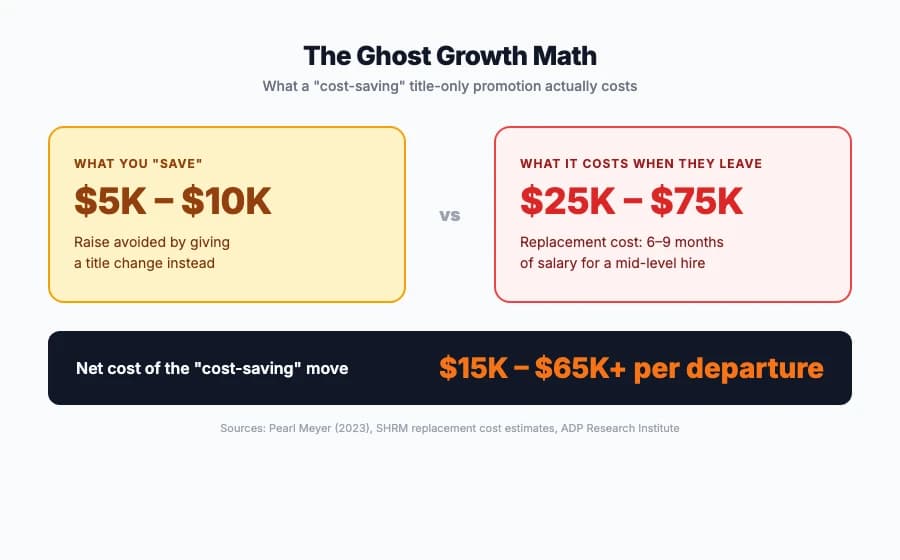
The replacement math is worse. Industry estimates typically place the cost of replacing a mid-level employee at six to nine months of salary. A "saved" raise of five to ten thousand dollars trades for a replacement cost of 25 to 75 thousand. That's the real cost of ghost growth, and it doesn't show up on a spreadsheet until someone resigns.
The connection to the Great Detachment
Ghost growth connects to what Gallup calls the Great Detachment 4. Their research found employee satisfaction hit a record low, with only 18% saying they're extremely satisfied with their employer. Connection to organizational mission dropped to 30%, down from 38% in 2021.
When people stop feeling connected, they start looking. Gallup found 51% of employees are now watching for or actively seeking a new job, the highest rate since 2015.
Here's the pattern I see in my coaching work. Ghost growth erodes individual trust. Then quiet cracking follows. Someone keeps showing up but stops believing the work leads anywhere. Eventually the whole team operates in low-grade detachment, present and productive enough but disengaged from anything beyond the current task list.
Gallup's State of the Global Workplace 5 report estimates low engagement costs the global economy $8.9 trillion in lost productivity annually. For a small business, you feel it differently: slower decisions, fewer ideas, a team that waits to be told instead of taking initiative.
What employees actually want instead
Career development and lateral growth, not money, top the list. When I ask owners what they think people want, the first answer is almost always compensation. Money matters, but it isn't the full story.
The Work Institute's 2024 Retention Report 6, based on over 20,000 exit interviews, found that lack of career development has been the number one reason for voluntary turnover for more than a decade. Not pay. Not benefits. Growth.
MIT Sloan's research across roughly 600 companies found something that surprises most leaders. Lateral career moves are 12 times more predictive of retention 7 than promotions, and 2.5 times more important than pay.
That changes the entire conversation. You don't need a promotion budget to retain people. You need a growth culture.
The Center for Creative Leadership's 8 70-20-10 research shows 70% of leadership capability comes from challenging on-the-job assignments, not courses or credentials. Stretch projects and cross-functional exposure are the primary development tools.
Recognition matters more than most leaders realize. Gallup and Workhuman tracked 3,500 employees over two years and found that well-recognized employees were 45% less likely to have turned over 9. Yet only 22% say they get the right amount of recognition.
How to build genuine growth when you cannot always promote
Here's the practical shift. You stop thinking about promotions as the primary growth tool and start building a system around lateral development and honest conversations.
-
Name the constraint honestly. If you can't promote or give a raise right now, say so. "I value your work. The budget doesn't support a raise this quarter. Here's what I can offer, and here's when we'll revisit compensation." Transparency isn't weakness. It's the foundation of trust.
-
Build lateral paths into your operating rhythm. Assign project ownership with real stakes. Pair people across functions for a quarter. Create skill milestones with review dates.
LinkedIn's data shows employees at companies with strong internal mobility stay nearly twice as long: 5.4 years compared to 2.9.
-
Delegate decisions, not just tasks. If every call still runs through you, nobody is growing. This is the heart of delegation without abdication. Pick one decision domain per person and transfer the authority, not just the workload.
-
Make development conversations routine, not annual. One owner I coach shifted from annual reviews to monthly 20-minute growth check-ins. Within two quarters, two people who'd been coasting took on new project leads. The conversations weren't complicated. They were consistent.
-
Recognize contribution specifically, not generically. "Good job this quarter" does nothing. "Your client onboarding redesign cut our setup time by two days and three clients mentioned it" builds identity.
When ghost growth might be the honest temporary move
I want to be fair about this. There are moments when a title adjustment without an immediate raise is reasonable.
Maybe you're six months from a funding round, or you're restructuring after losing a key contract, or the business genuinely can't support higher compensation right now. Those are real situations.
The difference between ghost growth and an honest interim step is transparency.
Ghost growth pretends the title is the reward. An honest interim step says: "This title reflects where I see your role heading. Compensation needs to catch up, and here's the timeline I'm committing to." Then you write it down and follow through.
If you're in a position where you need to have that conversation, it connects to the broader principle of purpose-driven leadership. People can handle uncertainty. They can't handle being managed around the truth.
The Canadian small business context
This matters differently when you run a smaller operation.
CFIB's 2025 workforce research 10 shows 57% of Canadian small businesses report a disconnect between what candidates expect in pay and what the business can offer. Half say they simply can't match large-company compensation.
The answer isn't to compete on titles alone. BDC's Built for Performance study 11 found that Canada's most successful SMEs invest 50% more in staff training and nearly three times more in manager training than average. A separate BDC workplace culture study 12 (2024) found 85% of small businesses that actively invest in workplace culture report better engagement and lower turnover.
You don't need an enterprise HR budget. You need honest conversations, real project ownership, and a manager who follows through. Those are coaching skills, not budget line items.
One move this week
If you suspect ghost growth on your team, start with one conversation.
Pick the person whose title changed most recently without a matching shift in authority or pay. Schedule 30 minutes. Ask them directly: "Does your current role reflect real growth, or does it feel like a title without traction?"
Then listen. What they say will tell you exactly where to start.
If that conversation reveals a pattern across more than one person, you're looking at a team-level issue worth addressing with psychological safety as the foundation.
Let's Build Brilliance Together
Ghost growth isn't a character flaw. It's a structural pattern, and the fix is honest conversations and follow through, not bigger budgets.
If you're recognizing this pattern on your team, reach out for a free consultation. No sales pitch, just an honest conversation about where you are and what you're working on.
Research Notes & Sources
If you want to go deeper, these are the studies and reports behind the key points in this post.
- HCAMag: Ghost growth leaves majority of workers feeling stalled, survey finds(hcamag.com)
- Pearl Meyer survey on changing job title practices(pearlmeyer.com)
- ADP Research on promotions and employee motivation(mediacenter.adp.com)
- Gallup: The Great Detachment(gallup.com)
- Gallup State of the Global Workplace(gallup.com)
- Work Institute 2024 Retention Report(info.workinstitute.com)
- MIT Sloan Review on lateral moves and retention(sloanreview.mit.edu)
- Center for Creative Leadership 70-20-10 rule(ccl.org)
- Gallup and Workhuman on recognition and retention(gallup.com)
- CFIB workforce challenges research(cfib-fcei.ca)
- BDC Built for Performance study(bdc.ca)
- BDC workplace culture study(bdc.ca)
Category & Tags
Frequently Asked Questions
What is ghost growth in the workplace?
Ghost growth is when an employee receives a new title, expanded responsibilities, or the appearance of advancement without meaningful change in pay, authority, or career trajectory. A MyPerfectResume survey found 65% of workers have experienced it.
How do fake promotions affect employee retention?
Hollow promotions erode trust. ADP Research found 29% of employees leave within one month of their first promotion when it doesn't come with real advancement. The Work Institute reports lack of career development has been the top reason for quitting over a decade running.
What can small business owners do instead of title inflation?
Build lateral growth paths: project ownership, cross training, skill milestones, and honest career conversations. MIT Sloan found lateral moves are 12 times more predictive of retention than promotions.
Is giving a title without a raise always wrong?
Not always. Sometimes budget constraints are real and temporary. The issue is transparency. If you name the gap honestly and pair the title with a concrete development plan, people can accept a delay. If you pretend the title is the reward, trust breaks.
About the Author

About the Author
Mark Mayo
Head Coach, MBC
We get up each morning excited about sharing our 20-plus years of business acumen with small business owners and their teams. Collaborating with hard-working owners to achieve their personal and business goals brings rewards. When we develop you and grow your leaders, we create the momentum that moves you and your business forward. It starts with a first step. Then we can build brilliance together.
Related Articles

What Got You Here Won't Get You There: The Leadership Habits That Stop Working
Marshall Goldsmith found that the habits driving early success become liabilities at the next level. Here are the six that trip leaders up most.
Read What Got You Here Won't Get You There: The Leadership Habits That Stop Working
From Operator to Leader: How Business Owners Make the Shift
Most owners started their business by being great at the work. That same hands-on identity becomes the ceiling. Five shifts to move from operator to leader.
Read From Operator to Leader: How Business Owners Make the Shift
Succession Planning When You ARE the Whole Business
When clients call your cell and your team waits for your approval on everything, succession planning is about detangling yourself from the business first.
Read Succession Planning When You ARE the Whole Business