Leadership Transition & Change
From Operator to Leader: How Business Owners Make the Shift
You built this business with your hands. You know every process, every client quirk, every workaround that keeps things running. If someone on your team gets stuck, you can step in and finish the job faster than explaining it.
That competence is the problem. Not because it's wrong, but because it's become the ceiling. The thing that got the business to this point is the same thing keeping it here. And the shift from operator to leader is the one nobody prepares you for: from doing the work to leading the people who do it.
You Built This. That Is the Problem.
In coaching, I see this pattern constantly. The owner who is the best salesperson, the best technician, the best project manager on the team. They started the business because they were exceptional at the work. Now they run a company, but they're still doing the work as if they don't.
Most owners get stuck here because the business needs three roles filled and only one of them feels natural. Michael Gerber mapped this clearly in The E-Myth Revisited 1 (1995). He described the entrepreneur as someone who had an "entrepreneurial seizure," a technician who decided to start a business doing the technical work they already knew. The Technician does the work. The Manager builds systems. The Entrepreneur sets direction. In most small businesses, the Technician wins. The owner stays on the tools because that is where they feel competent and where results are visible.
The business doesn't need you to be great at the work anymore. It needs you to be great at something else entirely.
The Operator Identity
The operator identity is sticky because it's wired into how your brain rewards you. You finish a task, you see the result, you feel useful. That loop runs dozens of times a day. Nobody gives you that dopamine hit for thinking about strategy. Nobody thanks you for the meeting you didn't attend because you were planning next quarter.
Ram Charan, in The Leadership Pipeline 2 (2000), described this as the first passage of leadership: moving from managing yourself to managing others. It's the passage most business owners never formally make. The shift requires changing what you value. Personal output has to give way to enabling other people's output. That's not just a behaviour change. It's an identity change.
Most leadership books skip this part. They assume you already see yourself as a leader. But if you built the business by doing the work, your identity is the work. Letting go of it feels like letting go of the thing that made you successful.
The first passage of leadership is letting go of the work that made you feel competent.
Why Operators Stay Stuck
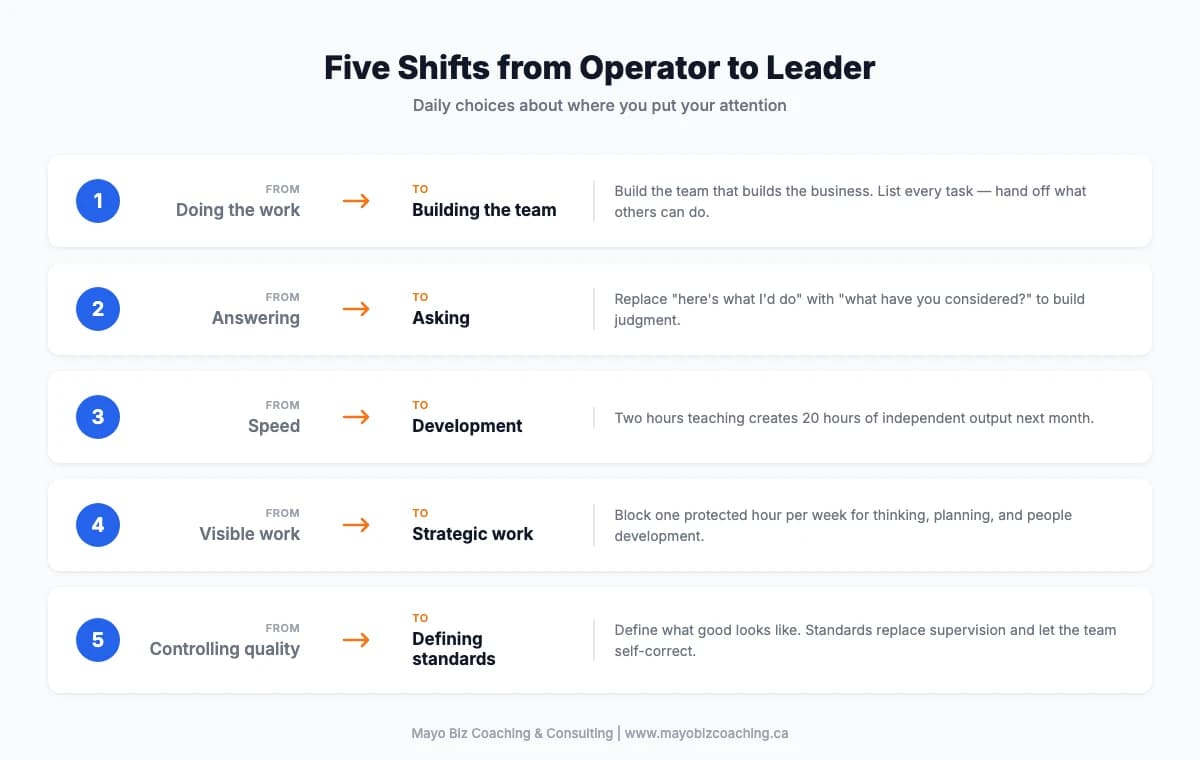
Three forces keep you operating when you should be leading.
The urgent always wins
Henry Mintzberg, in Managing (2009), found that managers operate at a frenetic pace with a persistent bias for action. The client call that just came in, the equipment that's broken. These feel productive because they are immediate and concrete. Meanwhile, the strategic work, the people development, the system design, sits permanently in the background.
Stephen Covey, in The 7 Habits of Highly Effective People (1989), framed this as the Quadrant II problem 3. The important-but-not-urgent work is where leadership actually lives: developing your team, building processes, planning for growth. But it never screams at you. The urgent always does. So the urgent always wins.
Speed is addictive
It takes you 20 minutes to do the task yourself. It would take two hours to teach someone else. The math seems obvious. Except you'll spend those 20 minutes again next week. And the week after. And you've now built a business that can't function without you in the middle of every decision.
Letting go feels like losing control
Watching someone do the work differently than you would is genuinely uncomfortable. They make choices you wouldn't make. They miss details you would catch. The urge to step in is overwhelming.
But different isn't wrong. And the cost of controlling every output is a team that stops thinking for themselves. If you want a deeper look at how to hand off work without hovering, the delegation without abdication framework covers this in detail.
The urgent, fast, and familiar always feels more productive than the slow, strategic work of leading. That feeling is wrong.
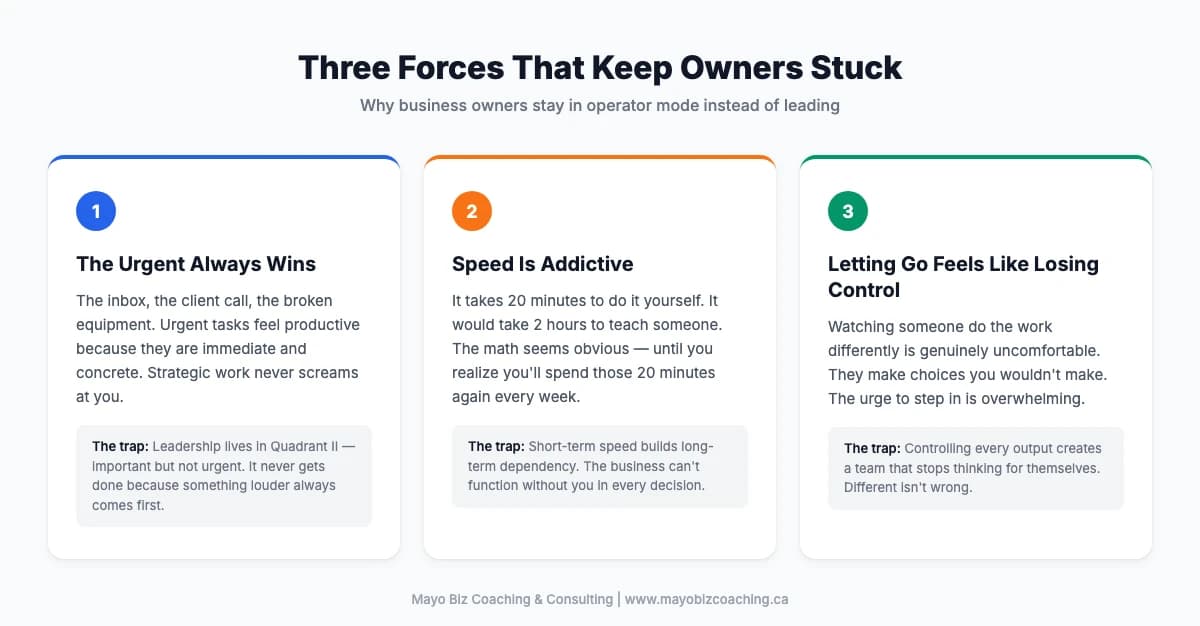
Five Shifts from Operator to Leader
The shift happens in five daily choices about where you put your attention.
1. From doing the work to building the team
Every hour you spend on a task someone else could do is an hour you didn't spend on work only you can do. Hiring, developing, setting direction. The owner's job is to build the team that builds the business.
Start by listing every task you do in a week. Mark the ones that only you can do. Be honest. The list is shorter than you think. Everything else is a candidate for handoff.
2. From answering to asking
When someone brings you a problem, your instinct is to solve it. That instinct creates a line outside your door and a team that doesn't develop judgment.
The manager-as-coach shift replaces "here's what I'd do" with "what have you considered?" One question changes the dynamic from dependency to development. Your team starts thinking before they escalate. You start hearing solutions instead of problems.
3. From speed to development
Yes, you can do it faster. But speed today costs you capacity tomorrow. The two hours you spend teaching create 20 hours of independent output over the next month.
Reframe the math. You're not losing two hours. You're buying back hundreds of hours over the next year. Development is the only investment that compounds in a people business.
4. From visible to strategic
The operator gets credit for visible work. The leader's best work is invisible: the hire that changed the team, the process that prevented a crisis, the conversation that kept a key person from leaving.
Block one hour per week for strategic thinking. Protect it like a client meeting. No email, no phone, no "quick questions." This is where Quadrant II work actually gets done.
5. From controlling quality to defining standards
You can't review every output forever. What you can do is define what good looks like and build the systems that maintain it.
Standards replace supervision. When the team knows the standard, they can self-correct. When they can self-correct, you don't need to be in the middle. This shift requires active listening as a leadership skill because your team will tell you where the standards are unclear, if you're willing to hear it.
The Canadian Small Business Reality
The numbers show why this shift is so hard to make and so necessary. A 2023 CFIB study on labour shortages 4 found that 73% of Canadian small business owners increased their own hours to compensate for staff shortages. The average owner already works well over 50 hours per week before shortages hit. Nearly half have declined sales or contracts because they couldn't handle the volume.
That pattern tells you everything. Every extra hour is an hour the owner spent operating. Every declined contract is revenue the business lost because the owner was doing the work instead of building the team that could handle it.
If you're caught in the coaching vs managing tension, you're not alone. Most owners bounce between the two without a framework for deciding which the moment requires.
The cycle only breaks when you start the shift on purpose.
Where to Start This Week
You don't need to transform overnight. You need one task and one hour.
Pick one task to hand off this month. Choose something you do regularly that someone on your team could learn. Not your most complex work. Something in the middle. Invest the time to teach it properly. Then step back and let them own it, imperfectly at first.
Use the freed time for one Quadrant II activity. A development conversation with a team member. A process that keeps breaking. A strategic question you've been avoiding. Anything that's important but never urgent enough to get done.
Schedule one protected strategic hour per week. Put it on the calendar. Treat it as non-negotiable. Use it for thinking, planning, or developing your people. This is the hour where the operator-to-leader shift actually happens.
Start with one task and one hour.
Let's Build Brilliance Together
The operator-to-leader shift is the hardest transition most business owners face because it asks you to stop doing the thing you're best at. That takes structured accountability and an outside perspective on what's keeping you stuck.
If you're working 55 hours a week and still feel like the business can't run without you, reach out for a free consultation. No sales pitch, just an honest conversation about where you are and what needs to change.
Research Notes & Sources
If you want to go deeper, these are the studies and reports behind the key points in this post.
Category & Tags
Frequently Asked Questions
What is the difference between an operator and a leader in a small business?
An operator does the work. A leader builds the people and systems that do the work. Operators add value through personal output. Leaders add value by developing the capability of others, setting standards, and making strategic decisions that only they can make.
Why do business owners struggle to stop doing the work themselves?
Three forces keep owners stuck: urgent tasks always feel more productive than strategic thinking, doing the work yourself is faster than teaching someone else, and letting go feels like losing control. The operator identity is reinforced daily because completed tasks give visible, immediate results.
How do you go from being an operator to being a leader?
Start with five shifts: move from doing the work to building the team, from answering to asking, from speed to development, from visible tasks to strategic work, and from controlling quality to defining standards. Pick one task to hand off this month and use the freed time for strategic thinking.
When does a business owner need to make the operator-to-leader shift?
The shift becomes necessary when you are the bottleneck. Signs include declining sales you cannot pursue, working 50 or more hours per week on tasks others could do, and a team that waits for your approval on routine decisions. The earlier you start, the less painful the transition.
About the Author

About the Author
Mark Mayo
Head Coach, MBC
We get up each morning excited about sharing our 20-plus years of business acumen with small business owners and their teams. Collaborating with hard-working owners to achieve their personal and business goals brings rewards. When we develop you and grow your leaders, we create the momentum that moves you and your business forward. It starts with a first step. Then we can build brilliance together.
Related Articles

Ghost Growth: The Fake Promotions Driving Your Team Away
Ghost growth gives employees titles without real advancement. Learn why fake promotions backfire and what leaders can do instead to retain talent.
Read Ghost Growth: The Fake Promotions Driving Your Team Away
The First 90 Days: How a Coach Helps You Succeed in a New Role
McKinsey research shows coaching doubles the success rate for leaders in transition. A practical 90-day framework to reach effectiveness faster.
Read The First 90 Days: How a Coach Helps You Succeed in a New Role
The Power of Fractional Leadership: Practical Value for Small Businesses
Fractional leadership gives small businesses access to seasoned executive expertise without full-time cost. Learn how this model accelerates growth.
Read The Power of Fractional Leadership: Practical Value for Small Businesses