Team Leadership Development
The Five Dysfunctions Hiding in Your Team
Your team looks fine on paper. People show up, hit most of their deadlines, and nobody is openly fighting. But something is off.
Meetings are quiet. The same two people do most of the talking. Good ideas die in silence because nobody wants to be the one to push back. And when things go sideways, you hear about it last.
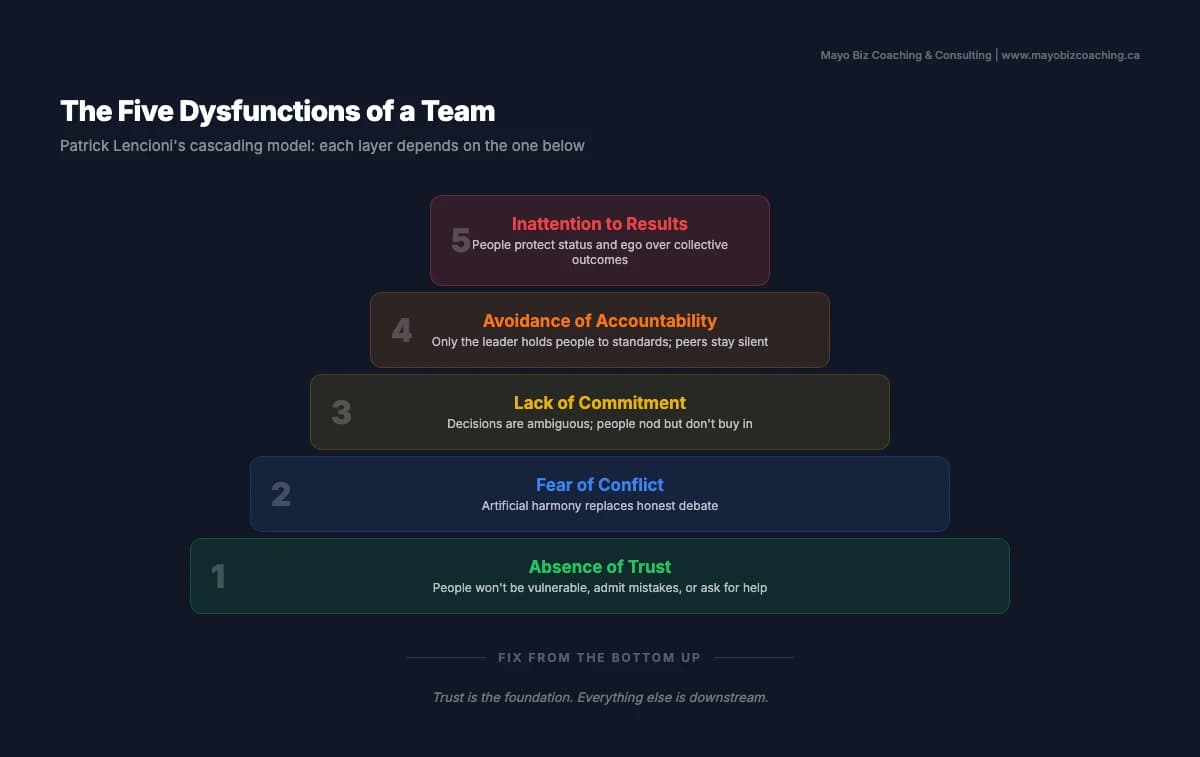
Patrick Lencioni spent decades studying why capable teams underperform. His model, The Five Dysfunctions of a Team 1, lays out five connected layers of breakdown that cascade from a single root cause. What makes the framework useful for small business owners is that it doesn't describe five separate problems. It describes one problem that shows up five different ways.
It starts with trust (and not the kind you think)
When most people hear "trust," they think reliability. Does this person follow through? Can I count on them?
Lencioni means something different. He's talking about vulnerability-based trust: the willingness to say "I made a mistake," "I don't know," or "I need help" without worrying it will be used against you.
In a team of five to fifteen people, this kind of trust is everything. There's nowhere to hide. If the owner can't admit they got something wrong, nobody else will either. I've worked with teams where the most talented person in the room hadn't voiced a real opinion in months. The last time they disagreed with the boss, the conversation didn't go well.
The numbers back this up. Gallup found 2 that only 21% of employees strongly agree they trust their organization's leadership. That number has been falling since 2019. In a small business, where relationships are closer and stakes feel more personal, a trust deficit doesn't just lower engagement. It poisons everything downstream.
If your team isn't telling you what's really going on, this is usually where it starts. Not with bad intentions. With a leader who hasn't made it safe enough to be honest. Psychological safety is the foundation, and building it is the leader's job.
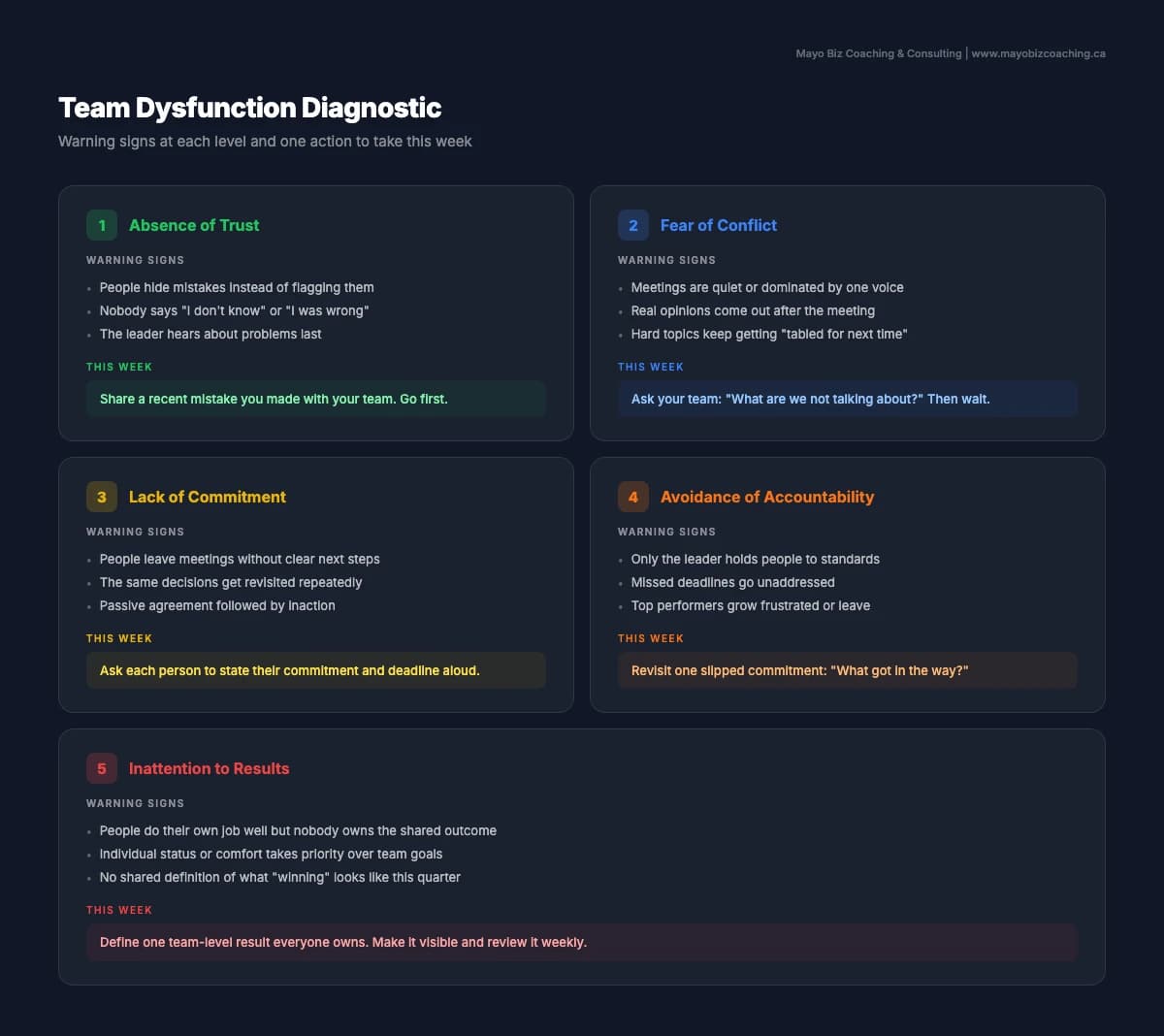
What to do this week: Share a recent mistake you made with your team. Not a manufactured vulnerability. A real one. Watch what happens to the room when you go first.
Fear of conflict looks like politeness
Once trust is missing, conflict disappears. Not the destructive kind. The productive kind. The conversations where people challenge each other's thinking, push back on weak plans, and say "I see this differently."
Without those conversations, meetings become performances. People nod along. The real discussion happens afterward in the hallway, in private messages, or not at all. You end up making decisions with half the information because the other half stayed locked inside someone who didn't feel safe enough to share it.
This costs real money. Research shows 3 employees spend roughly 2.8 hours per week dealing with workplace conflict. But most of that time isn't spent on productive disagreement. It's spent managing the fallout of issues that never got addressed directly: resentment, confusion, misalignment, and the endless cycle of relitigating decisions that were never genuinely settled.
Here is what I see in coaching sessions. The leader says "I want honest feedback." The team has learned through experience that honest feedback leads to a defensive reaction, a longer meeting, or a subtle shift in how they're treated. So they stay quiet. The leader interprets silence as agreement. It isn't.
Lencioni calls this "artificial harmony." The team looks aligned. Under the surface, nothing has actually been decided.
What to do this week: In your next team meeting, ask "What are we not talking about?" Then wait. Don't fill the silence. The first few times, you might get nothing. That's information too. If you need a framework for having difficult conversations once they surface, start there.
Without real debate, commitment falls apart
This is the dysfunction that trips up most small business owners. You leave a meeting thinking everyone is on the same page. A week later, half the team is doing something different.
The problem isn't forgetfulness. It's that people never actually committed. They agreed on the surface because the conversation never went deep enough to surface real disagreement. Without honest debate, you get compliance instead of commitment. People do what they're told (mostly) but they don't own the direction.
In Lencioni's model, commitment requires two things: clarity and buy-in. Clarity means everyone knows exactly what was decided and who owns what. Buy-in means people had a genuine chance to weigh in before the decision was made. You don't need consensus. You need people to feel heard.
The phrase Lencioni uses is "disagree and commit." It works, but only if the disagreement part actually happened. If people skipped the debate and went straight to "committing," what you have is silent resistance dressed up as teamwork.
I've watched this play out dozens of times. The owner makes a decision, asks if everyone is good, gets nods around the table, and three weeks later wonders why nothing has moved. The nods weren't agreement. They were surrender.
What to do this week: At the end of your next meeting, go around the room and ask each person to state, in their own words, what they're committing to and by when. If someone can't articulate it, the decision isn't clear enough yet.
Accountability becomes the leader's burden alone
When commitment is shallow, accountability collapses. Not because people are lazy. Because nobody holds each other to standards they didn't genuinely agree to in the first place.
In most small teams, the owner or senior leader becomes the only person doing the holding. Every missed deadline, every dropped ball, every quality issue routes back to one person. If this sounds familiar, you're experiencing dysfunction four.
Peer-to-peer accountability is what healthy teams do. A team member notices a colleague falling behind and says something directly. Not to the boss. To the person. That only happens when the team has trust (dysfunction one), the ability to have honest conversations (dysfunction two), and genuine commitment to shared goals (dysfunction three). Skip any of those layers and accountability defaults back to the leader.
The cost is real. Your best people get frustrated watching mediocre work go unchecked. They start to wonder why they bother performing at a high level when nobody else is held to the same standard. Gallup's research 4 shows managers account for roughly 70% of the variance in team engagement, and a big part of that variance comes down to whether standards are applied consistently.
If you've been reading about how to have accountability conversations, you know the frameworks exist. The reason they don't stick in most teams is that the layers underneath haven't been built yet.
What to do this week: Identify one commitment your team made in the last month that quietly slipped. Bring it up. Not as blame. As a question: "We agreed to X. We didn't get there. What got in the way?" The conversation itself is the point.
Results get lost when everything else is broken
The top of Lencioni's pyramid is inattention to results. When trust, conflict, commitment, and accountability are all compromised, people stop focusing on collective outcomes. They default to protecting their own territory and their own comfort.
This doesn't look like selfishness. It looks like a team where everyone does their job but nobody owns the outcome. The marketing person hits their metrics while the sales team struggles with misaligned leads. The operations manager keeps things running smoothly while the customer experience deteriorates at the edges. Everyone's piece works. The whole doesn't.
Google's Project Aristotle study 5 examined 180 teams and found that psychological safety was the single strongest predictor of team effectiveness. Stronger than team composition, seniority, or individual talent. The teams that performed best weren't the ones with the smartest people. They were the ones where people felt safe enough to take risks, make mistakes, and hold each other to a shared definition of success.
For small business owners, the lesson is direct. If your team feels like a collection of individuals doing adjacent work rather than a unit pulling toward the same thing, the fix isn't a better strategy deck. The fix is in the four layers beneath results. You need people who trust each other enough to argue, committed enough to follow through, and accountable enough to call it out when someone drifts.
What to do this week: Define one team-level result that matters this quarter. Not individual goals. One shared number the whole team owns. Put it somewhere visible and review it together weekly.
Where most leaders start (and why it doesn't work)
The natural instinct is to attack the symptom. Results are slipping, so you set clearer targets. Accountability is weak, so you build tracking systems. Nobody speaks up, so you tell people you want honesty.
None of that sticks because you're working from the top of the pyramid down. Lencioni's framework says the opposite: start at the bottom. Trust first. Then conflict. Then commitment. Then accountability. Results follow.
This takes patience, and it takes self-awareness. The leader who built the team's dysfunction (usually without realizing it) is the same person who needs to rebuild it. That's not a comfortable position. It's why most leaders who successfully work through this process don't do it alone.
A coach brings the objectivity the leader can't have about their own team. They can see patterns the leader is too close to notice: the defensive reaction that shuts down honesty, the decision-making style that creates shallow commitment, the standards that slip because nobody wants to be the enforcer.
The model isn't perfect. It was built from consulting experience, not controlled research. It doesn't account for external pressures like market conditions or resource constraints. And it frames everything through a deficit lens, which means it's better at diagnosing what's broken than celebrating what's working.
But after twenty-plus years and eight million copies sold, the core insight holds. Trust is the foundation. Everything else is downstream. If your team is struggling with feedback, delegation, or results, start by asking whether the people involved trust each other enough to be honest. The answer usually tells you where to begin.
Let's Build Brilliance Together
Every team has friction. The question is whether it's the kind that generates heat or the kind that generates progress. Working through these dysfunctions isn't comfortable, but it's the fastest path from a group of people sharing an office to a team that actually performs.
If you're recognizing some of these patterns in your own team, reach out for a free consultation. No sales pitch, just an honest conversation about where you are and what you're working on.
Research Notes & Sources
If you want to go deeper, these are the studies and reports behind the key points in this post.
- Meet Patrick Lencioni | The Table Group(tablegroup.com)
- Why Trust in Leaders Is Faltering and How to Gain It Back(gallup.com)
- Workplace Conflict Statistics in 2025 | Peaceful Leaders Academy(peacefulleadersacademy.com)
- Managers Account for 70% of Variance in Employee Engagement(news.gallup.com)
- Google re:Work - Guides: Understand team effectiveness(rework.withgoogle.com)
Category & Tags
Frequently Asked Questions
What are the five dysfunctions of a team?
Patrick Lencioni's model identifies five connected layers: absence of trust, fear of conflict, lack of commitment, avoidance of accountability, and inattention to results. They build on each other like a pyramid. If trust is missing at the base, every layer above it breaks down.
How do you fix team dysfunction in a small business?
Start at the foundation: trust. The leader goes first by admitting mistakes, asking for help, and showing vulnerability. Then build each layer in order. Create space for honest disagreement, close meetings with clear commitments, make accountability peer-to-peer instead of top-down, and define shared results the whole team owns.
What is the most common team dysfunction?
Absence of trust is the most common and the most damaging because every other dysfunction flows from it. Research shows only 21% of employees strongly trust their organisation's leadership. In small teams, low trust shows up as people hiding mistakes, avoiding honest conversations, and telling the leader what they want to hear.
How does a business coach help with team dysfunction?
A coach helps the leader see patterns they are too close to notice. They create a safe space to practise vulnerability and difficult conversations before doing it with the team. They also bring objectivity: the leader is usually both the cause and the potential solution, so an outside perspective speeds up the diagnosis and the recovery.
About the Author

About the Author
Mark Mayo
Head Coach, MBC
We get up each morning excited about sharing our 20-plus years of business acumen with small business owners and their teams. Collaborating with hard-working owners to achieve their personal and business goals brings rewards. When we develop you and grow your leaders, we create the momentum that moves you and your business forward. It starts with a first step. Then we can build brilliance together.
Related Articles

The Accountability Conversation: How to Hold People to Standards and Keep Their Trust
Most leaders know they need accountability conversations but keep putting them off. Frameworks from Patterson, Scott, and Raymond that make them productive.
Read The Accountability Conversation: How to Hold People to Standards and Keep Their Trust
Conscious Unbossing: Why Gen Z Doesn't Want to Manage
Over half of Gen Z workers don't want management roles. That's not entitlement. It's a rational response to how most organizations have designed the job.
Read Conscious Unbossing: Why Gen Z Doesn't Want to Manage
Why Your Best Employee Won't Leave But Won't Grow Either
Job hugging employee development can stall your leadership pipeline. Learn how to reopen growth with lateral paths, coaching talks, and clear expectations.
Read Why Your Best Employee Won't Leave But Won't Grow Either