Leadership Transition & Change
The First 90 Days: How a Coach Helps You Succeed in a New Role
You got the call. The promotion, the new company, the role you have been working toward. The excitement lasts about a week before a quieter feeling sets in. You are not sure who to trust yet. The team is watching. Every decision feels overweighted.
This is the transition gap. Research says it is where most new leaders stumble. The first 90 days are where credibility is built or lost.
McKinsey found 1 that two years after executive transitions, 27 to 46 percent are regarded as failures or disappointments. DDI's Leadership Transitions Report 2 puts the number at 35% for internal promotions and 47% for external hires. These are not edge cases. They are the norm.
The pattern I see in coaching is consistent. Smart, capable people walk into new roles without a transition strategy. They spend months reacting instead of leading.
Why So Many Transitions Fail
The failure rate surprises most people. If you were good enough to earn the role, why would the transition be so hard?
Because the skills that earned the promotion are rarely the skills the new role demands. Michael Watkins, IMD professor and author of The First 90 Days 3, calls this the breakeven problem. It is the gap between taking the role and creating sustained net value.
That gap can last for months. If the transition goes badly, you may never reach breakeven at all.
Watkins also argues that leadership careers are shaped by repeated transitions, not one-time promotions. Without a repeatable approach, leaders relearn painful lessons as the stakes keep rising.
The Real Reasons Leaders Struggle
McKinsey's research found that 68% of transitions founder on issues related to politics, culture, and people 1. Not strategy. Not technical competence. Relationships.
DDI's data adds context. About 40% of people said becoming an executive was not a positive experience 2. The stress of transition rivals major life challenges. Nearly half of leaders with stressful transitions rated themselves as average or below-average performers.
The Chartered Management Institute 4 found that 82% of new managers enter the role without formal training. CMI surveyed 4,500 workers through YouGov. Most leaders are thrown into transitions unprepared and expected to figure it out alone.
CCL's derailment research confirms where they fail. Two-thirds of derailed managers 5 struggled with adaptability during transitions. The skills that made them successful before became the habits that held them back.
The Identity Shift Nobody Talks About
The hardest part of a leadership transition is not the work. It is the identity change.
Maurer and London published research in the Journal of Management 6 showing that leaders who rely on the technical expertise that earned the promotion are rated as less successful in the new role. The shift from contributor to leader requires a fundamental rethinking of how you add value.
I have seen this play out many times. A VP of sales who got promoted because she closed the biggest deals keeps jumping into client calls instead of developing her team. A director of engineering who was the strongest coder reviews every pull request instead of building cross-team alignment. Their instinct is to do what made them great. The role demands something different.
KPMG's study of 750 high-performing executives 7 found that 75% experienced imposter syndrome during their careers, with transitions being a primary trigger. 54% of women executives said success made them feel more isolated.
This is where coaching makes the biggest difference. Not fixing a performance problem, but supporting the internal shift that every new role demands.
Coaching Changes the Equation
The evidence on coaching during transitions is strong.
McKinsey found that tailored executive coaching doubles the likelihood of transition success 1. When transitions succeed, teams are 90% more likely to meet three-year goals and 13% less likely to lose key people. Yet only 32% of organizations offer coaching during transitions.
IMD research led by Watkins 8 found that the right support can halve the time it takes for new leaders to get up to speed. The highest-impact interventions: helping leaders understand challenges, providing stakeholder feedback, and supporting key decisions early.
Gartner's research 9 adds a practical number. Executive leaders with a transition plan cut time to success by 9 months. Even an informal plan dropped the timeline from 8.9 months to 6.7 months.
A meta-analysis published in Frontiers in Psychology 10 reviewed 39 randomized controlled trials with 2,528 participants. Coaching showed a statistically significant effect size of g = .59 across leadership outcomes. Both virtual and in-person coaching produced comparable results.
A Practical 90-Day Framework
A transition coach does not hand you a plan. The work is structured around the decisions you face each week.
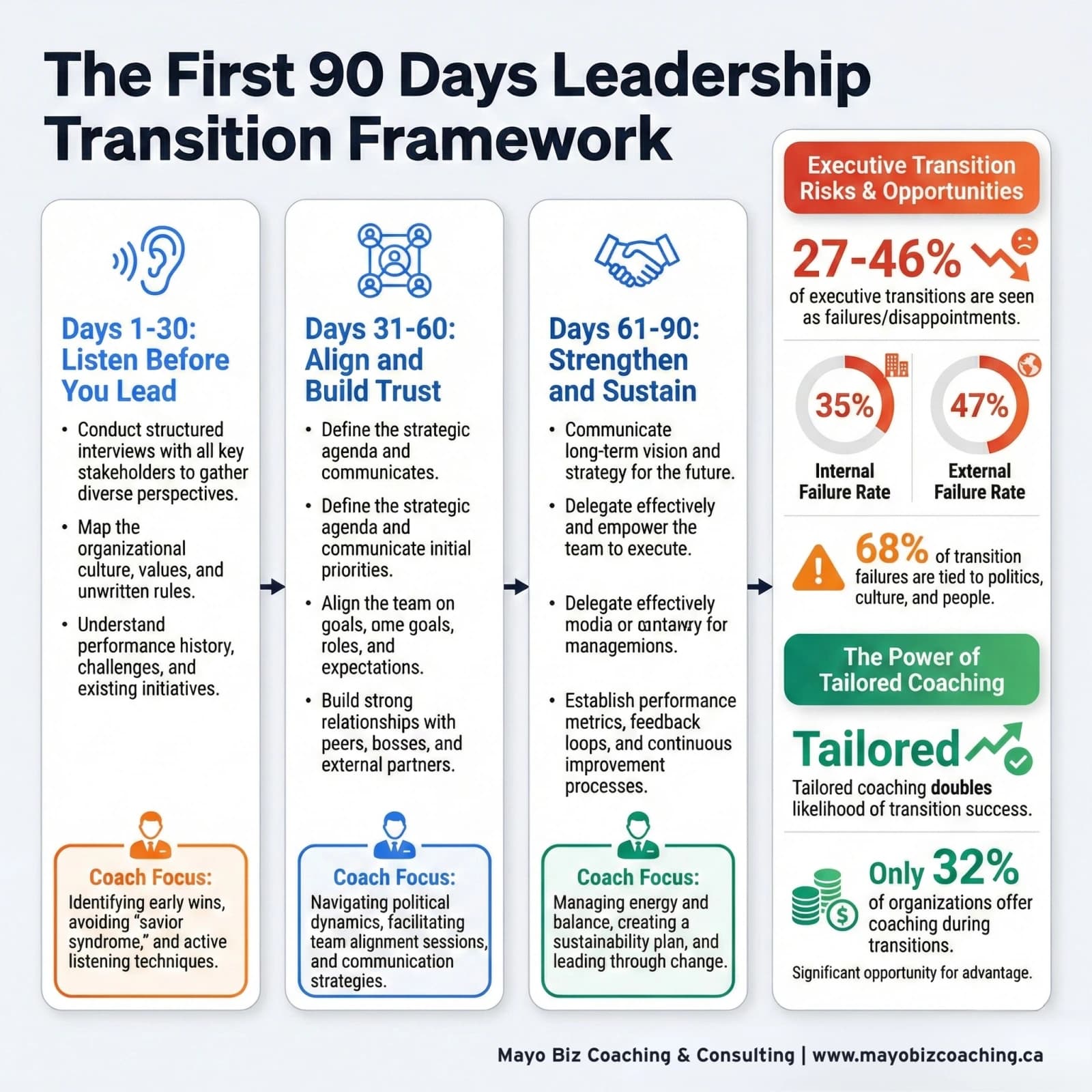
Days 1 to 30: Listen Before You Lead
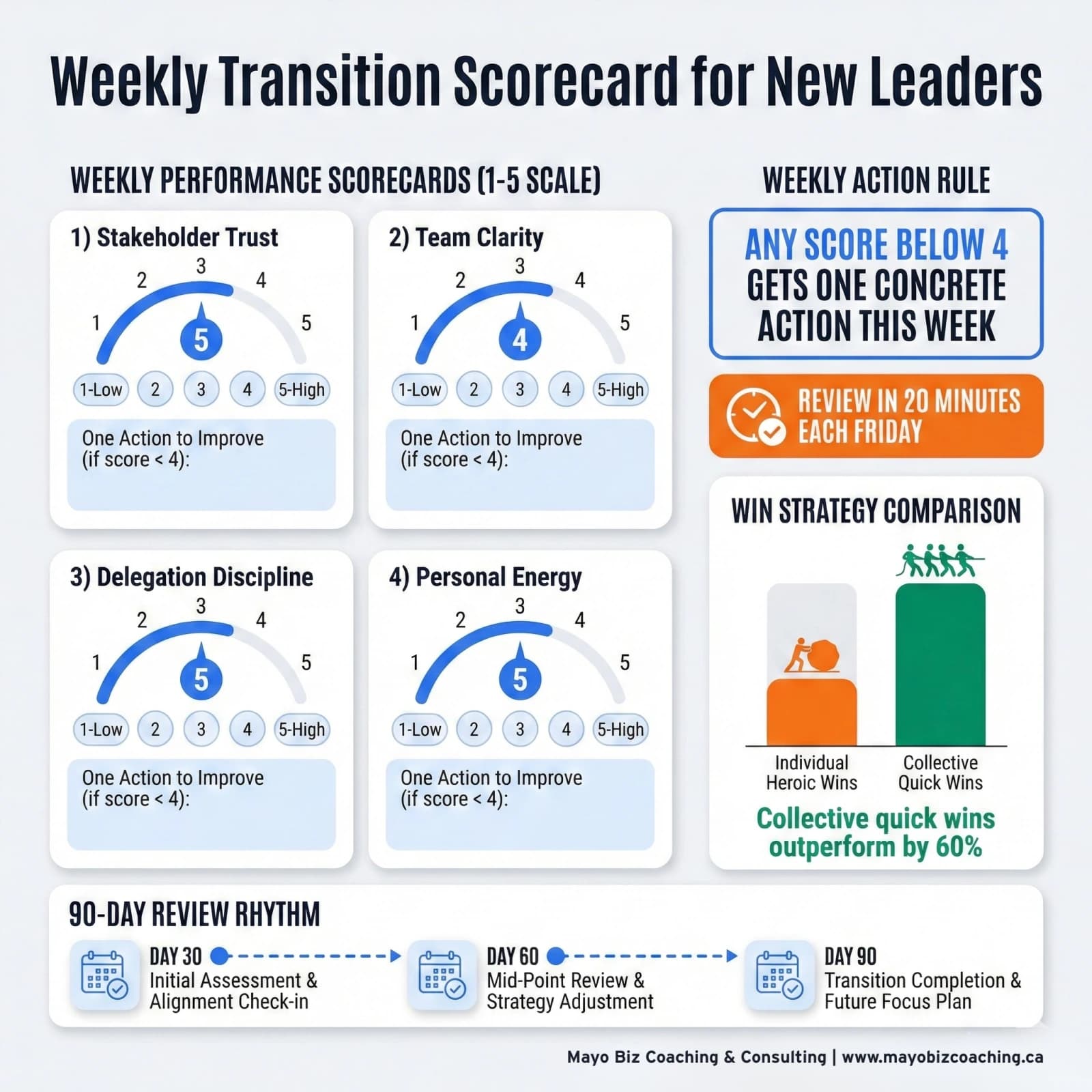
A coach helps you resist the urge to prove yourself immediately. CEB research on 5,400 new leaders 11 found that leaders who pursued individual heroic wins often backfired. Leaders who focused on collective quick wins outperformed peers by 60%.
Your coach helps you map stakeholders, understand the real culture, and identify where to listen before acting. Active listening is the core skill in this phase.
One client, a newly promoted operations director at a logistics firm, spent her first three weeks in back-to-back meetings and firefighting. She was exhausted and had not yet had a real conversation with two of her five direct reports. In our first coaching session, we mapped her calendar against her transition priorities. She canceled eight recurring meetings that pre-dated her arrival and replaced them with four structured one-on-ones. By day 45, her team had started bringing issues to her instead of working around them.
Days 31 to 60: Align and Build Trust
This is where you negotiate success with your manager and key stakeholders. What does success look like at 90 days? At six months? A coach helps you match your strategy to the situation.
Watkins' STARS model 3 distinguishes five contexts: Start-up, Turnaround, Accelerated Growth, Realignment, and Sustaining Success. Each demands a different leadership approach. A turnaround requires bold moves fast. A realignment requires building shared urgency around a problem people do not yet see.
I worked with a VP of product hired into a fast-growing SaaS company in southern Ontario. She came from a turnaround environment and brought that urgency into a team that was performing well but needed structure. Her first instinct was to restructure teams and change processes. In coaching, we identified the situation as accelerated growth, not turnaround. She shifted from "fix what is broken" to "build what is missing." That reframe changed how the team received her. Within 60 days she had buy-in from peers who had initially been skeptical.
Days 61 to 90: Strengthen and Sustain
By now you should have clear priorities, early trust, and a few visible wins. A coach helps you assess your team honestly, identify capability gaps, and build psychological safety so people tell you what is actually happening.
This phase is also where burnout risk rises. The intensity of the first two months catches up. A coach helps you pace yourself, delegate effectively, and protect your energy for the decisions that matter most.
Your Weekly Transition Scorecard
A practical coaching tool in this phase is a 20-minute weekly scorecard. Rate four areas from 1 to 5: stakeholder trust, team clarity, delegation discipline, and personal energy. Then set one action for every score below 4.
The goal is not perfection. The goal is early course correction before small drifts become political or performance problems. In Ontario small businesses, this matters because leaders often carry both strategic and operational load. A simple scorecard keeps your transition visible and discussable.
Why This Matters Right Now
The timing of this challenge has intensified.
Challenger, Gray and Christmas 12 tracked a record 2,221 CEO departures in 2024, the highest since tracking began in 2002. Spencer Stuart 13 reports 44% of new CEOs came from outside the company, a 12% increase from the prior year.
DDI's 2025 Global Leadership Forecast 14 shows only 20% of HR professionals report confidence in their leadership bench. Gartner's 2026 CHRO priorities 15 emphasize realizing AI value and driving performance amid uncertainty. Leaders are being asked to deliver major change with thinner pipelines.
People are moving into bigger roles faster, with less preparation, during a time of record complexity.
The Canadian Picture
The transition challenge hits Canadian businesses hard.
CFIB's 2023 report 16 found 76% of small business owners plan to exit within the next decade. Only 9% have a formal succession plan. Over $2 trillion in business assets will change hands.
MNP's 2025 Succession Readiness Report 17 surveyed 550 business owners and found 64.1% have no formalized succession plan. 62% of Canadian SMEs are owned by individuals nearing retirement. Only 8.5% have clear, actionable goals for transition.
RBC Economics 18 estimates 5.2 million boomers have already left the Canadian labour force, with the remainder reaching 65 by 2030. The Conference Board of Canada 19 reports these skills shortages cost $2.6 billion in lost GDP in 2024.
For Guelph and Ontario business owners, this is not abstract. Every succession, every promotion, every new hire into a leadership role is a transition that succeeds or fails. The difference, repeatedly, is whether the incoming leader gets structured support.
Let's Build Brilliance Together
Leadership transitions fail more often than they succeed. The cost shows up in team performance, retention, and months of lost momentum.
They also respond well to coaching. Structured support during the first 90 days can double the odds of success and cut months off the path to effectiveness.
If you are stepping into a new role, Leadership Transition coaching gives you a framework for the first 90 days and beyond. If you are preparing someone on your team, it gives them one too.
Reach out for a free consultation. No sales pitch, just an honest conversation about what you are walking into and how to lead well from the start.
Research Notes & Sources
If you want to go deeper, these are the studies and reports behind the key points in this post.
- Successful leadership transition is crucial for a firm(consultancy.eu)
- Why Executive Transitions Continue to Fail(ddi.com)
- The First 90 Days, Updated and Expanded(hbr.org)
- Chartered Management Institute(managers.org.uk)
- Two-thirds of derailed managers(cclinnovation.org)
- Journal of Management(journals.sagepub.com)
- KPMG Study Finds 75% Of Female Executives Across Industries Have Experienced Imposter Syndrome In Their Careers(prnewswire.com)
- How transition coaches accelerate executive onboarding - IMD business school for management and leadership courses(imd.org)
- Gartner's research(gartner.com)
- Frontiers | The effects of executive coaching on behaviors, attitudes, and personal characteristics: a meta-analysis of randomized control trial studies(frontiersin.org)
- The Quick Wins Paradox(hbr.org)
- New Records Set: CEO Exits Surge Post-Election in December 2024(challengergray.com)
- 2024 CEO Transitions: The measure of the market(spencerstuart.com)
- DDI's 2025 Global Leadership Forecast(media.ddiworld.com)
- Gartner: 4 key priorities for CHROs in 2026 to lead the AI-driven future of work(unleash.ai)
- Over $2 trillion in business assets are at stake as majority of small business owners plan to exit their business over the next decade(cfib-fcei.ca)
- MNP's 2025 Succession Readiness Report(mnp.ca)
- Canada faces peak aging as final boomers retire and population growth slows(rbc.com)
- Conference Board of Canada(fsc-ccf.ca)
Category & Tags
Frequently Asked Questions
Why do so many new leaders fail in their first 18 months?
DDI research shows 35% of internally promoted and 47% of externally hired executives fail. McKinsey found 68% of transitions founder on politics, culture, and people rather than competence or strategy.
How long does it take to get up to speed in a new leadership role?
Most leaders need several months to reach full effectiveness in a new role. A structured 90-day transition plan and coaching support usually shortens ramp-up by clarifying priorities, relationships, and early wins.
Does coaching help during leadership transitions?
McKinsey found tailored coaching doubles the likelihood of transition success, yet only 32% of organizations use it. IMD research shows coaching can halve time-to-effectiveness for new leaders.
What should a new leader focus on in the first 90 days?
Map stakeholders, pursue collective quick wins (CEB found these outperform solo wins by 60%), and match your strategy to the situation. Resist the urge to prove yourself through individual heroics.
About the Author

About the Author
Mark Mayo
Head Coach, MBC
We get up each morning excited about sharing our 20-plus years of business acumen with small business owners and their teams. Collaborating with hard-working owners to achieve their personal and business goals brings rewards. When we develop you and grow your leaders, we create the momentum that moves you and your business forward. It starts with a first step. Then we can build brilliance together.
Related Articles

What Got You Here Won't Get You There: The Leadership Habits That Stop Working
Marshall Goldsmith found that the habits driving early success become liabilities at the next level. Here are the six that trip leaders up most.
Read What Got You Here Won't Get You There: The Leadership Habits That Stop Working
From Operator to Leader: How Business Owners Make the Shift
Most owners started their business by being great at the work. That same hands-on identity becomes the ceiling. Five shifts to move from operator to leader.
Read From Operator to Leader: How Business Owners Make the Shift
Succession Planning When You ARE the Whole Business
When clients call your cell and your team waits for your approval on everything, succession planning is about detangling yourself from the business first.
Read Succession Planning When You ARE the Whole Business