Team Leadership Development
Conscious Unbossing: Why Gen Z Doesn't Want to Manage
Every few months, I sit with a business owner who says some version of the same thing: "I've got two or three people who could run a team. Smart. Capable. They just don't want the job."
It catches them off guard. They built their careers around the assumption that good people want to move up, and moving up means managing. But Gen Z watched what happened to the managers above them and drew a different conclusion.
They're not lazy. They're not entitled. They did the math. There's a name for it: conscious unbossing.
They saw managers working longer hours for marginal pay increases. They watched talented people get promoted into roles they were never trained for and then struggle in silence. They noticed that the person everyone depended on was also the person nobody checked in on. And they decided that wasn't the deal they wanted to take.
If you lead a team or run a business, it's worth paying attention. Not because you need to convince young workers they're wrong. Because they're telling you something true about the job you're offering.
They're Not Wrong
The numbers are consistent across every major survey. A Robert Walters survey of 3,600 Gen Z workers 1 found that 72% would rather advance as individual contributors than move into management. When asked about management specifically, 69% described the job as "high stress, low reward."
That tracks with what I hear in coaching conversations. The workers who say no aren't disengaged. They've watched the role closely and decided the trade-off doesn't add up.
The Canadian picture is similar. Robert Half Canada surveyed over 800 employees 2 and found 50% of Canadian Gen Z prefer senior roles without people management. Work-life balance was the top reason cited. As David Bolton from Robert Half put it, "Gen Z entered the workforce at a time when work-life balance and flexibility were receiving more focus than ever before." They're not rejecting ambition. They're rejecting a specific version of it.
And it goes further than management hesitation. Deloitte's 2025 Gen Z and Millennial Survey 3, covering more than 23,000 respondents across 44 countries, found that only 6% of Gen Z say leadership is their primary career goal. Six percent.
If over half of your next generation of leaders is declining the role, the problem isn't their attitude.
What They Watched Happen
When I ask younger workers what shaped their view of management, the answer is almost always observational, not theoretical. They didn't read an article about manager burnout. They watched it happen to someone they respected.
Gallup's 2025 global data 4 shows manager engagement fell to 27%, down from 30% just a year earlier. Younger managers were hit hardest. Managers carry a disproportionate influence on the people around them. Gallup's research consistently shows 70% of team engagement variance comes down to the manager. So when the manager is disengaged, the whole team feels it, and the people watching from below take note.
I see this in the firms I coach. The manager everyone relies on is often the one nobody checks in on.
Workloads have grown, too. Gallup's span-of-control data 5 shows the average manager now oversees 12.1 direct reports, up from 10.9 in 2024. That increase doesn't come with additional time, additional training, or a lighter administrative load. It just means more people to support, less time per person, and a role that increasingly feels like an impossible ask.
I've watched this play out firsthand. A team lead with twelve reports has no real time for any of them. Conversations get compressed into five-minute check-ins. Development plans gather dust. The person is managing a spreadsheet, not a team.
The Chartered Management Institute found 82% of managers are "accidental managers" 6. Promoted because they were good at their previous job, not because they were ready to lead people. No formal training. No coaching. Just a title change and an expectation to figure it out.
DDI's 2025 Global Leadership Forecast 7 found that 71% of leaders say their stress has risen since stepping into management.
Gen Z watched all of this. They saw people get promoted into a role that made them miserable, with no preparation and no support. The message was clear: management will cost you, and nobody is going to help you succeed at it.
They read the room correctly.
The Role Is the Problem, Not the Generation
The instinct for most organizations is to treat this as a generational attitude issue. How do we motivate them? How do we sell management better? How do we make them understand what leadership offers?
That framing misses the point.
When more than half of your talent pipeline doesn't want the job, the job needs redesigning. The role needs redesigning, not better marketing. And the data supports that interpretation. DDI found that 80% of HR leaders lack confidence in their leadership pipeline. That's not because young people lack ambition. It's because organizations haven't built a management role that ambitious people actually want.
I've coached business owners who blame generational differences for turnover in leadership roles. When we dig into the actual role, the pattern is the same. The manager handles scheduling, approvals, performance documentation, escalations, and status reporting. Somewhere at the bottom of the list, if there's time left, they get to develop people. The parts of leadership that matter to talented people have been crowded out by administration.
This is the coaching versus managing distinction we've written about before. If you strip management down to administration and crisis response, you've built a role that nobody with options would volunteer for. And that's exactly what many organizations have done.
The fix isn't generational sensitivity training. It's honest role design.
What Actually Makes Someone Want to Lead
Mentoring. That's what pulls them in. Younger workers aren't opposed to influence, growth, or responsibility. They're opposed to a specific version of management that trades their well-being for a title.
Robert Half Canada found that among the Gen Z workers who do want management roles, 55% cite mentoring others as their primary motivation. Not the title. Not the pay bump. The chance to help other people grow. That tells you what the role could be, if organizations built it differently.
DDI's research adds another dimension. Gen Z workers are 1.7 times more likely than other generations to step away from leadership to protect their well-being. It's a boundary. They've watched what happens when leaders don't set boundaries, and they've decided not to repeat it.
To be clear: not every individual contributor path is avoidance. Some people genuinely thrive outside management, and that's a valid choice. The concern is when capable people who could lead choose not to because of how the role is built.
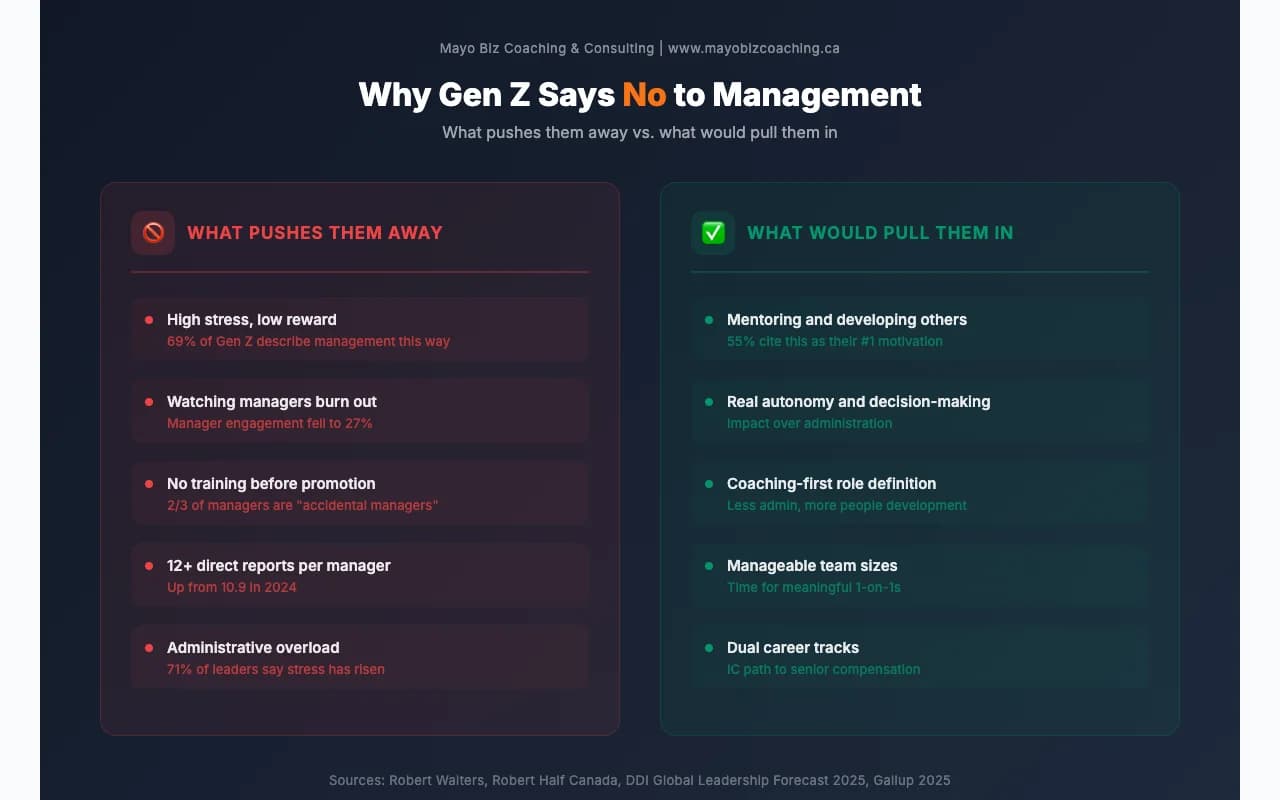
I worked with a growing services firm in Ontario that couldn't fill an internal team lead role. Three qualified people declined it. When we sat down with each of them individually and asked what would make the role worth taking, the answers overlapped almost word for word. Less administration, more time developing junior staff, fewer direct reports, and a clear path to continue growing without inheriting every operational problem.
Those aren't unreasonable requests. They're a blueprint.
If you want talented people to step into management, build a version of the role they'd actually choose.
What to Do This Week
This won't fix itself. Every year you don't address the design of your management roles, you lose potential leaders to other paths or burnout. Here's where to start.
-
Redefine the manager role around coaching, not administration. Audit how your managers spend their time. If more than half goes to scheduling, approvals, and status reporting, you've built an administrative role and called it leadership. Strip out what can be automated or reassigned. Make room for the work that actually drives team performance: one-on-ones, development conversations, feedback, and active listening.
-
Train before promoting. Stop making accidental managers. When someone moves into a people leadership role, they should already have foundational skills in delegation, feedback, and difficult conversations. The eight in ten managers who received no formal training are a direct cause of the reputation problem management now has.
-
Create dual career tracks. Individual contributor and management paths should both lead to senior compensation and recognition. When management is the only route to advancement, you force people into roles they don't want and aren't suited for. That's how you build a layer of reluctant managers who underperform and burn out.
-
Reduce direct report loads. Twelve direct reports is too many for meaningful people leadership. If you can't reduce the number, reduce the administrative burden so managers have time to actually lead the people they're responsible for.
-
Ask your best people what would make them want to lead. Not hypothetically. Sit down with the two or three people you wish would step up and ask directly: "What would the role need to look like for you to want it?" Their answers will tell you more about your organization's leadership design than any engagement survey.
The environment that makes management unappealing took years to build. But it starts with hearing "nobody wants to manage" as feedback about the role.
Let's Build Brilliance Together
If talented people are opting out of management at your organization, that's worth a conversation before your pipeline runs dry. Reach out for a free consultation and let's look at how your management roles are built and what it would take to make them worth choosing.
Research Notes & Sources
If you want to go deeper, these are the studies and reports behind the key points in this post.
- Gen Z are ‘conscious unbossing’—they’re avoiding stressful middle management roles | Fortune(fortune.com)
- 50% of Canadian gen-Zers prefer roles without people management, citing work-life balance: survey(benefitscanada.com)
- Deloitte Global Gen Z and Millennial Survey 2025(deloitte.com)
- State of the Global Workplace Report(gallup.com)
- Span of Control: What's the Optimal Team Size for Managers?(gallup.com)
- ‘Accidental managers’ are driving attrition(personneltoday.com)
- Conscious Unbossing(ddi.com)
Category & Tags
Frequently Asked Questions
What is conscious unbossing?
Conscious unbossing is a workplace trend where younger workers deliberately avoid management roles, preferring individual contributor paths. It reflects a calculated decision based on watching managers face high stress, long hours, and limited support rather than a lack of ambition.
Why don't Gen Z want to be managers?
Research from Robert Walters found 69% of Gen Z describe middle management as "high stress, low reward." They watched managers burn out without training or support and decided the trade-off wasn't worth it. Work-life balance and the burden of people management are among the top reasons cited.
How can companies make management roles more attractive?
Redesign the role around coaching rather than administration, train people before promoting them, reduce direct report loads, and create dual career tracks so leadership isn't the only path to senior compensation. Fifty-five percent of Gen Z who do want management cite mentoring others as their primary motivation.
What percentage of Gen Z want management roles?
Most don't. Robert Walters found 72% of Gen Z would rather advance as individual contributors, Robert Half Canada found 50% of Canadian Gen Z prefer non-management senior roles, and Deloitte's 2025 survey of more than 23,000 respondents found only 6% say leadership is their primary career goal.
About the Author

About the Author
Mark Mayo
Head Coach, MBC
We get up each morning excited about sharing our 20-plus years of business acumen with small business owners and their teams. Collaborating with hard-working owners to achieve their personal and business goals brings rewards. When we develop you and grow your leaders, we create the momentum that moves you and your business forward. It starts with a first step. Then we can build brilliance together.
Related Articles
The Manager-as-Coach Shift: From Solving to Asking
The manager-as-coach shift means changing a daily reflex, not learning a skill set. Five practical moves to stop solving and start developing your people.
Read The Manager-as-Coach Shift: From Solving to Asking
Workplace Loneliness Is a Leadership Problem, Not an HR One
One in five workers feel lonely at work, including 16% who come in every day. The research points to leaders, not HR programmes, as the real solution.
Read Workplace Loneliness Is a Leadership Problem, Not an HR One
Why Your Best Employee Won't Leave But Won't Grow Either
Job hugging employee development can stall your leadership pipeline. Learn how to reopen growth with lateral paths, coaching talks, and clear expectations.
Read Why Your Best Employee Won't Leave But Won't Grow Either