Team Leadership Development
Connection First: How Emotional Intelligence Builds Better Leaders

Emotional intelligence is one of the most practical leadership advantages you can build. When pressure rises, teams do not need louder direction. They need leaders who can stay steady, read the room, and respond in ways that build trust.
That is what connection-first leadership means. You still hold standards and make hard calls. You do it in a way that keeps people engaged, clear, and willing to speak up.
Gallup's 2025 workplace report 1 shows engagement remains weak in many teams. Low engagement often shows up as silence, passive compliance, and late risk escalation. Emotional intelligence helps you break that pattern.
Why Emotional Intelligence Matters for Leaders
Emotional intelligence (EI) is your ability to understand your own emotional patterns and respond well to other people's signals. It is not a personality trait but a leadership skill you can build with practice.
In day-to-day management, EI changes outcomes quickly. Trust holds during change. Team talk gets clearer.
Conflict is resolved sooner. Decision quality rises under pressure. People raise hard issues earlier.
Teams with safer talk tend to do better over time. Gallup's psychological safety findings 2 link safer environments with stronger engagement, productivity, and retention.
The Four Skills That Drive Emotional Intelligence
Most leadership models group EI into four skills:
- self-awareness
- self-management
- social awareness
- relationship management
Each skill builds on the previous one. If self-awareness is weak, self-management slips. If social awareness is weak, relationships lose trust quickly.
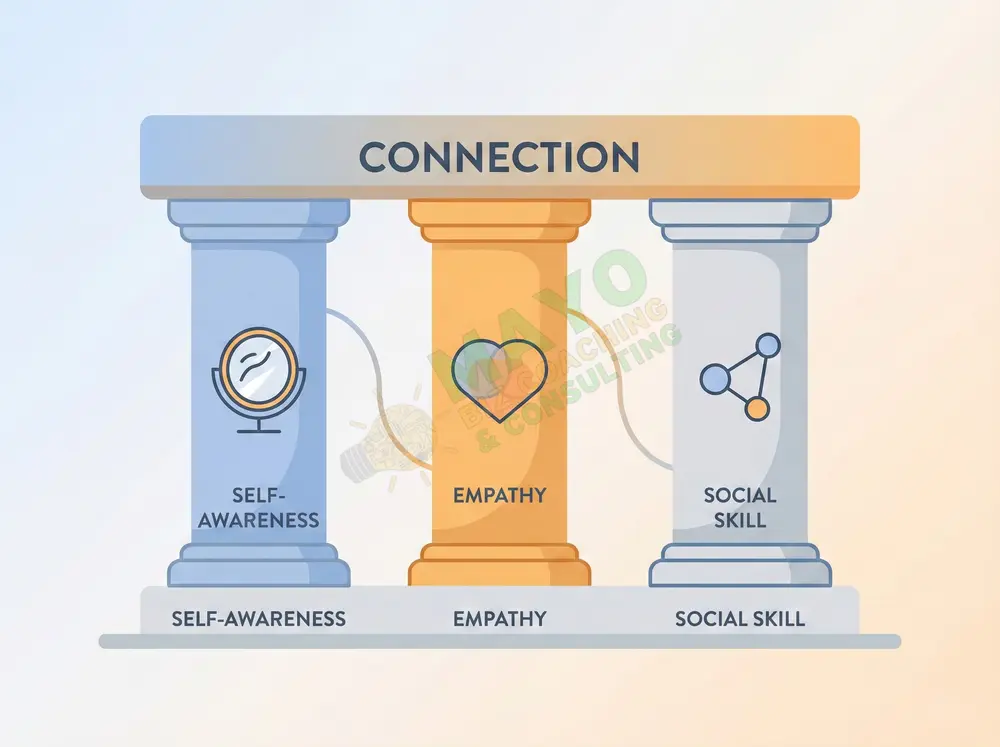
Self-Awareness in Action
Self-awareness is knowing your triggers, defaults, and blind spots before they control your behavior in public moments.
This is harder than most leaders assume. Tasha Eurich's research summary 3 notes that many people believe they are self-aware, while far fewer demonstrate it in practice.
In one client team of 15, a founder described himself as calm under pressure. Team feedback showed a different pattern: when deadlines moved, his tone became abrupt and he cut people off in meetings. He was not trying to intimidate anyone, but that was the effect.
We used a simple review method. After key meetings, he rated his behavior on clarity, tone, and curiosity. Then he compared those ratings with peer feedback. Within six weeks, interruption patterns dropped and his team raised risks earlier.
Self-awareness became useful because it was measured, not assumed.
Self-Management Under Pressure
Self-management is your ability to choose a useful response when you feel urgency, frustration, or uncertainty.
This does not mean suppressing emotion. It means creating a short pause between trigger and action so your response serves the goal.
When leaders self-manage well, teams read that as stability. When leaders react impulsively, teams learn to hide bad news.
Practical self-management habits are simple. Pause before you respond in high-stakes moments. Name the issue before assigning blame.
Separate facts, assumptions, and next actions. Delay non-urgent reactions until you have full context.
These habits support better execution and improve tone in meetings, calls, and daily choices at work.
Social Insight in Meetings
Social insight is your ability to notice emotional and relational signals across the team. You watch for what changes in meeting energy, participation, and follow-through.
In another coaching engagement with an 18-person operations team, managers were delivering status updates but skipping concerns. The leader thought momentum was strong because every report was "on track." Customer complaints said otherwise.
We introduced one rule in weekly reviews: each manager had to name one risk, one dependency, and one support request. Within a month, issue visibility improved and cross-team escalation sped up.
Social insight made hidden friction visible. That changed outcomes faster than any new dashboard.
Relationship Skills That Build Trust
Relationship management is where EI becomes practical. It is how you build trust, correct issues, and keep standards clear.
This is where active listening matters most. Listening is not passive. It is how you collect accurate information before you decide.
Center for Creative Leadership research 4 links empathetic leadership to stronger manager effectiveness ratings. The practical takeaway is simple: people execute better when they feel understood and respected.
You can think of trust like an emotional bank account. Deposits include clear follow-through, respect, recognition, and honest feedback. Withdrawals include broken commitments, dismissive reactions, and unclear expectations.
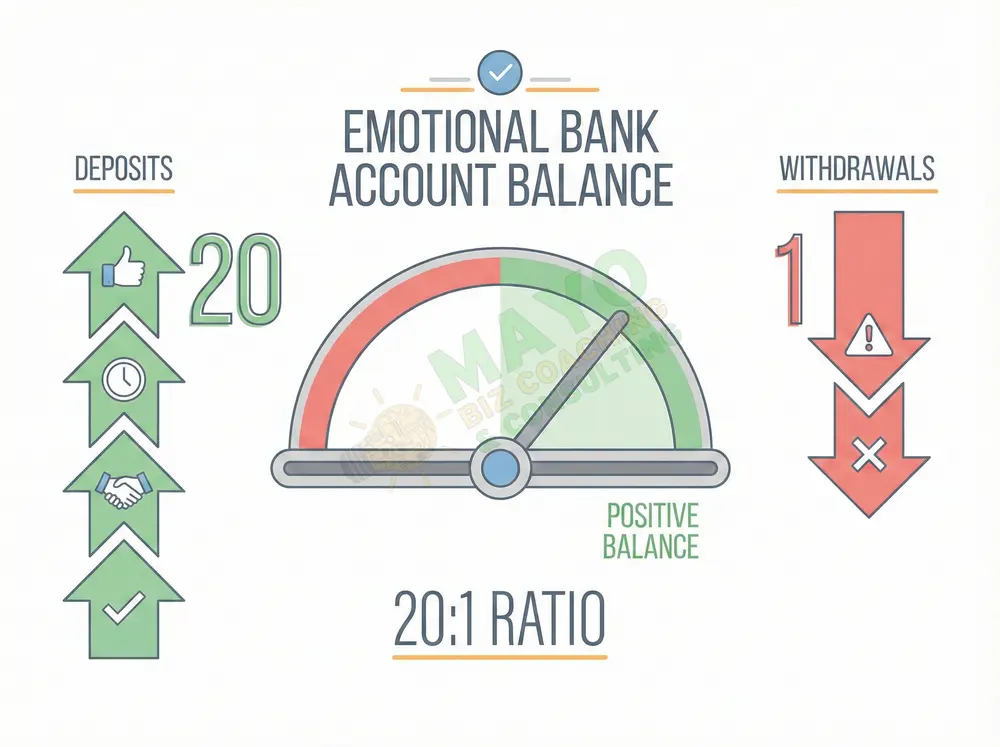
When deposits are consistent, teams can handle hard conversations without relationship collapse. When withdrawals dominate, even simple feedback feels threatening.
Common EI Mistakes
Leaders with strong intent still miss in predictable ways:
Mistake 1: Confusing calm with avoidance.
Staying calm is useful. Avoiding hard conversations is costly.
Mistake 2: Over-indexing on empathy, under-indexing on standards.
Support without standards creates comfort, not progress.
Mistake 3: Treating listening as agreement.
You can validate perspective without endorsing every proposal.
Mistake 4: Assuming tone does not matter.
Your words set direction, but your tone sets permission.
Mistake 5: Waiting for trust problems to surface publicly.
By the time conflict is visible, trust erosion is usually already advanced. Often this shows up as quiet cracking, where people still perform but silently lose engagement.
A 60-Day EI Plan
If you want practical progress, run a short cycle with clear checkpoints.
Days 1 to 20: baseline and awareness.
Track your own behavior in key meetings. Ask for feedback from three people on clarity, tone, and listening quality.
Days 21 to 40: response discipline.
Use one consistent structure for difficult conversations: clarify facts, name impact, ask perspective, confirm commitments.
Days 41 to 60: team integration.
Add a regular team prompt: "What concern are we not discussing yet?" Review risk visibility and escalation quality every week.
In my work with leadership teams, this approach usually improves team talk quality before financial metrics move. That is expected because early signals lead lag outcomes.
How to Measure EI in Practice
Use a simple monthly scorecard. Track one-on-one quality. Track speed from issue discovery to decision.
Track how many escalations include proposed options. Track retention risk signals from key contributors.
If these indicators improve over six to eight weeks, your EI work is translating into real operating performance.
If they stall, audit manager routines before rewriting values language. Most failures are execution failures, not intent failures.
What to Say in High-Pressure Moments
Leaders often know EI matters but freeze when pressure hits. A short script helps you respond with clarity and calm.
When a plan breaks, start with: "Let's slow this down and get the facts." This lowers panic and keeps people in problem-solving mode.
When someone raises a concern late, avoid blame-first language. Try: "Thank you for raising this now. What did you see first?" That keeps trust intact while you still address standards.
When a meeting gets tense, name the dynamic in plain terms. Say: "We are all pushing hard, and we are talking past each other. Let's align on the decision we need in this room." This resets focus without shaming anyone.
When you need to challenge performance, combine support with standards. Try: "I know this has been hard. The standard still stands. Let's agree on the next two actions and review by Friday." That keeps both care and clarity visible.
In one client team of 13, this language shift reduced defensive reactions in weekly reviews within three weeks. The work did not get easier, but the conversations got cleaner and faster.
You do not need perfect words. You need repeatable words that reduce fear and increase action.
Weekly EI Cadence
Most leaders improve EI through routine, not insight alone. Use one weekly cadence and keep it for at least eight weeks.
Monday: set intent.
Pick one behavior to practice this week. Examples: ask one more question before giving advice, or summarize what you heard before replying.
Midweek: run a short reflection.
Review one meeting and ask: where did I react too fast, and where did I stay curious? Capture one lesson in one sentence.
Friday: close with follow-through.
Choose one trust deposit for next week. It might be a hard feedback conversation, a clear commitment update, or a one-on-one you have delayed.
In another coaching engagement with a 20-person team, managers used this cadence for two months. They reported better one-on-one quality, faster issue escalation, and fewer unresolved tensions at week end.
This cadence works because it is light and fits real leadership schedules. It also builds proof over time that EI is not theory. It is how work gets done with less friction.
Coaching Support for Faster Progress
Leaders often know what to do but struggle to do it consistently under pressure. That is where external coaching helps.
A coach can help you identify blind spots you cannot see internally. A coach can help you rehearse hard conversations before high-risk moments. A coach can also help you build routines that hold both empathy and standards.
This is also where coaching and managing intersect. You coach to build capability and you manage to protect execution. EI helps you choose the right approach at the right time.
Let's Build Brilliance Together
EI is a leadership skill you can strengthen with focused practice.
If you want structured support building these skills, Executive Presence & Communication helps you improve self-awareness, communication, and high-stakes leadership behavior.
If you are ready to improve how your team talks and performs under pressure, reach out for a free consultation. No pressure, just an honest conversation about where you are and what your team needs next.
Research Notes & Sources
If you want to go deeper, these are the studies and reports behind the key points in this post.
- State of the Global Workplace Report(gallup.com)
- How to Create a Culture of Psychological Safety(gallup.com)
- How to Improve Your Emotional Intelligence - Professional & Executive Development | Harvard DCE(professional.dce.harvard.edu)
- The Importance of Empathy in the Workplace(ccl.org)
Category & Tags
Frequently Asked Questions
Why does emotional intelligence matter for leaders?
Emotional intelligence helps leaders stay steady, read team signals, and respond in ways that build trust. Higher EI improves communication, conflict handling, and decision quality when pressure rises.
What is the Emotional Bank Account?
The Emotional Bank Account is Stephen Covey's idea that each interaction either builds or erodes trust. Deposits include listening, keeping commitments, and clear recognition. Withdrawals include broken promises, dismissive responses, and unclear expectations.
How can a coach help develop emotional intelligence?
A coach helps you spot blind spots, practice difficult conversations, and build repeatable habits under real pressure. That turns emotional intelligence from theory into daily leadership behavior.
About the Author

About the Author
Mark Mayo
Head Coach, MBC
We get up each morning excited about sharing our 20-plus years of business acumen with small business owners and their teams. Collaborating with hard-working owners to achieve their personal and business goals brings rewards. When we develop you and grow your leaders, we create the momentum that moves you and your business forward. It starts with a first step. Then we can build brilliance together.
Related Articles

How to Have Difficult Conversations Without Destroying Trust
Difficult conversations do not need to damage trust. Use evidence-based frameworks to give clear feedback, improve accountability, and protect relationships.
Read How to Have Difficult Conversations Without Destroying Trust
How to Build a Feedback Culture That Actually Works
Build a feedback culture where honest input is normal, not an event. Five practical rituals, backed by Gallup research, to make feedback a daily team habit.
Read How to Build a Feedback Culture That Actually Works
The Manager-as-Coach Shift: From Solving to Asking
The manager-as-coach shift means changing a daily reflex, not learning a skill set. Five practical moves to stop solving and start developing your people.
Read The Manager-as-Coach Shift: From Solving to Asking