Executive Leadership & Career Coaching
Beyond IQ and EQ: Leadership Intelligences Nobody Taught You

You do not need one more leadership acronym. You need a way to make better decisions when pressure is high and time is short.
Most owners I coach still hear leadership framed as IQ versus EQ. That framing is too narrow for 2026. IQ EQ XQ AQ leadership is a more useful lens because different moments demand different strengths.
If your strategy is clear but your team is stuck, raw analysis is not enough. If morale is good but execution slips, empathy alone is not enough. If you rely only on what worked before, your experience can become a trap. And if you cannot adapt quickly, all your strengths lose value.
IQ EQ XQ AQ leadership is a stack, not a contest
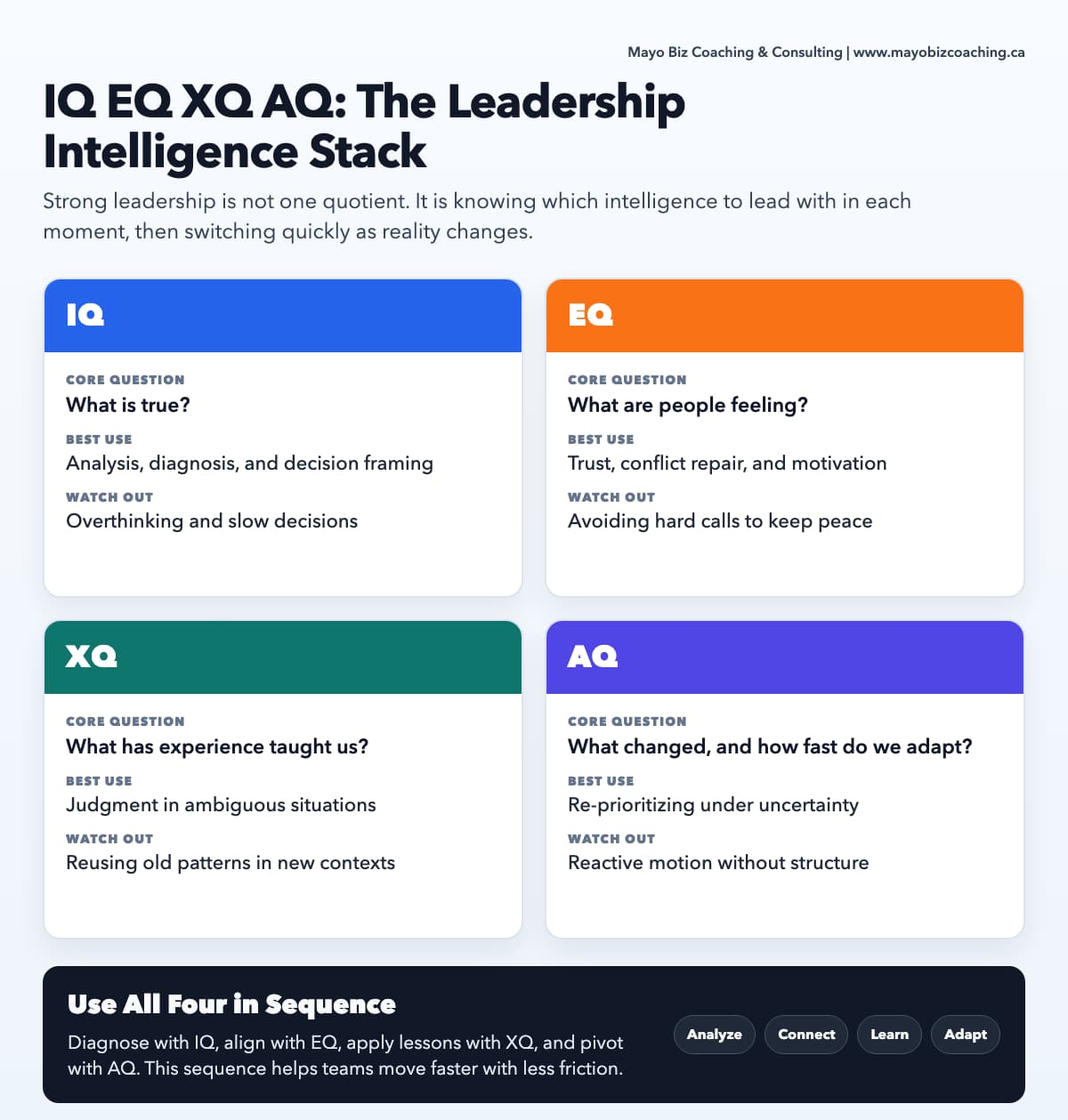
The most practical way to use these intelligences is to treat them as a stack:
- IQ helps you analyze complexity and spot patterns.
- EQ helps you read people and build trust.
- XQ helps you apply lived experience with judgment.
- AQ helps you adapt when conditions change.
No single quotient wins every situation. Strong leadership comes from using the right intelligence at the right time, then switching fast when reality shifts.
Here is a practical comparison:
| Intelligence | Core question | Strongest use | Common failure mode |
|---|---|---|---|
| IQ | What is true? | Analysis, diagnosis, planning | Overthinking, slow decisions |
| EQ | What are people feeling? | Trust, conflict, motivation | Avoiding hard calls to keep peace |
| XQ | What have we learned from lived experience? | Judgment in ambiguous situations | Repeating old patterns in new contexts |
| AQ | What changed, and how fast do we adapt? | Pivoting under uncertainty | Reacting without focus or structure |
When you lead a team of 8 or 20 people, you often cycle through all four in the same week.
IQ still matters, but the impact is smaller than many leaders assume
IQ is still relevant. A large 2024 meta analysis in the Journal of Applied Psychology confirmed general cognitive ability predicts job performance, but at lower levels than many older headline claims suggested (Sackett et al., 2024 1).
That matters for leadership because it resets expectations. IQ is valuable, but it is not a magic multiplier. It helps you structure problems, evaluate trade offs, and avoid weak logic. It does not guarantee influence, alignment, or follow through.
Another 2024 meta analysis found little evidence that cognitive ability becomes less useful with job tenure (Hambrick et al., 2024 2). In simple terms, strong thinking still matters even when people are experienced.
So what is the practical takeaway this week: treat IQ as your analytical floor, not your leadership ceiling.
EQ is where strategy turns into trust and execution
Emotional intelligence is often discussed softly, but the evidence base is not soft. A meta analysis found EI was meaningfully related to job performance and added predictive value beyond cognitive ability and personality traits (O'Boyle et al., 2011 3).
For leaders, that extra value shows up in team behaviour. A cross cultural meta analysis reported that leader emotional intelligence was positively related to subordinate task performance and organizational citizenship behaviour (Miao et al., 2018 4).
If that sounds academic, translate it like this: teams execute faster when they trust your intent and feel understood.
This is why I keep returning to connection-first emotional intelligence. Without connection, strategy stays on slides. With connection, strategy moves into daily behaviour.
EQ does not mean being agreeable all the time. It means reading the room accurately, naming what is real, and having hard conversations without destroying trust.
XQ is lived experience turned into usable judgment
XQ is commonly used as shorthand for experiential intelligence. The useful part of this idea is simple: experience helps only when you reflect on it and apply it to the right context.
The most credible academic bridge here is research on successful intelligence. A 2021 meta analysis found successful-intelligence training improved student outcomes, with stronger effects in socioemotional areas than pure academic outcomes (Saw and Han, 2021 5).
For leaders, that points to a practical truth. Experience alone does not create wisdom. Reflection, pattern recognition, and context matching create wisdom.
You can see this clearly in experience intelligence leadership: the leaders who improve fastest are not the ones with the longest resumes. They are the ones who pause, extract lessons, and adjust behaviour in real time.
Use XQ carefully. It is a practical framework, not a complete replacement for established IQ or EQ research. If you present it that way, it becomes useful instead of hype.
AQ is the multiplier when uncertainty becomes the norm
AQ refers to adaptability: your ability to shift decisions, behaviour, and team systems when conditions change. The construct is well supported through adaptive performance research, which identified multiple dimensions of adaptability at work (Pulakos et al., 2000 6).
This is not a niche issue anymore. Research from the Center for Creative Leadership links poor adaptability to leadership derailment and shows that adaptable leaders perform better under changing conditions (Center for Creative Leadership 7).
For a small business owner, AQ shows up in plain situations:
- A key client changes buying behaviour
- A strong employee resigns unexpectedly
- Input costs jump for two quarters
- New tools alter how fast your team can deliver
In those moments, AQ is your ability to adapt without creating panic. You still need structure. You still need priorities. But you cannot lead as if last quarter still exists.
If this feels familiar, connect it to leading your team through economic uncertainty. AQ is uncertainty leadership in practice.
Which intelligence leads in which situation?
If you are asking, "Which one matters most?" the better question is, "Which one leads this situation first?"
Use this field guide:
- Strategic reset after weak results: start with IQ to diagnose facts, then EQ to align people around the plan.
- Escalating team conflict: start with EQ to stabilize trust, then IQ to define roles and decision rules.
- New market or product shift: start with AQ to reframe priorities quickly, then IQ to test options.
- Repeated mistakes despite good intentions: start with XQ to extract lessons from experience, then AQ to change routines.
- Decision gridlock at leadership level: start with IQ for clarity, then EQ to surface hidden concerns. If the environment changed, bring in AQ.
This sequencing helps you avoid a common trap: using your favourite intelligence in every scenario.
Spot your blind spot in 10 minutes
Most leaders overuse one intelligence and underuse another. You can identify your likely blind spot quickly.
Rate yourself from 1 to 5 on each statement:
- IQ: "I separate signal from noise quickly when data conflicts."
- EQ: "People tell me hard truths before problems escalate."
- XQ: "After setbacks, I capture lessons and change behaviour within a week."
- AQ: "When conditions shift, I re-prioritize quickly without losing team focus."
Now ask two team members you trust to rate you on the same four statements.
The biggest gap between your score and theirs is usually your development priority.
If your scores are all high, test them against outcomes. Are decisions faster? Is trust stronger? Is turnover lower? Are pivots cleaner? Leadership claims should always meet behavioural evidence.
A 30-day build plan for all four intelligences
You do not need paid assessments to improve this. You need focused reps.
- Week 1 (IQ): Pick one recurring decision. Write a one-page decision frame: assumptions, evidence, risk, trigger points.
- Week 2 (EQ): Run two listening-first one on ones. Ask what people are not saying in group meetings. Summarize back before you respond.
- Week 3 (XQ): Run a 30-minute after-action review on one win and one failure. Capture three lessons and one behaviour change per lesson.
- Week 4 (AQ): Identify one external change that could hurt or help you this quarter. Create one pivot option, assign an owner, and set review dates.
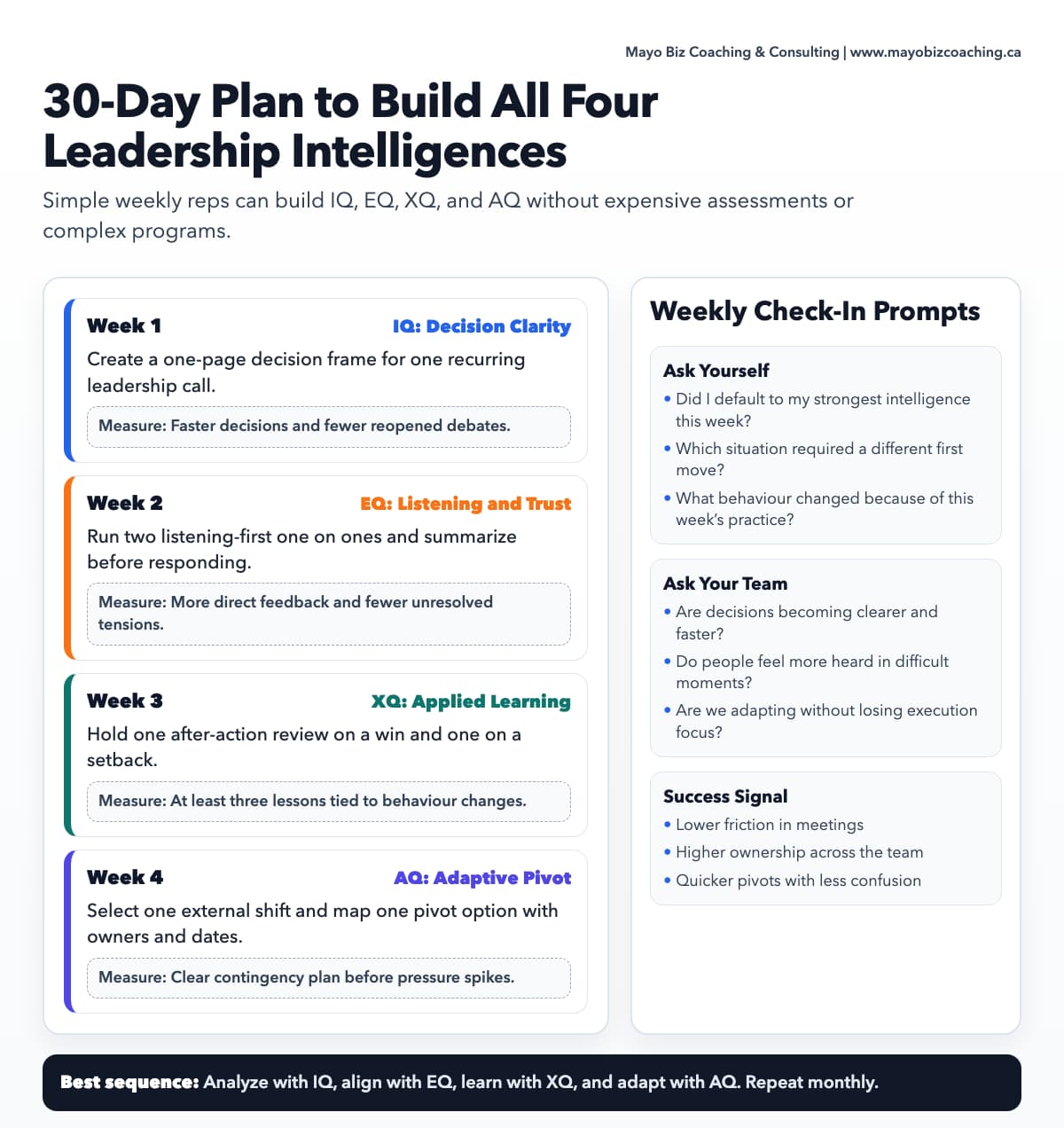
Why this works: it links intelligence to behaviour, and behaviour to business outcomes.
Canadian small business data supports that operational focus. BDC reports that firms investing intentionally in workplace culture see better engagement and retention outcomes (BDC, 2024 8). Culture is not separate from execution. It is the system where these intelligences compound.
Trade offs to keep in view
No framework is complete on its own.
- IQ without EQ can create brilliant plans nobody owns.
- EQ without IQ can create harmony without clear decisions.
- XQ without AQ can lock you into yesterday's playbook.
- AQ without IQ can become reactive motion instead of strategic change.
This is why leadership development should be portfolio based. Build all four, and adjust emphasis by situation.
If your team is currently stuck in overthinking or avoidance, you may also recognize patterns from decision paralysis. The fix is rarely one tool. It is better diagnosis plus better sequencing.
Let's Build Brilliance Together
The strongest leaders I work with are not the smartest person in the room every day. They are the most adaptive about which intelligence the moment requires, and they practice all four deliberately.
If you are noticing a blind spot in your own leadership stack, reach out for a free consultation. No sales pitch, just an honest conversation about where you are and what you're working on.
Research Notes & Sources
If you want to go deeper, these are the studies and reports behind the key points in this post.
- Sackett et al., 2024(pubmed.ncbi.nlm.nih.gov)
- Hambrick et al., 2024(pubmed.ncbi.nlm.nih.gov)
- O'Boyle et al., 2011(cir.nii.ac.jp)
- Miao et al., 2018(ideas.repec.org)
- Saw and Han, 2021(pubmed.ncbi.nlm.nih.gov)
- Pulakos et al., 2000(pubmed.ncbi.nlm.nih.gov)
- Center for Creative Leadership(ccl.org)
- BDC, 2024(bdc.ca)
Category & Tags
Frequently Asked Questions
Is IQ still important for leadership success?
Yes. IQ still predicts job performance, but the effect size is more modest than older claims. It is a useful foundation for analysis, not a complete leadership system on its own.
Does emotional intelligence add value beyond IQ?
Yes. Meta analyses show emotional intelligence adds predictive value beyond cognitive ability and personality, especially in trust building, team performance, and cooperative behaviour.
What is XQ in leadership?
XQ is typically used to describe experiential intelligence: your ability to convert lived experience into better judgment. It is a practical framework and should be used with clear evidence boundaries.
What does AQ mean for a small business leader?
AQ refers to adaptability under change. For small business leaders, it means adjusting priorities, decisions, and team routines quickly when markets, talent conditions, or customer needs shift.
About the Author

About the Author
Mark Mayo
Head Coach, MBC
We get up each morning excited about sharing our 20-plus years of business acumen with small business owners and their teams. Collaborating with hard-working owners to achieve their personal and business goals brings rewards. When we develop you and grow your leaders, we create the momentum that moves you and your business forward. It starts with a first step. Then we can build brilliance together.
Related Articles

Self-Awareness Is a Leadership Skill You Can Build
Most leaders think they're self-aware. Research says only 10-15% actually are. Here is how to close the gap and lead with clearer self-knowledge.
Read Self-Awareness Is a Leadership Skill You Can Build
Learning Agility: Why the Fastest Learners Lead Best
Learning agility predicts leadership success better than experience alone. Here is what it means for small business leaders and how to build it this month.
Read Learning Agility: Why the Fastest Learners Lead Best
Experience Intelligence: Why Your Best Leaders Design Experiences, Not Manage Outcomes
Experience intelligence is the leadership skill of designing how people feel at work. Learn why listening is the foundation and how to start this week.
Read Experience Intelligence: Why Your Best Leaders Design Experiences, Not Manage Outcomes