Team Leadership Development
Workplace Loneliness Is a Leadership Problem, Not an HR One
Something in your team doesn't quite fit. Meetings run fine. Work gets done. But conversations stop the moment they don't have to happen. People eat lunch at their desks. Nobody lingers.
If you pressed them, they'd all say everything is fine.
What you're seeing is workplace loneliness. Not isolation. Not dissatisfaction, necessarily. Loneliness: the quiet sense that the relationships here don't quite fill the gap.
And if you lead a team of 10 or 20 people, this is yours to address.
What the data actually shows
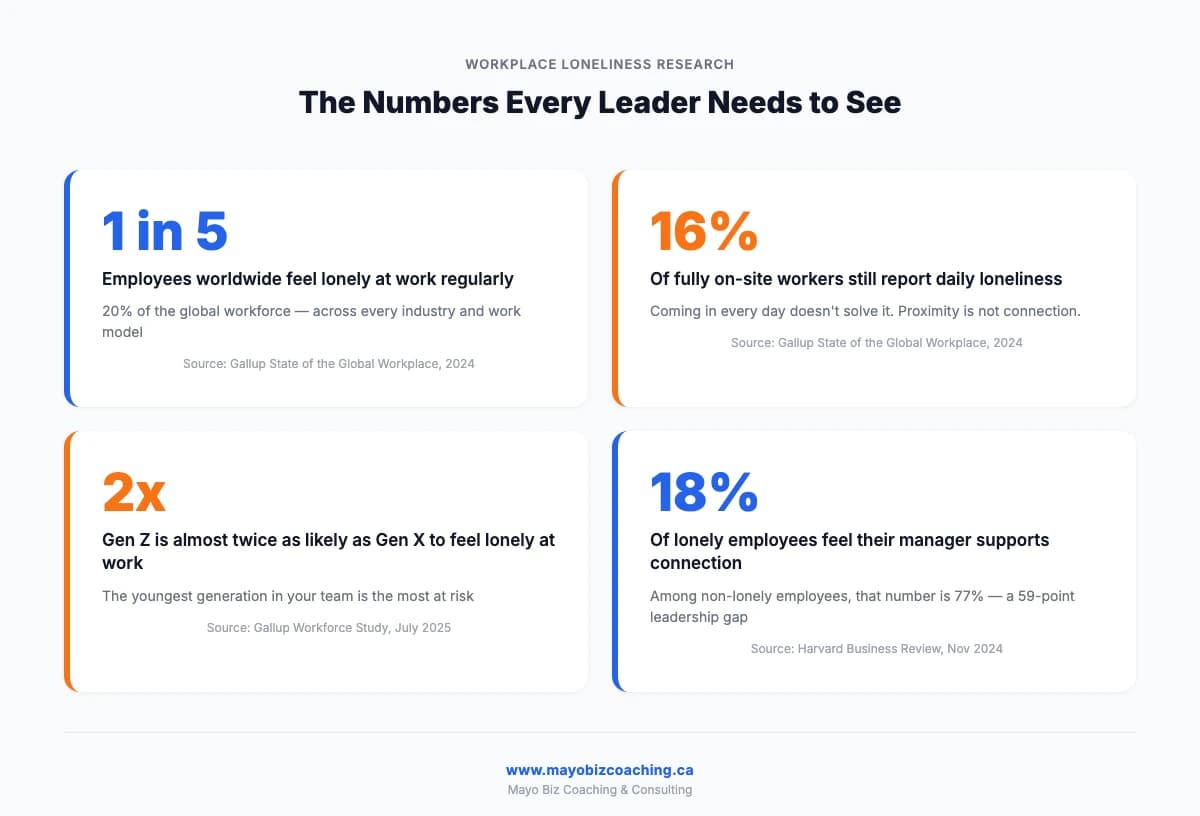
Gallup's 2024 State of the Global Workplace report 1 found that one in five employees worldwide experiences regular loneliness at work. That's 20% across every industry, every country, every kind of team.
Most leaders assume this is a remote work problem. Get people back to the office and it goes away.
It doesn't. Gallup found that 16% of fully on-site employees -- people who come in every single day -- still report daily loneliness. You can fill a room and still have people in it who feel completely alone.
The Gen Z data makes this harder to dismiss. Gallup's July 2025 workforce research 2 found that Gen Z employees are almost twice as likely as Gen X to say they experienced loneliness the day before. That's not an HR footnote. That's a retention and performance issue sitting in your team right now.
Why getting people back to the office doesn't fix it
Here is what the research says about the proximity assumption.
A 2024 study published in Harvard Business Review, "We're Still Lonely at Work" 3, looked closely at highly lonely employees. Those employees conducted 47% of their prior month's work in person. Nearly half of all their interactions were face-to-face. They were still deeply lonely.
The same research found that whether employees came in two days a week or five made no meaningful difference in their loneliness levels.
In Canada, Signal49's March 2025 research 4 (formerly the Conference Board of Canada) confirmed the same finding: remote, hybrid, and fully in-office workers show no significant difference in reported loneliness. What matters isn't where someone works. It's the quality of the relationships they have while working there.
Loneliness isn't a seating problem. It's a connection problem. Researchers at Portland State University put it plainly: loneliness is the subjective sense that your relationships are deficient, not a count of how many people are nearby. High-stress roles with poor manager support produce loneliness even in a full office. Physical presence doesn't change that equation. Deliberate connection does.
Why this is a leadership problem
The same HBR research found that only 18% of highly lonely employees felt their manager adequately supported workplace relationships. Among employees who weren't lonely, that number was 77%.
That gap -- 18% versus 77% -- is the leadership variable. It's the single biggest difference between a team where people feel genuinely connected and a team where they quietly don't.
A September 2025 Harvard Business Review analysis 5 framed it plainly: workplace loneliness costs U.S. companies up to $154 billion annually through burnout, declining productivity, and higher attrition. The same article argued that connection at work is "critical infrastructure" -- not a wellness programme perk -- and identified frontline leaders as the force that either builds or dismantles it.
Signal49's Canadian research adds a practical layer. Employees who feel their leaders are accessible and inclusive report meaningfully lower levels of isolation. Accessibility here isn't an open-door policy. It's leaders who are genuinely present in their interactions, not just physically available. That distinction matters in a small business where the owner and the team share the same ten metres.
For the owner of a 15-person business in Ontario, you are that frontline leader. You're closer to your team than any middle manager in a large company. That's an advantage. You can notice things, ask things, and respond to things that a corporate wellness programme never could.
The question is whether you're using that proximity deliberately.
What loneliness actually looks like on a small team
It rarely looks like someone sitting alone. It looks ordinary.
It looks like the person who always volunteers for solo tasks and never for collaborative ones. The one who is polite but entirely transactional in every interaction. The new hire who seems to be settling in but whose answers get shorter over time. The team member who does good work but has stopped offering ideas.
These aren't performance problems. They are social signals. A leader who is paying genuine attention will catch them early.
Psychological safety research tells us that lonely employees are far less likely to raise problems, share ideas, or ask for help. Loneliness and silence reinforce each other. The more disconnected someone feels, the less they speak. The less they speak, the less they're seen. The cycle tightens.
I've seen this pattern more times than I can count. A business owner says their team is "solid, no complaints." A few months later, their best person resigns.
When we work through it together, the signs were there for a year: shorter emails, fewer suggestions in meetings, skipped optional team lunches. He had noticed each of those things individually but never connected them. "I thought she was just busy." That's what loneliness looks like from the outside: someone being busy.
What leaders can do every day
This isn't about launching a connection programme or booking a team-building event. It's about daily behaviour.
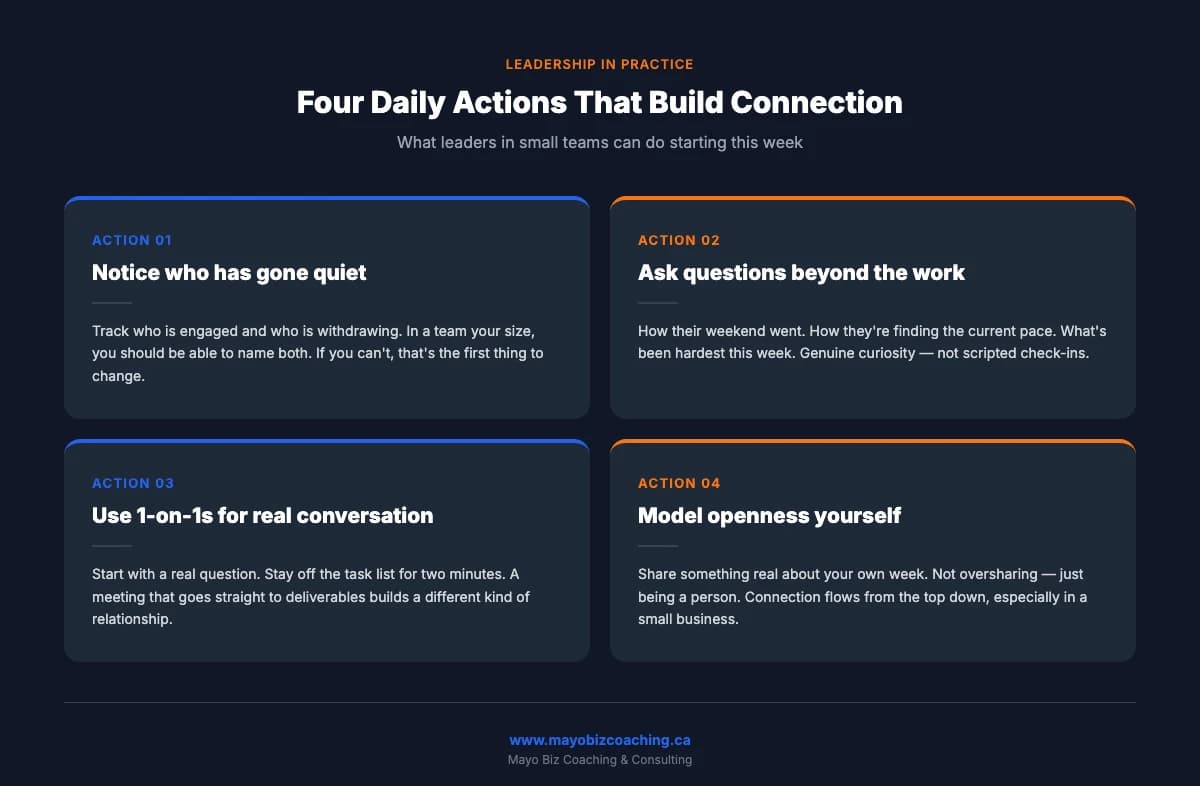
Notice who has gone quiet. Not in a surveillance way, but in the way you notice when something you know well has shifted. In a team your size, you should be able to name who is engaged and who is withdrawing. If you can't, that's the first thing to change.
Ask questions that aren't about the work. Not invasive questions. Not scripted wellness check-ins. Questions that treat someone as a person: how their weekend went, how they're finding the current pace, what's been the hardest part of the week. You don't need a coaching certification to do this. You need to be genuinely curious.
Use one-on-ones for real conversation, not just status updates. A regular one-on-one that starts with a real question and stays off the task list for a couple of minutes creates a different kind of relationship. The one that goes straight to deliverables can't do this. That small shift accumulates. Over a month, it changes how someone experiences their work.
Model the behaviour yourself. If you eat alone and go straight to your desk after every meeting, your team reads that. If you share something real about your own week in a team setting -- not oversharing, just being a person -- it gives everyone else permission to do the same. Connection tends to flow from the top down, especially in a small business.
Consistency is what makes any of this real. A single genuine question doesn't build connection. Repeated questions, over weeks and months, do. Your team learns whether you're curious about them as people or just performing it. That distinction shows up quickly.
Active listening is the root tool
All of this comes back to active listening. Not as a technique to deploy in specific situations, but as a genuine way of working with people.
Most people who feel lonely at work don't need more social events. They need to feel heard. They need to experience that someone noticed them, asked about them, and actually stayed with their answer instead of pivoting to the next item.
Active listening is how you create that experience in a daily, repeatable way. It's asking a real question and then staying quiet long enough to hear the full response. It's following up the next day on what someone told you the day before. It's catching yourself when you're already composing your reply while someone else is still talking.
Leaders who do this well don't think of it as loneliness prevention. They think of it as just how they work with people. That's the point.
The same behaviours that make your team feel connected also make you more effective as a leader. You learn what's really happening. People bring you problems before they become crises. Trust develops at a pace that no team event can replicate.
The connection-first leadership model isn't about lowering your standards. It's about recognizing that people perform better when they feel genuinely seen at work. The evidence is consistent. The practice is straightforward.
The only question is whether you're doing it.
Let's Build Brilliance Together
Workplace loneliness doesn't resolve on its own. But it doesn't require a programme, a budget, or a new initiative either. It requires leaders who pay attention, ask real questions, and create the daily conditions for genuine connection.
If you want to think through what that looks like in your team specifically, reach out for a free consultation. No sales pitch, just an honest conversation about where you are and what you're working on.
Research Notes & Sources
If you want to go deeper, these are the studies and reports behind the key points in this post.
Category & Tags
Frequently Asked Questions
Why do employees feel lonely at work even in an office?
Loneliness is about the quality of relationships, not physical proximity. Research found that 47% of highly lonely employees conducted nearly half their work interactions in person. What matters is whether people feel seen and valued, and that's shaped largely by how their manager engages with them day to day.
Is workplace loneliness a manager's responsibility?
Yes. Only 18% of highly lonely employees feel their manager adequately supports workplace relationships, compared to 77% of employees who aren't lonely. That gap is the leadership variable. The daily behaviours a leader chooses either build connection or let it erode.
What can a leader do about workplace loneliness on a small team?
Start with small, consistent daily actions: ask a question that isn't about the work, notice who has gone quiet in meetings, and use one-on-ones for real conversation rather than status updates. Active listening is the most practical tool a small business leader has, and it costs nothing.
Are Gen Z workers more affected by workplace loneliness?
Yes. Gallup's 2025 research found Gen Z employees are almost twice as likely as Gen X to report experiencing loneliness at work. That makes this a retention issue as much as a wellbeing one, since meaningful peer relationships are one of the top factors in Gen Z workplace motivation.
About the Author

About the Author
Mark Mayo
Head Coach, MBC
We get up each morning excited about sharing our 20-plus years of business acumen with small business owners and their teams. Collaborating with hard-working owners to achieve their personal and business goals brings rewards. When we develop you and grow your leaders, we create the momentum that moves you and your business forward. It starts with a first step. Then we can build brilliance together.
Related Articles
Why Your Best Employee Won't Leave But Won't Grow Either
Job hugging employee development can stall your leadership pipeline. Learn how to reopen growth with lateral paths, coaching talks, and clear expectations.
Read Why Your Best Employee Won't Leave But Won't Grow Either
FOBO: When Your Team Fears Becoming Obsolete
52% of workers fear AI will reshape their role. Coaching frameworks for leaders to recognize FOBO on their teams and turn anxiety into growth.
Read FOBO: When Your Team Fears Becoming Obsolete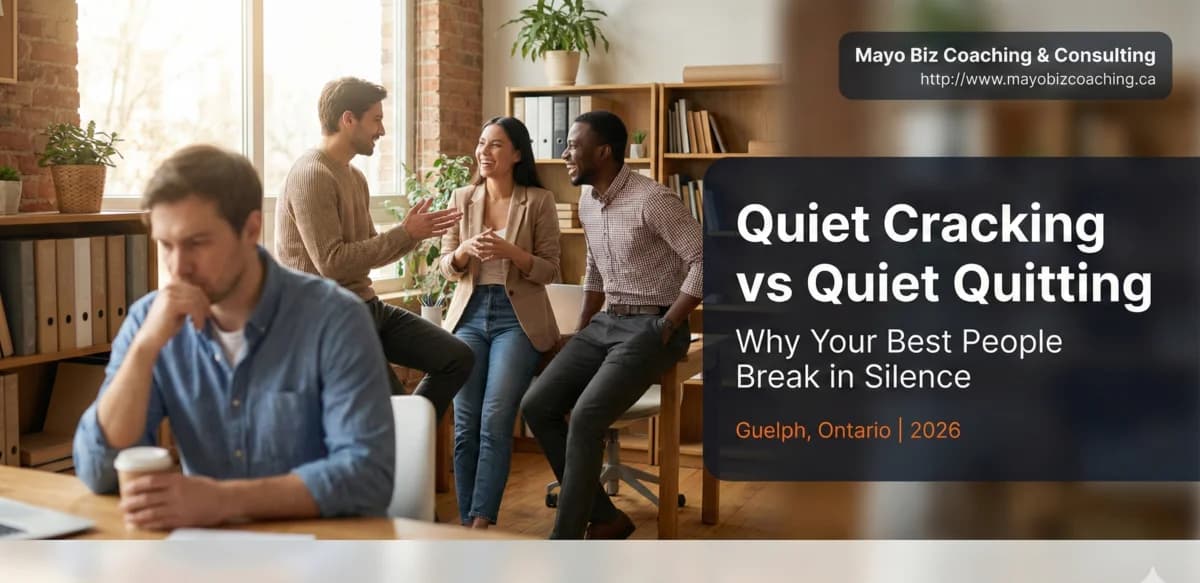
Quiet Cracking vs Quiet Quitting: Why Your Best People Break in Silence
54% of employees are quietly cracking at work. Learn how quiet cracking differs from quiet quitting, why leaders miss it, and what you can do about it.
Read Quiet Cracking vs Quiet Quitting: Why Your Best People Break in Silence