Team Leadership Development
Who Helped You? The One Question That Changes Team Culture

Someone on your team just closed a deal, solved a hard problem, or delivered a project ahead of schedule. Your instinct is to celebrate them. Good instinct. But there is a better first move.
Ask them: "Who helped you?"
Simon Sinek describes this as the single leadership habit that transforms how a team operates 1. As the first response to every win, not an afterthought.
Then, and this is the part most leaders skip, name those helpers publicly. In the team meeting, the group chat, the email to leadership. Make the assist as visible as the goal.
Why stars don't always win
Sinek tells a story from his time teaching. He stacked his top performers on one team, expecting them to dominate. Instead, they fought over credit and focused on protecting their own grades. The team of average performers? They covered for each other, shared the load, and focused on the group outcome. They won every time.
His conclusion: teams of average performers consistently beat teams of high performers. Not sometimes. Consistently.
That pattern shows up well beyond a classroom. Google's Project Aristotle 2 studied 180 teams and found that psychological safety, not raw talent or team composition, was the strongest predictor of team effectiveness. Teams with high psychological safety were rated effective twice as often by executives. The common thread wasn't who was on the team. It was whether people felt safe enough to rely on each other.
When you ask "who helped you?" and then name those people out loud, you're building exactly that kind of safety. You're telling your team: helping others is how we win here.
Most leaders don't realize they're doing the opposite. They celebrate the person who closed the deal, hit the number, or delivered the project. That's fine. But when that's the only thing that gets noticed, you're training your team to compete for the spotlight instead of supporting each other.
I hear this a lot in coaching: "My team doesn't collaborate well." When I ask how they recognize good work, the answer is almost always individual performance metrics. Revenue. Output. Targets. The helping that made those numbers possible is invisible to the system. You can't fix collaboration by telling people to collaborate. You fix it by making collaboration the thing that gets seen.
The recognition gap most leaders don't see
Most leaders think they're already doing this. The data says otherwise.
Gallup's recognition research (2016) 3 found that only one in three workers strongly agree they received recognition or praise for doing good work in the past seven days. One in three. And employees who don't feel adequately recognized are twice as likely to say they'll quit in the next year.
The data also shows where recognition lands hardest. The most memorable recognition comes from a direct manager (28%) or a senior leader (24%). Peer recognition, while valuable, ranks at just 9%. That tells you something important: when a leader publicly names the helpers behind a win, it carries more weight than almost any other form of acknowledgment.
Most recognition systems celebrate the person who scored. The salesperson who closed the deal. The developer who shipped the feature. The manager who hit the quarterly target. But none of those things happen alone. There's always someone who did the research, made the introduction, covered someone else's workload, or quietly solved a problem that would have derailed the whole effort.
Those people rarely get named. And over time, they stop going out of their way to help. Why would they? Nobody notices.
This comes up in coaching more than you'd expect. The people holding the team together often feel invisible. They're not asking for a trophy. They're asking for a sign that their effort registers. When that sign never comes, they pull back. They do what's required and nothing more. From the outside it looks like disengagement, but it's actually a rational response to a system that only rewards the visible wins.
What gratitude actually does to a team
Research from UC Berkeley's Greater Good Science Center (2017) 4 found that employees who regularly acknowledged who helped them through weekly gratitude letters saw measurable increases in productivity and autonomy at work. The researchers called gratitude "an activating, energizing force," not a passive warm feeling.
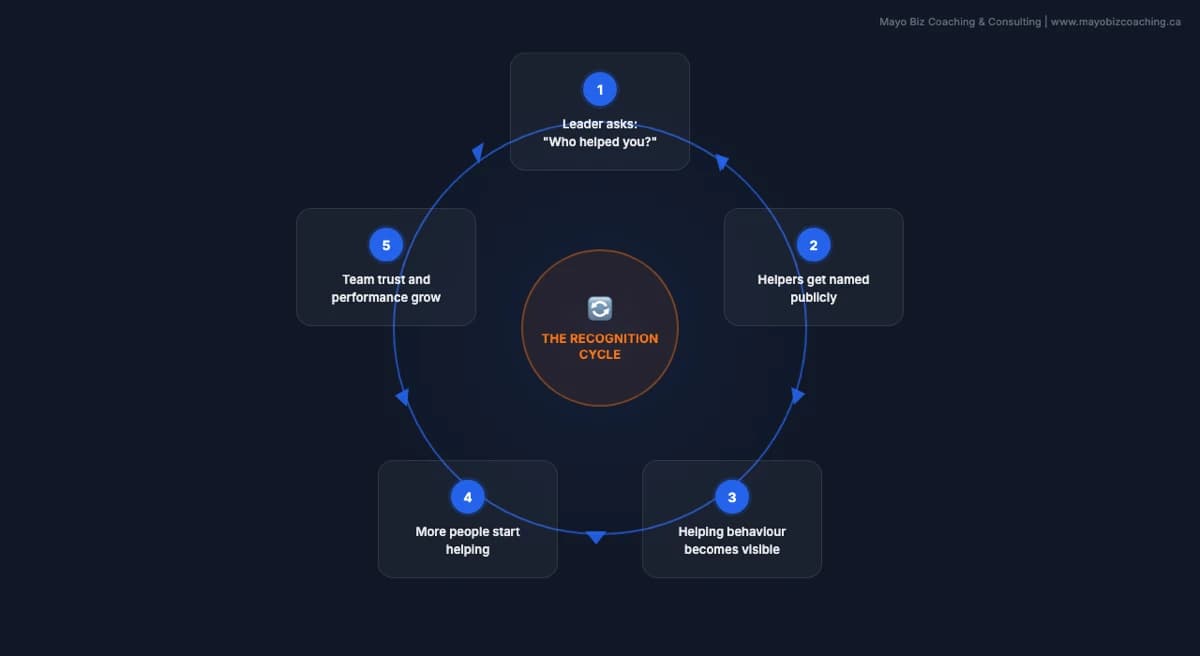
That lines up with what I see in coaching. When you tell someone their help mattered, they feel closer to the team. That closeness makes them want to prove they're worthy of it. So they help more. And the cycle builds on itself.
The reverse is also true. When helping goes unacknowledged, people start keeping score informally. That resentment is quiet, but it's corrosive. It shows up as reluctance to volunteer, slower response times on cross-team requests, and the kind of low-grade friction that makes a leader think they have a process problem when they actually have a recognition problem. Most of the collaboration issues I work on with leaders trace back to this. The fix isn't a new workflow or a better project management tool. It's making sure the people who help others know their effort landed.
Adam Grant's work on givers and takers in organizations (2013) 5 found the same pattern from the other direction. In most teams, people quietly decide whether to help or protect their time. When helping goes unrecognized, the givers burn out or learn to hold back. When it gets named and acknowledged, the social norm shifts. Helping becomes the thing people compete to do.
That's what "who helped you?" does at scale. It makes the invisible work visible, and people repeat what gets seen.
How to make this stick
The question only works if you ask it consistently and follow through publicly.
- Every win gets the question. Someone hits a milestone or solves a hard problem. Your first response is "who helped you?" Not after the congratulations. As part of them.
- Name the helpers by name. Sinek's example: when Elizabeth closes the big client, don't just celebrate Elizabeth. Find out that Jake did the research, Maria made the introduction, and Tom covered her other accounts. Then say that out loud, in front of the team.
- Do it every week. This isn't a quarterly programme or an annual award. It's a weekly rhythm. The consistency reshapes the culture, not the gesture itself.
- Watch what changes. People start helping each other more because they know it will be seen. They stop hoarding information because collaboration gets recognized. The quiet contributors who always made others better but never got noticed finally feel valued.
| Old pattern | New pattern |
|---|---|
| Celebrate the closer | Celebrate the closer and the team behind them |
| Individual metrics drive recognition | Helping behaviour drives recognition |
| Quiet contributors go unnoticed | Quiet contributors get named publicly |
| Stars compete for credit | Stars compete to be the person others name |
| Leader as scorekeeper | Leader as culture guardian |
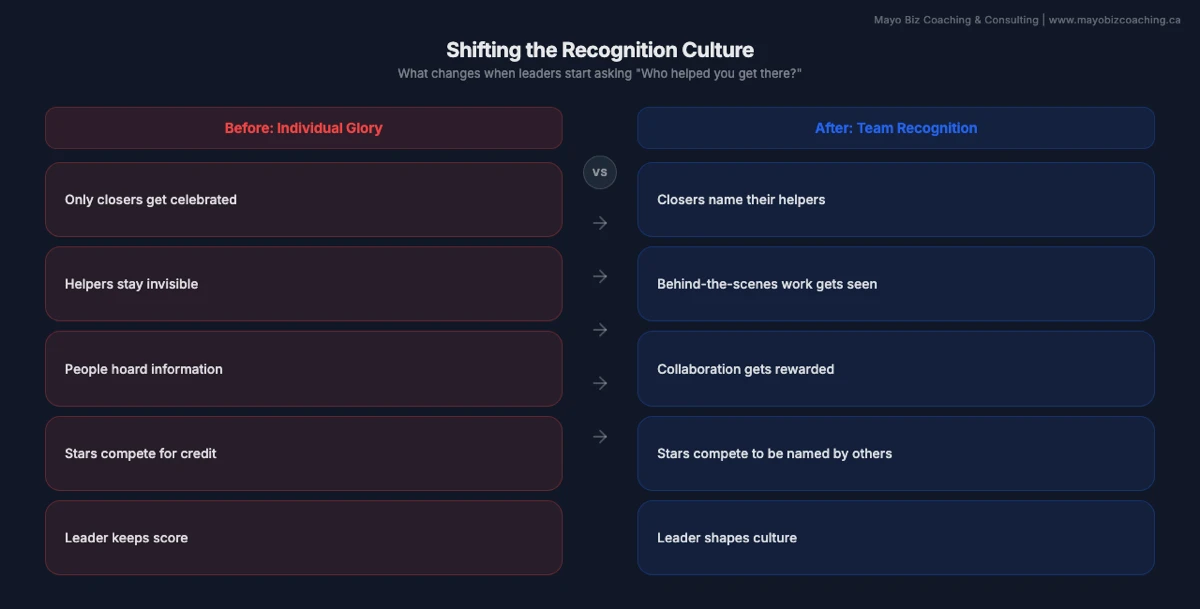
The question is simple. The follow-through is what builds the culture.
I've watched this shift happen in teams I work with. Once the leader commits to the weekly rhythm, the change usually shows up within a month. People start volunteering for things they wouldn't have touched before. Cross-team requests get faster responses. The quiet contributors who were pulling back start leaning in again because their work is finally visible. No new system required. No budget. Just one question, asked consistently, with follow-through that everyone can see.
From scorekeeper to culture guardian
Sinek puts it simply: "Leadership is not about being in charge. Leadership is about taking care of those in your charge."
Asking "who helped you?" is one way to live that out. The shift is what it does to you as a leader. It moves you from evaluating individual performance to multiplying the team's collective capability. You stop keeping score and start shaping culture.
That matters because the problems most teams struggle with, best people going quiet and psychological safety breaking down, don't get fixed with better processes. They get fixed when people believe their contributions matter and their help will be seen.
A caveat worth naming: this works best when your team already has a baseline level of trust. If psychological safety is very low, public naming can feel performative or even uncomfortable for introverted team members who prefer private acknowledgment. Read the room. Some people light up when named in front of the group. Others would rather hear it one-on-one. The question stays the same. How you deliver the recognition should fit the person.
One question. Asked every week. Followed through publicly.
It sounds small. The teams that do it will tell you it changed everything.
Let's Build Brilliance Together
Building a team culture where people genuinely help each other starts with how you respond to wins. It's a small shift that compounds fast.
If you're noticing that your team operates more like individuals sharing a room than a unit working together, reach out for a free consultation. No sales pitch, just an honest conversation about where your team is and what could shift.
Research Notes & Sources
If you want to go deeper, these are the studies and reports behind the key points in this post.
- Simon Sinek | The Optimism Company(simonsinek.com)
- Google re:Work - Guides: Understand team effectiveness(rework.withgoogle.com)
- The Importance of Employee Recognition: Low Cost, High Impact(gallup.com)
- How Gratitude Motivates Us to Become Better People(greatergood.berkeley.edu)
- In the Company of Givers and Takers(hbr.org)
Category & Tags
Frequently Asked Questions
Why does asking "who helped you?" improve team culture?
It shifts the spotlight from individual achievement to collective effort. When helpers are named publicly, people start collaborating more because they know their contributions will be seen. Over time, the team competes to be the person others name, not the one who takes all the credit.
How often should leaders recognize their team?
Gallup research (2016) shows that employees who receive recognition at least every seven days are significantly more engaged. Only one in three workers say they received recognition in the past week. Making "who helped you?" a weekly habit addresses this gap directly.
What is the connection between recognition and psychological safety?
Google's Project Aristotle found psychological safety is the top predictor of team effectiveness. Publicly naming helpers builds safety signals because it shows that contributing to others is valued as much as individual output. People take more interpersonal risks when they see helping behaviour rewarded.
Do high-performing teams need more recognition than others?
Often yes. Star performers stacked together tend to compete for individual credit rather than collaborate. Research shows teams of average performers with strong trust consistently outperform talent-heavy teams without it. Recognition of helpers is what builds that trust.
About the Author

About the Author
Mark Mayo
Head Coach, MBC
We get up each morning excited about sharing our 20-plus years of business acumen with small business owners and their teams. Collaborating with hard-working owners to achieve their personal and business goals brings rewards. When we develop you and grow your leaders, we create the momentum that moves you and your business forward. It starts with a first step. Then we can build brilliance together.
Related Articles
The Manager-as-Coach Shift: From Solving to Asking
The manager-as-coach shift means changing a daily reflex, not learning a skill set. Five practical moves to stop solving and start developing your people.
Read The Manager-as-Coach Shift: From Solving to Asking
Conscious Unbossing: Why Gen Z Doesn't Want to Manage
Over half of Gen Z workers don't want management roles. That's not entitlement. It's a rational response to how most organizations have designed the job.
Read Conscious Unbossing: Why Gen Z Doesn't Want to Manage
Workplace Loneliness Is a Leadership Problem, Not an HR One
One in five workers feel lonely at work, including 16% who come in every day. The research points to leaders, not HR programmes, as the real solution.
Read Workplace Loneliness Is a Leadership Problem, Not an HR One