Executive Leadership & Career Coaching
When "Do More With Less" Becomes the Only Strategy

You have said it. Maybe more than once. Maybe it was the right call at the time.
"We are going to have to do more with less."
It passes as leadership. It sounds like discipline, like toughness. And in the short run, it often works. The team rallies. Expenses stabilize. Things hold together.
The problem is what happens when it doesn't end.
For a lot of organizations, "do more with less" stops being a response to a specific pressure and becomes the answer to everything. Every slow quarter. Every budget cycle. Every resource request that comes across the desk. At that point, you're not managing a constraint. You're building a culture around one.
And that culture has a cost. It just takes a while to show up on the spreadsheet.
The Math Looks Right. The Reality Does Not.
The phrase is appealing because it frames sacrifice as efficiency. It implies there was always room to trim, that the organization was carrying weight it didn't need.
Sometimes that's true.
But the long-term numbers tell a different story. Harvard Business Review research on sustained cost-cutting 1 found that only 43% of companies actually hit their cost reduction targets in year one. By year three, only 11% sustain the behaviour. And when researchers looked specifically at the capacity for growth and innovation after cuts, only 9% of organizations hold onto it.
Nine percent.
Across-the-board reductions feel decisive in the moment. They also tend to leave organizations weakened and without direction: unbalanced, harder to steer, and in some cases without a clear path forward. That isn't a critique of the people who made those calls. It's a structural problem. When you cut everything evenly, you can't tell in advance which cuts will cost you the most.
The organizations that come out of cost-reduction cycles well are the ones that treated it as a prioritization exercise, not a percentage game. They asked which work differentiates them and protected that. Everything else was on the table.
I've worked with business owners who made that distinction clearly during tight years and came out stronger than competitors who cut everything equally. The difference wasn't luck. It was that they stayed deliberate about what to protect.
What It Does to Your People
The data on engagement is hard to look at right now, and it gets worse when you look at what's driving it.
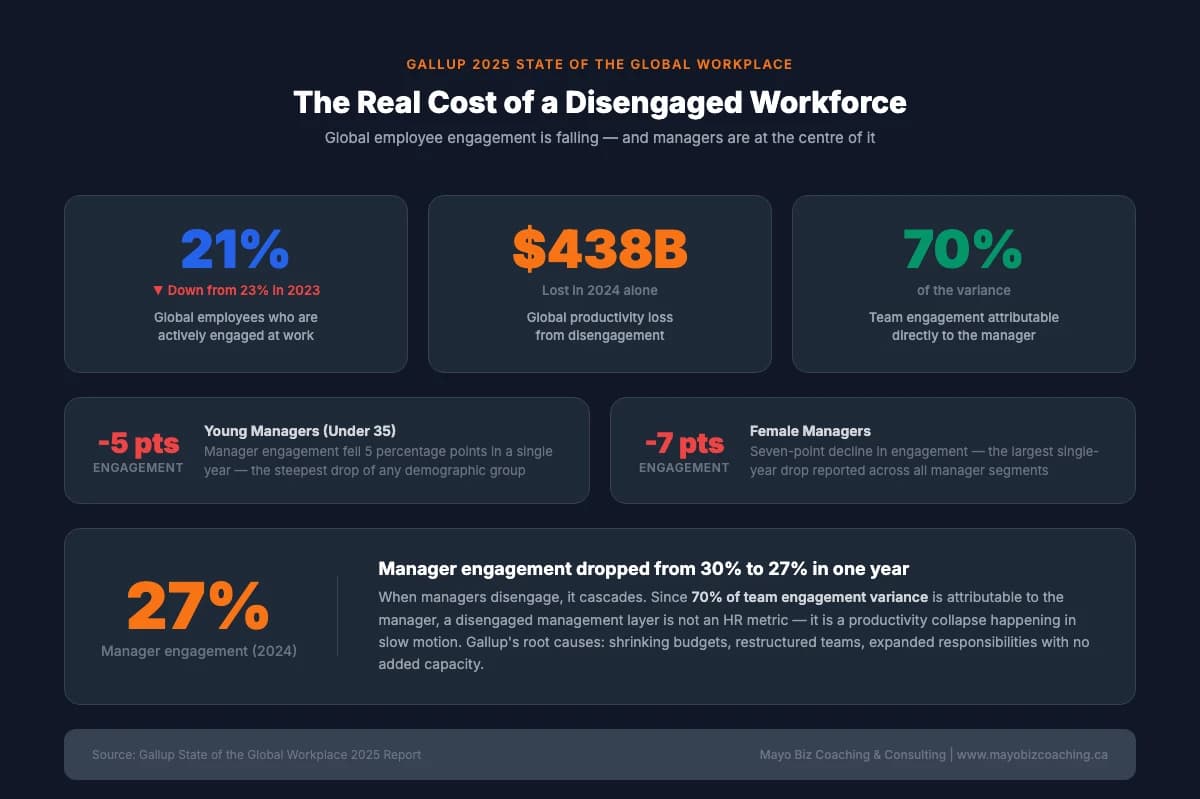
Gallup's 2025 State of the Global Workplace report 2 found global employee engagement fell to 21% in 2024. That's down from 23% the year before, and only the second decline in twelve years. The resulting productivity loss globally was $438 billion. When Gallup listed the causes, the fingerprints of "do more with less" were all over it: post-pandemic restructuring, shrinking budgets, expanded responsibilities with no added capacity.
The effect showed up most visibly in managers. Manager engagement dropped from 30% to 27% in a single year. Female managers saw a seven-point drop. Young managers, five points. These are the people who translate organizational decisions into daily team experience. Gallup's research consistently shows that 70% of team engagement variance is attributable to the manager.
So when the managers are running out of energy, it cascades.
I see this pattern in coaching conversations. Leaders who are working hard, who genuinely care, who have spent 18 months asking their teams to absorb more and saying thank you along the way. They're running out of goodwill to spend. The team knows how these conversations go before they start. The ask is already expected. The emotional response is just quieter than it used to be.
That quiet isn't a good sign.
Why Good Leaders Fall Into This Pattern
None of this is about poor intentions. The "do more with less" instinct is adaptive, at least in the beginning.
When revenue contracts, expenses have to respond. Leaders who act decisively during a downturn, who protect cash and right-size their operations, often save their businesses. The reflex made sense when it first appeared.
The trap is when it becomes a default rather than a deliberate response. When the only question in the room is "what can we cut?" rather than "what are we actually trying to build, and what does that require?"
There's a cognitive dimension to this that's worth understanding. Deloitte's research on the scarcity mindset 3, grounded in decades of behavioural economics, describes what sustained resource pressure does to decision-making.
Operating under chronic constraint depletes the finite mental capacity that people need for good judgment. The brain gets pulled toward immediate pressure. Strategic thinking, creative problem-solving, the ability to weigh real trade-offs: all of it degrades under that load. This isn't a character flaw. It's a documented cognitive response to prolonged scarcity.
In plain terms: the longer your leadership team runs in survival mode, the less capacity they have to think of anything else.
That's when "do more with less" stops being a tool and becomes the only tool. Not because it's right for the situation. Because it's the only thing that feels manageable.
What You Are Actually Trading
When this becomes the culture, several things disappear quietly.
-
Development investment. Training, coaching, stretch assignments, development conversations. These get cut first because they're easy to quantify and feel optional. But a 2025 Center for Creative Leadership article 4 cites research showing companies that invest consistently in leadership development generate 21% higher profitability than those that don't. That gap doesn't show up this quarter. It shows up 18 months from now, when your competitors have built internal capacity and your best managers have gone somewhere that will invest in them.
-
Psychological safety. When people absorb more without acknowledgement, the unspoken message is clear: the organization's needs come first, and yours are secondary. Over time, they stop raising problems early. They stop suggesting improvements. They do exactly what's asked and nothing more.
Psychological safety isn't a culture program. It's the condition that makes discretionary effort possible. Once it goes, you can't mandate it back.
- Your best people's options. High performers have choices. When they start asking whether there's somewhere better, they're usually already past the point of being retained by a conversation. The cost of replacing one strong employee typically runs between 50 and 200% of their annual salary. That's the cost of the strategy, just counted differently.
The burnout research captures what this feels like from the inside. In workplace surveys, employees name the cause directly: "We are doing more with less these days, and my task list has grown and grown." The workload grew. The support didn't.
They named your strategy. By name.
"Do Better" Is Not the Same Ask
There's a version of this that works. It's just a different conversation.
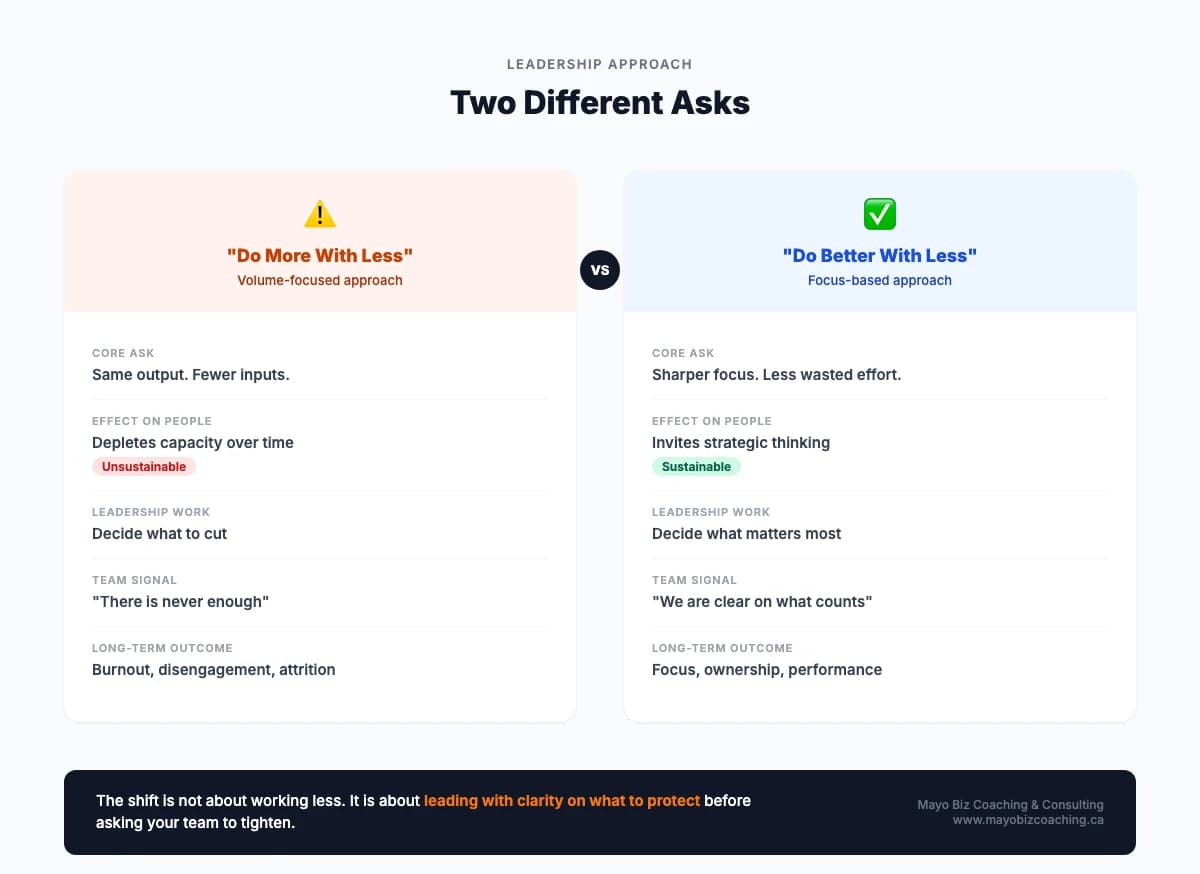
"Do more with less" is a volume problem dressed up as efficiency. You're asking for the same output from fewer inputs. That equation holds until people run out of capacity, or until they decide the equation isn't worth solving anymore.
"Do better with less" is a different ask. It's not about volume. It's about focus. Which work actually matters right now? What are we doing that produces nothing of value? Where are we spending time and energy on work that no one would miss if it stopped?
That question requires the leader to do harder thinking first. Before you ask your team to tighten, you need to know what you're protecting. Which capabilities are genuinely important? Which relationships and investments, if lost, would cost you something real?
| Do More With Less | Do Better With Less | |
|---|---|---|
| Focus | Volume: same output, fewer inputs | Focus: sharper priorities, less waste |
| Effect on people | Depletes capacity over time | Invites strategic thinking |
| Leadership ask | Absorb more | Decide what matters |
| Sustainable? | No | Yes, with clear direction |
This conversation isn't easy. Deciding what to protect means making choices that will disappoint some people. Some work will stop. Some requests will get a clear no. That visible trade-off is more honest than asking everyone to absorb more without saying what matters.
HBR's framework for this 1 is worth knowing. Categorize your work into three tiers: the roughly 15-20% that differentiates you competitively, the 15-20% that supports and enables that competitive work, and the 60-70% that is operational necessity. When you need to cut, you look at the third category first. You don't cut evenly across all three. And you don't touch the first without understanding exactly what you're giving up.
Delegation also matters more during tight periods, not less. When you're thin on resources, you need your team thinking and deciding at a higher level. That only happens when they have real authority, not just additional tasks added to a list that's already too long.
What to Try This Week
This isn't about reversing every difficult decision you've made. It's about checking whether "do more with less" has quietly become the only conversation you know how to have with your team.
-
Name what you are not willing to cut. Write down the things that would genuinely cost you something important if they disappeared. Development time. A key team ritual. A planning session you keep pushing. Once you have that list, protect it explicitly and find cuts somewhere else.
-
Have a real conversation with your managers. Not "are you doing OK?" That question gets a socially acceptable answer. Ask instead: "What are you absorbing right now that shouldn't be yours to absorb?" Most managers are carrying things that were never formally assigned to them. Finding that hidden load and reducing it often matters more than any wellness initiative.
-
Ask your team what to stop. "What are we doing right now that we could stop without actually losing anything important?" This redirects the team from absorbing volume to thinking strategically about what has real value. You'll be surprised by how much comes back.
The goal isn't to pretend constraints aren't real. They are. The question is whether the response to every constraint is the same, or whether you still have more than one tool in the conversation.
Let's Build Brilliance Together
Asking your team to stretch during a hard period is sometimes the right call. The issue is when stretching becomes the permanent setting, and when the only signal your team receives is that there is never enough.
If this is a pattern you are navigating, reach out for a free consultation. No sales pitch. Just an honest conversation about where the pressure is coming from and what your options actually are.
Research Notes & Sources
If you want to go deeper, these are the studies and reports behind the key points in this post.
Category & Tags
Frequently Asked Questions
What does "do more with less" mean in business?
"Do more with less" is a management approach that asks teams to maintain or increase output while reducing resources, headcount, or budget. Used occasionally, it's a reasonable response to constraint. Used chronically, it erodes engagement, trust, and the conditions that make performance sustainable.
How does chronic cost-cutting affect employee engagement?
Gallup's 2025 State of the Global Workplace report found global employee engagement fell to 21%, with shrinking budgets and expanded responsibilities among the leading causes. Disengagement cost the global economy $438 billion in lost productivity in 2024 alone.
What is the difference between "do more with less" and "do better with less"?
"Do more with less" is a volume request: same output, fewer inputs. "Do better with less" is a focus request: sharper priorities, less wasted effort. The first depletes people. The second asks them to think strategically, which most teams are capable of when given the space.
What should leaders protect during budget cuts?
Leadership development, psychological safety, and honest communication. Harvard Business Review research shows only 9% of companies maintain capacity for innovation after across-the-board cuts. Protecting these investments during tight periods is what separates organizations that recover from those that stall.
About the Author

About the Author
Mark Mayo
Head Coach, MBC
We get up each morning excited about sharing our 20-plus years of business acumen with small business owners and their teams. Collaborating with hard-working owners to achieve their personal and business goals brings rewards. When we develop you and grow your leaders, we create the momentum that moves you and your business forward. It starts with a first step. Then we can build brilliance together.
Related Articles

Leading Your Team Through Economic Uncertainty
79% of Canadian small businesses say tariffs block their planning. Coaching frameworks for honest team communication and leadership during uncertainty.
Read Leading Your Team Through Economic Uncertainty
Learning Agility: Why the Fastest Learners Lead Best
Learning agility predicts leadership success better than experience alone. Here is what it means for small business leaders and how to build it this month.
Read Learning Agility: Why the Fastest Learners Lead Best
Beyond IQ and EQ: Leadership Intelligences Nobody Taught You
IQ EQ XQ AQ leadership is not about choosing one quotient. Learn what each predicts, where each breaks down, and how small business leaders build all four.
Read Beyond IQ and EQ: Leadership Intelligences Nobody Taught You