Leadership Transition & Change
What Got You Here Won't Get You There: The Leadership Habits That Stop Working

The team is quieter than it used to be. Good people are leaving, or staying and going flat. You're working harder, but the return on that effort keeps shrinking.
You got the promotion. Or you built the business from scratch. Either way, it worked. But the habits that carried you here don't seem to be carrying you forward.
Marshall Goldsmith spent decades coaching over 200 CEOs on exactly this problem. His book What Got You Here Won't Get You There puts it plainly: the leadership habits that drove your early success can become the things holding you back.
This isn't about the first shift from doing to leading. It's about what happens after you've already made that shift. You're leading. You're successful. And the way you lead is starting to work against you.
The success trap
Goldsmith identified a pattern he calls the superstition of success. It works like this: "I behave this way. I am successful. Therefore I must be achieving results because I behave this way."
That logic looks airtight. It isn't. Most successful leaders succeed in spite of certain behaviours, not because of them. The competitiveness that pushed you through early challenges? It becomes the need to win every conversation. Your decisiveness starts shutting down other people's ideas before they finish talking. And the confidence that once earned you trust quietly turns into an inability to listen.
The research backs this up. A Center for Creative Leadership review (1996) 1 of 12 studies on management derailment found that the median failure rate for managers is 50%. Half of all managers fail. According to CCL, the top reason isn't technical incompetence. It's interpersonal problems: arrogance, volatility, inability to build relationships, or refusal to adapt.
These aren't people who lacked ability. They were driven and successful at a previous level. Then the game changed, and their habits didn't.
Six habits that stop working
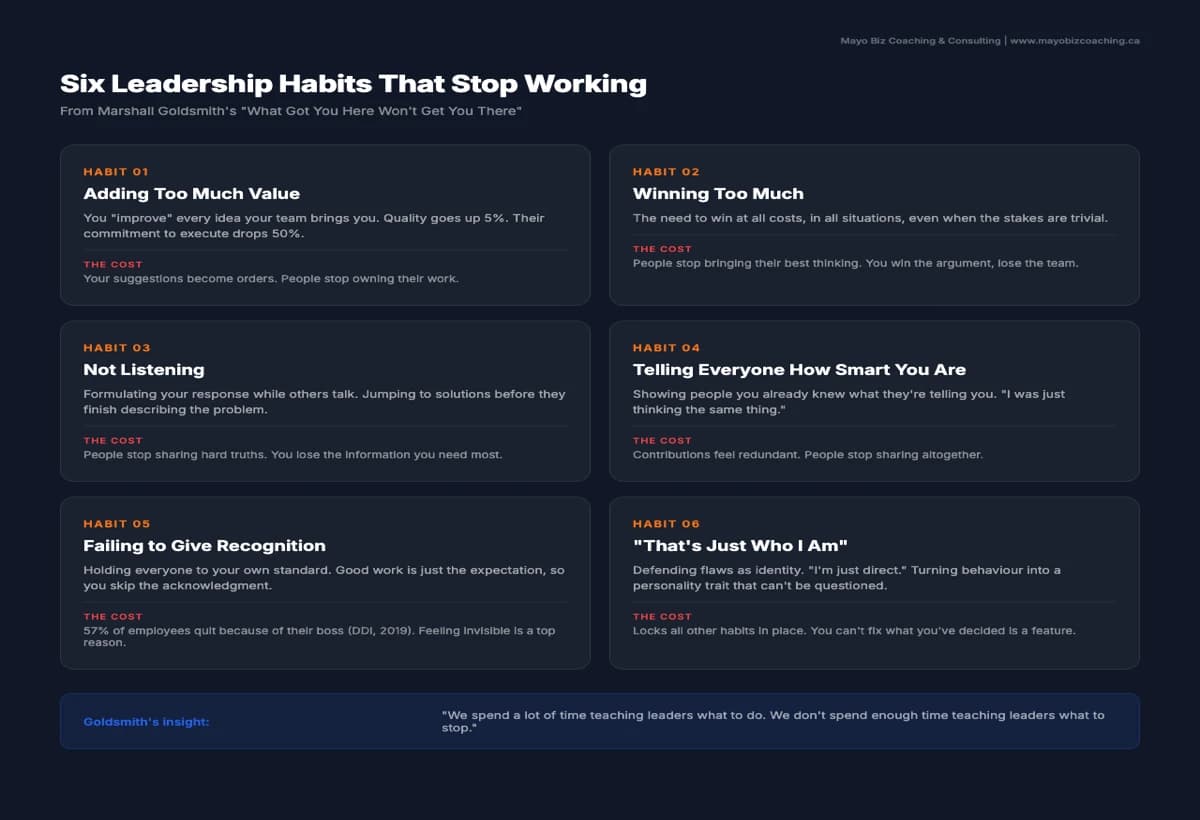
Goldsmith catalogued 20 specific behavioural habits that hold successful leaders back. They're not character flaws. He calls them transactional flaws: small, repeated behaviours in everyday interactions that accumulate into real damage. Here are the six I see most often with the leaders I work with.
1. Adding too much value
This is the habit that hits home for almost every leader I coach.
Someone on your team brings you an idea. It's good. Maybe 80% of the way there. So you help. You add your perspective, tweak the approach, suggest a better direction. The idea gets 5% better.
But here's what you missed: the person's commitment to execute just dropped by 50%. They walked in owning that idea. They walked out executing yours.
Goldsmith puts it as a formula: the effectiveness of any plan equals the quality of the idea multiplied by the person's commitment to making it work. When you "improve" someone's idea, you might nudge the quality up slightly, but you gut the commitment. The math doesn't work in your favour.
JP Garnier, then CEO of GlaxoSmithKline, told Goldsmith that the most important thing he learned from coaching was to stop and ask himself "Is it worth it?" before speaking 2. Half the time, the answer was no. As Goldsmith puts it: "The higher up you go, the more your suggestions become orders."
If you've ever wondered why your team waits for your input before moving, or why they check in on decisions you thought you'd already delegated, this habit might be the reason. You're not micromanaging. You're just adding too much value.
2. Winning too much
Goldsmith calls this the "underlying disease" that fuels most other bad leadership habits. It's the need to win at all costs, in all situations, even when it doesn't matter.
You win the argument about where to hold the off-site. You win the debate about which vendor to use. You win the discussion about something you'll forget by Friday. And every time you win, someone on your team loses a little motivation to bring their best thinking to the table.
This one trips up high performers because winning is exactly what got them promoted. A 2019 study in the Quarterly Journal of Economics 3 tracked promotions across 131 firms and found that the best individual performers were the most likely to move into management. But the better someone was as a solo contributor, the worse their team performed under them. A doubling of pre-promotion sales was linked to a 7.5% drop in each direct report's output.
That's the Peter Principle backed by hard data. The drive and competitiveness that make someone a great individual contributor are the same habits that shrink a team's capability when carried into a leadership role unchecked.
3. Not listening
Not listening looks like formulating your response while they're still talking. It looks like checking your phone in one-on-ones. It looks like jumping to solutions before someone finishes describing the problem.
I've written before about active listening as a leadership operating system, and this is where it connects to Goldsmith's work. He lists "not listening" as one of the most passive-aggressive forms of disrespect a leader can show. Not because you intend disrespect, but because the message it sends is clear: what you're saying isn't worth my full attention.
The higher you rise, the worse this gets. People stop bringing you the hard truths because your body language tells them you've already moved on. And you lose the information you actually need.
4. Telling the world how smart you are
This one is subtle. It's the need to show people you already knew what they're telling you. Someone shares a finding, and you say "I was just thinking the same thing." A team member solves a problem, and you mention you'd considered that approach already.
You're not trying to steal credit. You're trying to show you're still sharp. But the effect is the same: people stop sharing because your response makes their contribution feel redundant. Why bring you something if you always already know it?
Research by Tasha Eurich (2018) 4 found that 95% of people think they're self-aware, but only 10-15% actually are. The gap matters here because this habit is almost invisible to the person doing it. You think you're building rapport by showing you're on the same page. Your team thinks you're making every conversation about you.
Building genuine self-awareness means getting honest about how others experience your behaviour, not just how you intend it.
5. Failing to give recognition
This isn't about formal awards or employee-of-the-month plaques. It's about the daily acknowledgment that someone's work mattered.
Successful leaders often skip recognition because they hold everyone to their own standard. If the work is good, that's just the expectation. Why would you praise someone for meeting the bar? Because the bar keeps moving, and people need to know their effort registers.
DDI's Frontline Leader Project (2019) 5 found that 57% of employees who leave their jobs do so because of their boss. Not because of pay, not because of the company. Because of their direct leader. And one of the most common complaints is feeling invisible, that good work goes unnoticed while mistakes get immediate attention.
If your best people are going quiet or disengaging, this habit deserves a hard look.
6. "That's just who I am"
Goldsmith calls this an excessive need to be "me." It's the habit of defending your flaws as identity. "I'm just direct." "I don't sugarcoat things." "That's how I've always operated."
Every one of those statements is a wall against change. You've turned a behaviour into a personality trait, which means any request to change it feels like an attack on who you are. The result: you stay the same while the people around you learn to work around you rather than with you.
This is the habit that locks all the other habits in place. You can't fix what you've decided is a feature.
Why smart leaders can't see it
Here's the uncomfortable part. If these habits are so common and so damaging, why don't leaders just stop?
Because success creates a blind spot. When things go well, you credit your approach. When things go poorly, you blame circumstances. The more successful you've been, the harder it is to accept that some of your habits might be part of the problem.
Goldsmith saw this in every engagement. "It's hard to help people who don't think they have a problem," he wrote. "It's impossible to fix people who think someone else is the problem."
The data supports this. That same CCL research on executive integration 6 found that the leaders who derailed were not less talented than the ones who succeeded. Both groups had strong track records. The difference was adaptability. The leaders who failed had succeeded in a series of similar roles, which reinforced their existing habits. The leaders who thrived had more varied experiences, which forced them to adjust.
Learning agility is the pattern here. The leaders who keep growing are the ones who keep adjusting. The ones who stall are the ones who keep doing what worked before.
How to change: Goldsmith's feedforward method
Goldsmith's approach to changing these habits is simpler than you'd expect. He doesn't start with personality assessments or deep introspection. He starts with one question directed outward: how do others experience my leadership?
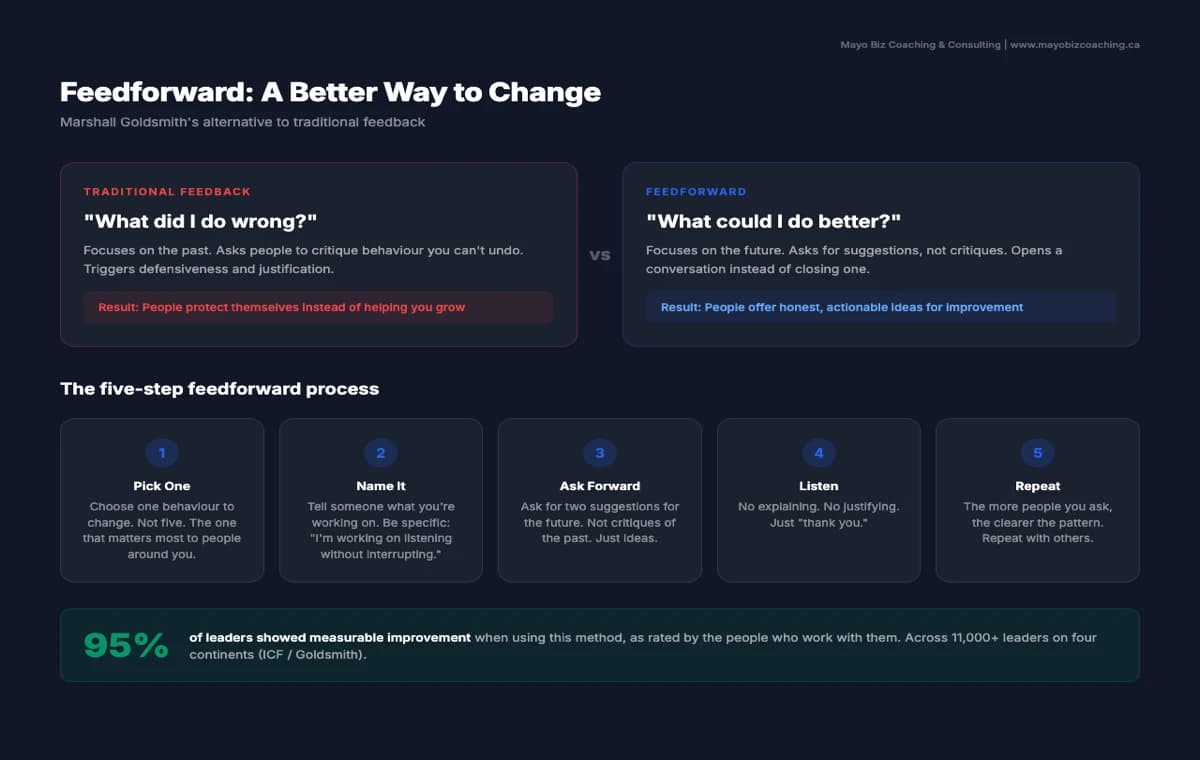
His feedforward technique works like this:
- Pick one behaviour to change. Not five. One. The one that would matter most to the people around you.
- Tell someone what you're working on. A colleague, a direct report, your partner. Be specific: "I'm working on listening without interrupting."
- Ask for two suggestions for the future. Not critiques of the past. Just two ideas for what you could do differently going forward.
- Listen without defending. No explaining, no justifying. Just "thank you."
- Repeat with others. The more perspectives, the better.
The difference between feedforward and traditional feedback is the direction it faces. Feedback asks: what did I do wrong? That triggers defensiveness. Feedforward asks: what could I do better? That opens a conversation.
In his coaching practice, Goldsmith used this inside a broader process called stakeholder centered coaching. The leader picks one or two behaviours, tells their team they're working on them, and follows up monthly for 12-18 months. Stakeholders rate whether they see improvement. According to the ICF's analysis of coaching outcomes 7, Goldsmith's method produced measurable improvement in 95% of cases across more than 11,000 leaders on four continents.
That number stands out because the measurement comes from the team, not the leader. It's not "I feel like I'm better." It's "the people around me agree that I'm better." That's the standard that matters.
Where to start this week
You don't need a 12-month coaching engagement to begin. Pick the habit from the list above that made you most uncomfortable. That discomfort is data.
Then try three things:
| Action | Why It Works |
|---|---|
| Ask one person: "What's one thing I could do better as a leader?" | Opens the door to external self-awareness without requiring a full 360 |
| In your next three meetings, notice how often you add to someone else's idea | Brings the "adding too much value" habit into conscious awareness |
| When someone brings you good news, respond with recognition before analysis | Breaks the pattern of skipping acknowledgment and jumping to the next problem |
Goldsmith's core insight is that leadership growth at this level isn't about learning new skills. It's about stopping old habits. "We spend a lot of time teaching leaders what to do," he wrote. "We don't spend enough time teaching leaders what to stop."
The habits that got you here were real. They worked. And now the question isn't whether they were good habits. It's whether they're still the right ones.
Let's Build Brilliance Together
The hardest part of this shift is seeing it clearly. The habits that helped you succeed feel like strengths, and hearing that they might be holding you back takes honest self-reflection.
If you're recognizing some of these patterns in your own leadership, reach out for a free consultation. No sales pitch, just an honest conversation about where you are and what's next.
Research Notes & Sources
If you want to go deeper, these are the studies and reports behind the key points in this post.
- Center for Creative Leadership review (1996)(cclinnovation.org)
- Marshall Goldsmith: Before Speaking, Ask ‘Is It Worth It?’(chiefexecutive.net)
- The Peter Principle Isn't Just Real, It's Costly(nber.org)
- What Self-Awareness Really Is (and How to Cultivate It)(hbr.org)
- New DDI Research: 57 Percent of Employees Quit Because of Their Boss(prnewswire.com)
- CCL research on executive integration(ccl.org)
- Coaching Statistics: The ROI of Coaching in 2024 - ICF(coachingfederation.org)
Category & Tags
Frequently Asked Questions
What does "what got you here won't get you there" mean?
It is a concept from executive coach Marshall Goldsmith. The behaviours that drove your early career success, like decisiveness, competitiveness, and confidence in your own ideas, can become liabilities as you move into senior leadership. The habits that made you successful stop working when your role shifts from individual contribution to leading through others.
What are the most common leadership habits that hold leaders back?
Goldsmith identified 20 habits, but six show up most often: winning too much, adding too much value to other people's ideas, not listening, failing to give recognition, telling everyone how smart you are, and refusing to change because "that's just who I am." These are interpersonal habits, not technical skill gaps.
How do you know if your leadership habits are holding you back?
Warning signs include: your best people leave or go quiet, you have the last word in most conversations, your team checks with you before making decisions you already delegated, and people agree with you too quickly. Research by Tasha Eurich found that 95% of people think they are self-aware, but only 10-15% actually are.
What is feedforward in leadership coaching?
Feedforward is Marshall Goldsmith's alternative to traditional feedback. Instead of asking people to critique your past behaviour, you describe one thing you want to improve and ask for two suggestions for the future. It avoids the defensiveness that feedback triggers and gives you specific, actionable ideas you can start using immediately.
About the Author

About the Author
Mark Mayo
Head Coach, MBC
We get up each morning excited about sharing our 20-plus years of business acumen with small business owners and their teams. Collaborating with hard-working owners to achieve their personal and business goals brings rewards. When we develop you and grow your leaders, we create the momentum that moves you and your business forward. It starts with a first step. Then we can build brilliance together.
Related Articles

From Operator to Leader: How Business Owners Make the Shift
Most owners started their business by being great at the work. That same hands-on identity becomes the ceiling. Five shifts to move from operator to leader.
Read From Operator to Leader: How Business Owners Make the Shift
Succession Planning When You ARE the Whole Business
When clients call your cell and your team waits for your approval on everything, succession planning is about detangling yourself from the business first.
Read Succession Planning When You ARE the Whole Business
The First 90 Days: How a Coach Helps You Succeed in a New Role
McKinsey research shows coaching doubles the success rate for leaders in transition. A practical 90-day framework to reach effectiveness faster.
Read The First 90 Days: How a Coach Helps You Succeed in a New Role