Executive Presence & Influence
The Power of Active Listening: A Leadership and Life Skill
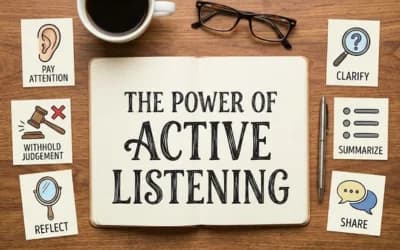
Active listening is one of the highest-return leadership skills you can build. Most leaders think they listen well because they care and stay polite. The real test is different: do people share hard truths early, and do your conversations lead to better action?
When active listening is weak, teams hide risk, repeat problems, and leave meetings with fuzzy ownership. When active listening is strong, people speak sooner, decisions improve, and trust rises.
This skill is not soft or optional. It is operational in one-on-ones, team meetings, feedback conversations, and high-stakes decisions.
Why Active Listening Matters for Leaders
Leaders work through conversations. If your conversations are shallow, your execution will be shallow too.
Harvard Business Review 1 describes active listening as a mix of cognitive, emotional, and behavioral skill. That framing matters because good listening is not silence alone. It is attention, interpretation, and response.
Center for Creative Leadership 2 also emphasizes that listening must lead to action. If people feel heard but nothing changes, trust declines quickly.
In practical terms, active listening helps leaders:
-
catch issues before they become expensive
-
improve decision quality with fuller context
-
reduce avoidable conflict
-
build trust during change
-
improve one-on-one value
If you lead people, this skill affects nearly every result you care about, from trust and retention to speed and quality for your team. When managers lack these skills, the role becomes unsustainable. That dynamic is part of why younger workers are avoiding management altogether.
What Active Listening Is and Is Not
Active listening is not waiting for your turn to talk. It is not nodding while drafting your response.
Active listening is full attention plus clear understanding checks. It is asking useful questions, reflecting what you heard, and confirming next steps.
It also includes emotional accuracy. You name what you hear in tone, concerns, and facts.
Finally, it includes follow-through. If no action follows the conversation, the listening did not land.
The Core Skills of Active Listening
1. Full Attention
Close screens, silence notifications, and face the speaker. Attention is visible before it is verbal.
If you glance at messages while someone shares a concern, trust drops even if your words are kind. People read attention as respect.
2. Clarifying Questions
Ask questions that reduce ambiguity. Avoid questions that defend your current view.
Useful examples:
- "What changed since last week?"
- "What risk do you see that I may be missing?"
- "What support do you need to move this forward?"
These questions improve quality of information fast and reduce avoidable rework because concerns surface before decisions are locked.
3. Reflect and Paraphrase
Summarize what you heard in plain words. Then ask if your summary is accurate.
This step prevents false agreement and shows you care enough to verify, not assume.
4. Name Emotion Without Drama
You do not need therapy language, but you do need emotional accuracy.
Simple lines work:
- "You sound frustrated by the delay."
- "It sounds like the scope keeps shifting."
- "I hear concern about quality risk."
Emotion labeling lowers tension because people feel understood, which makes problem-solving calmer and more direct under pressure.
5. Respond With Clear Next Steps
Good listening ends with action: confirm owner, timeline, and decision path, or conversations feel productive but change nothing.
Common Active Listening Mistakes
Most leaders miss in predictable ways.
Mistake 1: solving too fast.
You jump to advice before the issue is clear.
Mistake 2: defending intent.
You explain what you meant instead of hearing impact.
Mistake 3: asking leading questions.
You ask questions that push your preferred answer.
Mistake 4: treating listening as agreement.
You can validate perspective without agreeing to every request.
Mistake 5: no follow-through.
You listen well in the room, then fail to close the loop later.
Fixing these five issues usually creates visible gains within weeks.
Real Scenarios: Where Listening Changes Outcomes
In one client team of 16, meetings looked efficient but unresolved tension kept growing. The leader believed the team was aligned because no one argued openly.
In coaching, we added one listening routine: each manager had to name one concern and one support request before meeting close. Within four weeks, risks surfaced earlier and cross-team handoffs improved.
In another coaching engagement with a senior leader, one-on-ones felt polite but unhelpful. Direct reports left with no clear ownership and repeated the same issues.
We changed the structure to three active listening checkpoints: clarify context, paraphrase the core issue, then confirm one next step with date. After six weeks, one-on-one quality improved and repeated issue cycles dropped.
In my work with leaders, this pattern is common. Better listening improves execution because people share the truth sooner.
Active Listening in High-Stakes Moments
Listening gets hardest when stakes are high, which is exactly when it matters most.
Use this short sequence in hard conversations:
-
Start with intent: "I want to understand the full picture."
-
Ask one open question and stop talking.
-
Reflect what you heard in one sentence.
-
Ask what outcome they need next.
-
Confirm decision owner and timing.
This sequence keeps the conversation grounded and prevents reactive decisions made from partial information.
If you are balancing support and accountability, this post on coaching versus managing helps you choose the right stance in real time.
A 30-Day Active Listening Practice Plan
You do not build this skill by reading once. You build it through repeat practice.
Week 1: attention reset.
Choose two meetings where you remove distractions and focus only on listening behavior.
Week 2: question quality.
Use three clarifying questions in each one-on-one before offering advice.
Week 3: reflection habit.
Paraphrase key points in every important conversation and ask, "Did I capture that right?"
Week 4: action close.
End conversations with one owner, one date, and one explicit next step.
Track what changes: issue visibility, conversation quality, and speed from concern to action.
Active Listening Scripts for Common Moments
Leaders often ask for exact words they can use when pressure is high. Scripts help because they reduce guesswork and keep tone steady.
Use one core line in tense moments: thank you for raising this early, what risk do you see right now?
Keep language simple so people focus on substance, options, and next steps.
Coaching Active Listening Across a Team
Active listening should not live only in one leader. It works best when the team shares the same conversation standards.
Start by defining three meeting norms: one person speaks at a time, key points are paraphrased, and every discussion ends with clear ownership.
Teach managers to use one listening check in each one-on-one. A good check is, "Let me confirm what I heard before we decide."
Review two or three conversations each month as a leadership group. Focus on what worked, what was missed, and what to repeat.
Use role-play for difficult cases before high-stakes meetings. Practicing in low risk settings improves behavior when stress is real.
In my work with leaders, shared listening norms raise trust quickly because people know what good communication looks like every week.
Weekly Reflection Prompts
Reflection keeps active listening from fading after the first month. Use five prompts at the end of each week.
Ask yourself: where did I listen with full attention, and where did I interrupt or rush to solve? Name one example for each.
Ask: which issue surfaced early because I asked a better question? Then capture the exact question so you can reuse it.
Ask: where did I hear emotion but ignore it? Plan one repair conversation if needed.
Ask: which conversation ended with unclear ownership? Rewrite the close using owner, date, and next step.
Ask: what single listening behavior will I practice next week in every one-on-one? Keep it small and specific.
How to Measure Progress
Use a simple monthly scorecard:
-
one-on-one quality rating
-
number of issues raised early
-
repeat issue rate
-
meeting close clarity (owner + date)
-
trust pulse from direct reports
You do not need perfect metrics. You need consistent review.
If these measures improve over two months, your active listening is translating into team performance. If they stall, audit your routines and coaching cadence.
This post on emotional intelligence in leadership can help you strengthen the self-awareness side of listening under pressure.
Where Coaching Helps Most
Many leaders know active listening matters but struggle to apply it when stress rises. Coaching helps by making the skill observable and repeatable.
A coach can help you rehearse high-stakes conversations, review real meeting patterns, and build scripts that fit your voice. That turns active listening from concept into daily behavior.
Let's Build Brilliance Together
Active listening helps leaders build trust, improve decision quality, and reduce avoidable conflict. It is one of the simplest skills to start and one of the hardest to sustain alone.
If you want structured support building this skill, Executive Presence & Communication gives you practical tools for one-on-ones, feedback, and high-stakes conversations.
If you want to improve how your team communicates and executes, reach out for a free consultation. No pressure, just an honest conversation about where listening is helping and where it is not.
Research Notes & Sources
If you want to go deeper, these are the studies and reports behind the key points in this post.
Category & Tags
Frequently Asked Questions
What is active listening?
Active listening is the skill of giving full attention, checking understanding, and responding in ways that move the conversation forward. It goes beyond hearing words to understanding meaning, emotion, and intent.
Why does active listening matter for leaders?
Active listening improves trust, issue visibility, and decision quality. Teams share risks earlier when they feel heard, which helps leaders solve problems faster and reduce avoidable conflict and rework.
What are the key components of active listening?
Core components are full attention, clarifying questions, paraphrasing, emotion labeling, and clear next-step responses. Strong listening also includes follow-through so people see that what they shared affected action.
About the Author

About the Author
Mark Mayo
Head Coach, MBC
We get up each morning excited about sharing our 20-plus years of business acumen with small business owners and their teams. Collaborating with hard-working owners to achieve their personal and business goals brings rewards. When we develop you and grow your leaders, we create the momentum that moves you and your business forward. It starts with a first step. Then we can build brilliance together.
Related Articles

Building Executive Presence: Command a Room Without Saying a Word
Executive presence accounts for 26% of promotion decisions, yet 67% is gravitas, not polish. Learn to build presence that earns trust through substance.
Read Building Executive Presence: Command a Room Without Saying a Word
How to Build a Personal Brand That Reflects Your True Leadership
Personal branding for executives: build a research-backed audit, narrative, and visibility plan that strengthens trust, executive presence, and career growth.
Read How to Build a Personal Brand That Reflects Your True Leadership
Your Team Says Everything Is Fine. It Isn't.
Managers think engagement is improving. Their teams disagree. Here's how to spot the leadership perception gap and start hearing what's real.
Read Your Team Says Everything Is Fine. It Isn't.