Executive Presence & Influence
Your Team Says Everything Is Fine. It Isn't.
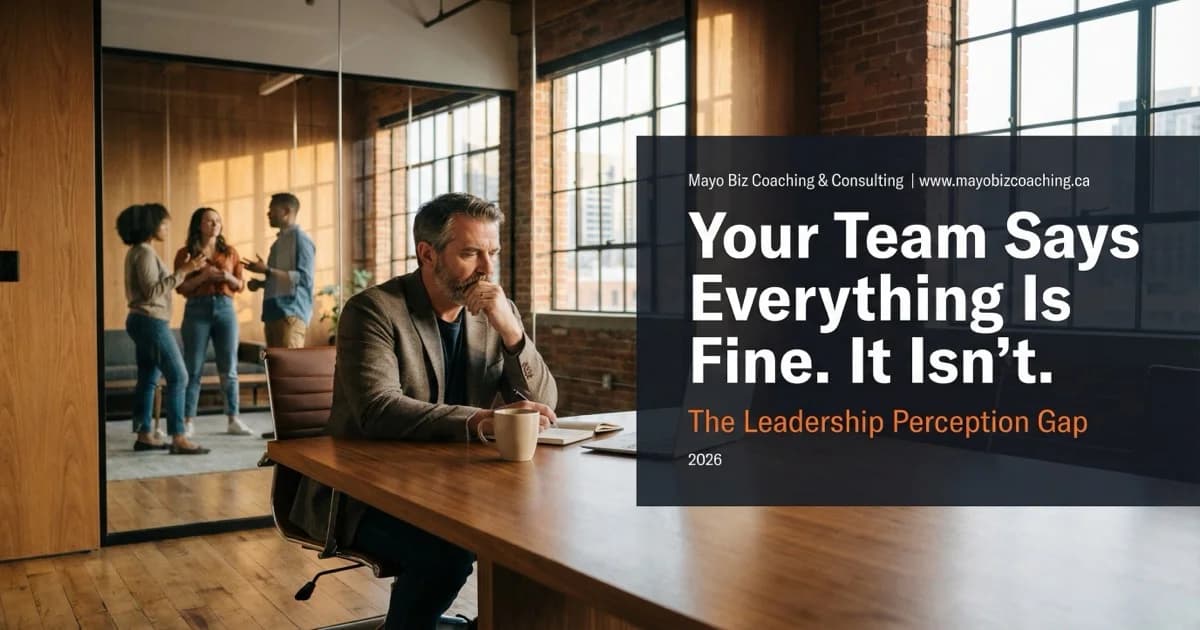
You ask how things are going. Everyone says "Fine." The meeting moves on. Nobody pushes back on the new process. Nobody flags the client issue you heard about secondhand. The room is calm, cooperative, and completely quiet.
That quiet is the problem. And part of you already knows it.
The leadership perception gap is the distance between what you believe is happening on your team and what your people actually experience. It's one of the most common patterns I see in coaching, and one of the hardest to spot from the inside.
The Leadership Perception Gap Nobody Talks About
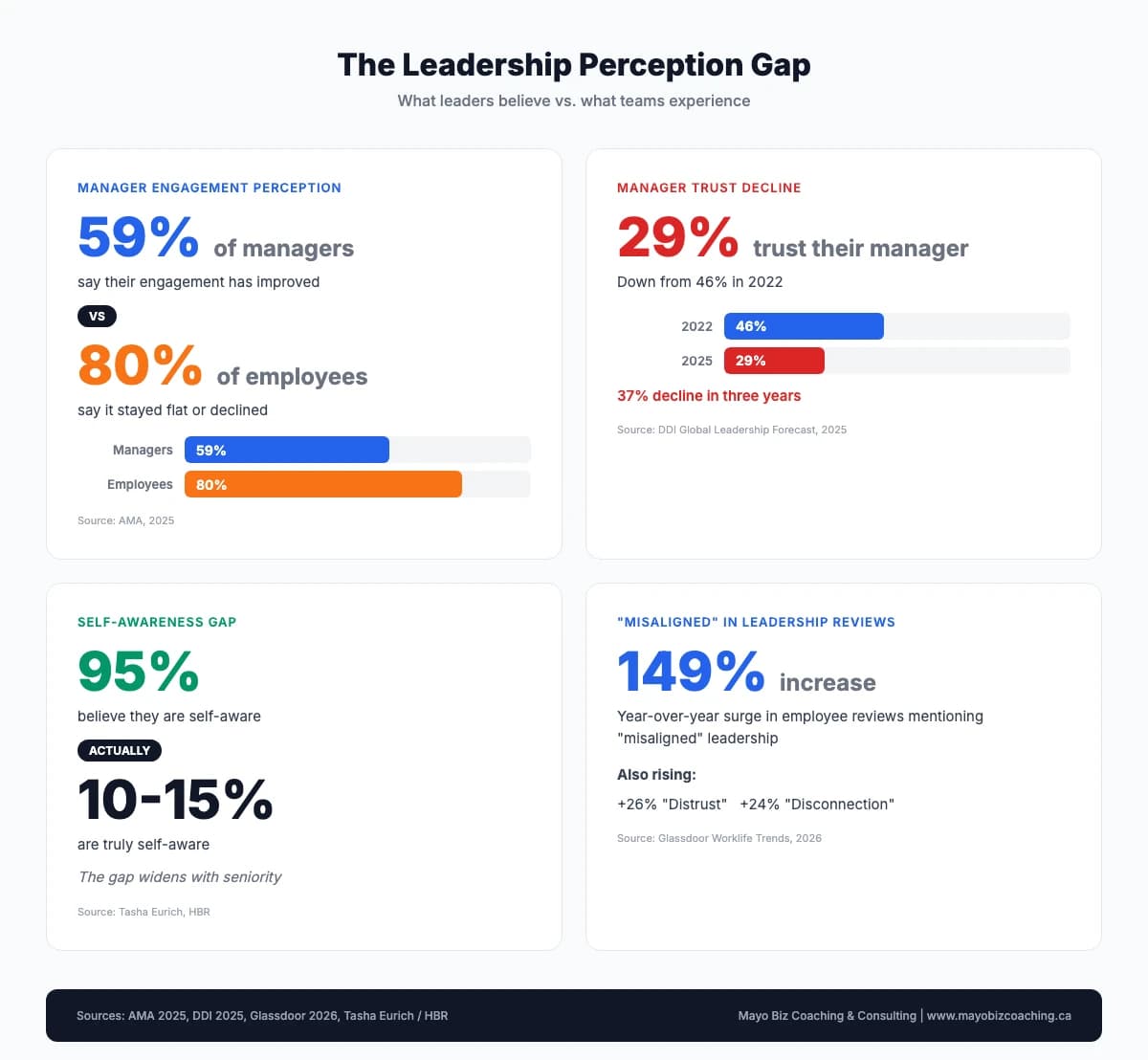
Glassdoor's 2026 Worklife Trends 1 found that in employee reviews mentioning senior leadership, the word "misaligned" surged 149% year over year. "Distrust" rose 26%. "Disconnection" climbed 24%.
Those aren't performance complaints. They are relationship complaints. Employees are saying their leaders operate in a different reality than the one the team lives in every day.
The American Management Association's 2025 research 2 confirmed the pattern with numbers that should stop every leader mid-sentence. Fifty-nine percent of managers report their own engagement has improved over the past year. But 80% of employees say their manager's engagement either stayed flat or declined.
The majority of managers believe they are getting better. The majority of their teams disagree. This is not a question of who is right. Both sides are telling their own truth. The manager is working harder, thinking deeper, carrying more. And none of that effort is landing the way they think it is.
Why You Can't See What Your Team Sees
The perception gap doesn't come from arrogance or neglect. It comes from a natural blind spot that grows worse the more responsibility you carry.
Tasha Eurich's 2018 research in Harvard Business Review 3 found that 95% of people believe they are self-aware. The actual number is closer to 10-15%. The gap widens with seniority. The more authority you hold, the less honest feedback you receive, and the less accurate your self-image becomes.
There are two reasons this hits small business owners hard.
First, you are probably the most invested person in the room. You feel your commitment deeply. But your team doesn't experience your internal commitment. They experience your external behaviour: how you respond to bad news, whether you follow through on promises, how you handle stress in front of them.
Second, your team has learned what happens when they speak up. If the answer is nothing, they stop. If the answer is defensiveness, they stop faster. They don't announce the moment they give up on honest conversation. They just start saying "Fine."
What the Trust Data Actually Means
DDI's 2025 Global Leadership Forecast 4 surveyed over 10,000 leaders across more than 50 countries. They found only 29% of employees trust their immediate manager. That's down from 46% in 2022: a 37% decline in three years.
For context, direct manager trust has historically been higher than trust in senior leadership. That pattern has now reversed. The people closest to employees are now trusted less than the executives employees rarely see.
If fewer than one in three of your people trust you, and you assume they do, every decision you make rests on a faulty foundation. You think the team is aligned, but they are complying. You think silence means agreement, but it means avoidance.
Gallup's 2025 State of the Global Workplace 5 reinforces why this matters operationally. Managers account for 70% of the variance in team engagement. When the person responsible for that engagement cannot accurately read their team, engagement doesn't decline gradually. It drops, and nobody explains why.
For a small business owner, that 70% figure is not abstract. Your attention, your follow-through, and your ability to read the room are the single biggest variables in whether your team shows up or checks out.
I've written before about why teams go silent when they don't feel safe. But the perception gap adds a layer. It isn't just that the team won't speak. It's that the leader doesn't realize there is something to hear.
The Real Cost of "Fine"
Here's what the perception gap looks like when it finally becomes visible.
Turnover catches the owner off guard. "I had no idea they were unhappy. They never said anything." That's the gap. They did say something, just not with words. They said it with shorter answers, less volunteering, and eventually a resignation letter.
Then there's initiative fatigue. The leader rolls out a new process, a new tool, a new meeting format. The team nods. Adoption is low. The leader assumes the team resists change. In reality, the team didn't believe the leader would follow through because the last three initiatives quietly disappeared.
And then there's isolation at the top. The leader feels like they carry everything alone. And they do, because the team has stopped offering ideas, challenges, or honest pushback. The leader interprets that as lack of ownership. The team interprets their own silence as self-preservation.
I've seen each of these patterns dozens of times. They all start the same way: a leader who genuinely cares about their team but has lost accurate signal about what that team actually needs.
One business owner I worked with told me his team was "solid, no complaints." Two months later, his best project manager resigned. When we talked through it, the signs had been there for a year: shorter emails, fewer suggestions in meetings, skipped optional team lunches. He'd noticed those things individually but never connected them. "I thought she was just busy," he said. That's the perception gap in action. The information was available. It just wasn't being read.
How to Start Hearing What's Real
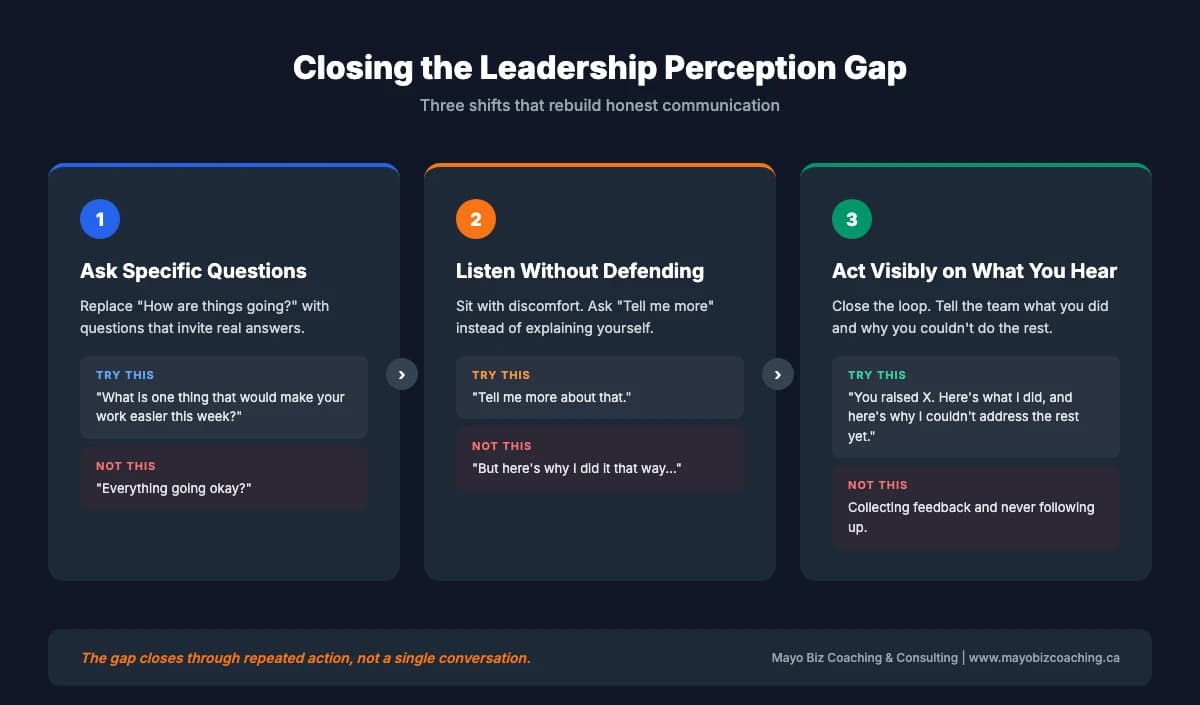
Closing the leadership perception gap doesn't require a survey vendor or an expensive 360 assessment. It starts with changing how you ask, how you listen, and what you do with what you hear.
Ask Specific Questions
"How are things going?" invites "Fine." Specific questions invite real answers.
Try these instead:
- "What is one thing that would make your work easier this week?"
- "When was the last time you felt frustrated here, and what caused it?"
- "If you could change one thing about how I communicate, what would it be?"
The specificity makes it safer to answer honestly. It also shows you are prepared to hear something other than good news.
Listen Without Defending
This is the hardest part. When someone tells you something that contradicts your self-image, your first instinct will be to explain, justify, or correct. That instinct is the gap in action.
Active listening means sitting with discomfort long enough for the other person to finish. It means asking "Tell me more about that" instead of "But here's why I did it that way." It means treating the feedback as information, not an attack.
The moment you defend, the conversation is over. Your team just learned, one more time, that honesty isn't worth the trouble.
Act Visibly on What You Hear
This is the step most leaders skip. Harvard Business Review's 2024 research on employee feedback 6 describes what researchers call "inaction fatigue": employees stop giving honest input when they don't see results from previous feedback. The gap between collecting input and visibly responding to it is where trust breaks down.
Asking for feedback and doing nothing with it is worse than never asking at all. It confirms the team's suspicion that speaking up is a performance exercise, not a real invitation.
You don't need to fix everything immediately. But you do need to close the loop. Say it plainly: "You raised X. Here's what I did, and here's why I couldn't address the rest yet." Say it once and mean it. Keep saying it. That's how trust comes back.
The Self-Awareness Question
If you've read this far, you're probably asking yourself: "Is this me?"
That question itself is a good sign. Most leaders with a significant perception gap don't reach the point of questioning it. The research says the gap widens with seniority precisely because senior leaders receive less honest feedback. That makes them more confident in a picture that grows less accurate over time.
Here's a diagnostic question I use in coaching: think about the last time someone on your team disagreed with you openly. If you can't remember, the gap is probably wider than you think.
Emotional intelligence helps you recognize the gap. But recognition alone doesn't close it. The gap closes through repeated action: asking, listening, responding, and changing behaviour based on what you hear.
One honest conversation won't fix it. If trust has eroded over months or years, a single attempt at openness can feel performative to a team that has learned to be cautious. The work is sustained and sometimes uncomfortable. Some leaders find that the gap is wider than they expected, and that's a hard thing to sit with.
That's also why coaching matters here. A coaching conversation gives you a space to process what you're hearing without the pressure of responding in real time. You can work through defensiveness, examine your blind spots honestly, and build a plan for how you'll show up differently. That outside perspective often makes the difference between a leader who learns about the gap and one who actually closes it.
Let's Build Brilliance Together
The leadership perception gap isn't a character flaw. It closes when you start asking better questions and stay in the room long enough to hear the real answers.
If you're starting to wonder what your team isn't telling you, reach out for a free consultation. No sales pitch, just an honest conversation about where you are and what you're working on.
Research Notes & Sources
If you want to go deeper, these are the studies and reports behind the key points in this post.
- Glassdoor's 2026 Worklife Trends(glassdoor.com)
- American Management Association's 2025 research(amanet.org)
- Working with People Who Aren’t Self-Aware(hbr.org)
- Global Leadership Forecast 2025(ddi.com)
- State of the Global Workplace Report(gallup.com)
- Turn Employee Feedback into Action(hbr.org)
Category & Tags
Frequently Asked Questions
What is the leadership perception gap?
The leadership perception gap is the disconnect between how leaders view their own effectiveness and how their teams experience it. AMA research found 59% of managers believe engagement improved, while 80% of employees say it stayed flat or declined.
Why do employees hide problems from their managers?
Employees stay silent when speaking up feels risky. DDI found only 29% of employees trust their immediate manager. Without psychological safety, honest feedback gets replaced with polite agreement.
How can a leader close the perception gap?
Start by asking specific questions instead of general ones. Replace "How are things going?" with "What is one thing that would make your work easier this week?" Then act visibly on what you hear.
How common is the leadership perception gap in small businesses?
Very common. Glassdoor found "misaligned" surged 149% in leadership reviews. Research shows 95% of people believe they are self-aware while only 10-15% actually are. Small teams often lack formal feedback channels that surface honest input.
About the Author

About the Author
Mark Mayo
Head Coach, MBC
We get up each morning excited about sharing our 20-plus years of business acumen with small business owners and their teams. Collaborating with hard-working owners to achieve their personal and business goals brings rewards. When we develop you and grow your leaders, we create the momentum that moves you and your business forward. It starts with a first step. Then we can build brilliance together.
Related Articles

Building Executive Presence: Command a Room Without Saying a Word
Executive presence accounts for 26% of promotion decisions, yet 67% is gravitas, not polish. Learn to build presence that earns trust through substance.
Read Building Executive Presence: Command a Room Without Saying a Word
How to Build a Personal Brand That Reflects Your True Leadership
Personal branding for executives: build a research-backed audit, narrative, and visibility plan that strengthens trust, executive presence, and career growth.
Read How to Build a Personal Brand That Reflects Your True Leadership
The Power of Active Listening: A Leadership and Life Skill
Active listening goes beyond hearing words. Learn how this essential leadership skill builds trust, strengthens relationships, and drives team success.
Read The Power of Active Listening: A Leadership and Life Skill