Team Leadership Development
Start With Why for Teams: Turn Purpose Into Weekly Decisions

Your team probably has a purpose statement somewhere. Maybe it is on the wall in the boardroom. Maybe it lives in a slide deck from last year's offsite. Maybe you wrote it yourself after reading Start With Why. Either way, most teams end up in the same place.
The statement isn't the problem. The problem is that nobody uses it on Tuesday afternoon when three competing priorities land at once.
I hear this constantly in coaching. Leaders invest real thought into purpose, then watch it sit idle while the team defaults to whatever feels most urgent. The why gets drafted. The what takes over. Weeks pass. Nothing changes.
That's not a purpose problem. It's a translation problem.
The 70/15 Gap
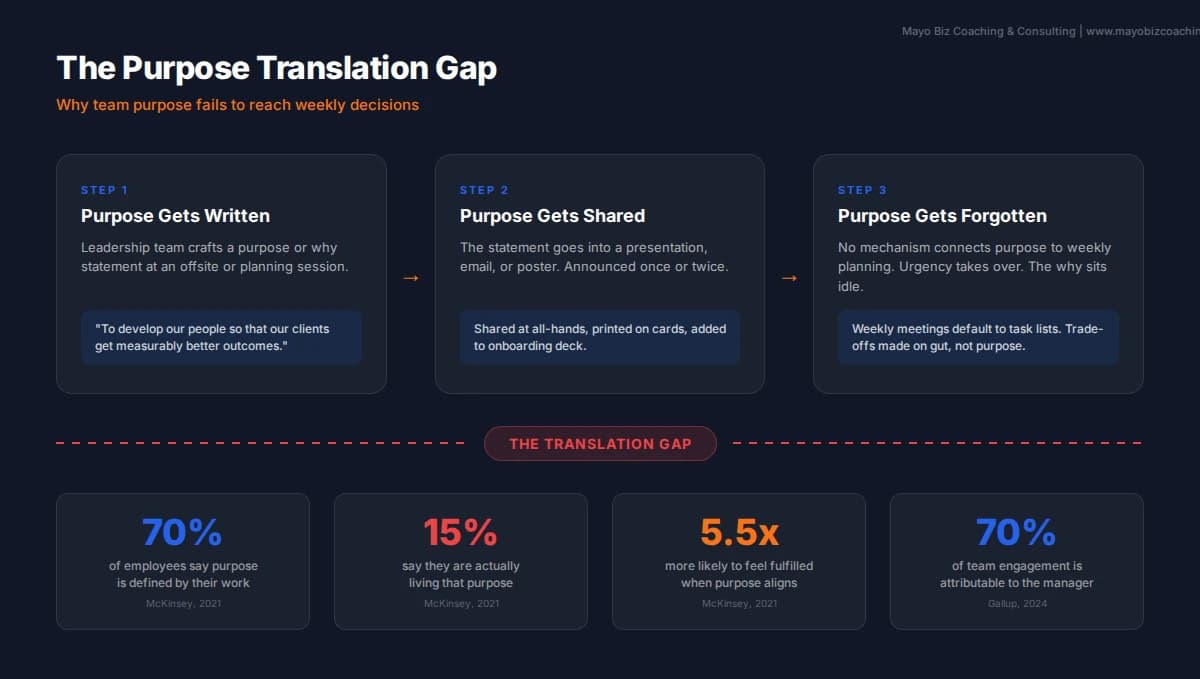
McKinsey published research in 2021 showing that 70% of employees say their sense of purpose is defined by their work 1. People care about meaning. That's not in question.
But in that same 2021 research, only 15% of frontline managers and employees said they were actually living their purpose at work. That gap between caring about purpose and experiencing it is enormous. And it's not a gap you close with a better statement. You close it with a better weekly habit.
The same research found that employees whose individual purpose aligns with their organization's purpose are 5.5 times more likely to feel fulfilled at work, with measurably higher engagement, resilience, and retention. Purpose is not a feel-good exercise. When it connects to daily work, teams perform differently.
Here is what that means for your team this week: the purpose conversation is not finished when the words are right. It is finished when your team uses those words to make decisions.
Why Teams Get Stuck at the Statement
Simon Sinek's Golden Circle 2 gives a clean framework: start with why, then work outward to how and what. Most leaders understand the concept. The challenge is that they apply it once, at the organizational level, then expect it to trickle down.
It rarely does.
A company why tells you the reason the organization exists. A team why tells you the specific contribution your team makes and the impact that contribution creates. Those are different conversations, and most teams don't have the second one.
In his follow-up book Find Your Why, Sinek offers a practical formula for teams: "To [contribution] so that [impact]." One sentence. Not a manifesto, not a paragraph of aspirational language. One sentence that is specific enough to test decisions against.
The other failure I see often is that teams treat the why as a communications exercise instead of decision architecture. They announce purpose at an offsite, pin it to the wall, and go back to work the same way they did before. Nobody builds a mechanism to bring it into regular planning.
Stephen Covey made a similar distinction between the compass and the clock. The compass tells you whether you are headed somewhere meaningful. The clock tells you how to schedule the day. Most teams only manage the clock 3. They're efficient, but they're not necessarily working on the right things. That is what happens when purpose stays abstract: you end up with a well-organized team running in the wrong direction.
What a Team Why Actually Sounds Like
A useful team why passes two tests. First, it is specific enough that someone outside the team could tell what you do differently from other teams. Second, it is short enough that any member can say it from memory.
Here are three patterns I use in coaching to help teams get there:
Contribution plus impact. "To [what we do] so that [what changes because of it]." This is Sinek's formula, and it works well for teams that have a clear deliverable or service.
Strength plus audience. "We are at our best when we [core strength], and that helps [specific group] to [specific outcome]." This version borrows from Marcus Buckingham's strengths-first thinking. It anchors purpose in what the team naturally does well rather than an aspirational stretch.
Problem plus standard. "We exist to solve [recurring problem] to a standard of [what good looks like]." This one works for operational teams where purpose needs to connect to both a quality bar and an outcome.
None of these take more than 15 minutes to draft in a team conversation. The statement doesn't need to be perfect. It needs to be honest and usable.
The Three-Question Weekly Filter
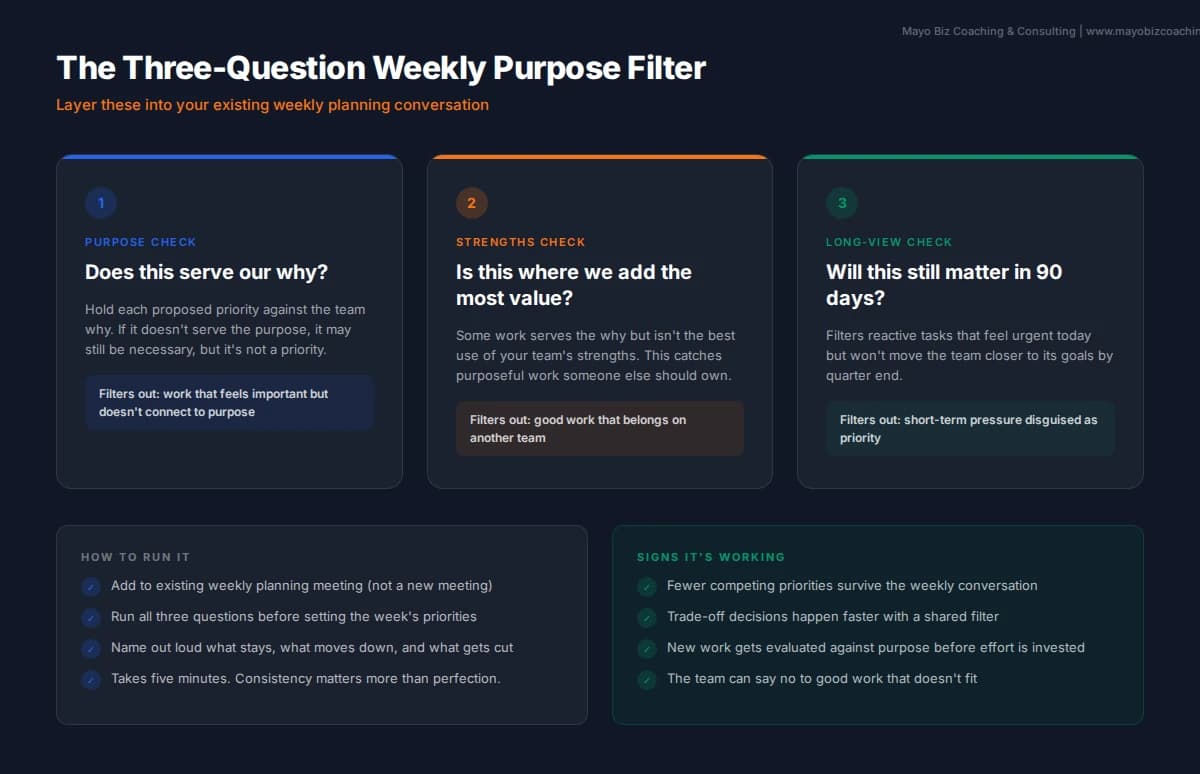
Here is the practical tool I want you to take from this post. Once your team has a why statement, you need a recurring mechanism to keep it in play.
Not a new meeting. Not a new process. Three questions layered into whatever weekly planning conversation you already run.
Question 1: Does this serve our why?
Before you set the week's priorities, hold each one against the team why. If the work does not serve the why, it may still be necessary, but it is not a priority. Name the difference out loud. Teams that skip this step default to urgency over purpose every time.
Question 2: Is this where we add the most value?
Some work serves the why but is not the best use of your team's strengths. This question catches the trap where teams do purposeful work that someone else should own. If you want to go deeper on matching work to talent, the habits in coaching vs. managing help here.
Question 3: Will this still matter in 90 days?
This is the long-view check. It filters out reactive tasks that feel urgent today but will not move the team closer to its goals by quarter end. It also protects against short-term panic, which is one of the most common ways purpose loses to pressure.
That is the full filter. Three questions. Five minutes at the top of the week. The repetition is the point. Purpose becomes real through consistent use, not perfect wording.
Why the Manager Is the Translation Layer
Gallup's 2024 State of the Global Workplace 4 report found that 70% of team engagement is attributable to the manager. That finding has held steady across years of their research, and it carries a practical implication for purpose work.
The team's purpose doesn't land because of a CEO speech or a company retreat. It lands when the direct manager uses it consistently in weekly conversations, priority setting, and trade-off decisions.
That is also where most purpose initiatives die. Senior leaders define the why. They share it once or twice. Then weekly work continues without a connection point, and the manager, who is the one person positioned to bridge purpose and execution, never gets the tools or the habit to do it.
If you manage managers, this is where to focus. Give them the three-question filter. Model it in your own planning. Ask them to report back on what they chose not to do this week and why. The discipline of saying no is where purpose becomes operational.
Global engagement sits at just 21% according to Gallup's 2024 State of the Global Workplace report. In Canada, the picture is somewhat stronger, but even here, roughly one in four employees reports being disengaged. For small businesses 5, where teams are smaller and each person's contribution is more visible, that disengagement hits harder. A five-person team with one disengaged member feels it immediately.
In that context, a clear team why is not a luxury. It is a baseline operating tool.
Common Mistakes That Hollow Out Team Purpose
I see these patterns regularly in coaching.
Writing a Why That Is Really a What
"We deliver exceptional customer service." That is a what. A why would explain the reason behind that service and what it makes possible for the people you serve. If your team statement reads like a job description, it is not a purpose. Rewrite it through the "so that" lens.
Making Purpose a One-Time Event
An offsite exercise without a weekly follow-up mechanism is a one-time event. Purpose that is not revisited weekly loses influence within a month. The three-question filter exists specifically to prevent this.
Confusing Alignment With Agreement
Your team doesn't need to feel inspired by the purpose statement every Monday morning. They need to understand it well enough to use it. Alignment means people can apply the why to their own decisions, not that everyone experiences the same emotional connection to it.
Skipping the Hard Conversation About What to Stop
Purpose is a filter. Filters remove things. If your team defines a why and does not stop or deprioritize anything as a result, the purpose is decorative. The most honest test of whether a team why is real: what did you decide not to do because of it?
If accountability conversations are difficult on your team, this is where the friction usually starts. It's hard to hold someone accountable for priorities when the priorities aren't connected to a shared reason.
A Two-Week Purpose Reset
If your team doesn't have a working why, or has one that collects dust, here's a short path forward.
Week 1: Draft the Team Why
Run a 30-minute team conversation. Ask three questions:
- What do we contribute that nobody else on this team or in this organization does?
- When we are at our best, what does that look like?
- Who benefits most from our work, and what changes for them?
Combine the answers into one sentence using the "to [contribution] so that [impact]" formula. Do not polish it. Test it.
Week 2: Use It
Run your regular weekly planning meeting. Before setting priorities, ask the three filter questions. Note what stays, what moves down, and what gets cut.
At the end of the week, check: did the priorities hold? Did anyone reference the why when making a trade-off?
If the answer is yes even once, the purpose is starting to work. Keep going.
If the answer is no, look at whether the issue is the statement itself or whether the team does not yet trust that it is safe to use purpose as a reason to say no. That second problem is a psychological safety question, not a purpose question.
How You Know It Is Working
Watch for these signals over the next 90 days:
- Team members reference the why in everyday priority conversations, not only in formal presentations.
- Fewer competing priorities survive the weekly planning conversation.
- Trade-off decisions happen faster because there is a shared filter.
- New work gets evaluated against purpose before effort is invested.
- The team can say no to good work that does not fit.
These are not soft outcomes. They reduce rework, shorten decision cycles, and free up capacity for the work that actually matters.
The Real Point
Start with why is a good idea that most teams stop too early. The statement is step one. The weekly filter is step two. The discipline to revisit it every week is what turns purpose into performance.
Your team doesn't need a better why. They need a reliable way to use the one they have.
Let's Build Brilliance Together
Purpose works when it reaches weekly decisions, not when it reaches the wall. If you are trying to connect your team's work to something that matters and want a practical starting point, reach out for a free consultation. No sales pitch, just an honest conversation about where you are and what you are working on.
Research Notes & Sources
If you want to go deeper, these are the studies and reports behind the key points in this post.
- Help Your Employees Find Purpose or Watch Them Leave(mckinsey.com)
- The Golden Circle(simonsinek.com)
- Habit 2: Begin With the End in Mind(franklincovey.com)
- State of the Global Workplace 2024 Report(gallup.com)
- Key Small Business Statistics 2024(ised-isde.canada.ca)
Category & Tags
Frequently Asked Questions
How do you apply start with why to a team?
Write a one-sentence team why using the formula "To [contribution] so that [impact]." Then test every weekly priority against it. If the work does not serve the why, it is a distraction, not a priority.
Why do most team purpose statements fail?
They fail because there is no recurring mechanism to use them. McKinsey found that 70% of employees define purpose through their work, but only 15% say they are actually living it. The gap is translation, not intention.
What is a simple way to connect purpose to weekly work?
Use a three-question filter at the start of each week: Does this serve our why? Is this where we add the most value? Will this still matter in 90 days? It takes five minutes and keeps priorities honest.
What is the difference between team purpose and company mission?
A company mission describes why the organization exists. A team purpose is more specific: it defines the contribution your team makes and the impact that contribution creates. Both matter, but the team version is what guides weekly decisions.
About the Author

About the Author
Mark Mayo
Head Coach, MBC
We get up each morning excited about sharing our 20-plus years of business acumen with small business owners and their teams. Collaborating with hard-working owners to achieve their personal and business goals brings rewards. When we develop you and grow your leaders, we create the momentum that moves you and your business forward. It starts with a first step. Then we can build brilliance together.
Related Articles

Who Helped You? The One Question That Changes Team Culture
Simon Sinek says teams of average performers consistently beat star-stacked teams. The difference is one habit: making the assist as visible as the goal.
Read Who Helped You? The One Question That Changes Team Culture
The Manager-as-Coach Shift: From Solving to Asking
The manager-as-coach shift means changing a daily reflex, not learning a skill set. Five practical moves to stop solving and start developing your people.
Read The Manager-as-Coach Shift: From Solving to Asking
Conscious Unbossing: Why Gen Z Doesn't Want to Manage
Over half of Gen Z workers don't want management roles. That's not entitlement. It's a rational response to how most organizations have designed the job.
Read Conscious Unbossing: Why Gen Z Doesn't Want to Manage