Executive Leadership & Career Coaching
How to Measure the ROI of Business Coaching: What the Research Actually Shows
You are thinking about hiring a business coach, maybe because someone recommended it or because you have been reading about it for months. Before you commit the time and money, you want to know whether coaching actually produces measurable results.
How to measure the ROI of business coaching is the practical question behind that decision.
That is a fair question, and the coaching industry has not made it easy to answer. Search "coaching ROI" and you will find a wall of impressive numbers: 529% returns, 788% ROI, and 6x your investment back. These figures get repeated so often that they start to sound like established facts.
They are not. Some are based on legitimate research, while others are what researchers call "zombie stats." These numbers are often recycled from small, dated, or weak studies. If you are going to invest in coaching, you deserve an honest look at what the evidence actually shows.
Research and statistics here are current as of February 2026.
Where The Big Numbers Come From
Three studies dominate the coaching ROI conversation. Their origins matter because most coaching websites cite them without context.
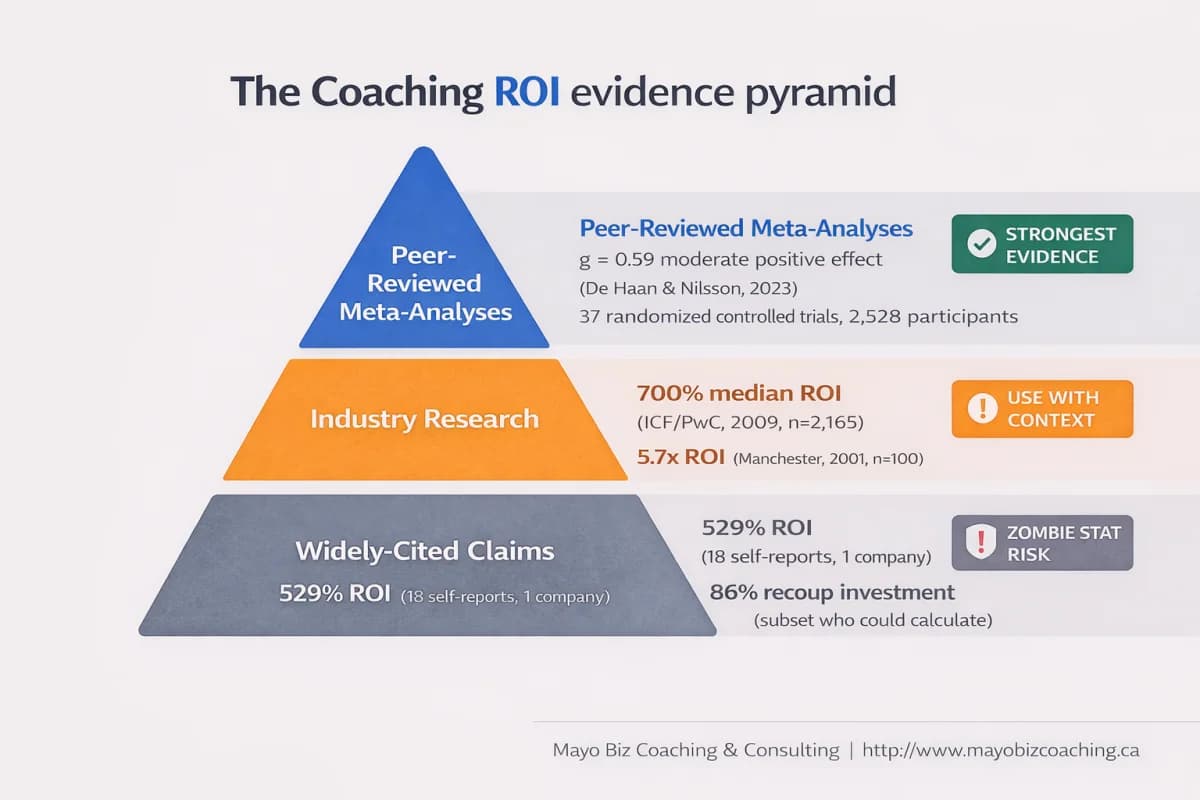
The "529% ROI" claim comes from a 2001 MetrixGlobal case study 1 by Merrill C. Anderson. The full finding was 529% ROI excluding retention benefits and 788% including them. The number sounds extraordinary.
Here is what is often missed. This was one Fortune 500 telecom company. Of the 43 participants, only 30 responded to the survey.
Of those 30, only 18 could estimate financial benefits. The ROI calculation rests on self-reported dollar estimates from 18 people at one company.
The "5.7x ROI" claim comes from a 2001 Manchester Inc. study 2 of 100 Fortune 1000 executives. It is more robust than the MetrixGlobal study.
It still has the same core limitation. Executives estimated their own coaching benefits in dollar terms. That method is prone to hindsight bias and pressure to look good. The study was published in Manchester's own journal, not a peer-reviewed academic publication.
The "700% median ROI" claim comes from the 2009 ICF Global Coaching Client Study 3, conducted by PricewaterhouseCoopers. This is the strongest of the three with 2,165 coaching clients surveyed across 64 countries.
It also found that 86% of those who could calculate ROI reported at least breaking even. The key detail is "of those able to provide figures." That is not 86% of all respondents. The figures were still self-reported by coaching clients, not independently audited.
These are real studies, and they are not fabricated. The problem is how they are presented. Claims of universal 500-700% returns ignore key limitations, so these findings are data points rather than universal laws.
What Rigorous Research Actually Found
The strongest evidence for coaching effectiveness comes from meta-analyses of randomized controlled trials. In these studies, one group receives coaching, a control group does not, and researchers compare outcomes. They rely on measured effects rather than self-reported ROI estimates.
The most rigorous is De Haan and Nilsson's 2023 meta-analysis 4, published in Academy of Management Learning & Education. They analyzed 37 randomized controlled trials with 2,528 participants from 1994 to 2021. Their finding was a moderate positive effect size of g = 0.59.
What does "moderate positive effect" mean in practice? It means coaching reliably improves outcomes, but the improvement is meaningful and real rather than miraculous. For context, an effect size of 0.59 is comparable to many well-known medical and education methods.
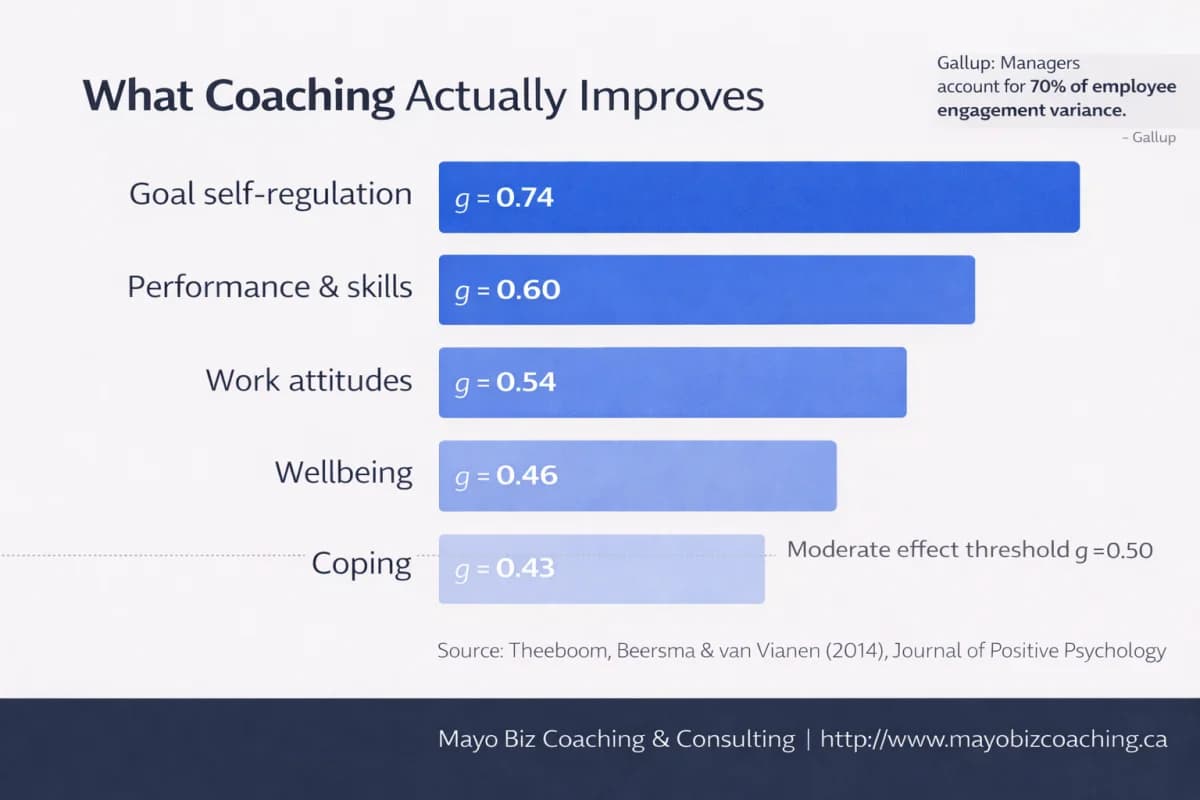
Theeboom, Beersma, and van Vianen's 2014 meta-analysis 5 broke this down across outcome categories:
- Goal-directed self-regulation: g = 0.74 (strong).
- Performance and skills: g = 0.60 (moderate to strong).
- Work attitudes: g = 0.54 (moderate).
Other outcomes also improved:
- Wellbeing: g = 0.46 (moderate).
- Coping: g = 0.43 (moderate).
The pattern is clear. Coaching is most effective at helping people set better goals and follow through on them. It is moderately effective at improving skills, attitudes, and wellbeing. This matches what good coaches see in practice: coaching works best when someone is motivated and clear on outcomes.
Nicolau et al.'s 2023 meta-analysis 6 of 20 RCT studies added another insight: coaching has the strongest impact on behavioral outcomes. People who receive coaching change what they do more than what they feel or believe. Actions first, attitudes follow.
The Engagement Connection: Where Coaching Hits Hardest
The most compelling case for coaching ROI does not come from the coaching industry at all. It comes from Gallup's Q12 meta-analysis 7. It aggregated 456 studies across 276 organizations and 2.7 million employees.
Their findings on high-engagement versus low-engagement teams:
- 23% higher profitability.
- 18% higher productivity in sales.
- 81% lower absenteeism.
- 18-43% lower turnover.
And the finding that matters most for coaching: managers account for 70% of the variance 8 in employee engagement scores. Not compensation. Not company culture in the abstract. The manager.
This is where coaching ROI becomes concrete. Manager behavior is the biggest driver of engagement, and engagement predicts profitability, productivity, and retention. Investing in how leaders lead is a business decision with measurable downstream effects.
Gallup's 2024 research 9 sharpened this further: 42% of employees who voluntarily left their jobs said their departure could have been prevented. Nearly half reported no meaningful conversation with their manager in the three months before leaving. That is a coaching problem hiding inside a retention problem.
The Canadian SMB Reality
If you run a small business in Canada, the ROI question is not abstract. It is personal.
The Future Skills Centre 10 found that Canadian employers spend an average of $240 per employee annually on training. That is roughly one-third of the OECD average. Canadian businesses underinvest in development compared with every G7 peer.
The gap is widest among small businesses. At firms with 1-10 employees, only 30% receive on-the-job training. At firms with 1,000+ employees, the figure is 62%.
This matters because 98% of Canadian businesses are small businesses 11, employing nearly 5.7 million people in the private sector. The leadership development gap is not affecting a niche. It is affecting the backbone of the economy.
BDC's advisory board study 12 provides strong Canadian-specific evidence. Businesses that formed advisory boards saw sales grow 67% on average in the following three years. Their long-term productivity was 18% higher than businesses without advisory support. It also found that 86% of entrepreneurs with an advisory board said it had an important impact on their success.
What Coaching Cannot Do
Honest conversations about coaching ROI require acknowledging what coaching is not good at.
Kruger's 2025 peer-reviewed study 13 in Human Resource Development Quarterly examined coaching failures directly. Out of 357 coachees surveyed, 3.6% experienced coaching as predominantly negative. Three root causes emerged: mismatched expectations, poor relationship dynamics, and company interference such as hidden agendas.
Coaching fails when it is forced on someone who does not want it. It fails when there are no clear goals defined upfront. It fails when the organization uses it as a performance improvement plan in disguise rather than a genuine development tool. And it fails when the coach is not qualified to handle the complexity of the situation.
The research on durability is also honest about a gap. Most coaching studies measure outcomes right after the engagement or within a few months. Long-term data beyond 12 months is still limited.
A 2023 RCT by Brooks et al. 14 showed that a ten-week coaching program reduced burnout and increased engagement in leaders. The study did not track whether those gains lasted a year later.
The practical implication: coaching is not a one-time fix. The evidence suggests that periodic re-engagement every 6-12 months sustains behavioral change more effectively than a single intensive engagement.
How to Actually Measure Your Coaching ROI
Forget trying to calculate a precise percentage return because self-estimated dollar figures are unreliable. Measure leading indicators that predict business outcomes.
Before coaching starts, establish baselines for team outcomes:
- Employee retention rates and voluntary turnover.
- Engagement scores (even an informal pulse survey counts).
- Revenue per employee.
Also establish baselines for leadership behavior:
- Time you spend on strategic work versus reactive firefighting.
- How often your direct reports bring you problems versus options.
- Decision-making speed on key initiatives.
During and after coaching, track people and team signals:
- How your team communicates with you (more candor usually means better psychological safety).
- Whether your best people are staying.
- Quality of delegation (are you letting go effectively, as explored in coaching versus managing?).
Track owner-level and customer signals as well:
- Your own energy and clarity around priorities.
- Customer satisfaction and repeat business.
A common scenario I see in coaching looks like this: an owner starts with no baseline and little trust in ROI math. We set five indicators and review them every two weeks. By month three, the owner can usually see trends in delegation quality, retention risk, and strategic time.
Another common pattern is decision speed. Teams start by escalating every issue to the owner. After coaching, managers bring options with trade-offs, decisions move faster, and the owner gets strategic time back.
The ICF/HCI research series on coaching cultures 15 consistently found that organizations with strong coaching cultures report 60% above-average revenue compared to peers. That is correlational, not causal. But it suggests a pattern: leaders who invest in development tend to build organizations that outperform.
A Plain-Language ROI Check You Can Use This Month
If this still feels abstract, keep it simple. You do not need a complex model to start. You need a short loop you can run each week.
Start small. Move fast.
Pick one outcome goal. Make it clear and concrete. Example: reduce avoidable turnover in one team. Or move owner time from daily fire drills to planning.
Pick one behavior goal. Tie it to the outcome. Example: each manager brings one risk and one option every week.
Set a baseline in week one. Use the data you already have. A rough baseline is better than no baseline.
Run a short review every two weeks. Ask what changed, what stalled, and what the team learned. Keep the review to 30 minutes.
Use simple stop and start calls. Stop one habit that adds noise. Start one habit that improves clarity.
Name an owner for each action. Put a due date on each action. Check progress in the next review.
Do this for eight weeks. Look for trend lines, not perfect data. Most teams can see signal by week six.
If results improve, keep the loop. If results stall, adjust the behavior goal first. Do not rewrite the whole plan too fast.
This process is practical for small teams. It works with limited time and limited budget. It also makes coaching value visible before quarter-end reports arrive.
The Bottom Line on Coaching ROI
The flashy numbers (529%, 700%, 6x) are not lies. They are real findings from real studies, but they are often presented without the context that makes them meaningful. Peer-reviewed meta-analyses tell a more honest story: coaching produces moderate, reliable, positive effects on goal attainment, performance, wellbeing, and leadership behavior.
For a small business owner, skip the "529% return" headline. Ask a better question: will stronger leadership improve retention, engagement, productivity, and growth? Across decades of research and millions of data points, the answer is yes.
An ICF and HCI 2023 research update 16 found that 72% of organizations with coaching programs reported a direct correlation with increased employee engagement. Gallup's data shows that engaged teams are 23% more profitable. The math runs in one direction.
Coaching is not magic. It is a structured process for getting better at the part of business that matters most: how you lead people. In small businesses, every person's contribution is amplified, so that improvement has outsized impact.
Let's Build Brilliance Together
If you are weighing the investment in coaching, the research supports the decision. Not with inflated promises, but with consistent evidence that better leadership produces better outcomes.
If you want focused support on these outcomes, Executive Leadership & Career Coaching helps you build the leadership habits that move these metrics.
If you want to explore what coaching could look like for your situation, reach out for a free consultation. No pressure, no sales pitch. Just an honest conversation about where you are and what you are working toward.
Research Notes & Sources
If you want to go deeper, these are the studies and reports behind the key points in this post.
- 2001 MetrixGlobal case study(researchportal.coachingfederation.org)
- 2001 Manchester Inc. study(researchportal.coachingfederation.org)
- 2009 ICF Global Coaching Client Study(researchportal.coachingfederation.org)
- De Haan and Nilsson's 2023 meta-analysis(api.crossref.org)
- Theeboom, Beersma, and van Vianen's 2014 meta-analysis(api.crossref.org)
- Nicolau et al.'s 2023 meta-analysis(frontiersin.org)
- Gallup's Q12 meta-analysis(gallup.com)
- managers account for 70% of the variance(gallup.com)
- Gallup's 2024 research(gallup.com)
- Future Skills Centre(fsc-ccf.ca)
- 98% of Canadian businesses are small businesses(ised-isde.canada.ca)
- BDC's advisory board study(bdc.ca)
- Kruger's 2025 peer-reviewed study(api.crossref.org)
- 2023 RCT by Brooks et al.(frontiersin.org)
- coaching cultures(coachingfederation.org)
- ICF and HCI 2023 research update(coachingfederation.org)
Category & Tags
Frequently Asked Questions
What is the average ROI of business coaching?
A 2009 ICF/PricewaterhouseCoopers study of 2,165 clients found a median 700% ROI among people who could estimate it. Randomized trial meta-analyses show coaching delivers moderate, reliable gains in performance, goal attainment, and wellbeing.
Is the 529% coaching ROI statistic accurate?
Yes, with limits. The 529% figure came from a 2001 MetrixGlobal case study at one Fortune 500 firm and relied on financial self-estimates from 18 participants. It is a real data point, not a universal benchmark.
How do you measure coaching ROI for a small business?
Track baseline and follow-up metrics: retention, engagement, revenue per employee, decision speed, and strategic time. BDC data shows SMEs with advisory support reported 67% higher sales growth, so define your baseline before coaching starts.
Is business coaching worth the investment for small business owners?
Usually yes when goals are clear. A UPS Store survey found mentored businesses survived five years at about double the rate (70% vs 35%). Gallup also reports managers drive most engagement variance, which affects retention and productivity.
About the Author

About the Author
Mark Mayo
Head Coach, MBC
We get up each morning excited about sharing our 20-plus years of business acumen with small business owners and their teams. Collaborating with hard-working owners to achieve their personal and business goals brings rewards. When we develop you and grow your leaders, we create the momentum that moves you and your business forward. It starts with a first step. Then we can build brilliance together.
Related Articles

Delegation Without Abdication: How to Let Go and Still Lead
Gallup found high-delegator CEOs earn 33% more revenue. Learn a five-level delegation framework that builds team capability without losing control.
Read Delegation Without Abdication: How to Let Go and Still Lead
Self-Awareness Is a Leadership Skill You Can Build
Most leaders think they're self-aware. Research says only 10-15% actually are. Here is how to close the gap and lead with clearer self-knowledge.
Read Self-Awareness Is a Leadership Skill You Can Build
Coaching Conversations: A Practical Framework for Leaders
A coaching conversation changes who does the thinking. The GROW framework, the neuroscience of self-generated insight, and four traps to avoid.
Read Coaching Conversations: A Practical Framework for Leaders