Team Leadership Development
Quiet Cracking vs Quiet Quitting: Why Your Best People Break in Silence

Your team looks fine on the surface. Deadlines are met. Nobody is complaining. But your strongest contributor stopped volunteering for new projects last month. Another one gives shorter answers in one-on-ones. A third shows up on time, does solid work, and has not offered a new idea in weeks.
You might not notice any of this. That is the problem.
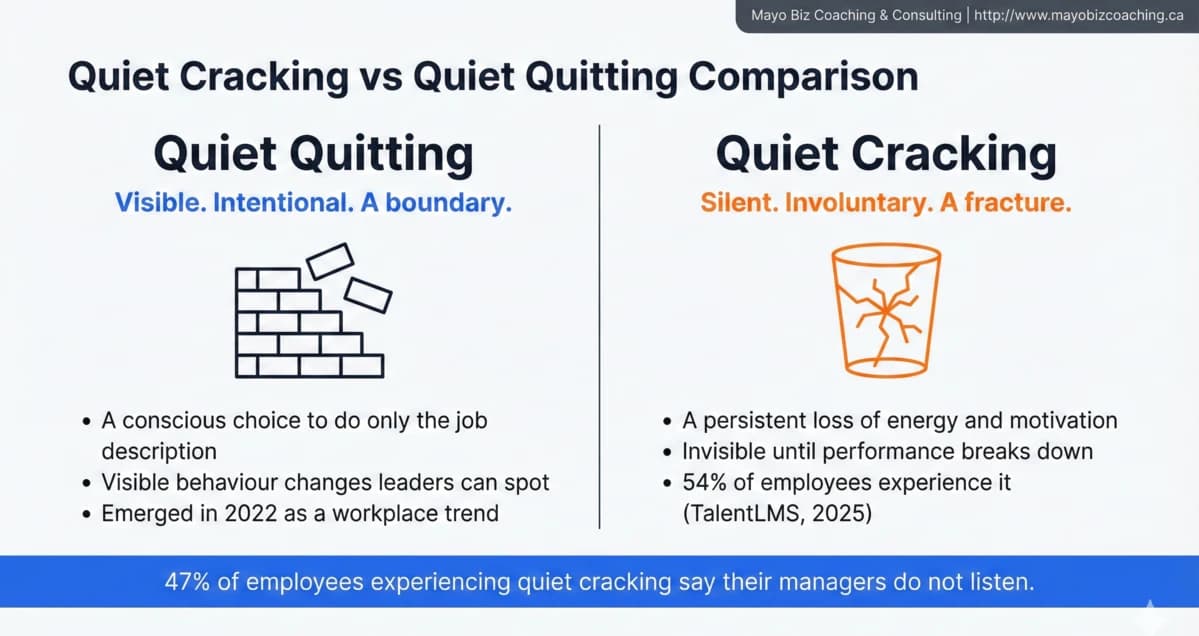
Quiet quitting made headlines in 2022. It was visible and intentional. Leaders could see it happening and decide how to respond. Quiet cracking is different. It is silent and involuntary. A 2025 TalentLMS survey found 54% of employees experience it.
What Quiet Quitting Actually Was
Quiet quitting had a clear signal. People decided to do their job description and nothing more. No extra hours, no volunteering for stretch projects, no emotional investment beyond what the role required.
It was a conscious boundary. For many workers, it was a healthy correction after years of burnout culture. They pushed back against the expectation that loyalty meant overwork.
The reason quiet quitting got so much attention is that leaders could see it. When someone stops answering emails at 7 p.m., you notice. When they decline optional meetings, you notice. The behaviour change was visible, which meant leaders could respond.
Quiet quitting started a conversation. Quiet cracking is not a conversation at all.
Quiet Cracking Is Not a Choice
Quiet cracking is a persistent feeling of workplace unhappiness. It leads to disengagement, poor performance, and a growing desire to leave. TalentLMS defined the term in 2025 1 after surveying 1,000 employees and finding that 54% experience it. One in five experience it frequently or constantly.
The difference that matters: quiet quitting is intentional. Quiet cracking is not. People who are quietly cracking want to do good work. Their spirit is wearing down, not their willingness.
They are not choosing to disengage. They are losing the capacity to stay engaged.
Think of it this way:
Quiet quitting is someone building a wall. You can see the wall.
Quiet cracking is someone developing hairline fractures. You cannot see them until something breaks.
| Quiet Quitting | Quiet Cracking | |
|---|---|---|
| Intent | Deliberate boundary-setting | Involuntary erosion |
| Visibility | Observable behaviour changes | Hidden behind steady performance |
| Root cause | Rejection of overwork culture | Accumulated stress wearing down motivation |
| What it looks like | Doing the job description, nothing more | Doing good work, but without energy or initiative |
I coached a director of operations at a mid-size company who had been on her leadership team's high-potential list for three years. When I met her, she was still meeting every target. But she told me she felt hollow at work. She described it as "running on the fumes of who I used to be."
Her manager had no idea. Her performance reviews were strong. She smiled in meetings. She had not missed a deadline.
But she had quietly stopped caring about the outcomes behind those deadlines. That is quiet cracking.
Why Leaders Miss It
Quiet cracking is almost invisible to the people responsible for stopping it. A few things explain why.
The Anxiety Zone
Amy Edmondson's research on psychological safety 2 explains why people hide their struggles at work. In her four-zone framework from The Fearless Organization, she describes what happens when accountability is high but safety is low. She calls it the anxiety zone. People care about their work and want to meet standards, but they do not feel safe admitting they are struggling.
In that zone, nobody raises their hand. Nobody says "I need help." Nobody admits they are running on empty.
Instead, they manage impressions. They perform fine while fracturing underneath.
I see this pattern often in leadership teams where performance standards are high but emotional honesty is low. The leaders work hard and deliver results. They also quietly resent the work, avoid tough conversations, and stop bringing their best thinking. The post on psychological safety and team silence explores how that dynamic takes hold.
Silence is not agreement. It is often a sign that people do not feel safe enough to tell you what is really going on.
Emotional Bottling
Susan David, the Harvard psychologist behind Emotional Agility (2016), describes two common responses to workplace stress: bottling and brooding. Bottlers push difficult emotions aside and keep going. The problem is that suppressed emotions do not disappear. They leak out as withdrawal, shorter patience, and declining engagement.
David makes a sharp observation about workplace culture. When the only acceptable answer to "How are you?" is "Good, thanks," you have created conditions where cracking stays hidden. Toxic positivity does not build resilience. It builds silence.
People who are quietly cracking are often bottlers. They are not dramatic or difficult. They just slowly stop bringing the effort and ideas that set them apart.
The Fog Before the Break
Sociologist Corey Keyes first described this emotional state as "languishing." Adam Grant brought the concept into the mainstream in his 2021 New York Times piece. According to the Times, it became the most-read article the paper published that year. Languishing sits between depression and burnout: a persistent fog of low motivation and emptiness that most people cannot name.
Grant called it "the neglected middle child of mental health." You are functioning. You are showing up. But the spark is gone. For leaders trying to spot quiet cracking, languishing is what it feels like from the inside.
If you are waiting for someone to visibly break down before you act, you have already missed months of quiet cracking.
The Warning Signs You Are Probably Missing
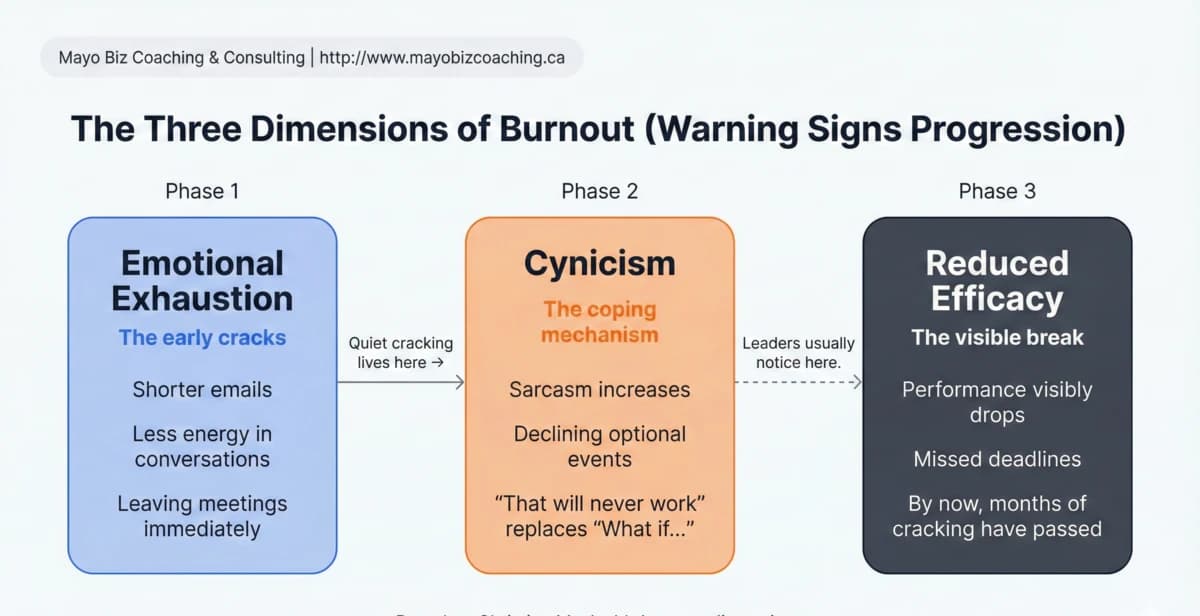
Christina Maslach, the researcher who created the Maslach Burnout Inventory, identified three dimensions of burnout that tend to build on each other. In our coaching experience, quiet cracking maps to the first two phases, the ones that are easiest to miss. The post on burnout as a leadership problem covers Maslach's full framework in depth.
Stage 1: Emotional exhaustion. The earliest sign. People feel depleted but keep performing. You might notice shorter emails, less energy in conversations, or someone who used to stay after meetings to chat but now leaves immediately.
Stage 2: Cynicism. The coping mechanism. People distance themselves from the work emotionally. Sarcasm increases. Enthusiasm for new initiatives drops. You hear more "That will never work" and less "What if we tried..."
Stage 3: Reduced efficacy. This is when performance visibly drops. But by this stage, the person has been quietly cracking for months.
Before stage 3, quiet cracking looks like this:
- Fewer questions in meetings
- Declining optional team events
- Slower responses on non-urgent items
- "I'm fine" on repeat, without detail
- Good work, but no spark behind it
- Less pushback on decisions they would have challenged before
A production manager I worked with checked every item on this list. His leader described him as "reliable but flat." When I asked whether anything had changed, the leader said, "Not really. He has always been steady."
But steady was new. That manager used to push back, argue for better processes, and stay late to solve problems voluntarily. "Steady" was what remained after the drive had cracked away. It took an outside conversation to help that leader see it.
If someone who used to bring energy now just brings consistency, that shift is worth a real conversation.
What Active Listening Actually Changes
One stat ties all of this together. The same TalentLMS research found that 47% of employees experiencing quiet cracking say their managers do not listen to their concerns. That is nearly half.
Not "do not act on" their concerns. Do not listen.
Active listening is not a personality trait. It is a set of behaviours that leaders can practise and improve. The guide on active listening for leaders covers the full skill set. For quiet cracking, what matters most is simple.
Listening is not waiting for your turn to speak. Stephen Covey said it simply: most people listen with the intent to reply, not to understand. When a team member says "Everything is fine," an active listener hears the flatness behind the words and follows up.
One genuine question can reveal what performance reviews miss. "How are you really doing with all of this?" Ask it in a private setting, with no laptop open and no time pressure. That one question creates more signal than any quarterly review.
When people experience being heard, the cost of speaking up drops. They start sharing earlier. Problems come out before they spread.
I coached a small business owner in Ontario whose team of 12 seemed disengaged after a difficult Q3. He had tried a team lunch. He tried a half-day offsite. Nothing changed.
I asked him one question: "When was the last time you sat with each person for 20 minutes and just listened?" He could not remember.
We started there. Within six weeks, two people raised workload concerns they had been sitting on for months. A third admitted she had been interviewing elsewhere but reconsidered after feeling heard.
Listening did not fix everything. But it was enough.
What to Do This Week
You do not need a program. You need four conversations.
1. Have one real one-on-one. Not a status update. Not a project check-in. Sit with one person and ask how they are doing with their workload, their energy, and whether they feel like they are growing. Then listen without solving.
2. Name the pattern out loud. If you have noticed someone pulling back, say so directly and without judgment. "I have noticed you seem quieter in team meetings lately. I want to check in, not evaluate." Naming it reduces the stigma of admitting struggle.
3. Ask about workload and actually adjust. The DDI 2025 Global Leadership Forecast 3 found that only 19% of rising leaders demonstrate strong delegation skills. When people are cracking under workload, asking them to "prioritise better" is not the answer. Redistributing work is. The post on delegation without abdication walks through how to hand off work without losing visibility.
4. Stop rewarding exhaustion. Pay attention to what you praise. If the loudest recognition goes to the person who worked the weekend, you are telling the team that cracking quietly is the price of belonging. Recognise outcomes and effort, not hours and sacrifice.
The Gallup 2025 State of the Global Workplace 4 report found that global engagement dropped to 21%. Manager engagement fell from 30% to 27%. The managers responsible for spotting quiet cracking are quietly cracking themselves. Better conversations help, but so does reducing the load that makes those conversations feel impossible.
Start with one conversation this week. That is enough to begin.
Let's Build Brilliance Together
Quiet cracking does not announce itself. It does not show up in performance reviews or exit interviews. It hides between "I'm fine" and "I'm done." It only comes out when someone actually listens.
If you are seeing these patterns on your team, Team Leadership Development coaching can help. We work on the specific listening, delegation, and feedback skills that stop cracks before they spread.
If you want to start with a conversation, reach out for a free consultation. No sales pitch, just an honest conversation about where your team is and what needs to change next.
Research Notes & Sources
If you want to go deeper, these are the studies and reports behind the key points in this post.
- TalentLMS defined the term in 2025(talentlms.com)
- psychological safety(hbr.org)
- DDI 2025 Global Leadership Forecast(ddi.com)
- Gallup 2025 State of the Global Workplace(gallup.com)
Category & Tags
Frequently Asked Questions
What is the difference between quiet cracking and quiet quitting?
Quiet quitting is intentional boundary-setting where employees choose to do only their job description. Quiet cracking is involuntary. People want to perform but are silently losing the energy and motivation to keep going.
What are the signs of quiet cracking on a team?
Watch for fewer questions in meetings, declining optional events, slower responses on non-urgent items, repeated "I'm fine" answers, and good work delivered without any spark or initiative behind it.
How common is quiet cracking in the workplace?
A 2025 TalentLMS survey found 54% of employees experience some level of quiet cracking. One in five experience it frequently or constantly. Nearly half say their managers do not listen to their concerns.
What can leaders do to prevent quiet cracking?
Start with genuine one-on-one conversations, practise active listening, redistribute workloads fairly, and stop rewarding exhaustion. Structural changes matter more than wellness perks.
About the Author

About the Author
Mark Mayo
Head Coach, MBC
We get up each morning excited about sharing our 20-plus years of business acumen with small business owners and their teams. Collaborating with hard-working owners to achieve their personal and business goals brings rewards. When we develop you and grow your leaders, we create the momentum that moves you and your business forward. It starts with a first step. Then we can build brilliance together.
Related Articles

FOBO: When Your Team Fears Becoming Obsolete
52% of workers fear AI will reshape their role. Coaching frameworks for leaders to recognize FOBO on their teams and turn anxiety into growth.
Read FOBO: When Your Team Fears Becoming Obsolete
Why Your Best People Aren't Speaking Up
When your strongest contributors go quiet, they haven't become compliant. They're calculating whether it's worth the risk. Here is how to read the silence.
Read Why Your Best People Aren't Speaking Up
The Five Dysfunctions Hiding in Your Team
Patrick Lencioni's Five Dysfunctions model shows why capable teams underperform. Here is how to spot each dysfunction and what to do about it this week.
Read The Five Dysfunctions Hiding in Your Team