Work-Life Integration & Purpose
Purpose Driven Leadership: Why Putting People First Drives Results

Purpose driven leadership matters most when your metrics look fine but your team energy feels flat, even with targets, dashboards, and reports. Yet your best people seem disengaged and turnover keeps rising, a pattern common in businesses that optimize for numbers without clarifying meaning.
Here is the hard possibility: your scorecard may be signaling the wrong priorities, even though numbers still matter. Metrics alone can tell people they are a means to an end. When that message lands, extra effort drops.
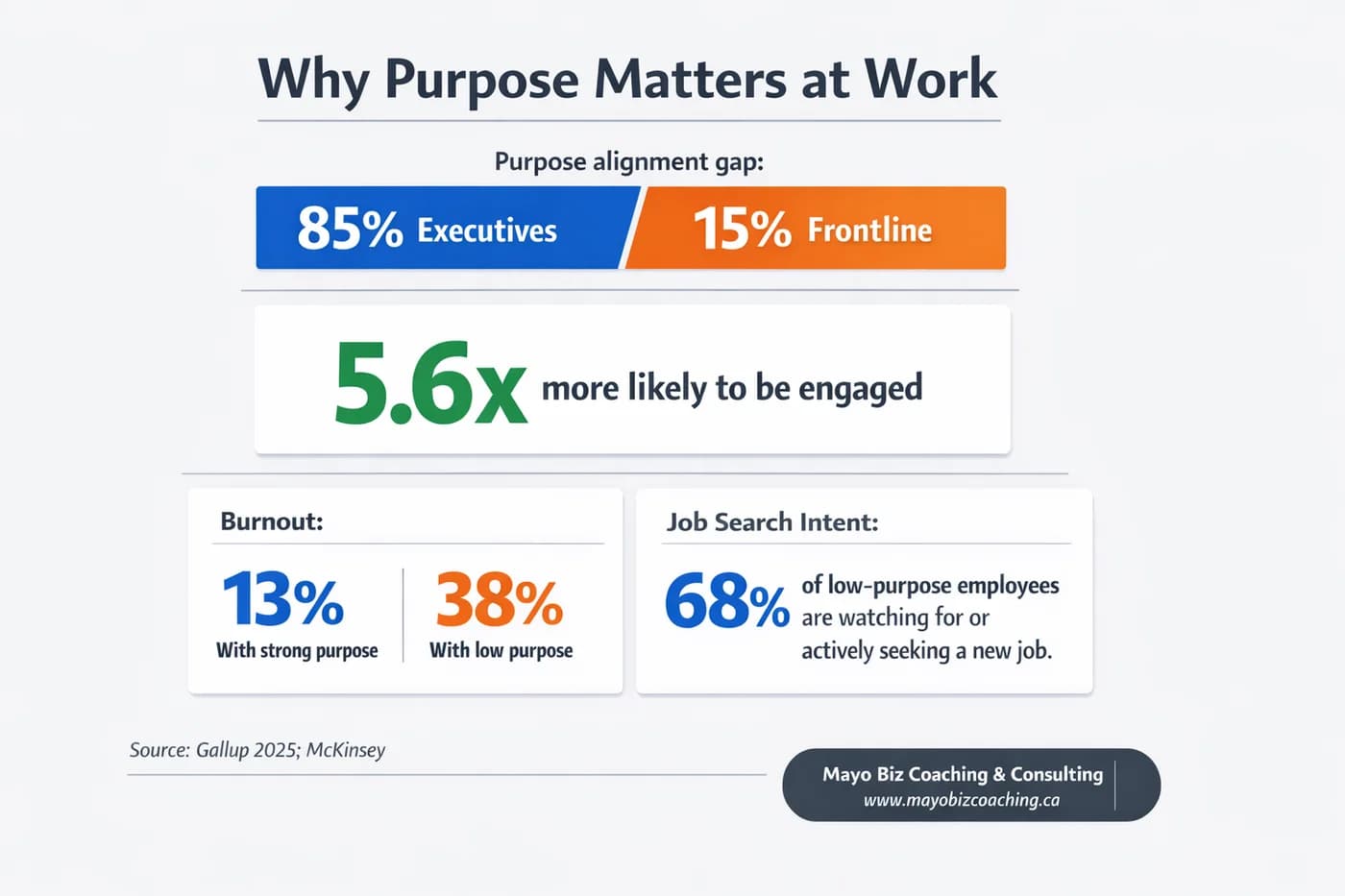
Gallup's 2025 research 1 found that only 18% of employees feel their work aligns with purpose.
Nearly half said they work mainly for pay and benefits. That gap is where many teams lose momentum and loyalty.
Purpose driven leadership closes that gap, and the evidence is clear.
What Purpose Driven Leadership Actually Means
Purpose driven leadership starts with one shift: define why your organization exists beyond profit. This is not a tagline but a daily rule that shapes decisions, priorities, and behavior.
People ask what the team is doing, and they also ask why the work matters to them.
If leaders miss that answer, teams default to task completion and short-term compliance.
Simon Sinek's Golden Circle framework 2 makes this practical: Why, How, What. Most organizations communicate in reverse, leading with what they do and then explaining how.
Purpose driven leaders invert that sequence. They lead with why, connect it to behavior, then align execution.
The Best Buy Proof: 335% Returns by Putting People First
If this sounds abstract, look at Best Buy under Hubert Joly. When he became CEO in September 2012, the company was in crisis, with showrooming crushing margins and confidence low.
The default playbook was obvious: cut costs, close stores, and reduce headcount. Best Buy had already tried versions of that approach, and results did not improve fast enough.
Joly chose a different path and spent early time with frontline teams, listening before major changes. He then framed Best Buy's purpose as enriching lives through technology rather than simply selling electronics.
Joly argued 3 that profit is an outcome, not a purpose.
In his Yale School of Management interview 4, he described leadership as creating conditions where people can do their best work.
Results followed that shift.
Best Buy reported 335% total shareholder return 5 during his tenure, versus 104% for the S&P 500 over the same period.
The company also delivered multiple years of comparable sales growth.
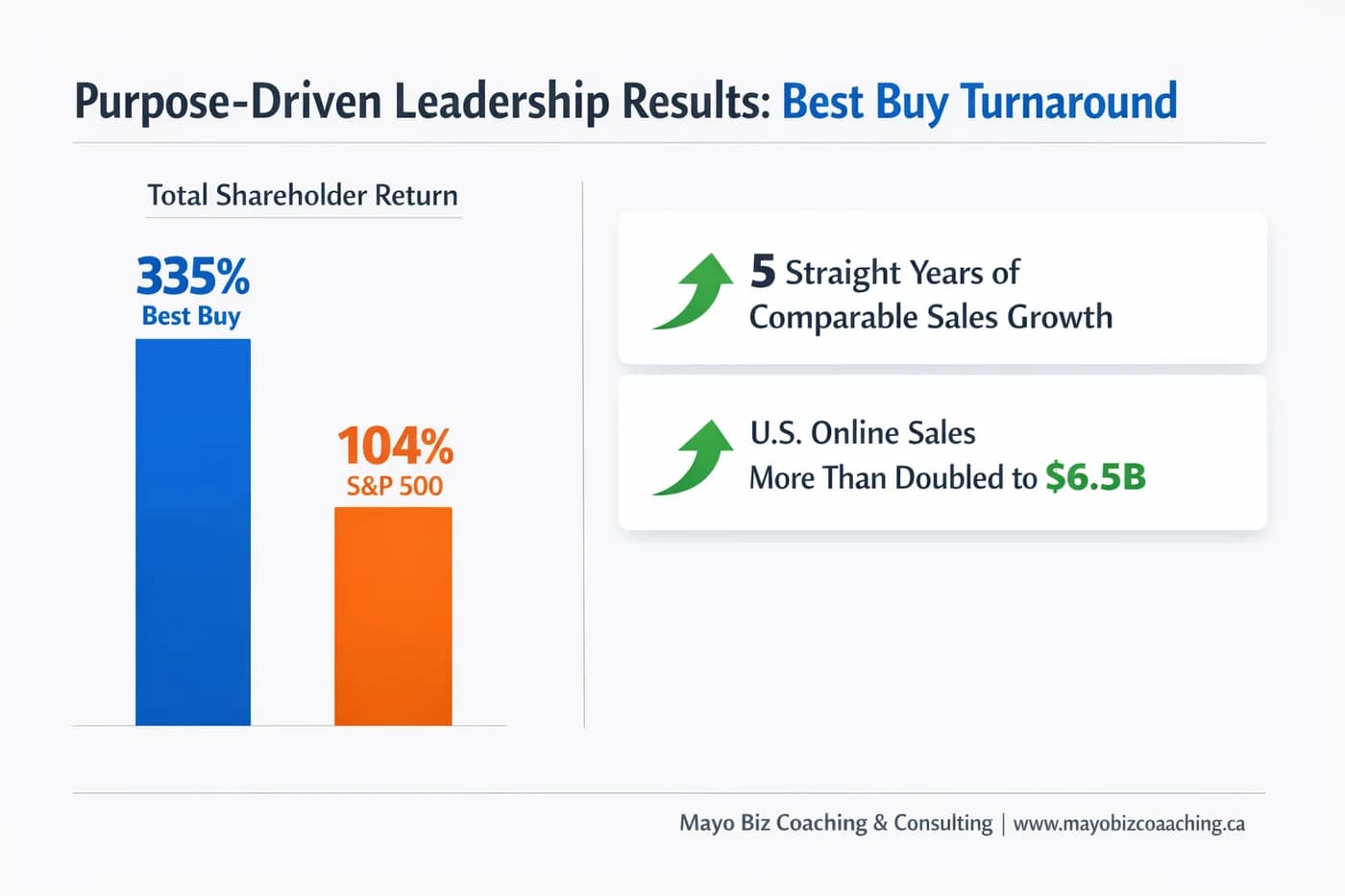
Best Buy did not recover because of one financial tactic. It recovered because the organization changed what it optimized for.
The Leader as Gardener, Not Taskmaster
Joly uses a useful metaphor: the leader as gardener. A gardener does not force growth; a gardener creates conditions where growth becomes likely.
Leadership works the same way. You do not command sustained engagement into existence. You build a setting where it can take root.
Three conditions matter most:
Psychological safety is the soil. People cannot do great work if they fear punishment for speaking honestly. As we explored in psychological safety, teams need safety plus accountability.
Purpose is the sunlight. People need to see how daily work connects to something that matters. If purpose stays abstract, work drifts into checkbox behavior.
Connection is the water. Leaders need direct contact with the work. Active listening is not soft. It helps you surface risks, ideas, and truth early.
Why This Hits Differently for Small Business
Large-company examples can feel distant when you run a team of 8 or 25. In practice, purpose driven leadership is often easier in a small business. The impact is faster, and signals are clearer.
You are the culture. In a small company, there is no thick management buffer. Your behavior sets tone every day.
Connection is built in. You are close to customers and staff by default. That proximity makes feedback loops faster.
Impact is concentrated. One disengaged person is visible immediately. One energized person is equally contagious.
BDC research 6 found that SMEs with intentional culture practices report better engagement, lower turnover, and better decisions. This is exactly where purpose-led leadership compounds.
Five Shifts That Move You From Metrics-First to Purpose-First
Purpose driven leadership does not reject metrics; it changes which metrics lead and which metrics lag.
1. Define Your Noble Purpose (and Make It Specific)
"We help people" is too vague to guide behavior. A useful purpose is specific enough that each person can explain it in one sentence.
Try this test: if profit were neutral for one year, what would your company still exist to do? That answer usually reveals your real purpose.
2. Connect Every Role to the Purpose
In one Ontario client team of 14 people, the purpose statement looked strong on paper. In one-on-ones, only 3 team members could link weekly tasks to that purpose. Performance was steady, but engagement was low.
We added one standing one-on-one question: "How did your work this week support our purpose?" Within six weeks, handoffs improved and initiative increased.
Ask that same question in your next check-in. If answers are vague, the issue is not motivation. The connection is not visible enough yet.
3. Measure Lead Behaviors Alongside Lag Results
Revenue, margin, and retention are lag measures. They matter, but they describe what already happened.
Lead measures track daily behavior: one-on-one quality, speed of decision-making, escalation quality, and collaboration across roles. These are the actions your team can influence today.
In another coaching engagement with a 22-person service business, leaders tracked how often managers brought options instead of problems. Within two months, decision cycles shortened and owner bottlenecks dropped.
The 4 Disciplines of Execution 7 calls this a winnable game. People engage when they can influence the score while work is still happening.
4. Go First With Vulnerability
Leaders set the emotional rules. If you only share wins, people hide risk. If you name your own miss early, people speak up earlier.
That is not softness but clear transparency that improves execution quality.
This also connects to emotional intelligence. Self-awareness is the starting point for credible leadership.
5. Align Accountability With Purpose
Purpose without accountability becomes comfort, and accountability without purpose becomes pressure. High-performing teams need both.
Hold short weekly check-ins tied to commitments and behavior, not output alone. Ask, "What did you do this week that advanced our purpose?"
Link accountability to behavior, then to outcomes. That sequence builds trust and performance together.
Common Mistakes That Undermine Purpose-Driven Leadership
The first mistake is treating purpose as a launch event instead of an operating rhythm. Leaders announce values once, then return to old review habits and old incentives. When weekly decisions ignore purpose, the team assumes the statement was marketing language.
The second mistake is overloading managers with metrics while giving little coaching support. Many managers are promoted for personal output, not for translating purpose into team behavior. If they cannot connect goals, feedback, and purpose, execution fragments across the organization.
The third mistake is rewarding outcomes that conflict with declared values. If collaboration is praised but heroics are promoted, people follow the reward system. Purpose becomes credible only when accountability, recognition, and behavior all point in the same direction.
A 90-Day Purpose Execution Plan
In my work with leaders, the best approach is a short execution cycle with clear checkpoints. Ninety days is long enough to change habits and short enough to keep urgency. Use three focused phases.
Days 1 to 30: clarify and align. Write one plain-language purpose statement, then define three behaviors that prove the purpose is active. Have each manager explain how their weekly work supports those behaviors, then close gaps quickly.
Days 31 to 60: measure and coach. Track lead measures managers can influence now, including one-on-one quality, decision speed, and escalation quality. Review those measures weekly, coach missed behaviors, and remove bottlenecks that slow follow-through.
Days 61 to 90: reinforce and scale. Tie recognition and accountability to purpose-aligned behavior alongside lag outcomes. Document what changed, where resistance surfaced, and which practices produced the strongest lift.
One retail client with 18 staff used this cycle after a difficult hiring quarter. Voluntary departures dropped in the next quarter, and more people joined cross-training. The owner also reported fewer emergency escalations and more proactive planning from supervisors.
How to Know the Shift Is Working
Look for early behavioral signals before you wait for quarterly financial results. Purpose work appears first in meetings, handoffs, escalation quality, and manager follow-through.
In effective teams, people raise risks earlier and suggest options instead of only reporting problems. You hear more constructive disagreement, because clarity matters more than image management.
Decision cycles usually shorten because fewer issues bounce between teams without ownership. Managers spend less time defending turf and more time clearing shared bottlenecks.
Track three indicators every two weeks: one-on-one quality, speed from issue discovery to decision, and proportion of escalations that include proposed options.
If those indicators improve for six to eight weeks, lag outcomes usually follow. Retention stabilizes, customer issues surface earlier, and leaders reclaim time for strategic work.
When indicators stall, do not rewrite the purpose statement immediately. Audit manager routines first, because execution habits fail more often than purpose language.
In one professional-services team, the purpose statement stayed the same for six months. The leadership cadence changed: weekly behavior reviews, clear ownership, and faster feedback loops.
That cadence reduced rework, improved client handoffs, and lowered after-hours firefighting across managers. The owner reported better planning quality and fewer end-of-week surprises.
Purpose became credible because daily leadership behavior matched the message, week after week. That consistency is where culture moves from slogan to system.
30-Day Reset
If this feels big, start with a short reset for your current team and your real work this month. Keep the plan small and focused on one clear result. Keep the language plain and easy for every manager to repeat. Keep the cadence tight with one weekly check-in and one clear close.
Use short words. Use clear asks in every meeting this month.
Week 1 is for clarity. Write one purpose line in simple words. Test it with your team. Ask each person to repeat it in their own words.
Week 2 is for role fit. Ask each manager one question: what work this week served the purpose? Ask each manager one more question: what work did not.
Week 3 is for habits. Add one 20-minute check-in. Use one agenda each time. Risk, decision, owner, due date.
Week 4 is for proof. Review what changed in team behavior. Review what changed in team results. Keep what worked and drop what did not.
Use a very small scorecard. Track three things only:
- How fast blocked work gets a decision.
- How many issues are raised early.
- How often managers bring options instead of only problems.
Keep each score visible. Share it in the same weekly slot. Small teams improve fast when they see one clear score.
In one client team, the owner used this reset after two strong staff quit in one month. The team had goals, but no shared purpose language. By week four, meeting prep improved and cross-team blame dropped.
In another coaching engagement, a manager used the same reset with a seven-person unit. Staff started flagging risk two days earlier on average. That gave the owner time to fix problems before clients felt the hit.
You do not need a big culture program to begin. You need clear words and repeatable habits. Purpose grows when people can link daily work to real value.
If your plan stalls, simplify again. Cut one metric. Cut one meeting. Keep one behavior loop that the team can run every week.
Numbers
The case is strong. Gallup's 2025 research 1 found employees with strong work purpose were 5.6 times more likely to be engaged.
The same study found lower burnout and lower quit intent among purpose-aligned employees. These are direct operating signals for any owner.
Deloitte's research 8 describes a purpose premium across growth, innovation, talent, and risk.
Purpose is not a branding layer but a work system.
For small businesses, this matters even more. You usually cannot outspend larger employers. You can out-lead them by creating meaning, clarity, and accountability.
Let's Build Brilliance Together
Shifting from metrics-first to purpose-first leadership is a daily leadership practice. You define what matters, connect people to it, and coach behaviors that support it.
If you want structured support with that shift, Team Leadership Development helps you build these habits across your managers and team leads.
If you are seeing signs that your team is optimizing for the wrong things, reach out for a free consultation. No sales pitch, just an honest conversation about where your leadership is now and what to do next.
Research Notes & Sources
If you want to go deeper, these are the studies and reports behind the key points in this post.
- Gallup's 2025 research(news.gallup.com)
- Golden Circle framework(simonsinek.com)
- Joly argued(hbr.org)
- Yale School of Management interview(som.yale.edu)
- 335% total shareholder return(corporate.bestbuy.com)
- BDC research(bdc.ca)
- 4 Disciplines of Execution(franklincovey.com)
- Deloitte's research(deloitte.com)
Category & Tags
Frequently Asked Questions
What is purpose-driven leadership?
Purpose-driven leadership means defining why your organization exists beyond profit and aligning decisions, goals, and behavior to that purpose. It gives people a clear reason for the work instead of treating it as a target to hit.
How does purpose-driven leadership improve business performance?
Gallup found employees with a strong sense of purpose are 5.6 times more likely to be engaged. At Best Buy, Hubert Joly's purpose-first turnaround delivered 335% total shareholder return versus 104% for the S&P 500, plus five years of comparable sales growth.
How do I shift from profit-first to purpose-first leadership?
Start by defining your organization's purpose beyond profit and connecting each role to that purpose in one-on-ones. Track lead behaviors like coaching quality and collaboration instead of relying only on lag metrics like quarterly revenue. Build psychological safety so people raise issues early.
What is human magic in leadership?
Human magic is Hubert Joly's term for the performance that emerges when people feel safe, valued, and connected to meaningful purpose. Instead of forcing results through pressure and metrics, leaders create conditions where people choose to bring their best work.
About the Author

About the Author
Mark Mayo
Head Coach, MBC
We get up each morning excited about sharing our 20-plus years of business acumen with small business owners and their teams. Collaborating with hard-working owners to achieve their personal and business goals brings rewards. When we develop you and grow your leaders, we create the momentum that moves you and your business forward. It starts with a first step. Then we can build brilliance together.
Related Articles
The Manager Burnout Crisis No One Is Talking About
Managers are the most burned out group at work, yet they support everyone else first. Research reveals why they crack in silence and what actually helps.
Read The Manager Burnout Crisis No One Is Talking About
Burnout Is a Leadership Problem, Not a Personal One
Research from Gallup and WHO shows burnout stems from workplace conditions, not personal weakness. Learn what leaders can change first to reduce risk.
Read Burnout Is a Leadership Problem, Not a Personal One
From Why to What: Set Goals People Actually Care About
Most goals fail because they skip purpose. Learn a practical framework to translate your team why into goals people commit to and actually finish.
Read From Why to What: Set Goals People Actually Care About