Team Leadership Development
Psychological Safety: Why Your Team Won't Tell You What's Wrong
Psychological safety is often the missing piece when a team looks calm but underperforms. Meetings stay polite, risks go unspoken, and hard truths arrive too late. You feel the gap in missed handoffs, slow decisions, and quiet turnover.
Most leaders read silence as agreement. In practice, silence usually means people do not feel safe enough to speak. Gallup's 2025 workplace report 1 shows engagement remains low globally, and leaders still underestimate the cost of disengagement.
When people stop speaking up, teams lose speed, judgment, and trust. That is why psychological safety is an operating issue with measurable results, not a culture slogan.
What Psychological Safety Actually Means
Psychological safety comes from Amy Edmondson's work on team learning in hospitals. Her original study showed that better teams reported more errors, not fewer, because they felt safe enough to report and fix them. The concept is grounded in research, not trend language (Edmondson, 1999 2).
In plain language, psychological safety means your team can ask questions, admit mistakes, and challenge ideas without fear of punishment. It does not mean people get a free pass. It means honesty is met with curiosity, then accountability.
That distinction matters. A team can look friendly and still be unsafe if people avoid hard topics.
Google Proved It Matters at Scale
Google's Project Aristotle 3 studied 180 teams over multiple years. The strongest predictor of team effectiveness was not talent mix or seniority. It was psychological safety.
Google also found safety supports the other conditions teams need to perform: dependability, structure, meaning, and impact. When safety is weak, those factors break down fast. People protect themselves instead of solving problems together.
For leaders, the takeaway is practical: if people do not feel safe to speak, performance systems cannot carry the load alone.
The Numbers Are Hard to Ignore
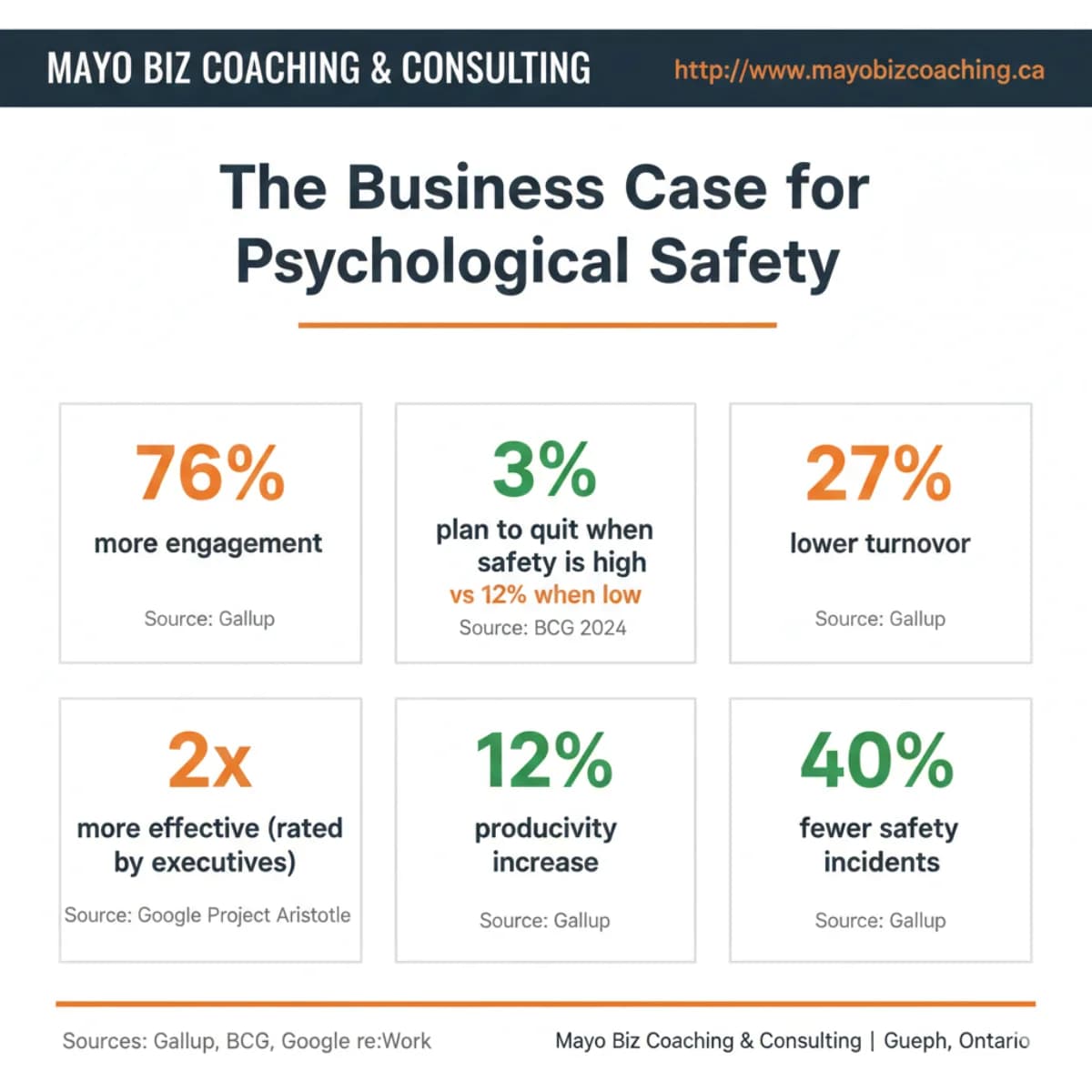
The business impact is measurable. Gallup's psychological safety data 4 ties stronger safety to higher engagement, lower turnover, higher productivity, and fewer safety incidents.
For small businesses, those shifts are amplified. One avoidable departure can remove 10% to 20% of your team capacity. One delayed concern can affect customers by the end of the same week.
This is why psychological safety is not a soft initiative. It is an operating discipline that protects execution quality.
What Psychological Safety Is Not
Leaders usually miss psychological safety in predictable ways. Edmondson's HBR guidance 5 is useful because it clears up these myths quickly.
It is not being nice. Nice teams avoid tension to keep peace. Safe teams address tension early, with respect and clarity.
It is not an open-door policy. Open doors are passive. Safe leaders ask direct questions and actively invite dissent.
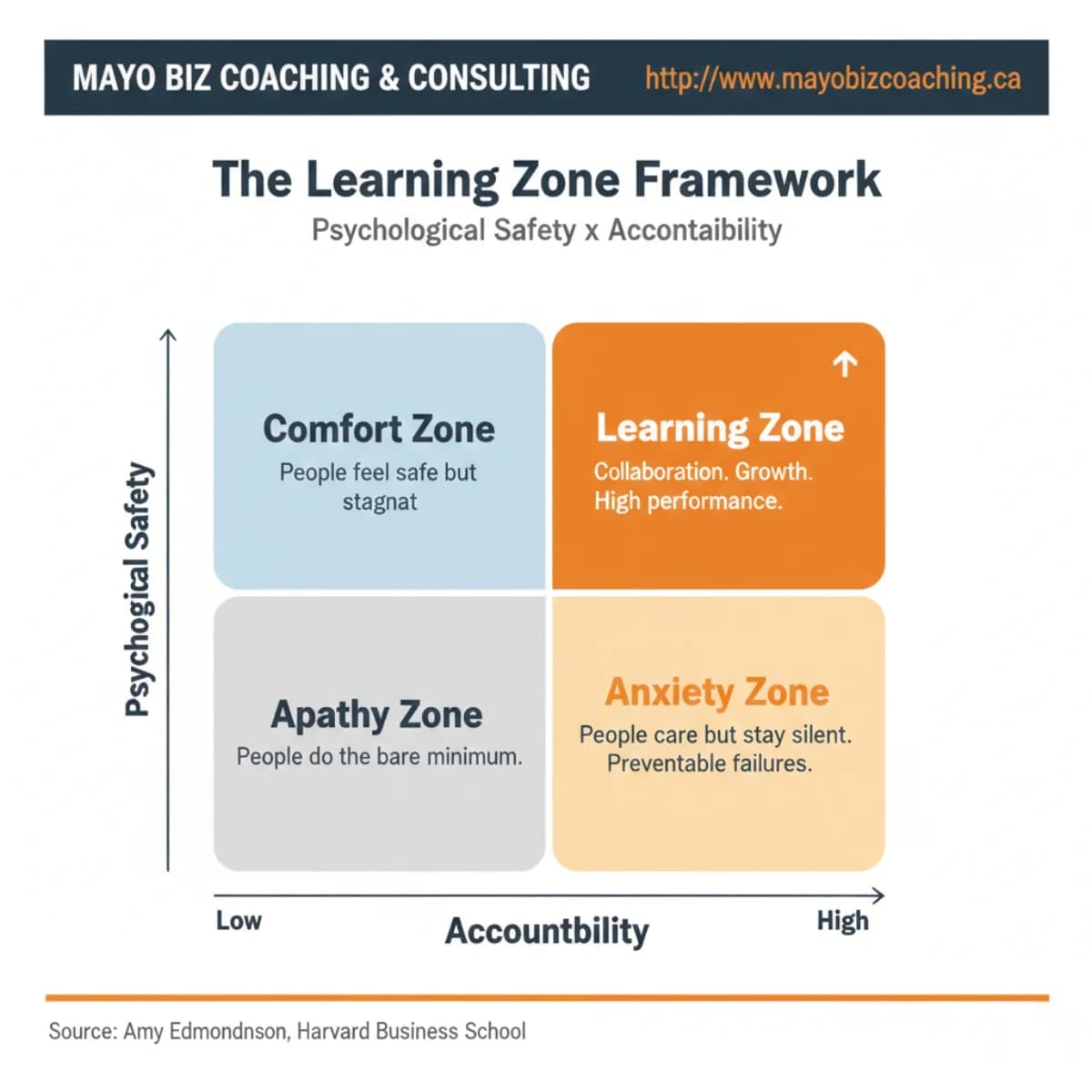
It is not low standards. Safety without accountability becomes comfort. High-performing teams hold both: candor and clear expectations.
It is not a one-time rollout. You cannot mandate safety by memo. People decide if it is real from daily interactions.
The Middle Manager Blind Spot
A 2025 HBR study 6 found middle managers reported the lowest psychological safety scores in many organizations. They often absorb pressure from both directions. They protect senior leaders from noise while trying to shield teams from churn.
That dynamic creates filtered reporting. Leaders hear status updates that sound stable, while risks stay local until they become expensive.
In one Ontario client team of 18, supervisors kept reporting "all green" project status while rework was rising each week. The owner believed delivery was steady until a major client escalation exposed the gap.
We introduced a 20-minute weekly risk review with one rule: each manager had to name one unresolved risk and one support request. Within five weeks, issue visibility improved, and cross-team response time dropped.
That is how safety changes outcomes. People surface risk sooner, and leaders act before the damage spreads.
Why This Hits Small Business Harder
Small businesses feel psychological safety failures faster than large enterprises. You have fewer buffers, less redundancy, and tighter customer relationships.
If one relationship breaks down on a team of ten, everyone feels it. If one strong contributor leaves, work shifts immediately, and quality pressure climbs.
The upside is speed. You can reset team norms in days, not quarters, when leadership behavior is consistent.
In my work with founders and small leadership teams, the fastest gains come from simple routines. Short risk check-ins, clear decision ownership, and direct follow-up create trust faster than broad culture campaigns.
How to Build It: Specific Behaviors That Work
You do not need a complex framework to start. You need repeatable leadership behavior that makes candor normal.
Ask, then wait. Replace "Any questions?" with one specific prompt: "What risk are we missing?" Hold silence long enough for a real answer.
Go first with vulnerability. Name one miss and one lesson from your own work before asking others to do the same. This links to strong self-awareness and sets tone fast.
Respond with curiosity first. Start with "Walk me through what happened." Curiosity keeps people in problem-solving mode.
Reward candor publicly. Thank people who raise issues early, especially when their message is inconvenient. Teams watch what leaders reward more than what leaders say.
Practice active listening on purpose. Put devices away, ask clarifying questions, and reflect key points back. When people feel heard, they keep speaking.
Pair candor with commitments. End hard conversations with clear ownership, due dates, and follow-up checks. Safety without follow-through loses credibility.
In another client team of 14, a founder shifted one-on-ones from status updates to two fixed prompts.
The first prompt focused on blockers: what is getting in your way. The second prompt focused on decisions: what decision do you need from me.
Within six weeks, escalations came earlier and deadline misses dropped.
If you want a practical structure for this balance, it also shows up in coaching and managing: support people directly, then hold clear standards.
The Ontario Context
For Ontario employers, psychological safety is both a leadership topic and a legal one. It sits beside legal duties on workplace violence and harassment.
Ontario's guidance on workplace violence and harassment law 7 outlines employer obligations for policy, training, reporting, and investigation. The legal baseline is clear: prevention and response are management responsibilities.
Canada also has a national standard for psychological health and safety at work. The Mental Health Commission of Canada 8 provides practical guidance on the CAN/CSA-Z1003 standard.
For small firms, the CFIB resource page 9 is useful because it translates policy requirements into owner-level actions.
The practical point is simple. Legal compliance can set the floor, but leadership behavior sets the daily climate.
Safety and Accountability Must Work Together
Some leaders worry that more openness will reduce performance pressure. That risk is real only when standards are unclear. Safety works when expectations stay visible and follow-through is disciplined.
HBR's analysis on overcorrecting safety 10 makes the same point: support and challenge must move together. Teams need room to speak and a clear bar for execution.
The goal is not constant comfort. The goal is fast learning, earlier risk visibility, and stronger decisions under pressure.
When you get this right, you see three early signals. People flag issues sooner, meetings include healthy disagreement, and managers bring options instead of only problems.
Those signals usually show up before lag outcomes. Retention stabilizes, customer issues surface sooner, and leaders reclaim time for strategic work.
A 60-Day Psychological Safety Plan
Most teams do not need a culture reboot. They need a short operating cycle with clear behaviors and visible follow-up.
Days 1 to 20: set the baseline. Ask each manager to run three check-ins. Use the same two prompts in each one.
Ask, "What risk are we not discussing?" Then ask, "What decision is blocked?"
Track response quality, not volume alone.
Days 21 to 40: build response discipline. For every risk raised, confirm owner, deadline, and next review date in the same meeting. Public follow-through is what turns speaking up into trusted habit.
Days 41 to 60: reinforce team standards. Review which issues were raised early, which were raised late, and what the delay cost in time or rework. Use those examples to coach better escalation habits, not to punish the messenger.
In one 22-person service business, this cycle exposed a pattern of late client-risk reporting by week three. Managers were polite in meetings but delayed hard updates until problems were obvious. After six weeks of structured check-ins, risks were raised earlier and client handoffs became smoother.
In another team of 11, the owner added a short Friday review. The key prompt was simple: what truth did we avoid this week.
The first two weeks were quiet.
By week four, people started naming process gaps and unclear ownership. Those gaps had slowed delivery for months.
Track one score each week: the share of risks raised before they hit a deadline, budget, or customer promise. In one logistics client, that score moved from 32% to 71% in eight weeks after leaders responded to bad news with support and clear ownership. The shift cut weekend firefighting, shortened planning meetings, and gave managers more time to coach people instead of fixing late surprises.
This is where psychological safety becomes visible. Teams do not need perfect candor on day one. They need steady proof that honest input leads to action, learning, and better decisions.
A Simple Weekly Script Leaders Can Use
If you want a fast start, use a 15-minute script each week. Keep the same questions. Keep the same order. Keep the same follow-up.
Start with one check-in question. Ask, "What risk are we not saying out loud?" Wait for a full answer. Do not rescue the room too early.
Move to one decision question. Ask, "What is blocked right now?" Ask who owns the next step. Ask when the team will report back.
End with one support question. Ask, "What do you need from me this week?" This keeps accountability clear. It also keeps support visible.
Write each risk in plain words. Link each risk to one owner and one date. Close the loop in the next meeting.
Use one simple score. Track the share of risks raised before they hit a customer, deadline, or budget. Most teams improve this score within a month when leaders respond with calm and clarity.
In one small client team, this script cut late surprises in half over six weeks. In another coaching engagement, it helped a new manager run hard conversations without shutting people down.
You do not need perfect language to build safety. You need consistent behavior.
Ask clear questions. Listen fully. Follow through every week.
Let's Build Brilliance Together
Psychological safety grows through daily leadership choices. You ask better questions, listen without punishing honesty, and follow candor with clear accountability.
If you want structured support building those habits across your managers, Team Leadership Development gives you a practical coaching and accountability system.
If your team is holding back and you want to change that pattern, reach out for a free consultation. No sales pitch, just an honest conversation about what is happening and what to do next.
Research Notes & Sources
If you want to go deeper, these are the studies and reports behind the key points in this post.
- Gallup's 2025 workplace report(gallup.com)
- Edmondson, 1999(api.crossref.org)
- Project Aristotle(rework.withgoogle.com)
- Gallup's psychological safety data(gallup.com)
- Edmondson's HBR guidance(hbr.org)
- 2025 HBR study(hbr.org)
- workplace violence and harassment law(ontario.ca)
- Mental Health Commission of Canada(mentalhealthcommission.ca)
- CFIB resource page(cfib-fcei.ca)
- HBR's analysis on overcorrecting safety(hbr.org)
Category & Tags
Frequently Asked Questions
What is psychological safety in the workplace?
Psychological safety is the shared belief that people can ask questions, admit mistakes, and challenge ideas without punishment. Amy Edmondson introduced the term, and Google's Project Aristotle found it was the strongest predictor of team effectiveness.
How does psychological safety improve team performance?
Gallup reports that teams with strong psychological safety see higher engagement, lower turnover, better productivity, and fewer safety incidents. People speak up earlier, so teams fix problems faster and make better decisions.
What are common mistakes leaders make when building psychological safety?
The biggest mistake is confusing safety with being nice. Safety requires candor with respect. Other mistakes include passive open-door policies, weak follow-through after feedback, and low accountability that creates comfort but not performance.
Is psychological safety a legal requirement in Ontario?
Ontario employers must address workplace violence and harassment under the Occupational Health and Safety Act. Canada also has a national standard for psychological health and safety at work (CAN/CSA-Z1003), with practical guidance for employers.
About the Author

About the Author
Mark Mayo
Head Coach, MBC
We get up each morning excited about sharing our 20-plus years of business acumen with small business owners and their teams. Collaborating with hard-working owners to achieve their personal and business goals brings rewards. When we develop you and grow your leaders, we create the momentum that moves you and your business forward. It starts with a first step. Then we can build brilliance together.
Related Articles
Why Your Best People Aren't Speaking Up
When your strongest contributors go quiet, they haven't become compliant. They're calculating whether it's worth the risk. Here is how to read the silence.
Read Why Your Best People Aren't Speaking Up
The Five Dysfunctions Hiding in Your Team
Patrick Lencioni's Five Dysfunctions model shows why capable teams underperform. Here is how to spot each dysfunction and what to do about it this week.
Read The Five Dysfunctions Hiding in Your Team
The Accountability Conversation: How to Hold People to Standards and Keep Their Trust
Most leaders know they need accountability conversations but keep putting them off. Frameworks from Patterson, Scott, and Raymond that make them productive.
Read The Accountability Conversation: How to Hold People to Standards and Keep Their Trust