Work-Life Integration & Purpose
The Manager Burnout Crisis No One Is Talking About
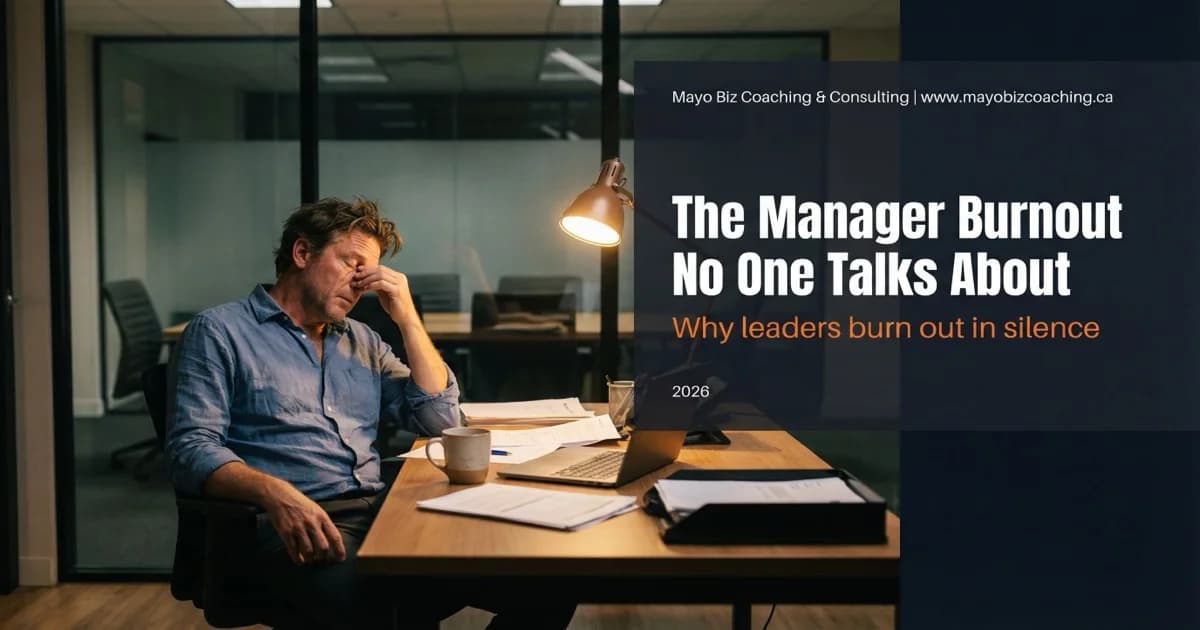
You're the person everyone comes to. Your team brings problems. Your boss brings pressure. Clients bring urgency. And somewhere in the middle of all that, you stopped taking care of yourself.
Not dramatically. Not all at once. You just started skipping lunch, then stopped exercising. The weekends stopped feeling restful. You check your phone before your feet hit the floor, and the knot in your stomach doesn't fully loosen until Friday night.
You're not alone, and this isn't a personal failure. Manager burnout is everywhere, and almost nobody is addressing it.
The Numbers Nobody Shares at Leadership Meetings
The data on manager burnout has reached a point where ignoring it is a business risk. We've written before about how burnout is a leadership problem for teams. But here's the part that gets less attention: the leaders themselves are cracking.
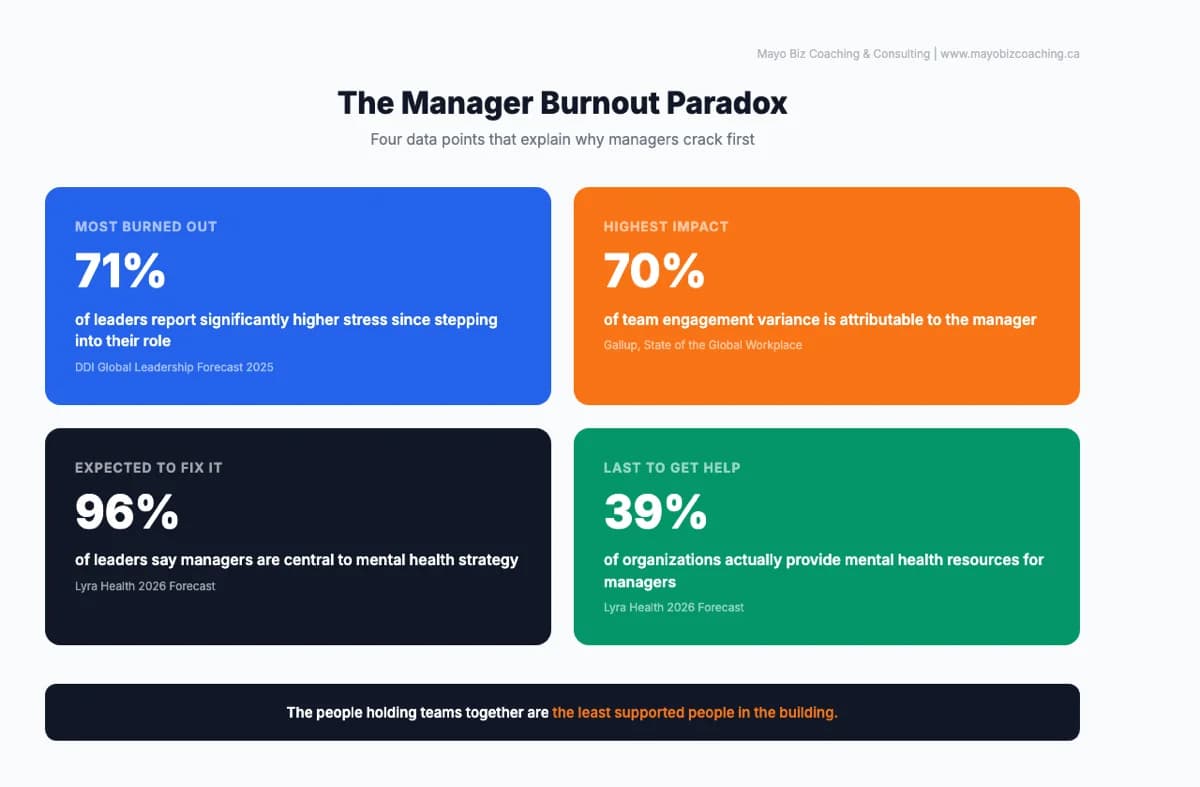
DDI's 2025 Global Leadership Forecast 1 surveyed over 10,000 leaders and 2,000 organizations across 50 countries. They found 71% of leaders report significantly higher stress since stepping into their current role. Forty percent have considered leaving leadership entirely to protect their wellbeing.
That's not a headline about some other company's problem. Close to three out of four leaders are saying their role is making them worse, not better.
Gallup's 2025 data 2 adds another layer. Manager engagement fell from 30% to 27% globally in 2024. That means the people responsible for motivating everyone else are losing motivation themselves. Young managers under 35 dropped five points. Women managers dropped seven. Individual contributors held steady at 18%.
Here's what makes this a business problem beyond wellness. Gallup's research shows managers account for at least 70% of the variance in team engagement. When a manager cracks, the whole team feels it.
The Paradox: Holding Everyone Else Together While Falling Apart
This is the part nobody says out loud. Organizations know managers matter. Lyra Health's 2026 forecast 3 found that 96% of leaders say managers are central to their mental health strategy. Ninety-five percent believe managers need more support.
Yet only 39% of those same organizations actually provide mental health resources for their managers. That gap between knowing and doing is the problem.
Deloitte's 2025 Global Human Capital Trends 4 found that 40% of managers report a decline in mental health after becoming managers. Only 13% of their time goes toward developing the people they lead. The rest is administrative tasks, problem-solving, and keeping the system running.
I see this pattern regularly in coaching. A business owner promotes their best performer into a people leadership role. That person now manages a team of eight, keeps their old responsibilities, and gets no training, no peer support, and no permission to struggle. Six months later they're exhausted and wondering if they made a mistake accepting the role.
The problem isn't the person. It's the system that put them there without support.
Why Managers Stay Silent
A 2025 study published in Harvard Business Review 5 by Hagen and Zhao surveyed 1,160 managers and found something that surprised even the researchers. Middle managers feel the least psychological safety at work. Their score (68.0 out of 100) fell below both C-suite executives (72.7) and their own direct reports (72.2).
The people responsible for creating psychological safety for others feel less safe than anyone around them.
The study identified five reasons:
- Increased visibility after promotion creates risk aversion
- Senior leaders rarely model fallibility
- Systems reinforce the illusion of perfection
- Structural isolation from peers limits support
- Steep learning curves meet high scrutiny
Jennifer Moss, a Canadian author and burnout researcher, frames this clearly. Burnout is an organizational problem, not an individual one. In her 2021 Harvard Business Review research 6, conducted during the pandemic, she found that 89% of respondents said their work life was getting worse, and only one in five described it as good.
When someone spends their entire day supporting others and absorbing pressure from both directions, "just take a mental health day" isn't a serious answer. The structure needs to change.
What Manager Burnout Looks Like in a Small Business
In a company of 15 to 50 people, manager burnout looks different than the enterprise version. There's no HR department to flag it. No engagement survey to catch it. Often the burned-out manager is also the owner, or reports directly to one.
Here's what I watch for when coaching business owners and their leadership teams:
You stop having real conversations. One-on-ones become status updates. You ask "how's it going?" but you don't actually listen because you have 14 other things waiting. You used to be curious about your people. Now you're just getting through the day.
You make decisions by avoidance. Instead of addressing performance issues, you work around them. Instead of having difficult conversations, you tell yourself it'll sort itself out. The backlog of avoided decisions grows heavier every week.
You feel resentful toward the people you lead. This one catches leaders off guard. You start seeing your team's needs as burdens. Someone asks for feedback and you feel irritated, not engaged. That resentment is a signal, not a character flaw. It means your tank is empty.
When It Shows Up in Your Body
You can't separate work from rest. Evenings fill with email. Weekends include "just one quick thing." Your mind stays at work even when your body is home. The recovery time between stressful periods shrinks until there's no recovery at all.
Your body tells you before your mind does. Trouble sleeping. Headaches that linger. Getting sick more often. These physical signals are easy to dismiss, but they're usually the first honest feedback a burned-out manager receives.
Christina Maslach, the researcher behind the Maslach Burnout Inventory 7, describes three dimensions: exhaustion, cynicism, and reduced professional accomplishment. Most managers I work with recognize all three when someone names them clearly.
The Moment Everything Shifts
In my experience, the turning point isn't a technique. It's the moment a leader says, out loud, "I'm not okay."
That sentence changes the conversation entirely. It moves from "how do I push harder" to "what needs to change." And that's where coaching starts to work.
I worked with a general manager running a 20-person service company in Ontario who had been carrying operations, HR, and client escalations solo for over a year. Sleep was broken. Patience was gone. Two good people had already left, and a third was interviewing. The GM didn't need a motivational talk. They needed someone to help restructure how the work was distributed.
We started by mapping every recurring responsibility and identifying which ones required the GM's judgment and which could transfer to someone else with clear ownership and a weekly check-in. Within two months, eight tasks moved off their plate. Overtime dropped. The GM started having real one-on-ones again, not because of a productivity hack, but because there was finally room to breathe.
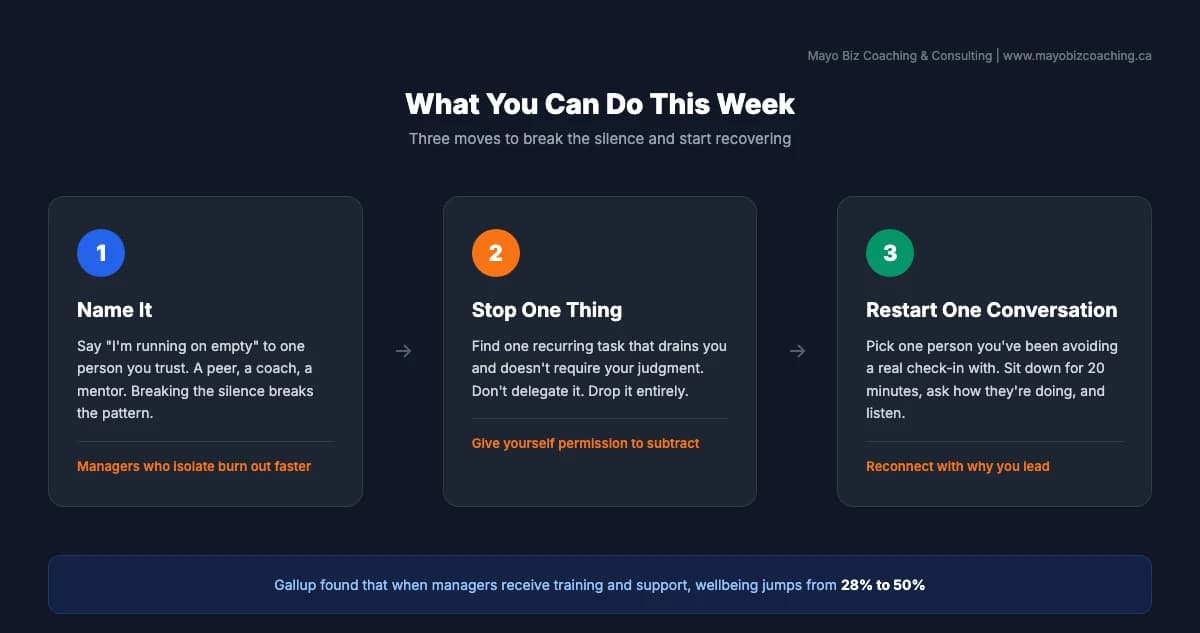
This is what Gallup's research points to as well. When managers receive role-specific training and consistent support, their reported wellbeing jumps from 28% to 50%. That's a 22-point shift from one intervention: giving the manager what they need to succeed.
Delegation is the most practical place to start. DDI's burnout research 8 found it's the single most effective skill for preventing leader burnout at 80% effectiveness. Yet only 19% of rising leaders demonstrate strong delegation abilities. The skill that matters most is the one managers are least likely to have.
What You Can Do This Week
You don't need a wellness program or a corporate retreat. Here's where to start. These steps won't fix a broken system overnight, but they break the pattern of silence that keeps burned-out managers stuck.
-
Name it. Say "I'm running on empty" to one person you trust. A peer, a coach, a mentor. The sentence itself breaks the pattern of silence. Managers who isolate under pressure burn out faster than those who share the load.
-
Pick one thing to stop doing. Not delegate. Stop. Look at your week and find one recurring task that drains you and doesn't require your judgment. Remove it. Give yourself permission to drop something without replacing it.
-
Restart one real conversation. Pick one person on your team you've been avoiding a real check-in with. Sit down for 20 minutes, ask how they're doing, and listen without solving. That single conversation reconnects you to the part of leadership that matters and reminds you why you stepped into the role. Active listening is the skill underneath everything else.
The Canadian Picture
As of 2026, Canadian data confirms what the global research shows.
Mental Health Research Canada's 2025 report 9 found that 39% of Canadian employees report burnout, up from 35% in 2023. Companies investing in prevention cut rates nearly in half (from 47% to 27%), saving roughly $3,400 per employee. The data is clear: prevention works better than reaction.
For small business owners specifically, the numbers are sharper. CFIB's 2022 survey 10 found 66% of Canadian small business owners were close to burnout, a figure shaped by pandemic-era pressures that may have shifted since.
BDC's 2025 survey 11 offers more recent data: 36% of entrepreneurs say mental health challenges interfere with their ability to work at least once a week. For owners under 40, that rises to 60%. If you run a small business and recognize that pattern, you're far from alone.
Canada also created the world's first national standard for psychological health and safety in the workplace: CAN/CSA-Z1003, a voluntary framework covering workplace factors like workload, psychological support, and organizational culture. It applies to organizations of any size. The framework is there. Using it is the gap.
Let's Build Brilliance Together
Manager burnout isn't a sign of weakness. It's a sign that the system around you needs to catch up with what you're carrying. The people who hold teams together need real support: coaching, delegation, peer connection, or honest conversation about workload.
If you're recognizing yourself in this post, reach out for a free consultation. No sales pitch, just an honest conversation about where you are and what needs to change first.
If you're experiencing symptoms of clinical depression or anxiety, please reach out to a qualified mental health professional. In Canada, call or text 988 for the Suicide Crisis Helpline, available 24/7. This post addresses workplace and leadership factors, not clinical treatment.
Research Notes & Sources
If you want to go deeper, these are the studies and reports behind the key points in this post.
- Global Leadership Forecast 2025(ddi.com)
- State of the Global Workplace Report(gallup.com)
- 2026 Workforce Mental Health Trends Forecast(lyrahealth.com)
- 2025 Global Human Capital Trends(deloitte.com)
- Middle Managers Feel the Least Psychological Safety at Work(hbr.org)
- Beyond Burned Out(hbr.org)
- Maslach Burnout Inventory (MBI) - Assessments, Tests | Mind Garden - Mind Garden(mindgarden.com)
- DDI Data Reveals Delegation Is Top Factor in Preventing Burnout(ddi.com)
- Mental Health in the Workplace 2025 — Mental Health Research Canada(mhrc.ca)
- Small business owners nearing a breaking point while struggling to support their employees’ mental health | CFIB(cfib-fcei.ca)
- Mental Health and Productivity of Entrepreneurs Under Pressure Amid High Uncertainty: BDC Survey(bdc.ca)
Category & Tags
Frequently Asked Questions
Why are managers more burned out than other employees?
Managers carry emotional labour for their teams while facing growing workloads. DDI found 71% report higher stress since stepping into their role. They absorb pressure from above and below with limited peer support or psychological safety.
What are the signs of manager burnout in a small business?
Common signs include skipping one-on-ones, making decisions by avoidance, losing patience with questions you used to welcome, and feeling resentful toward the people you lead. Physical exhaustion alone is not the full picture.
How does manager burnout affect team performance?
Gallup research shows managers account for at least 70% of the variance in team engagement. When a manager burns out, the team loses its primary source of clarity, feedback, and support. Turnover and disengagement follow.
What is the most effective way to reduce manager burnout?
Research points to coaching, delegation, and peer support. Gallup found that when managers receive proper training and support, their wellbeing jumps from 28% to 50%. Delegation alone reduces burnout risk by 80% according to DDI.
About the Author

About the Author
Mark Mayo
Head Coach, MBC
We get up each morning excited about sharing our 20-plus years of business acumen with small business owners and their teams. Collaborating with hard-working owners to achieve their personal and business goals brings rewards. When we develop you and grow your leaders, we create the momentum that moves you and your business forward. It starts with a first step. Then we can build brilliance together.
Related Articles
Burnout Is a Leadership Problem, Not a Personal One
Research from Gallup and WHO shows burnout stems from workplace conditions, not personal weakness. Learn what leaders can change first to reduce risk.
Read Burnout Is a Leadership Problem, Not a Personal One
Purpose Driven Leadership: Why Putting People First Drives Results
Purpose driven leadership improves engagement and retention. See Hubert Joly's Best Buy turnaround, and why putting people first drives results.
Read Purpose Driven Leadership: Why Putting People First Drives Results
Self-Awareness Is a Leadership Skill You Can Build
Most leaders think they're self-aware. Research says only 10-15% actually are. Here is how to close the gap and lead with clearer self-knowledge.
Read Self-Awareness Is a Leadership Skill You Can Build