Executive Leadership & Career Coaching
Leading with Vision: How to Turn Direction Into Daily Decisions

You can have good people, solid effort, and still feel your team pulling in five directions.
Most leaders I work with do not have a motivation problem. They have a clarity problem. The team is busy, but priorities keep shifting. Meetings sound productive, but follow-through is uneven. Everyone is working hard, yet the work does not always add up.
That is usually where leading with vision becomes practical, not philosophical.
Vision is not about sounding inspirational for one town hall. It is about creating shared direction people can use in real decisions, especially when pressure is high and trade-offs are unavoidable.
Why Vision Matters Right Now
Gallup's February 11, 2025 research across 52 countries found that the top need followers describe in positive leaders is hope. Hope represented 56% of leadership attributes, followed by trust at 33% (Gallup 1).
In plain terms, people need to believe tomorrow can be better and that their leader can be trusted to help them get there.
As of Gallup's January 23, 2024 U.S. workplace data, only 33% of employees were engaged, and employees reported less clear expectations and weaker connection to organizational mission than four years prior (Gallup 2).
When expectations are unclear, people do not usually stop caring. They start protecting themselves, narrowing focus to local tasks, and waiting for direction instead of taking initiative.
Gallup's 2025 global workplace report adds the same signal at system level: engagement is 21% globally and 31% in the U.S. and Canada (State of the Global Workplace 2025 3). Teams are not short on activity. They are short on aligned meaning and clear priorities.
In coaching, this shows up the same way every time: leaders keep restating targets, but people still cannot see how today's choices connect to the larger direction.
Vision Is a System, Not a Slogan
One useful way to frame this comes from the Center for Creative Leadership's DAC model, published March 15, 2024. It treats leadership outcomes as three conditions: direction, alignment, and commitment (CCL DAC model 4).
CCL defines weak direction as people feeling pulled in different directions. Weak alignment shows up as rework, duplication, and missed deadlines. Weak commitment looks like people protecting individual wins over collective success.
That language is helpful because it moves vision out of theory and into behaviour you can observe on Tuesday afternoon.
If people cannot name the top priorities. If teams keep duplicating effort. If managers protect functions instead of outcomes.
You do not have a communication problem first. You have a leadership-direction problem.
Simon Sinek's Golden Circle 5 gives a second practical lens: start with why, then connect to how and what. Covey's Habit 2 6 adds the execution side: begin with the end in mind by defining the desired destination and clear measures of success.
Put those together and vision becomes concrete:
- Why are we doing this?
- What future are we building?
- What must be true by the end of this quarter?
If you are already working on purpose language, keep this distinction clear: purpose explains why you exist, while vision clarifies what future your team is building together next. The purpose conversation in purpose-driven leadership is essential, but it becomes operational only when weekly priorities and decisions line up with that future picture.
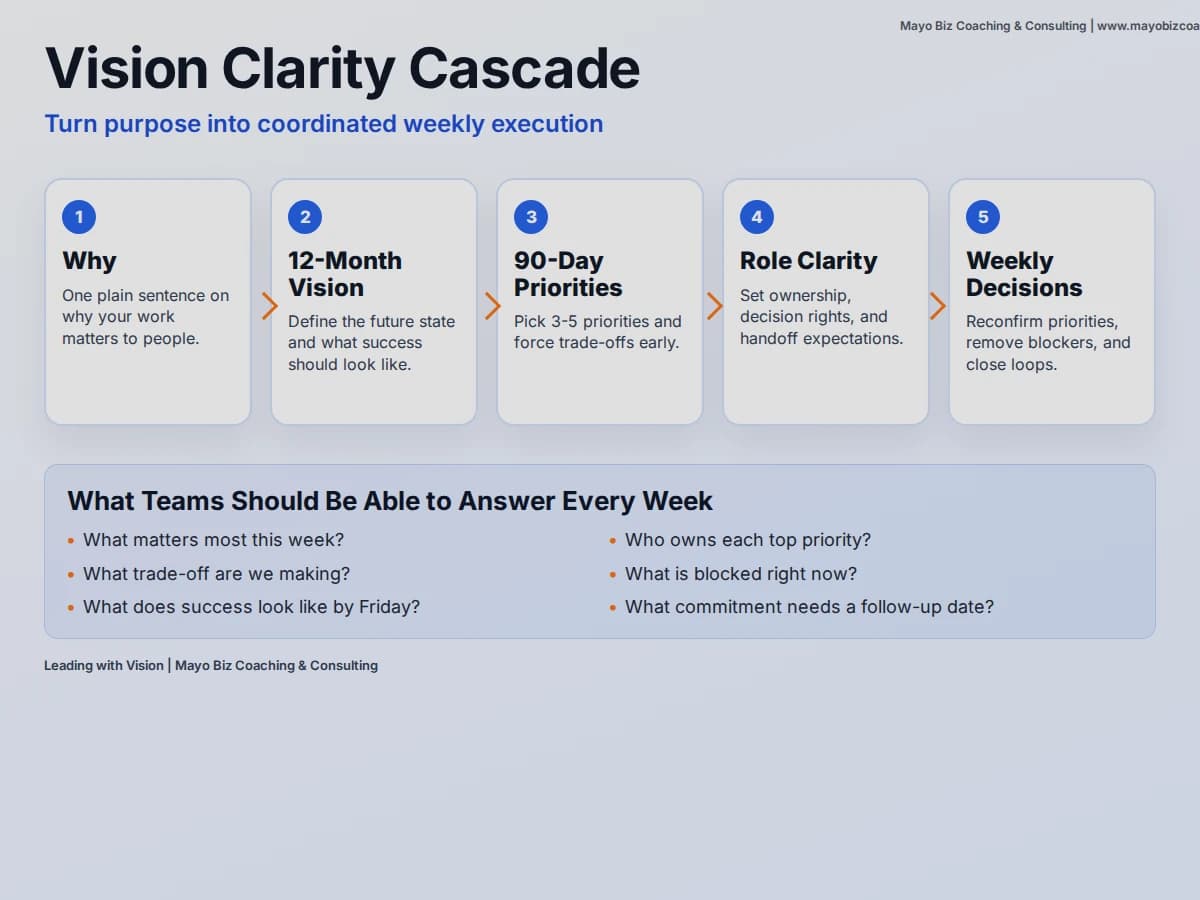
A Practical Vision Cascade for Owners and Executives
When leaders ask me how to lead with vision without sounding abstract, I use a five-step cascade.
1. Name the Why in Plain Language
Skip polished statements your team cannot repeat.
Borrow from Sinek's framing: your why is purpose, cause, or belief, not revenue as an end state. A practical test is simple: can a frontline employee explain why your work matters in one sentence?
If they cannot, you do not have a shared why yet.
2. Describe the End State for the Next 12 Months
Covey's point about beginning with the end in mind is useful because it forces specificity.
Define what success looks like 12 months from now in behaviour terms, not only financial terms:
- what customers should experience
- what team habits should be visible
- what standards should be non-negotiable
This is where many visions fail. Leaders define ambition, but not observable outcomes.
3. Convert Vision Into 90-Day Priorities
If everything is strategic, nothing is strategic.
Choose 3-5 priorities for the next 90 days and force trade-offs. A clear vision always reduces options before it creates momentum. If your quarterly list keeps growing, your team is receiving mixed direction.
This step protects against short-term panic. Strong leaders still pursue results, but they do not sacrifice long-term trust and capability for short-term optics.
4. Clarify Roles and Decision Rights
Direction without role clarity creates friction.
CCL's DAC language helps here: alignment means people know how their work fits the whole. Spell out ownership, handoffs, and decision rights. Where two people can approve the same decision, delays and politics grow.
If rework is high, role clarity is usually low.
5. Install a Weekly Vision Conversation Rhythm
Gallup's 2024 analysis found that one meaningful manager conversation per week is one of the strongest leadership activities for building high-performance relationships (Gallup 2).
This is where vision lives or dies.
Use a short weekly conversation template:
- What matters most this week?
- What is blocked?
- What trade-off do we need to make?
- What does success look like by Friday?
If you want a stronger listening cadence in those conversations, the habits in active listening make this much easier to run consistently.
The Weekly Translation Most Teams Miss
Many leadership teams announce vision in quarterly meetings, then spend the next twelve weeks reacting.
That gap is expensive. Gallup reported that employees who can do remote-ready jobs but lack coworker role clarity are far less likely to strongly agree they know what is expected. When coworker expectations are clear, the numbers jump sharply across work setups (Gallup 2).
In other words, vision does not break because people reject it. It breaks because nobody translates it into coordinated expectations week by week.
This is where trust and vision meet. When people see stable priorities and fair trade-offs, trust rises. When priorities whipsaw and rationale stays hidden, trust drops. The patterns in how leaders build trust are not separate from vision work. They are the operating mechanics of vision.
Common Mistakes That Create Vision Drift
I see these four repeatedly.
Mistake 1: Confusing Vision With Motivation
A motivating message can help for a day. Vision has to shape decisions for months.
If priorities do not change after your vision message, it was communication, not leadership direction.
Mistake 2: Keeping Too Many Priorities Open
Teams cannot execute seven top priorities at once. They choose informally, and informal choices usually reward urgency over strategic value.
Mistake 3: Talking Vision Only at Senior Levels
When managers do not have language to translate strategy to daily work, teams hear abstract goals and concrete pressure.
Mistake 4: Avoiding Accountability in the Name of Positivity
Positive leadership is not soft leadership. Vision needs standards. Expectations need follow-through. If accountability is fuzzy, vision becomes a poster.
The practical bridge is the same one I use in the accountability conversation: support and standards must move together.
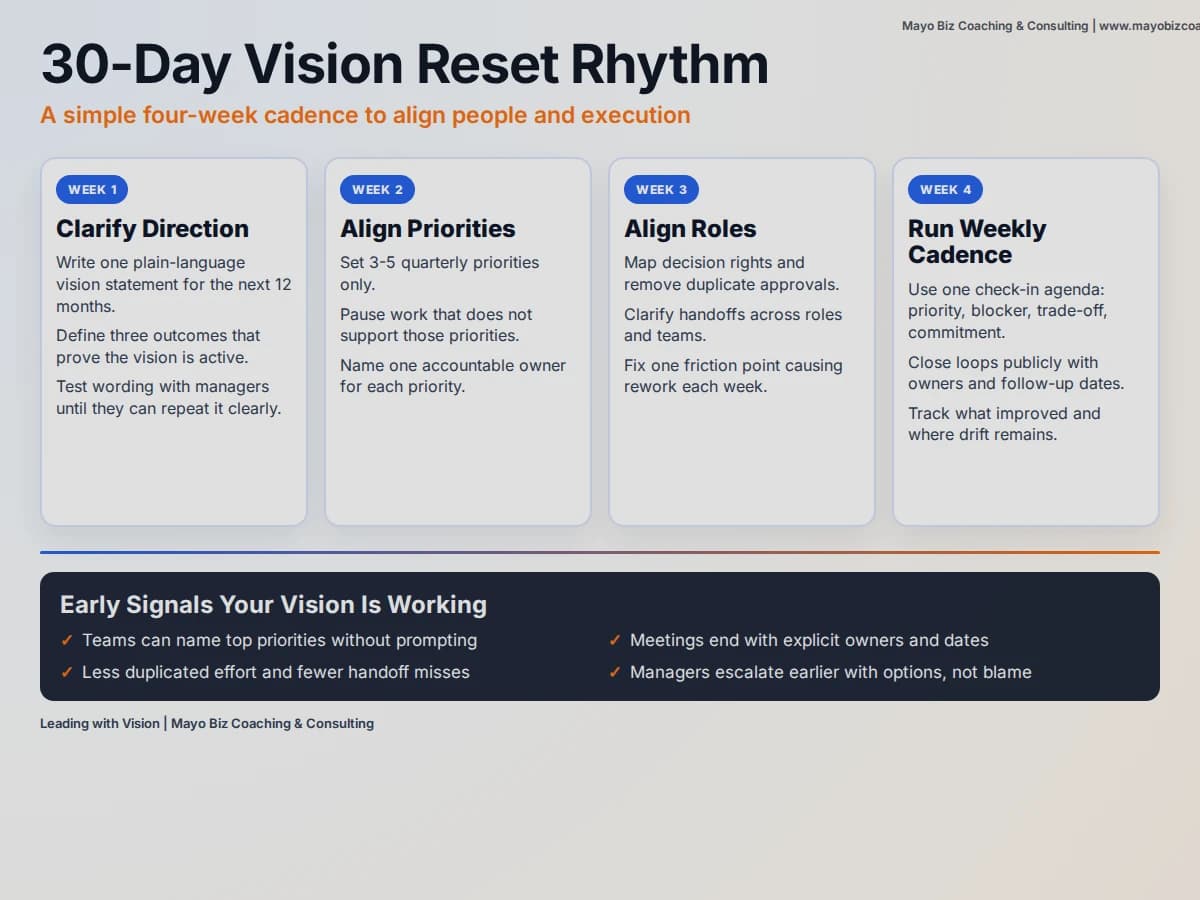
A 30-Day Vision Reset
If your team feels busy but scattered, use this short reset.
Week 1: Clarify the Direction
Write one plain-language vision statement for the next 12 months. Define three outcomes that would prove it is real.
Week 2: Align Priorities
Set 3-5 quarterly priorities. Cut or pause work that does not support them. Name clear owners for each priority.
Week 3: Align Roles and Decisions
Map key decisions and who owns each one. Remove duplicate approvals. Clarify handoffs across teams.
Week 4: Build the Weekly Rhythm
Run short weekly conversations with every manager:
- top priority
- blocker
- trade-off
- next commitment
Then close loops publicly so people can see follow-through.
How You Know Vision Is Working
Do not wait for annual surveys to judge progress. Watch for leading signals:
- Teams can name the top priorities without prompting.
- Fewer projects stall in handoff.
- Meetings include clearer trade-off decisions.
- Managers escalate earlier with options, not just problems.
- Rework drops because ownership is clear.
These are practical markers that direction, alignment, and commitment are improving.
I also suggest tracking one behavioural score and one execution score for 90 days. Behavioural score: the percentage of weekly check-ins where priorities and owners are explicit by the end of the meeting. Execution score: percentage of top-priority commitments completed on time without escalation. Those two measures quickly show whether vision is being translated into action or being discussed without follow-through.
The Bottom Line
Leading with vision is less about inspiration and more about disciplined clarity.
Start with why. Define the end state. Narrow priorities. Clarify roles. Protect the weekly conversation rhythm.
That is how vision becomes a leadership operating system instead of a quarterly message.
Let's Build Brilliance Together
When vision is clear, teams move faster with less friction and better ownership. The work feels more focused, and decision quality improves because people understand what matters most.
If you want support turning your vision into a practical weekly leadership rhythm, reach out for a free consultation. No sales pitch, just an honest conversation about where you are and what needs to change next.
Research Notes & Sources
If you want to go deeper, these are the studies and reports behind the key points in this post.
- What Do People Need Most From Leaders?(gallup.com)
- In New Workplace, U.S. Employee Engagement Stagnates(gallup.com)
- State of the Global Workplace 2025 Report(gallup.com)
- Direction + Alignment + Commitment (DAC) = Leadership(ccl.org)
- The Golden Circle(simonsinek.com)
- Habit 2: Begin With the End in Mind(franklincovey.com)
Category & Tags
Frequently Asked Questions
What does leading with vision actually mean in daily leadership?
Leading with vision means your team can connect daily decisions to a clear future direction. It is not one speech. It is repeated clarity on purpose, priorities, roles, and trade-offs so people know what matters most this week.
How often should leaders communicate vision to a team?
Vision should be translated weekly, not quarterly. Gallup reports that one meaningful manager conversation per week is one of the strongest drivers of high-performance relationships, which helps keep priorities clear as work changes.
What is the difference between vision and goals?
Vision describes the future you are building and why it matters. Goals are the measurable milestones inside that future. Strong teams need both: a clear destination and clear next steps.
How do you know if your team is aligned to the vision?
You see fewer competing priorities, less rework, and better ownership in meetings. If people can explain the team priorities in plain language and connect their role to them, alignment is improving.
About the Author

About the Author
Mark Mayo
Head Coach, MBC
We get up each morning excited about sharing our 20-plus years of business acumen with small business owners and their teams. Collaborating with hard-working owners to achieve their personal and business goals brings rewards. When we develop you and grow your leaders, we create the momentum that moves you and your business forward. It starts with a first step. Then we can build brilliance together.
Related Articles
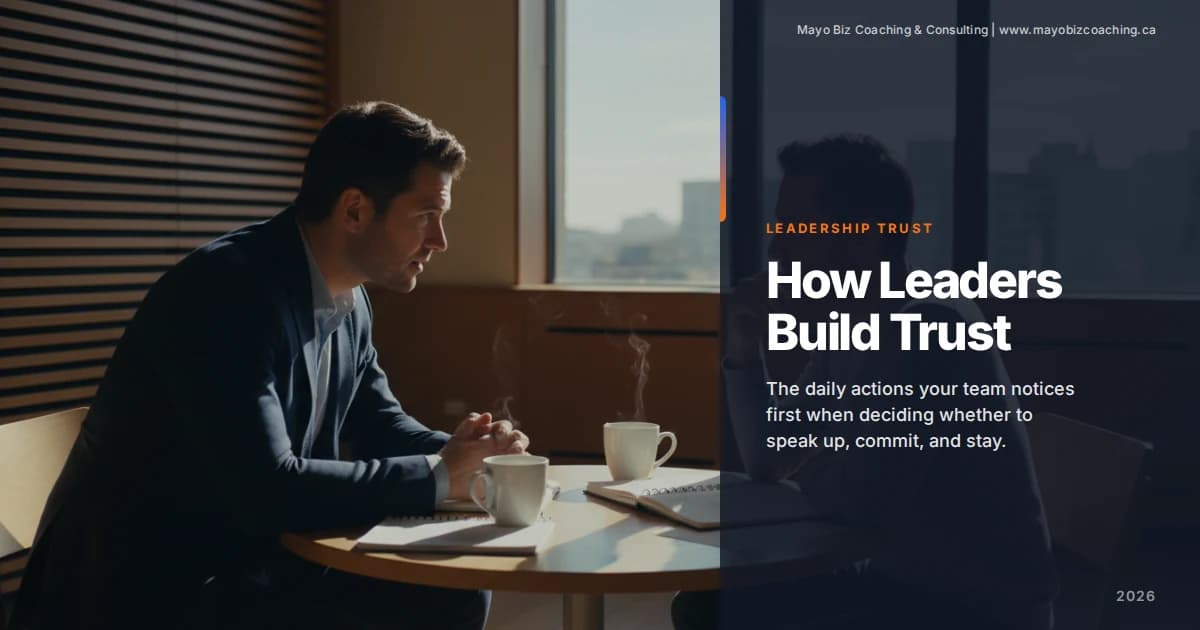
How Leaders Build Trust: What Your Team Notices First
How leaders build trust is less about charisma and more about clear, consistent behaviour. Learn the daily actions that make teams speak up and stay.
Read How Leaders Build Trust: What Your Team Notices First
Self-Awareness Is a Leadership Skill You Can Build
Most leaders think they're self-aware. Research says only 10-15% actually are. Here is how to close the gap and lead with clearer self-knowledge.
Read Self-Awareness Is a Leadership Skill You Can Build
Leading Without Certainty: Why Grounded Beats Confident
Brené Brown's grounded confidence formula helps leaders trade performative certainty for honesty. Here's what that shift looks like in practice.
Read Leading Without Certainty: Why Grounded Beats Confident