Executive Leadership & Career Coaching
Leading Your Team Through Economic Uncertainty

You are reading the same headlines your team is reading. Tariffs. Trade wars. Job losses in Ontario. Every morning you walk into work carrying two questions you cannot answer honestly: "Are we going to be OK?" and "What happens next?"
Your employees are watching you for signals. Your calm. Your hesitation. The things you say in the hallway and the things you do not.
Here is what I have learned coaching business owners through periods like this. The uncertainty is not the hardest part. The hardest part is leading people through it when you are uncertain yourself.
Why This Uncertainty Hits Differently
Most business owners have weathered downturns before. What makes this one different is the grinding, open-ended quality of it.
In 2025, the CFIB Business Barometer long-term index crashed to an all-time low of 25.0 1. That is lower than during the COVID-19 pandemic, the 2008 financial crisis, or 9/11. The drop was 24.8 index points in a single month.
Ontario sits at the centre of it. The Financial Accountability Office projects tariffs will result in 119,200 fewer jobs across the province in 2026 2. Guelph, Kitchener-Waterloo, and Windsor are among the hardest-hit communities. Manufacturing alone could lose 57,700 positions.
A pandemic arrives and everyone mobilizes. Tariff uncertainty grinds. It stretches across months with no clear resolution. 79% of small businesses cite unpredictable tariffs as a barrier to planning 3. You cannot build a strategy when the rules keep changing within hours.
That grinding quality is what makes it so corrosive to leadership. There is no single big conversation. Just hundreds of small moments where you choose between honesty and reassurance, between acting and waiting.
The Silence Problem
When leaders do not have answers, most go quiet. It feels protective. It is the opposite.
A Perceptyx study of 1,500 employees 4 found that 35% received no leadership communication about tariffs at all. Not bad communication. No communication. The result: 54% said economic stress made it difficult to be productive. 54% lost sleep over it.
Silence does not protect your team. It fills the vacuum with worst-case scenarios. When employees lack information, they fill the gap with rumours, assumptions, and catastrophic thinking. The less you say, the more they imagine.
I coached an owner last year who delayed talking to his team about rising material costs for three months. He was trying to figure it out first. "I didn't want to scare them."
By the time he finally had the conversation, two of his best people had already started looking. Not because the news was bad. Because the silence made them assume it was worse. If you have been putting off a difficult conversation about the state of the business, the cost of delay is already compounding.
Your Anxiety Is Contagious
This is the part nobody wants to hear. How you carry your own stress directly shapes how your team performs.
Organizational psychology is clear on this. Leader anxiety reduces team performance two ways. Cognitive interference: your team gets distracted by your stress. Emotional exhaustion: they absorb your negative emotions and burn out faster. This is measurable, not metaphorical.
I worked with a manufacturing owner during a previous downturn who was working 14-hour days, skipping meals, and responding to emails at midnight. Her team read every one of those signals. Within two months, her top three people were exhausted, her office manager had called in sick six times, and productivity had dropped visibly.
What changed? She started managing her own state before managing the business. Fifteen minutes of structured reflection before her first meeting each day. One honest conversation with a peer about what she was carrying. A commitment to leave by 6 PM three days a week.
Her team noticed within days. She had not changed a single policy. The person at the top had simply stopped radiating fear. McKinsey calls this "deliberate calm": the discipline of monitoring your circumstances and your internal emotional state at the same time. It is not fake positivity. It is the practice of choosing your response rather than being swept along by it.
BDC's 2025 Mental Health Survey 5 found that 36% of Canadian entrepreneurs say mental health challenges interfere with their work at least weekly. Among owners under 40, that number is 60%. If this is you, you are not failing. You are carrying a weight that most people never see.
What to Actually Say When You Do Not Have Answers
This is the question I hear most often in coaching sessions right now: "What do I say in the team meeting on Monday?"
Here is a framework that works. Lead with four things: what you know, what you do not know, what you are doing about it, and what you need from them.
What you know. Share the facts as you understand them. "Our costs on imported materials have gone up 15%. That affects our margins on three product lines."
What you do not know. Name the uncertainty honestly. "I do not know how long these tariffs will last. Nobody does."
What you are doing about it. Show agency, not just worry. "We are renegotiating with two suppliers this week. I am meeting with our accountant on Thursday to map out three different scenarios."
What you need from them. Invite contribution. "I need your ideas. If you see waste or a better way to do something, bring it to me. We are going to get through this by thinking together."
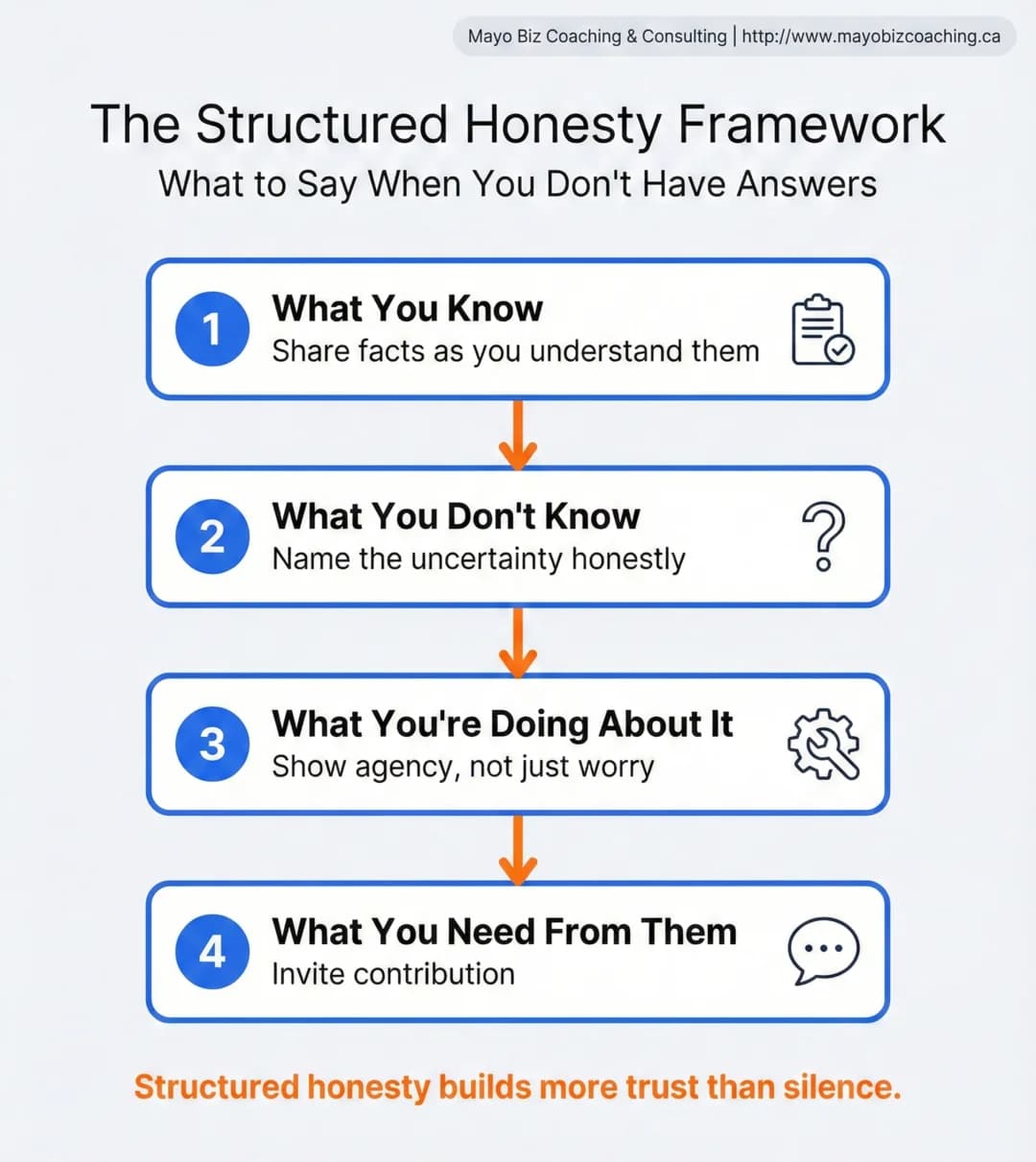
Call it structured honesty, not scripted optimism. Transparency and authenticity build trust only when paired with genuine empathy and realistic optimism. Optimism without transparency reads as denial. But honesty without a plan reads as giving up.
One client, a services firm owner in Guelph, used this framework in a Friday all-hands meeting. She told me afterward that the team's response surprised her. "They weren't scared by what I said. They were relieved. They had been imagining something much worse."
Your team already knows things are hard. They are not looking for certainty. They are looking for a leader who is honest and who includes them in the response.
Keeping Your Best People When Times Are Tight
During uncertainty, your highest performers leave first. Not because they are disloyal. Because they have options, and they are watching for signals about whether you are being straight with them.
Gallup's research 6 shows that four times as many people quit because of their work environment than because of pay. Trust, development, and honest communication outweigh compensation every time. That is good news for small business owners who cannot match enterprise salaries.
A construction company owner I coached was certain he would lose his best project manager during a cash-flow crunch. Instead of waiting for the resignation, he had a direct conversation: "Things are tight. I want to be honest about that. I also want you to know you are critical to this team. Let me show you what the next six months look like and where I see your role going."
The project manager stayed. Two years later, he told my client that single conversation was the reason.
Psychological safety protects teams even when material resources are scarce. A 2024 longitudinal study of 27,000 workers 7 found that baseline psychological safety reduced burnout and increased intent to stay, even during severe constraints. You do not need a bigger budget to keep your people. You need an environment where they feel safe enough to stay and honest enough to contribute.
Making Decisions When the Ground Keeps Shifting
Economic uncertainty does not pause while you deliberate. The temptation is to wait for clarity before acting. But clarity may not come for months, and waiting has its own cost.
A few principles that help:
Separate the reversible from the irreversible. Most decisions during uncertainty are adjustable. You can change pricing. You can restructure a team. You can pause a project and restart it. Save your deliberation for truly permanent choices. For everything else, move.
Define "good enough" before you look at options. When stress is high, the temptation is to keep searching for the perfect answer. Decide in advance what three criteria matter most. The first option that meets all three gets the green light.
Set a decision deadline. Without a boundary, uncertainty fills every available space. Pick a date, gather what you can by then, and commit.
If decision paralysis is becoming a pattern, I wrote a separate guide with five specific frameworks for moving forward. The short version: the best leaders during downturns are not the ones who are right most often. They are the ones who act, learn, and adjust faster.
The leaders I coach who navigate uncertainty well share one trait. They treat "I do not know yet" as a starting point, not a stopping point. They stay honest with their teams, manage their own state, and keep making the next decision with the information they have.
Let's Build Brilliance Together
Economic uncertainty does not require you to have all the answers. It requires you to show up honestly, manage your own state, and make the next right decision with what you have.
If this resonates with what you are going through right now, reach out for a free consultation. No sales pitch. Just an honest conversation about where your business is and what your team needs from you next. You can also explore executive leadership coaching to see if it is the right fit. If you are not sure whether coaching makes sense right now, here is how to tell.
Research Notes & Sources
If you want to go deeper, these are the studies and reports behind the key points in this post.
- Small business confidence plummets to all-time low as U.S.-Canada trade war ramps up(cfib-fcei.ca)
- The Potential Impacts of US Tariffs on the Ontario Economy - Financial Accountability Office of Ontario %(fao-on.org)
- Impact of the U.S.-Canada trade war on businesses(cfib-fcei.ca)
- Are You Saying Enough About Tariffs? How Silence Hurts Confidence(blog.perceptyx.com)
- Mental Health and Productivity of Entrepreneurs Under Pressure Amid High Uncertainty: BDC Survey(bdc.ca)
- Indicator: Employee Retention & Attraction(gallup.com)
- Psychological Safety as an Enduring Resource Amid Constraints - PMC(pmc.ncbi.nlm.nih.gov)
Category & Tags
Frequently Asked Questions
How do I talk to my team about economic uncertainty?
Lead with four things: what you know, what you do not know, what you are doing about it, and what you need from them. Structured honesty builds more trust than silence or false reassurance.
Should I be honest with employees about financial problems?
Yes. A Perceptyx study found 35% of employees received no leadership communication about tariffs. Those with no information were far less engaged. Silence fills with worst-case assumptions.
How does coaching help leaders during economic downturns?
Coaching provides a structured thinking partner for high-stakes decisions, helps leaders manage their own stress before it affects the team, and builds the communication skills uncertainty demands.
What keeps good employees from leaving during tough times?
Trust, not pay. DDI research shows high-potential talent is 2.7 times more likely to leave if their manager stops providing growth opportunities. Direct, honest conversations matter more than raises.
About the Author

About the Author
Mark Mayo
Head Coach, MBC
We get up each morning excited about sharing our 20-plus years of business acumen with small business owners and their teams. Collaborating with hard-working owners to achieve their personal and business goals brings rewards. When we develop you and grow your leaders, we create the momentum that moves you and your business forward. It starts with a first step. Then we can build brilliance together.
Related Articles
When "Do More With Less" Becomes the Only Strategy
When cost-cutting becomes your only leadership lever, it quietly trades the conditions that make your team effective. Here is what to do instead.
Read When "Do More With Less" Becomes the Only Strategy
Self-Awareness Is a Leadership Skill You Can Build
Most leaders think they're self-aware. Research says only 10-15% actually are. Here is how to close the gap and lead with clearer self-knowledge.
Read Self-Awareness Is a Leadership Skill You Can Build
Coaching Conversations: A Practical Framework for Leaders
A coaching conversation changes who does the thinking. The GROW framework, the neuroscience of self-generated insight, and four traps to avoid.
Read Coaching Conversations: A Practical Framework for Leaders