Team Leadership Development
Just Cause in Real Teams: A Practical Test for Mission Clarity

Your team has a mission statement. It might be on the wall, on a slide, or in a document that got shared at an offsite two years ago. Someone wrote it carefully. People nodded when they read it.
And nobody uses it to make a single decision.
This is one of the most common just cause leadership gaps I see in coaching. Leaders invest real thought into defining purpose. They get the words right. Then Monday arrives, and the statement sits while the team defaults to whatever is loudest. The mission exists. The clarity doesn't.
The gap isn't the statement itself. Most mission statements were never built to do the job a real cause requires. They describe what the company does. They don't describe a future worth committing to.
What a Just Cause Actually Is
Simon Sinek introduced the just cause concept in The Infinite Game 1. The core idea is simple. A just cause is a specific vision of a future state so appealing that people willingly sacrifice to help advance it. It isn't a goal. Goals are finite. A cause keeps going.
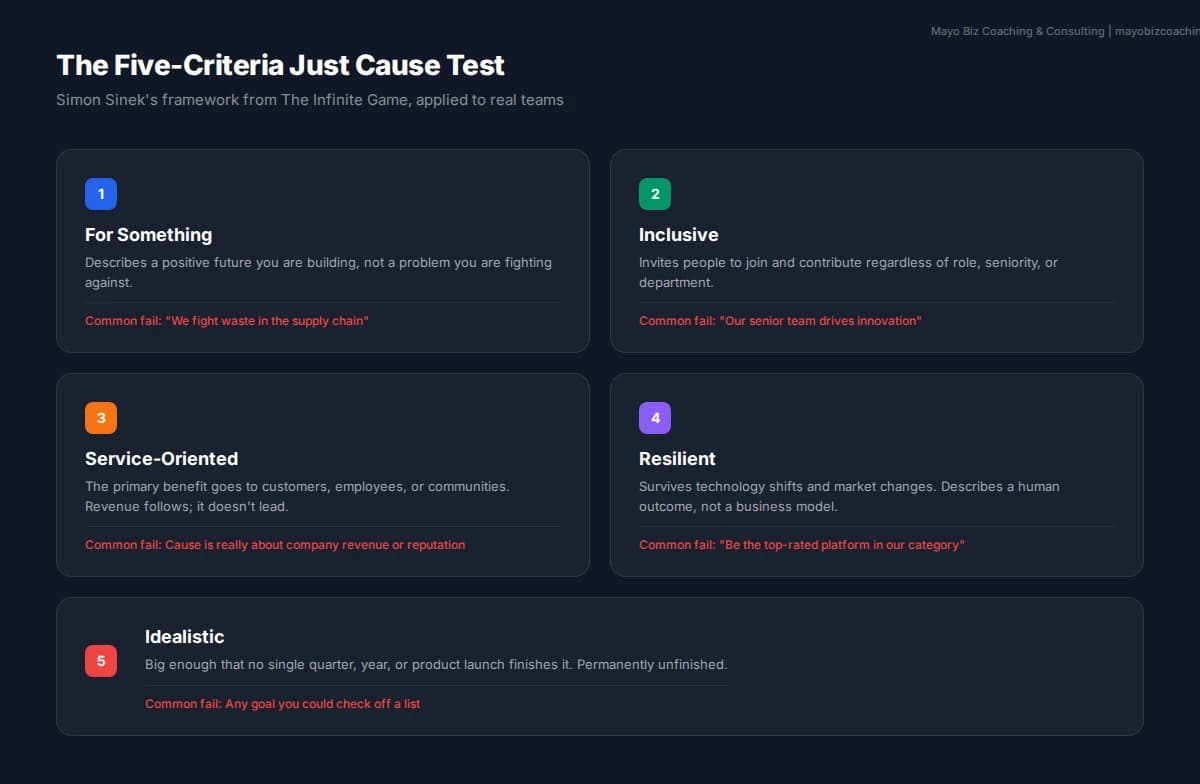
Sinek sets five criteria. A just cause must be:
- For something. It stands for a positive future, not against a competitor or a problem.
- Inclusive. It invites people to join and contribute, regardless of role or seniority.
- Service-oriented. The primary benefit goes to others, not to the organization itself.
- Resilient. It survives technology shifts and market changes.
- Idealistic. It is big enough that no single quarter, year, or product launch finishes it.
That list sounds straightforward. In practice, most team mission statements fail two or three of these criteria the moment you test them honestly.
"We deliver best-in-class service to our clients" is operational, not aspirational. It's a what, not a why. It isn't resilient because the definition of best-in-class shifts every year. And it isn't idealistic because you could theoretically finish it on a good Tuesday.
"We help business owners build teams they're proud of." That's closer. It's for something. It invites others in. It benefits people beyond the company. It survives a recession and a technology change. And it's never finished.
The distinction matters because a cause that meets all five criteria does something a slogan cannot. It gives people a reason to stay when the work gets hard and a filter for decisions when priorities compete.
Why Most Teams Stop at the Slogan
The reason most mission statements fail the just cause test isn't laziness. It's timing. They get written at the wrong moment.
Most mission statements are drafted during a planning cycle, an offsite, or a brand refresh. The pressure is to produce a polished sentence that sounds good in a deck. So the team focuses on clarity and polish, which are good qualities, but not the same as building a cause people will sacrifice for.
What gets lost is the forward-looking question. Not "what do we do well?" but "what future are we trying to build, and who benefits?"
I hear this distinction in coaching constantly. Leaders describe their mission and it sounds like a job description. When I ask them what they're building toward, the answer changes. It gets bigger. It gets more specific about the people they serve. And almost always, it gets more honest.
Mission statements answer a communications question. A just cause answers a leadership question. If your team has the first but not the second, the purpose stays on the wall and the decisions stay reactive.
The Five-Question Mission Clarity Test
Here's the practical tool. Take your team's current mission or purpose statement and run it through these five questions. Do it with your team, not alone. The conversation matters as much as the answers.
Question 1: Are we for something, or against something?
Read the statement out loud. Does it describe a future you're building, or a problem you're reacting to? "We fight waste in the supply chain" is against something. "We help manufacturers run clean, efficient operations so their margins fund growth" is for something.
Being against a problem can rally energy short term. It doesn't sustain commitment because the moment the problem shrinks, the cause disappears. If your cause vanishes when the problem does, it isn't a cause yet.
Question 2: Does this invite others in?
Could a new hire read this and see themselves in it? Could a customer? Could a partner? If the statement only makes sense to the leadership team that wrote it, it's exclusive by design.
Inclusive causes use language that welcomes contribution. "Our senior team drives innovation" is a closed circle. "We build a workplace where the best idea wins regardless of who says it" is an open one.
Question 3: Does the primary benefit go to others?
This is where I see the most failures. Read the statement and ask: who benefits most? If the honest answer is the company's revenue or the leadership team's reputation, the cause is self-serving. That doesn't mean revenue is bad. It means revenue is a result, not a cause.
Service-oriented causes name a benefit to customers, employees, communities, or an industry. The benefit to the company follows. It doesn't lead.
Question 4: Would this survive a major shift?
Imagine your industry changes significantly in the next five years. New technology, new regulation, new competition. Does the cause still hold? If it depends on a specific product or a specific market condition, it's fragile.
A resilient cause describes a human outcome, not a business model. "Help small business owners lead with confidence" survives almost any market shift. "Be the top-rated SaaS platform in our category" doesn't.
Question 5: Is it bigger than any single win?
Could you ever finish this? If yes, it's a goal, not a cause. Goals are useful. They belong on the quarterly plan. But they don't sustain the kind of long-term commitment that holds teams together through hard stretches.
The best causes are permanently unfinished. There's always another person to serve, another standard to raise. That's what makes the work feel worth continuing even after a hard quarter.
If your team's statement passes all five, you have a cause. If it fails one or two, you have a starting point and a specific gap to close. If it fails three or more, you're running on a slogan, and you'll feel it every time the work gets hard.
The Numbers Behind Mission Clarity
The business case for a real cause isn't abstract.
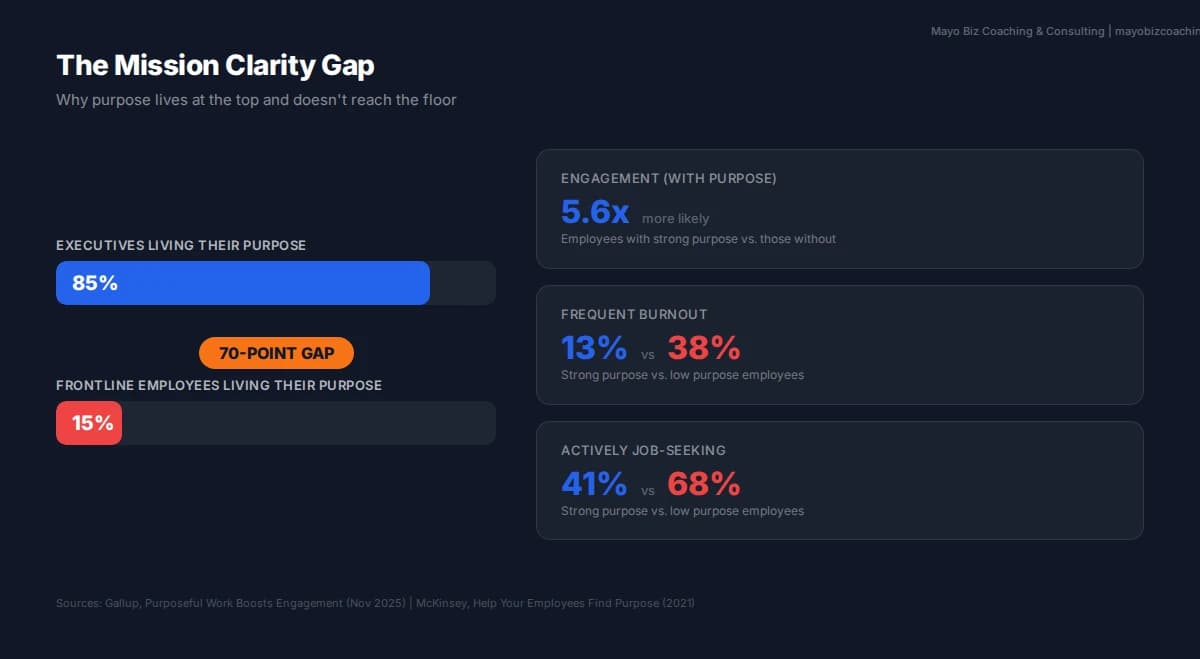
Gallup's November 2025 research on purpose at work found that employees with a strong sense of purpose are 5.6 times more likely to be engaged 2 than those without it. Only 18 percent of employees describe their current job as having a purpose they personally believe in. Forty-five percent say they work primarily for a paycheck.
For a team leader, that means most of your people are either disconnected from purpose or have never been asked to connect their work to one. The opportunity isn't motivational. It's structural. Give people a cause they can see in their daily work, and engagement shifts.
The same Gallup research found that employees who strongly agree their organization's mission makes their job feel important are 3.6 times more likely to experience strong work purpose. When purpose is present, only 13 percent burn out frequently compared with 38 percent without it. Job-seeking drops from 68 percent to 41 percent. That isn't just an engagement metric. That's your bench strength walking out the door because the daily work feels disconnected from anything bigger.
McKinsey's 2021 research tells a parallel story. Seventy percent of employees say their sense of purpose is defined by their work 3. But only 15 percent of frontline managers and employees say they're actually living their purpose, compared with 85 percent of executives.
That 70-point gap between senior leaders and the people closest to the work is the real clarity problem. The cause might exist at the top. It isn't reaching the floor. I see this constantly: the CEO can recite the mission, but the person shipping the product can't.
A Deloitte Core Beliefs and Culture survey 4 found that 82 percent of employees at purpose-driven organizations are confident their company will grow, versus 48 percent at companies without a clear sense of purpose. Full employee engagement hits 73 percent at purpose-driven firms compared with 23 percent elsewhere.
Here's what those numbers mean for your team this week. If your people can't connect their daily work to a cause they believe in, you're leaving engagement, retention, and performance on the table. Your team has the motivation. What's missing is the structure that converts it into meaning.
Running the Test With Your Team
The test works best as a conversation. Here's how I walk teams through it.
Set up (10 minutes)
Print or project the current mission statement. Read it out loud. Then share the five criteria without judgment. Say: "We're going to test our statement against these five standards. The point isn't to criticize what we wrote. It's to find out where we can make it stronger."
If people feel the exercise is about exposing a failure, they'll defend the statement instead of examining it. The post on psychological safety covers why this dynamic is predictable and how to keep it productive.
Run each question (25 minutes)
Take the five questions one at a time. For each one, ask the team: does our statement pass this test? Why or why not? Write down the answers without editing them.
Some questions will pass quickly. Others will open a conversation the team has been avoiding. That's the value. The criteria give people language to name a gap they could feel but couldn't articulate.
Score and decide (10 minutes)
Count the passes. If you have four or five, your cause is strong. Focus on the weekly habit of using it in decisions. The three-question weekly filter in Start With Why for Teams is designed for exactly that stage.
If you have two or three passes, pick the weakest criterion and rewrite just that part of the statement. Don't start over. Build on what's already honest.
If you have one or zero passes, you have a different situation. You need a new conversation, not a revision. Start with one question: what future are we trying to build for the people we serve? Let the answer to that question become the seed for a real cause.
After the test
The test is a snapshot. What counts now is whether the cause shows up in how the team actually works. I watch for two signals: does the cause come up in weekly priority conversations, and has the team said no to something because it didn't fit?
If the answer to both is yes within 90 days, the cause is alive. If not, return to the test and find out which criterion is still failing in practice.
When the Cause Is Clear, Trust Follows
There's a connection between just cause leadership and trust that I want to name directly.
When people understand the cause and see it in how the team operates, they trust the direction even when they disagree with a specific decision. They can separate "I would have chosen differently" from "I don't know where we're going." That distinction changes everything about how hard conversations land.
When the cause is unclear, every difficult decision feels arbitrary. People question motives. Accountability conversations feel personal because there's no shared standard to point to. If that pattern sounds familiar, the work in how leaders build trust connects directly here.
A clear cause doesn't prevent disagreement. It gives disagreement a productive frame. People argue about how to serve the cause instead of whether the cause exists at all.
The Real Test
The five-question diagnostic tells you whether your statement qualifies as a just cause. But the real test is simpler than any framework.
Ask three people on your team, individually, what the team exists to do and who benefits. If you get three different answers, you don't have a shared cause yet. If you get three versions of the same idea in different words, you do.
That alignment doesn't come from a perfect sentence. It comes from a conversation your team has had often enough that the answer lives in how they think, not in what they've read.
Most teams I work with don't need a better mission statement. They need an honest test of the one they have and the willingness to close the gaps. They need a weekly habit that keeps the cause in the room where decisions get made.
Let's Build Brilliance Together
A cause your team can test and use in weekly decisions changes every conversation that follows. If you're looking at your mission statement and wondering whether it's doing that job, reach out for a free consultation. No sales pitch, just an honest conversation about where you are and what you're working on.
Research Notes & Sources
If you want to go deeper, these are the studies and reports behind the key points in this post.
- The Infinite Game(simonsinek.com)
- Purposeful Work Boosts Engagement, but Few Experience It(news.gallup.com)
- Help Your Employees Find Purpose or Watch Them Leave(mckinsey.com)
- Deloitte Survey: Strong Sense of Purpose Key Driver of Business Investment(prnewswire.com)
Category & Tags
Frequently Asked Questions
What is a just cause in leadership?
A just cause is a forward-looking purpose so clear and compelling that people willingly commit to advancing it. Simon Sinek defines five criteria: it must be for something positive, inclusive, service-oriented, resilient to change, and idealistic enough that the work is never finished.
How is a just cause different from a mission statement?
A mission statement describes what an organization does. A just cause describes why the work matters and what future it serves. Many mission statements are operational descriptions dressed up as purpose. The test is whether people can use it to make decisions, not just recite it.
How do you test if your team has a real just cause?
Run the five-question diagnostic: Is it for something, not against something? Does it invite others in? Does it serve people beyond the company? Would it survive a major industry shift? Is it big enough that no single quarter finishes it? If any answer is no, you have a goal or a slogan, not a cause.
Why does mission clarity matter for team performance?
Gallup found that employees with a strong sense of purpose are 5.6 times more likely to be engaged. They also burn out less and stay longer. The connection between mission clarity and performance is measurable, not theoretical.
About the Author

About the Author
Mark Mayo
Head Coach, MBC
We get up each morning excited about sharing our 20-plus years of business acumen with small business owners and their teams. Collaborating with hard-working owners to achieve their personal and business goals brings rewards. When we develop you and grow your leaders, we create the momentum that moves you and your business forward. It starts with a first step. Then we can build brilliance together.
Related Articles

Start With Why for Teams: Turn Purpose Into Weekly Decisions
Most teams have a purpose statement but no way to use it. Learn a three-question weekly filter that turns your team why into real decisions.
Read Start With Why for Teams: Turn Purpose Into Weekly Decisions
From Why to What: Set Goals People Actually Care About
Most goals fail because they skip purpose. Learn a practical framework to translate your team why into goals people commit to and actually finish.
Read From Why to What: Set Goals People Actually Care About
Who Helped You? The One Question That Changes Team Culture
Simon Sinek says teams of average performers consistently beat star-stacked teams. The difference is one habit: making the assist as visible as the goal.
Read Who Helped You? The One Question That Changes Team Culture