Team Leadership Development
Why Your Best Employee Won't Leave But Won't Grow Either
Low turnover can hide a growth problem. I keep hearing this from owners: "My team is stable, but it feels like we are standing still." If that sounds familiar, your real issue may be job hugging employee development. By job hugging, I mean people staying in role for security while stretch work and skill building stall.
In my coaching work with small teams, this pattern shows up fast. Decisions slow down. New ideas stall. Ambitious people start looking around before anyone has formally resigned. In a 12-person team, you feel this within weeks, not quarters.
A ResumeBuilder survey 1 found 57% of workers identified as job huggers in early 2026, up from 45% five months earlier. I treat that number as directional because it comes from a branded survey. I pair it with broader labour cooling in Statistics Canada's Job Vacancy and Wage Survey 2, which shows Canadian job vacancies have dropped to roughly half their 2022 peak. Together, the pattern fits what many managers are seeing on the ground.
DDI's own Global Leadership Forecast 2025 3, built on 10,796 leaders and 2,014 organizations, backs up the same risk with a larger sample. In DDI's public release on those findings, high potential individual contributors were 3.7 times more likely to plan an exit when managers weren't providing regular growth opportunities.
And if you're a manager, this puts you in a tricky position. You're being measured on retention, but still expected to deliver bigger results with the same team setup quarter after quarter.
Job hugging employee development is now a leadership issue
Here's the real issue: stability is fine, stagnation is not. We all go through seasons where staying put makes sense, but the role still has to keep evolving.
When a strong employee stays in the same lane for too long, two things happen at once. First, your current performance plateaus. Second, your next generation of leaders sees no pathway, and both cost you.
That's why this isn't an attitude issue. It's a team design issue.
I've seen owners treat this like a motivation problem. They try to "pump people up." It works for two weeks, then everyone goes back to status updates and routine. Motivation fades when nothing about the job actually changes.
The practical question is simpler: if this person is still here in 12 months, will they be more capable than today? If you can't answer yes with confidence, you're keeping the team intact while its capacity slowly drops.
Why this trend is getting stronger in 2026
You're not imagining the shift. The external market has cooled and that changes behaviour.
A WTW analysis of the Great Stay 4 describes this as a period where quits have cooled and people are holding roles longer while uncertainty stays high. Statistics Canada's Labour Force Survey 5 backs this up: only 14.3% of unemployed Canadians left their previous job voluntarily in early 2025, down from 17.6% a year earlier. Fewer perceived options means people feel less mobile, even when they're frustrated in role. They stick with what they know instead of risking a move.
At the same time, leaders are carrying more pressure with less energy. In Gallup's 2025 State of the Global Workplace 6, manager engagement dropped to 27%, and global engagement remained low. A 2025 TalentLMS survey 7 supports that picture, with 54% of workers reporting some level of quiet cracking (gradually losing motivation while still showing up). When managers are stretched and teams feel stuck, development conversations become tactical check ins.
Then the cycle feeds itself. Employees feel less momentum, so they protect the role they have. Managers see fewer stretch requests, so they lower expectations. Team learning slows again.
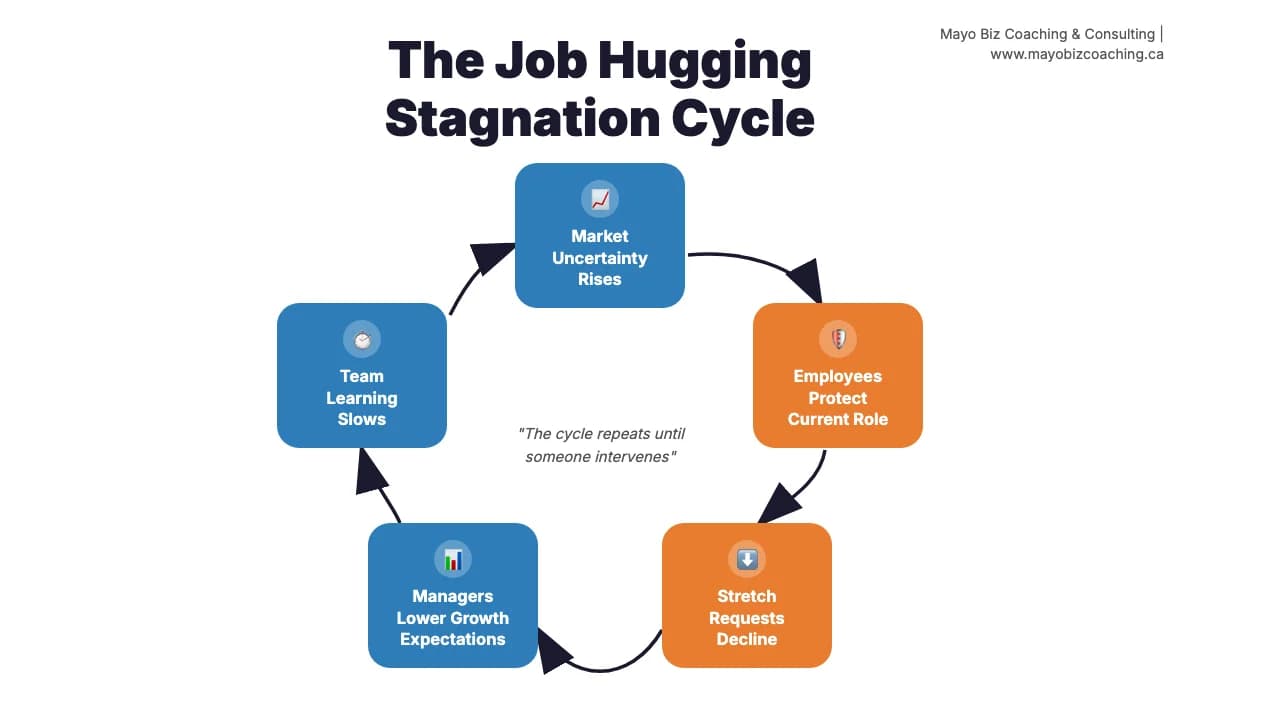
I want you to notice what this means: the issue isn't one person making a bad choice. It's a climate issue, and climate is something you can shift with one or two moves.
What most coverage misses about job hugging
Coverage from ResumeBuilder 1, Allwork 8, and SHRM 9 mostly frames job hugging from the employee side. That's useful, but incomplete for owners who need a bench today and a bench tomorrow.
From the manager side, the risk is a stuck leadership bench.
In many small teams I coach, when one long tenured employee stops growing, their direct reports adapt around that bottleneck. They stop asking for bigger work. They wait longer than they should. Some eventually leave, and often those are your most capable future leaders.
This is where DDI's broader leadership data is helpful. In that release, high potential individual contributors were 3.7 times more likely to plan an exit when managers weren't providing regular growth opportunities. That's a direct succession warning for any small team with a blocked middle layer.
So yes, your experienced employee may still be delivering. But if the team around them has stopped expanding, you're trading future capability for short term calm.
If this pattern feels familiar, it often intersects with low candour. Team members won't tell you they feel blocked unless they trust that honesty is safe. That's why this connects directly to psychological safety.
The manager dilemma: retain people, but do not freeze the system
Here's the part no one loves: you can't force ambition, and you shouldn't shame fear.
But you do have the right to define role evolution.
That's the line I coach leaders to hold. "I get that stability matters to you right now. And I need this role to keep changing as the business changes."
When managers avoid that conversation, they usually do it for good reasons. They don't want to lose a reliable person. They don't want to trigger defensiveness. They're already overloaded. I get it.
Still, avoiding the conversation doesn't avoid the cost. It only pushes it to your other team members, who then carry the load of adaptation without recognition.
Your job is to make growth feel safe while still making it expected.
Lateral growth is how you reopen movement
If vertical promotion isn't available, you need a lateral growth model. It should be part of how your team runs, not a fallback.
LinkedIn's 2025 Workplace Learning Report 10 keeps landing on the same point: companies that build career growth into daily work, instead of saving it for annual reviews, adapt faster. In a small business, that means creating clear sideways stretch options before frustration turns into disengagement.
Here are five that work in real teams:
-
Give one person end to end ownership of a priority initiative, with a clear business result, timeline, and review date.
-
Expand one part of the role with a new skill expectation, and remove one low value recurring task. Growth should feel like a step forward. If it just means more work for the same pay, people will resist it.
-
Pair operations with sales, or delivery with client strategy, for one quarter. A change in context teaches faster than another webinar.
-
Ask senior team members to mentor newer staff around defined goals. Teaching often reactivates purpose when routine work has gone flat.
-
Delegate decision rights, not just tasks. If everything still needs your final call, nobody is actually growing. This is the heart of delegation without abdication.
You don't need all five at once. Pick one move per person and track it properly.
The conversation script when someone is stuck but staying
You don't need a dramatic intervention. You need a direct, respectful conversation.
I suggest this sequence:
-
Start with observation: "You're reliable and valued here. I've noticed your role has looked very similar for a while, and I want us to talk about growth."
-
Name the reality: "Promotion opportunities are limited this year. Development still matters, and we can build that in other ways."
-
Ask for direction: "Which capability would make your work more meaningful over the next six months?"
-
Set one commitment: choose a lateral stretch move, define success, set a date.
-
Confirm support: "I'll coach you through this. We're planning growth, not throwing you in the deep end."
Then document the plan and follow up. That follow through is what turns a good conversation into a changed trajectory.
If you want a deeper framework for shifting between manager mode and coach mode, this connects closely to coaching vs managing.
Ontario context leaders should keep in view
Fear based staying can also create workload risk. People who feel replaceable may overwork quietly to prove value.
For Ontario employers, hours, overtime, and rest standards aren't optional interpretation points. The province's Employment Standards Act (ESA) covers hours of work and overtime 11 and vacation time 12. Worth a quick review if your team has started "just pushing through" week after week.
This isn't legal advice, and I always recommend legal counsel for case specific questions. The leadership point is straightforward: do not let loyalty language hide unsustainable patterns.
A team can look committed and still be heading toward burnout or compliance trouble.
A 30 day reset you can start this week
If your team feels stable but flat, run this reset in the next month.
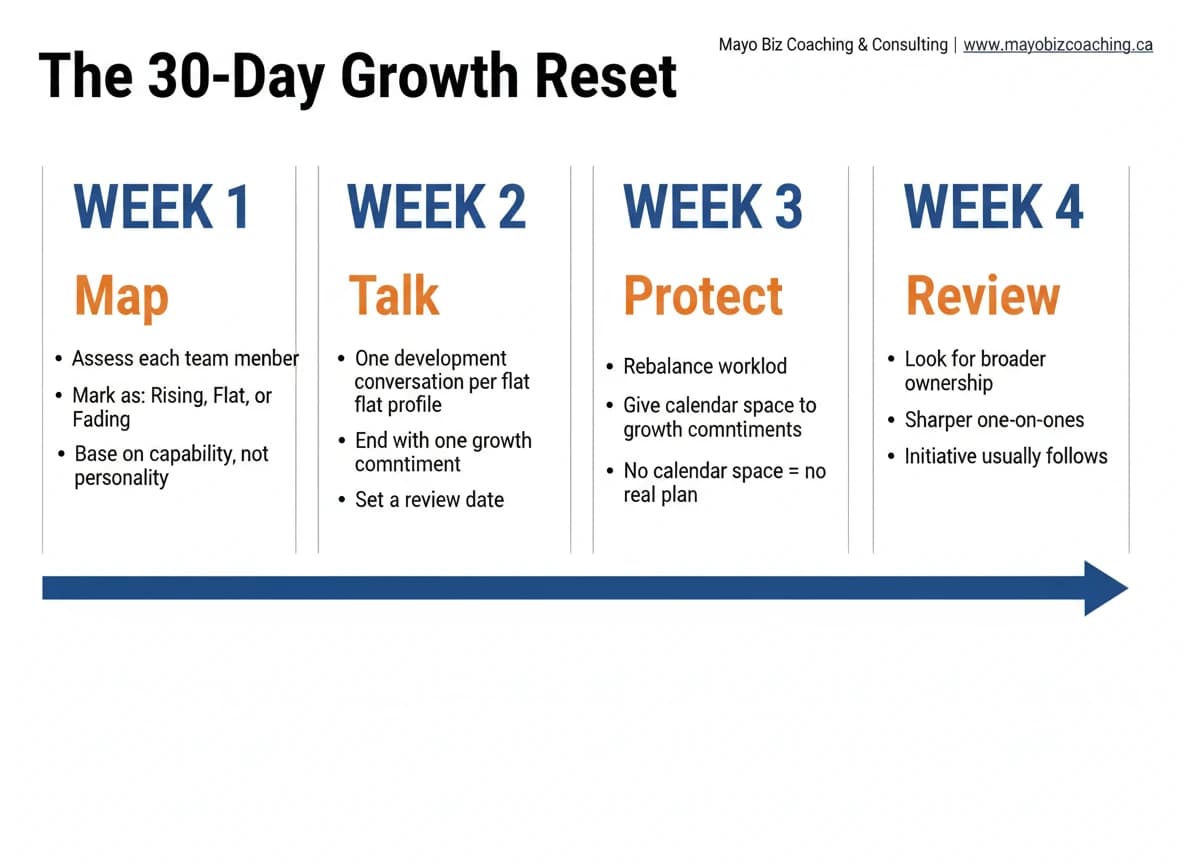
- Map growth status in week one. Mark each team member as rising, flat, or fading based on capability movement, not personality.
- Hold one focused development conversation per flat profile in week two. End every conversation with one concrete growth commitment and a review date.
- Rebalance work in week three to protect each commitment. If the growth move never gets calendar space, it was never a real plan.
- Review visible movement in week four. Look for broader ownership and sharper one on ones. Initiative usually follows.
One owner I coached used this exact reset with a seven person service team. By week three, a senior coordinator had taken full ownership of client onboarding, and two junior staff started asking for stretch work again.
No dashboard needed. Just visible change.
Let's Build Brilliance Together
If your team has people who are dependable but no longer stretching, do one thing this week. Schedule one 30 minute development conversation with each flat profile team member. Then set one measurable growth commitment for the next 30 days.
If you're recognizing this pattern on your team, reach out for a free consultation. No sales pitch, just an honest conversation about where you are and what you're working on.
Research Notes & Sources
If you want to go deeper, these are the studies and reports behind the key points in this post.
- ResumeBuilder on job hugging in 2026(resumebuilder.com)
- Statistics Canada Job Vacancy and Wage Survey(www150.statcan.gc.ca)
- DDI Global Leadership Forecast 2025(ddi.com)
- WTW on job hugging and the Great Stay(wtwco.com)
- Statistics Canada Labour Force Survey(www150.statcan.gc.ca)
- State of the Global Workplace(gallup.com)
- TalentLMS survey(talentlms.com)
- Allwork(allwork.space)
- SHRM on job hugging and talent bottlenecks(shrm.org)
- LinkedIn Workplace Learning Report(learning.linkedin.com)
- Ontario Employment Standards Act hours of work guide(ontario.ca)
- Ontario Employment Standards Act vacation time guide(ontario.ca)
Category & Tags
Frequently Asked Questions
What is job hugging in a leadership context?
Job hugging means an employee stays in role for safety, but stops stretching into new skills or responsibilities. The risk for leaders is hidden stagnation, not immediate turnover.
How do I spot job hugging early?
Look for steady output with declining curiosity: fewer stretch requests, repeated risk avoidance, and one on ones that stay tactical. You still have reliability, but growth has flattened.
What can I do when promotion is not available?
Build lateral growth. Assign project ownership, cross training, mentoring, and skill milestones with review dates. The message is simple: promotion may wait, development cannot.
Is job hugging always a problem?
Not always. In uncertain markets, short term stability is understandable. It becomes a leadership issue when fear based staying blocks succession, internal mobility, and team learning.
About the Author

About the Author
Mark Mayo
Head Coach, MBC
We get up each morning excited about sharing our 20-plus years of business acumen with small business owners and their teams. Collaborating with hard-working owners to achieve their personal and business goals brings rewards. When we develop you and grow your leaders, we create the momentum that moves you and your business forward. It starts with a first step. Then we can build brilliance together.
Related Articles
Why Your Best People Aren't Speaking Up
When your strongest contributors go quiet, they haven't become compliant. They're calculating whether it's worth the risk. Here is how to read the silence.
Read Why Your Best People Aren't Speaking Up
The Five Dysfunctions Hiding in Your Team
Patrick Lencioni's Five Dysfunctions model shows why capable teams underperform. Here is how to spot each dysfunction and what to do about it this week.
Read The Five Dysfunctions Hiding in Your Team
Conscious Unbossing: Why Gen Z Doesn't Want to Manage
Over half of Gen Z workers don't want management roles. That's not entitlement. It's a rational response to how most organizations have designed the job.
Read Conscious Unbossing: Why Gen Z Doesn't Want to Manage