Team Leadership Development
How to Build a Feedback Culture That Actually Works

You only hear what people really think when they are leaving. That exit interview lands a list of problems you could have fixed a year ago, if anyone had said something.
This is the gap most business owners feel but struggle to close. The distance between what your team thinks and what you actually hear. Building a feedback culture closes that gap. Not the annual review, suggestion box version. The kind where honest input is normal on a Tuesday morning, not saved for a formal process that everyone dreads.
The good news: this is a solvable problem. It doesn't require a new platform, an expensive consultant, or a culture overhaul. It requires a set of small, repeated behaviours from the person at the top.
What Feedback Culture Actually Means
A feedback culture is a team habit. Giving and receiving honest input is normal, expected, and safe. It's not a program. It's not a set of forms. It's how your team communicates every day.
This is different from feedback events. Annual reviews, 360 assessments (where feedback comes from peers, direct reports, and supervisors), and quarterly check-ins all have a place. But they are events, not culture. Gallup's 2019 workplace research 1 found that only 14% of employees say performance reviews inspire them to improve. Employees who receive weekly feedback are 5.2 times more likely to say they get meaningful input compared to those who receive it annually.
That gap tells you something important. The review isn't the problem. The frequency is.
Feedback culture requires a foundation of psychological safety. If people don't feel safe being honest, no amount of structure will make them speak up. Safety comes first. Rituals come second.
People tell you the truth before things break when they trust that honesty won't cost them. That's what feedback culture actually looks like.
Why the Owner Sets the Tone
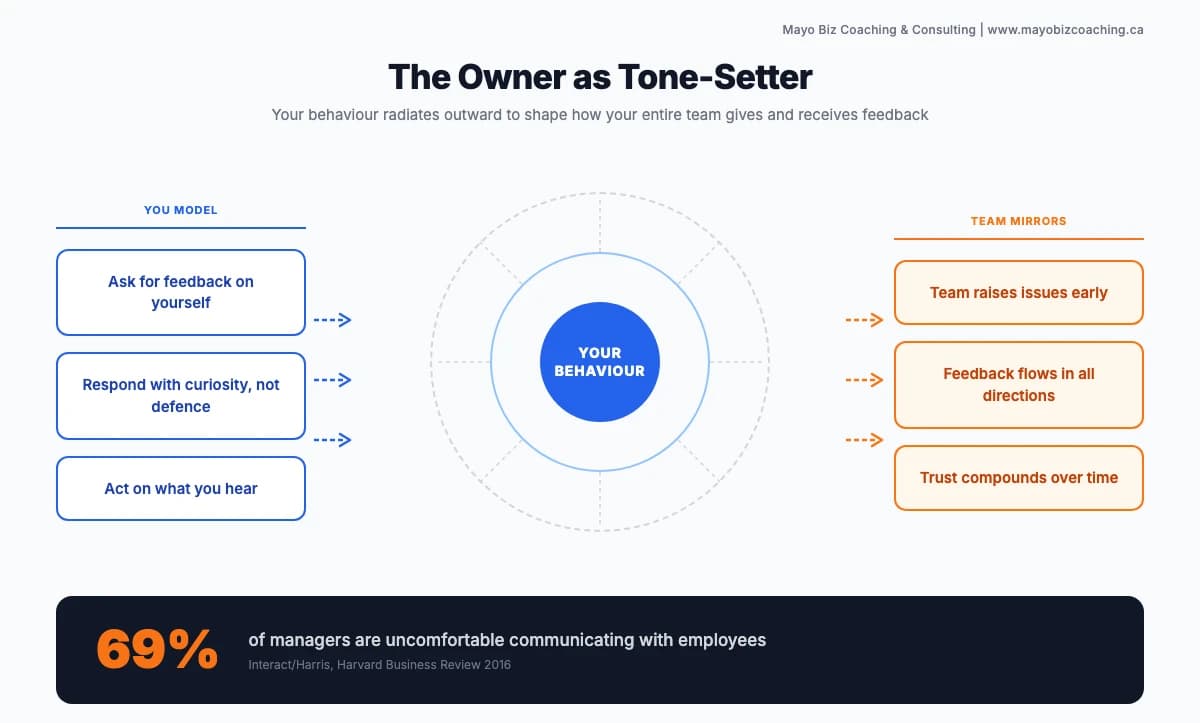
On a team of 10 to 20 people, the owner isn't part of the culture. The owner is the culture.
If you don't ask for feedback on yourself, no one gives it to anyone. If you react poorly once, people remember for a year. They watch what you do with hard truths more closely than anything you say about wanting honest input.
This isn't a theory. A 2016 Interact/Harris survey reported in Harvard Business Review 2 found that 69% of managers are uncomfortable communicating with their employees. Thirty-seven percent said they're uncomfortable giving direct feedback about performance. If the person running the team avoids honest conversations, the team learns that avoidance is the norm.
I have seen this pattern in coaching sessions more times than I can count. An owner says they want more honesty from their team, but when someone raises a concern in a meeting, the owner explains why the concern is wrong. That moment teaches the room more than any values poster on the wall.
One client, a manufacturing owner with 14 employees, told me his team never pushed back on anything. When we dug into it, he realized he had a habit of responding to concerns with "let me explain why we did it that way." His team stopped raising concerns because every concern became a debate. We changed one thing: he started responding with "tell me more about that" before offering any explanation. Within six weeks, two team leads started bringing up operational issues they had been sitting on for months.
Here's a practical first step. After your next decision, ask one person a direct question: "What is one thing I might be missing?" Then sit with the answer. Do not defend. Do not explain. Just listen.
If you want honest feedback flowing through your team, it starts with you asking for it and handling it well.
Five Rituals That Build the Habit
Feedback culture isn't built through a single initiative. It's built through repeated small practices that become habits. These five rituals form an ascending cadence, from daily to quarterly, that makes feedback part of how your team works.
1. The daily check-in question
Ask one specific question at your morning standup or team huddle. Not "any questions?" That invites silence. Try "What is one thing slowing you down today?" or "Where are you stuck right now?"
The specificity matters. A targeted question signals that you actually want to hear the answer. Keep it to one question, rotate it weekly, and listen without solving in the moment. When it's working, people answer honestly within 30 seconds and problems surface before they grow. The trap: turning it into a status report. The moment people start reciting task lists, the check-in loses its value.
2. The weekly one-on-one feedback exchange
This isn't a status update. It's a mutual feedback conversation. You ask for feedback on your own leadership first, then share yours.
Try this: "What is one thing I did this week that made your work harder?" Then offer your input using specific observations. This two-way exchange is where active listening matters most. Resist the urge to respond to their feedback with an explanation. Just take it in.
What good looks like: Both people leave with one clear thing to work on. The conversation takes 20 to 30 minutes.
Trap to avoid: Skipping it when things get busy. Cancelling one-on-ones tells your team that their development isn't a priority.
3. The peer feedback moment
After a project milestone, use a structured prompt for peer input. Keep it simple: "What did this person do that helped the project? What would you suggest they try differently next time?"
Written responses work well for introverts. Verbal exchanges work well for teams that already have some trust built. Either way, the structure prevents vague praise and avoids personal attacks.
When it's working, people receive specific input from colleagues, not just from their manager. One caution: don't make it anonymous. Anonymous feedback removes accountability and often drifts toward venting. Put names on it. If your team isn't ready for named peer feedback, that's a signal you need more safety first, not more anonymity.
4. The monthly retro
Three questions: What worked this month? What did not? What do we change going forward?
What matters here: the owner participates as an equal, not as the judge. Share what you think went wrong with your own decisions. When the team sees you reflecting honestly on your own missteps, they feel permission to do the same.
What good looks like: The meeting produces two or three specific changes, and someone owns each one.
Trap to avoid: Letting it become a complaint session without action items. Every issue raised needs an owner and a next step.
5. The quarterly feedback health check
Three plain questions for the whole team, answered honestly:
- Do I feel safe sharing honest feedback here?
- When I give feedback, does something change?
- Does my manager ask for feedback on their own performance?
If the answers trend positive over time, your culture is shifting. If they stay flat, something in the system is blocking honesty.
A Gallup meta-analysis 3 of strengths-based feedback found 14.9% lower turnover and 12.5% higher productivity in teams with regular feedback. Those numbers come from sustained practice, not a single conversation.
That sustained practice pays off quickly. Gallup's 2022 research 4 found that 80% of employees who received meaningful feedback in the past week are fully engaged. Feedback drives engagement more directly than almost anything else you can do as a leader.

Common Traps That Kill Feedback Culture
Even well-intentioned leaders undermine feedback culture with habits that feel helpful but aren't.
The praise sandwich. Positive, negative, positive. People learn to tune out the bread. They sit through the praise waiting for the real message. Be direct and kind instead. You can be honest without being harsh.
"My door is always open." This is passive, not safe. Waiting for people to come to you puts the burden on them. You have to walk through their door. Ask specific questions. Seek people out.
Asking for feedback, then defending every point. This is the most common killer I see in coaching. A leader asks "how am I doing?" and then spends ten minutes explaining why each piece of feedback is wrong. One defensive reaction undoes months of trust. Detert and Edmondson's research (2007) 5 found that 50% of employees reported it wasn't safe to speak up, and they were most reluctant to share ideas for improvement. Your reaction to feedback determines whether you get more of it.
Treating feedback as top-down only. If feedback only flows downward, it is performance management, not culture. Real feedback culture means input moves up, sideways, and down. The owner receives it as much as they give it.
When feedback conversations get harder, when they involve patterns of behaviour or repeated performance issues, that's a different skill set. Having difficult conversations without destroying trust requires more structure. And knowing when to coach versus manage helps you match your approach to the situation.
Most feedback cultures die not from a lack of tools, but from leader behaviour that contradicts the stated values.
How to Know It Is Working
You won't see a single dramatic shift. You'll see small signals that compound over time. Five signs your feedback culture is taking hold:
- People raise problems before they escalate. Issues come to you early, not after they've become crises.
- Feedback flows up and sideways, not just down. Team members give input to each other and to you, without being asked.
- New hires start giving input within their first month. When newcomers feel safe enough to speak up quickly, the culture is doing its job.
- Meetings include healthy pushback. Silence in meetings isn't agreement. When people challenge ideas respectfully, that's a sign of trust.
- You hear things you didn't want to hear, and the team watches how you respond. This is the real test. Your reaction in that moment shapes everything that follows.
None of these signals appear overnight. Most teams I work with start seeing small shifts within 60 to 90 days of consistent practice. Consistency is what matters. One good retro doesn't build a culture. Twelve of them in a row starts to.
Canadian small businesses are feeling this urgency. A 2024 BDC report 6 found that nearly 85% of Canadian SMEs that actively built positive workplace culture saw concrete benefits, including higher engagement and less turnover. Feedback culture isn't separate from workplace culture. It's how workplace culture becomes real.
You know it's working when people tell you things you didn't ask to hear, and they trust you to handle it well.
Let's Build Brilliance Together
A feedback culture doesn't happen by accident. It's built through consistent leadership behaviour, starting with the willingness to hear honest input about yourself.
If you're noticing that your team holds back, that problems surface late, or that honest conversations only happen when someone is leaving, reach out for a free consultation. No sales pitch, just an honest conversation about where you are and what you're working on.
Research Notes & Sources
If you want to go deeper, these are the studies and reports behind the key points in this post.
- More Harm Than Good: The Truth About Performance Reviews(gallup.com)
- Two-Thirds of Managers Are Uncomfortable Communicating with Employees(hbr.org)
- The Secret of Higher Performance(news.gallup.com)
- How Effective Feedback Fuels Performance(gallup.com)
- Why Employees Are Afraid to Speak(hbr.org)
- Optimizing Workplace Culture for Peak Performance - 2024 Report(bdc.ca)
Category & Tags
Frequently Asked Questions
What is a feedback culture in the workplace?
A feedback culture is a team habit where giving and receiving honest input is normal, expected, and safe. It happens in daily conversations, not just annual reviews. Teams with strong feedback cultures show higher engagement, lower turnover, and faster problem-solving.
How do leaders build a feedback culture on a small team?
Start by asking for feedback on yourself. Use a daily check-in question, run weekly one-on-ones with mutual input, and hold monthly retros where you participate as an equal. On a team of 10 to 20, the owner sets the tone directly through their own behaviour.
Why do employees avoid giving feedback to their manager?
Half of employees report it is not safe to speak up at work, according to research by Detert and Edmondson. One defensive reaction from a leader can undo months of trust. Employees watch how you respond to hard truths before deciding whether honesty is actually welcome.
How long does it take to build a feedback culture?
Most teams start seeing shifts within 60 to 90 days of consistent practice. New hires giving input within their first month is a strong early signal. Full culture change takes six to twelve months of sustained effort, especially from the owner.
About the Author

About the Author
Mark Mayo
Head Coach, MBC
We get up each morning excited about sharing our 20-plus years of business acumen with small business owners and their teams. Collaborating with hard-working owners to achieve their personal and business goals brings rewards. When we develop you and grow your leaders, we create the momentum that moves you and your business forward. It starts with a first step. Then we can build brilliance together.
Related Articles

The Manager-as-Coach Shift: From Solving to Asking
The manager-as-coach shift means changing a daily reflex, not learning a skill set. Five practical moves to stop solving and start developing your people.
Read The Manager-as-Coach Shift: From Solving to Asking
How to Have Difficult Conversations Without Destroying Trust
Difficult conversations do not need to damage trust. Use evidence-based frameworks to give clear feedback, improve accountability, and protect relationships.
Read How to Have Difficult Conversations Without Destroying Trust
Coaching vs. Managing: Why Great Leaders Master Both
Learn when to coach and when to manage. Research shows managers who master both approaches build more engaged teams and drive better results.
Read Coaching vs. Managing: Why Great Leaders Master Both