Executive Leadership & Career Coaching
How Leaders Build Trust: What Your Team Notices First
You can feel it when trust is thin.
Updates sound smoother than they should. Problems arrive later than they should. People nod in the meeting, then second-guess the decision in the hallway.
How leaders build trust has less to do with charisma than with what happens in those moments. Trust grows from the smaller things your team keeps score on. How you respond to bad news matters. So does whether you explain a decision, follow through, and keep the same tone in every room.
That matters because trust feels fragile in many workplaces right now. DDI's 2025 Global Leadership Forecast 1 found trust in immediate managers had fallen to 29% in its global study. That is not a soft culture problem. It is a leadership credibility problem.
Gallup reported in 2023 that only 21% of U.S. employees strongly agree 2 they trust the leadership of their organization. When trust drops that low, people protect themselves. They filter what they say. They hold concerns longer. They wait before committing.
In coaching, this is usually where the real issue shows up. Leaders tell me they want more ownership, more honesty, and more initiative from their teams. What they often need first is more trustworthiness in their own daily behaviour.
What Trust Actually Means at Work
Trust at work is not the same as being liked.
It is the belief that you are honest, steady, fair, and safe to work with when the pressure goes up.
Your team does not ask that question in formal language. They ask it in faster, more practical ways:
- If I raise a problem early, will this leader help me solve it or blame me for it?
- If priorities change, will I get a clear explanation or just a new demand?
- If I make a mistake, will I be coached, embarrassed, or ignored?
- If this leader makes a promise, should I believe it?
Gallup's global research on what people need from leaders is useful here. Across 52 countries, people most often described positive leaders through four needs: hope, trust, compassion, and stability 3. Hope mattered most, but trust was next. That is a helpful reminder for owners and executives: people do not just want a strategy. They want a leader whose intentions and reactions they can read.
That is why trust is less about image and more about predictability.
How Leaders Build Trust in Real Work
Trust grows when your behaviour becomes easier for people to believe.
Here are the patterns that matter most.
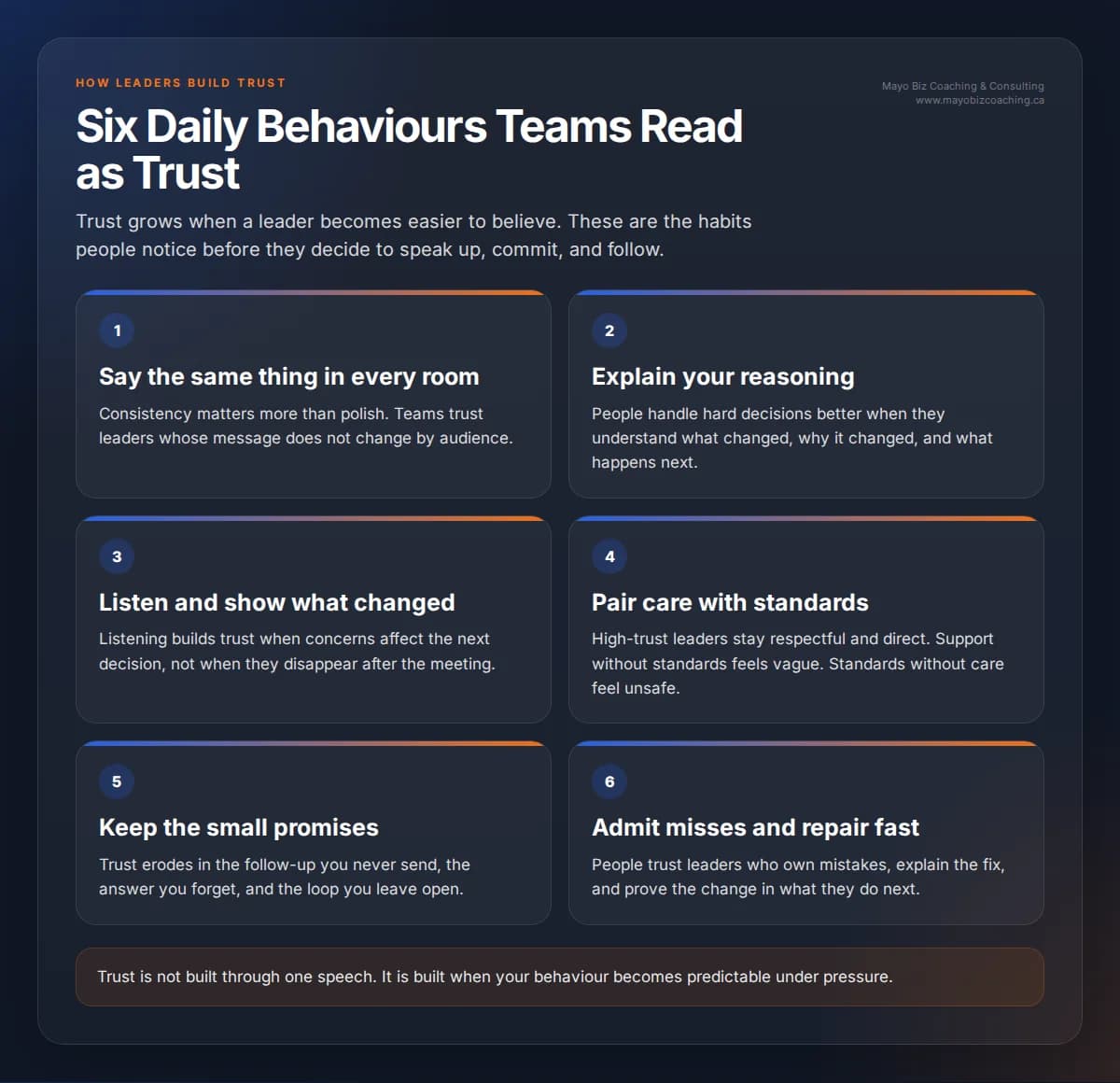
1. Say the Same Thing in Every Room
Teams notice quickly when the message changes by audience.
If the leadership team hears one version, managers hear another, and frontline staff get a softer or more polished version, trust starts to erode before anyone says it out loud. People do not need every detail, but they do need consistency.
Gallup's 2023 trust research is blunt. When employees strongly agree their leaders communicate clearly, inspire confidence in the future, and support change, 95% fully trust their leaders 2. The practical lesson is simple: trust rises when people understand what is happening, why it is happening, and what it means for them.
In practice, that means saying three things clearly and often:
- what is changing
- what is not changing
- what the next step is
If you skip any one of those, your team fills the gap with assumptions.
2. Explain Your Reasoning Before People Invent Their Own
Silence is expensive.
When leaders make decisions without explaining the rationale, people usually do not assume wisdom. They assume politics, avoidance, or indifference. Even good decisions can lose trust when the thinking stays hidden.
Gallup's 2022-2023 trust research points to the same pattern. Employees are far more likely to trust leadership when leaders create open, transparent dialogue and make expectations clear (Gallup on building trust in the workplace 4). That does not mean giving a 20-minute lecture every time you make a call. It means offering enough context that people can see the logic.
This matters even more in growing businesses, where people often feel the effect of a decision before they hear the explanation. A role changes. A process tightens. A project gets delayed. If the why arrives late, people start writing their own story about what is really going on.
The better move is plain language:
"Here is what we are seeing."
"Here is why we are changing course."
"Here is what I considered."
"Here is what I need from you now."
That kind of clarity calms people because it treats them like adults.
3. Listen in a Way That Changes What Happens Next
Listening builds trust when it affects the next decision, not when it simply makes people feel heard for a moment.
Gallup found employees who say their manager is always willing to listen to work-related problems are 4.2 times more likely 4 to strongly agree they trust organizational leadership. It is one of the clearest links between a daily leadership habit and trust.
This is one reason I come back to active listening so often with clients. Most leaders think they listen because they do not interrupt. Real listening is more visible than that. You ask a better question. You check understanding. You change course when new information earns it.
A simple test helps: after someone raises a concern, can they see what happened with it?
If people speak up and nothing changes, trust weakens.
If people speak up and you explain what you acted on, what you did not act on, and why, trust grows even when the answer is no.
4. Pair Care With Standards
Some leaders try to build trust by being easier on people. Others try to build trust by being relentlessly firm and calling that honesty.
Neither works for long.
The Center for Creative Leadership makes this point well in its 2024 work on change and trust. Leaders build trust when they balance the structural side of change with the people side. They hold urgency and patience, results and empathy, at the same time (CCL on leadership trust during change 5). When leaders lean too far in either direction, credibility slips.
This is where many owners get stuck. They think, "If I push too hard, I will damage the relationship." Then they swing the other way and think, "If I show too much understanding, standards will slide." In practice, trust comes from proving you can do both.
That sounds like:
- "I understand why this got stuck, and we still need a better handoff next week."
- "I appreciate you raising the issue early, and we need a firmer recovery plan by Friday."
- "I can support you here, but I cannot take ownership of it for you."
If you want help with that balance, it is the same tension I explored in coaching versus managing. It also sits underneath difficult conversations without destroying trust. Support and accountability are not opposites. High-trust teams need both.
5. Keep the Small Promises
Trust is rarely lost in one dramatic event. More often, it erodes in a slow drip.
You said you would follow up on a hiring concern and forgot.
You promised more context after a leadership meeting and never came back to it.
You asked people for candid feedback and then moved on like the conversation never happened.
These moments look small from the leader's seat. They do not feel small to the team.
One of the simplest trust habits I recommend is a visible follow-through list. Keep it short. Track the promises you made in meetings, one-on-ones, and project reviews. If you told someone you would come back with an answer, come back with an answer. If the answer changed, say so directly.
I see this a lot with owners who think the trust issue is strategic. Often it is smaller than that. A promised callback never happened. A concern got acknowledged but not resolved. A leader asked for candour, then got busy and never closed the loop.
This is boring leadership work. It is also some of the most important.
People trust leaders who close loops.
6. Admit Misses and Repair Fast
Leaders often assume trust rises when they look polished and unshakeable.
Usually the opposite is true.
DDI's 2023 trust research found that leaders who regularly show vulnerability are far more likely to be trusted. It also found that when leaders acknowledge failures or shortcomings, they are 7.5 times more likely to maintain trust 6. That does not mean oversharing or turning every setback into a confession. It means not pretending you got it right when you did not.
Repair sounds simple:
- name the miss
- own your part
- explain what changes now
- follow through on the repair
This is especially important if you are trying to build more psychological safety. Teams do not become more candid because a leader says, "You can be honest here." They become more candid when they see a leader respond well after getting something wrong.
What Breaks Trust Faster Than Leaders Expect
There are a few patterns that do damage quickly:
- inconsistency between words and actions
- avoiding hard conversations until the issue spreads
- public support and private doubt
- asking for honesty, then reacting defensively when it arrives
- setting expectations once and assuming everyone understood them the same way
Most trust problems are not really communication problems. They are pattern problems.
Your team is asking one quiet question all the time: "What happens here when something gets difficult?"
Your answer is not your values statement.
It is your behaviour.
A 30-Day Trust Reset for Leaders
If trust feels shaky on your team, do not launch a culture initiative first.
Start smaller. Start operationally.
Week 1: Audit your open loops
Write down every promise you have made to your team in the last two weeks. Meetings. One-on-ones. Project updates. Close as many loops as you can before making new commitments.
Week 2: Improve one conversation rhythm
Add two questions to your regular check-ins:
- What risk are we not naming early enough?
- What do you need from me to move this forward?
Then listen long enough to get a real answer.
Week 3: Explain more of your decisions
Choose three recent decisions and share the reasoning behind them. Keep it short. Tell people what you saw, what trade-offs you weighed, and what happens next.
Week 4: Repair one place where trust slipped
Pick one conversation you have been avoiding. Own what is true. Clarify expectations. End with one concrete next step and one follow-up date.
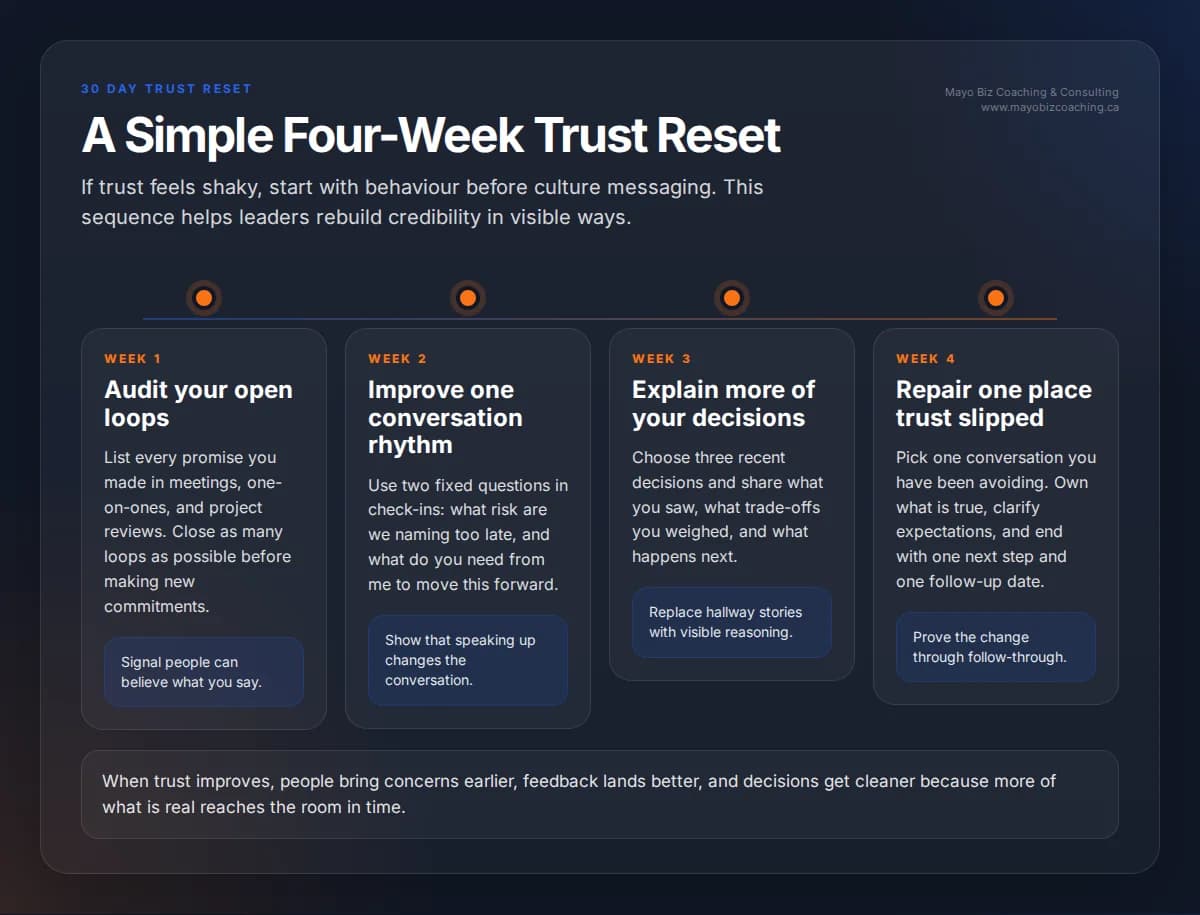
This is not flashy work. It is trust-building work.
And once trust improves, a lot of other leadership problems get easier. Feedback lands better. Delegation gets cleaner. Meetings get more honest. Decision quality goes up because people tell you more of what is real.
The Real Measure of Trust
You can usually tell trust is growing before engagement scores ever move.
People bring you bad news sooner.
They ask harder questions.
They challenge weak ideas without sounding rebellious.
Managers stop filtering every issue before it reaches you.
You spend less time reading between the lines.
That is the real measure. Not whether people describe the culture as nice. Whether they tell the truth early enough for you to do something useful with it.
Trust is not built through one speech, one retreat, or one values exercise.
It is built when your team learns, over time, that you are clear, steady, fair, and worth telling the truth to.
Let's Build Brilliance Together
Trust is one of the few leadership assets that improves almost everything around it. When people trust you, they speak sooner, execute better, and stay engaged longer.
If you want to strengthen trust across your leadership team, reach out for a free consultation. No sales pitch, just an honest conversation about what is happening and what better leadership habits could look like in practice.
Research Notes & Sources
If you want to go deeper, these are the studies and reports behind the key points in this post.
- Global Leadership Forecast 2025(ddiworld.com)
- Why Trust in Leaders Is Faltering and How to Gain It Back(gallup.com)
- What Do People Need Most From Leaders?(gallup.com)
- How to Build Trust in the Workplace(gallup.com)
- Why Leadership Trust Is Critical, Especially During Change(ccl.org)
- 7 Ways the Best Leaders Build Trust in the Workplace(ddiworld.com)
Category & Tags
Frequently Asked Questions
How do leaders build trust with a team?
Leaders build trust through repeated behaviour, not one big speech. Clear communication, consistent follow-through, active listening, fair accountability, and honest repair after mistakes matter more than charisma.
What builds trust faster at work: empathy or accountability?
The strongest leaders hold both together. Trust rises when people feel respected and supported, but it also depends on standards, predictable decisions, and leaders doing what they say they will do.
How long does it take to rebuild trust at work?
Trust usually breaks faster than it returns. Most teams need several weeks of consistent behaviour, clear communication, and visible follow-through before people believe the change is real.
What destroys trust on a team the fastest?
Inconsistency, silence, broken promises, and punishing honesty damage trust quickly. Teams stop speaking up when they cannot predict how a leader will react under pressure.
About the Author

About the Author
Mark Mayo
Head Coach, MBC
We get up each morning excited about sharing our 20-plus years of business acumen with small business owners and their teams. Collaborating with hard-working owners to achieve their personal and business goals brings rewards. When we develop you and grow your leaders, we create the momentum that moves you and your business forward. It starts with a first step. Then we can build brilliance together.
Related Articles
Leading Without Certainty: Why Grounded Beats Confident
Brené Brown's grounded confidence formula helps leaders trade performative certainty for honesty. Here's what that shift looks like in practice.
Read Leading Without Certainty: Why Grounded Beats Confident
Self-Awareness Is a Leadership Skill You Can Build
Most leaders think they're self-aware. Research says only 10-15% actually are. Here is how to close the gap and lead with clearer self-knowledge.
Read Self-Awareness Is a Leadership Skill You Can Build
Learning Agility: Why the Fastest Learners Lead Best
Learning agility predicts leadership success better than experience alone. Here is what it means for small business leaders and how to build it this month.
Read Learning Agility: Why the Fastest Learners Lead Best