Team Leadership Development
From Why to What: Set Goals People Actually Care About

You have a purpose statement and a list of quarterly goals. They live in different documents. They were written in different meetings. And if you asked your team to explain how one connects to the other, most would struggle.
That gap is where engagement goes to die.
I see this pattern constantly in coaching. A leader invests real energy into defining the team's purpose, then switches to a separate goal-setting process that runs on a completely different track. Purpose lives on the wall. Goals live in the spreadsheet. The two never meet in a weekly conversation.
The result is goals that people comply with but don't commit to. And there's a real difference between compliance and commitment. What's missing is a purpose to goals framework: a reliable way to build goals from the team's why so that people actually own them.
The Goal-Setting Motivation Gap
Goal setting is one of the strongest levers you have as a leader, but only when people understand why the goal matters. In a McKinsey survey, 72% of employees cited goal setting as a strong motivator 1. That's a high number. So why do so many teams treat goals like administrative overhead?
Because the motivating part isn't the goal itself. It's the connection between the goal and something bigger. The same research showed that people felt more motivated when their goals mixed individual and team targets and linked clearly to company priorities.
Here's what that means in practice: goal setting isn't a planning exercise. It's a purpose translation exercise. When you skip the translation, you get goals that are technically correct but emotionally empty.
Why Purpose Without Goals Is Just Inspiration
In the previous post on starting with why for teams, I walked through how to build a team purpose statement and use a weekly filter to keep it active. That filter is step one. But purpose without goals is just a warm feeling. It needs to land in specific, measurable work.
Simon Sinek's Golden Circle gives us the architecture: why, then how, then what 2. Most leaders understand the why. Fewer translate the how into operational habits. And the what, the actual goals, often gets built without referencing the why at all.
When people can see how their daily work connects to something they believe in, performance follows. McKinsey's research on organizational alignment 3 found that companies where employees feel that connection are twice as likely to sit above the median on earnings margins. Aligned people make better decisions faster, because they share a filter for what matters.
The same principle applies at the team level. When a team's goals clearly descend from its purpose, priority conflicts shrink. Trade-off decisions get easier. People stop debating what to work on and start doing the work.
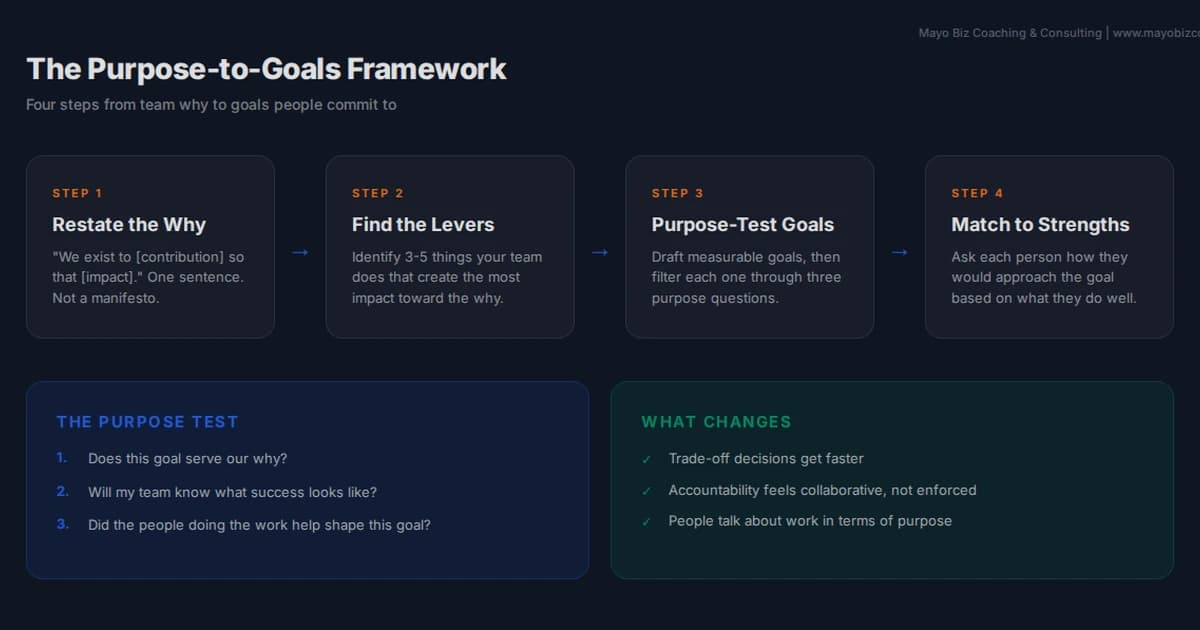
The Purpose-to-Goals Translation
Here's the framework I use with coaching clients. It takes a working team why and converts it into goals that people actually own.
Step 1: Restate the Why as a Contribution
Take your team's purpose statement and turn it into a contribution sentence. The format: "We exist to [contribution] so that [impact]." If you did this work in the start-with-why process, you already have it. If not, do that first.
The contribution sentence is your anchor. Every goal you set should trace back to it.
Step 2: Identify the Three to Five Levers
Ask your team: what are the three to five things we do that create the most impact toward our why? Not all the things we do. The things that matter most.
This is where most goal-setting processes fail. They start with the full list of responsibilities and try to set targets for everything. A purpose-first approach starts with the contribution and works backward to the levers that drive it.
I hear this a lot from the leaders I coach: "We can't just focus on three things. We have too many responsibilities." That's true. But responsibilities and priorities are not the same thing. Responsibilities are what you maintain. Priorities are what you improve. Goals should live on the priority side.
Step 3: Build Goals That Pass the Purpose Test
For each lever, draft a specific, measurable goal. Then run it through three questions:
-
Does this goal serve our why? If you can't draw a straight line from the goal to the team's contribution statement, it's maintenance, not a priority.
-
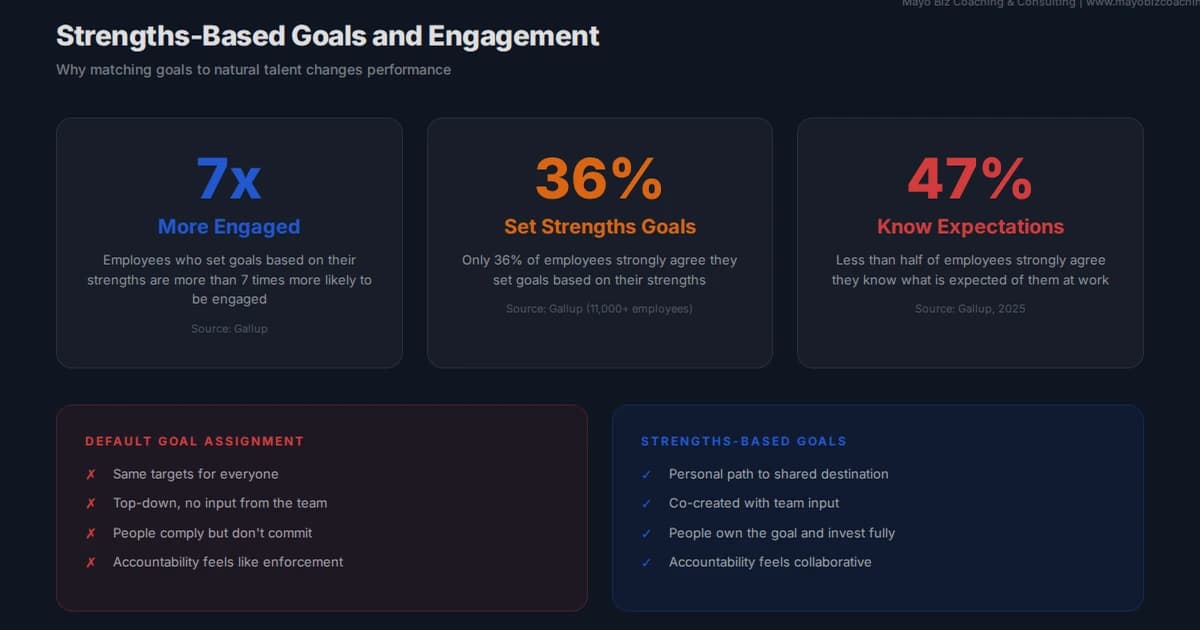
Will my team know what success looks like? Gallup's 2025 data puts it at 47% of employees who strongly agree they know what's expected of them 4, down 9 points from 2020. If your goal is vague, your team fills in the blanks differently. That's not a performance problem. It's a clarity problem.
-
Did the people doing the work help shape this goal? People are more motivated and see the process as fair when they help set their own goals. McKinsey's performance research confirms this pattern. Top-down goals get compliance. Co-created goals get commitment.
Any goal that fails one of these questions needs revision before it earns a spot on the list.
Step 4: Match Goals to Strengths
This is where most frameworks stop, and it's where the biggest gains get missed.
Most leaders don't think to match who does the goal to who is built for it. Gallup's data is striking: people whose goals align with their strengths are more than seven times more likely to be engaged 5. Seven times is not a marginal gain. It's a fundamentally different level of performance.
Yet in that same Gallup research, only 36% of employees could strongly agree that they set goals based on their strengths. Most either don't know their strengths or can't connect them to the goals they've been given.
Here's what that looks like in practice. Instead of assigning the same goal template to everyone, ask each person: "Given your strengths, how would you approach this goal? What would you do differently than someone else on the team?" The goal stays the same. The path to it becomes personal.
Marcus Buckingham makes this point in Nine Lies About Work: one size fits one. Two people can share a goal and take completely different approaches based on what they naturally do well. Your job as the leader is not to standardize the path. It's to hold the destination and give people room to get there their way.
What Changes When Goals Are Purpose-Connected
The shift from generic goals to purpose-connected goals changes how a team operates day to day.
Trade-off decisions get faster. When a new request lands, the team has a filter: does this serve our why and our current priorities? If not, it waits. Without that filter, every request competes equally, and the loudest or most urgent one wins.
Accountability feels different. Holding someone accountable for a goal they helped build and understand the reason behind is a collaborative conversation. Holding someone accountable for a goal that was handed to them feels like enforcement. Same conversation structure, completely different tone. If accountability conversations feel adversarial on your team, look at how the goals were set before you look at how the conversation was delivered.
People talk about work differently. When goals connect to purpose, the language changes. Instead of "I need to hit my numbers," you hear "This matters because..." That's not a small thing. It's how commitment sounds when it's real.
Common Mistakes in Purpose-to-Goal Translation
Setting Too Many Goals
If everything is a priority, nothing is. Three to five goals per quarter is a practical ceiling for most teams. More than that and the purpose connection thins out. Every additional goal dilutes focus and makes the why harder to see in daily work.
Treating Goals as Fixed for the Full Quarter
Goals should be reviewed regularly against the team why. Conditions change. New information arrives. A goal that made sense in January may not serve the purpose in March. Build in a midpoint check where you ask: does this still trace back to our why? If not, adjust.
Confusing Measurement With Meaning
A goal can be perfectly measurable and completely meaningless. "Increase report submissions by 15%" is measurable. But if nobody on the team can explain why that metric matters to the people they serve, it's just a number. Measurement matters. But meaning comes first.
Skipping the Strengths Conversation
Default goal distribution, where everyone gets the same targets regardless of what they do well, is one of the fastest ways to kill engagement. It signals that the leader sees interchangeable roles, not individual people. Take the time to ask how each person would approach the goal differently. That conversation is a natural fit for a coaching-style one-on-one. It takes an extra 10 minutes and changes the quality of the commitment entirely.
A Practical Starting Point
If you're reading this and thinking the full framework feels like a big change, here's a smaller first step.
Pick one goal your team is currently working on. In your next team meeting, ask two questions:
- Can anyone explain how this goal connects to our team's purpose?
- Who on this team is best positioned to lead this goal based on their strengths?
If the room goes quiet on the first question, you have a purpose translation gap. If people point to the same one or two names for every goal regardless of the topic, you have a strengths distribution gap.
Either answer tells you where to start.
The Real Point
Goals are not the starting line. Purpose is. When you build goals from purpose and match them to strengths, you get a team that doesn't just hit targets. They understand why the targets matter and bring their best work to reaching them.
The difference between a team that complies with goals and a team that commits to them is not motivation. It's design. Design the goals from the why, and commitment follows.
Let's Build Brilliance Together
Purpose-connected goals change how a team works, decides, and holds itself accountable. If you're looking at your current goals and wondering why they don't land the way you hoped, reach out for a free consultation. No sales pitch, just an honest conversation about where you are and what you're working on.
Research Notes & Sources
If you want to go deeper, these are the studies and reports behind the key points in this post.
- How Effective Goal-Setting Motivates Employees(mckinsey.com)
- Find Your Why: A Practical Guide for Discovering Purpose for You and Your Team(simonsinek.com)
- Connecting Strategy, Goals, and Meaningful Purpose(mckinsey.com)
- U.S. Employee Engagement Declines From 2020 Peak(gallup.com)
- Strengths-Based Goal Setting(news.gallup.com)
Category & Tags
Frequently Asked Questions
How do you connect team purpose to goal setting?
Start with a clear team why statement, then test every proposed goal against it. Goals that serve the why earn commitment. Goals that don't get deprioritized. The connection is the filter, not the statement itself.
Why do employees not care about their goals?
Most goals are handed down without context. When people don't know how a goal connects to something that matters, it feels like a task. Bringing people into the goal-setting conversation and making the connection to purpose explicit is what turns a target into a commitment.
What is a purpose to goals framework?
It is a structured approach that starts with team purpose and works outward to specific, measurable goals. Each goal must pass a purpose test before it is adopted. This ensures the team works on what matters, not just what is measurable.
How do strengths-based goals improve engagement?
When a goal aligns with what someone naturally does well, they invest differently. Gallup data puts it at seven times more likely to be engaged. The practical step: ask each person how they would approach the goal given their strengths, not just whether they can hit the number.
About the Author

About the Author
Mark Mayo
Head Coach, MBC
We get up each morning excited about sharing our 20-plus years of business acumen with small business owners and their teams. Collaborating with hard-working owners to achieve their personal and business goals brings rewards. When we develop you and grow your leaders, we create the momentum that moves you and your business forward. It starts with a first step. Then we can build brilliance together.
Related Articles

Start With Why for Teams: Turn Purpose Into Weekly Decisions
Most teams have a purpose statement but no way to use it. Learn a three-question weekly filter that turns your team why into real decisions.
Read Start With Why for Teams: Turn Purpose Into Weekly Decisions
Who Helped You? The One Question That Changes Team Culture
Simon Sinek says teams of average performers consistently beat star-stacked teams. The difference is one habit: making the assist as visible as the goal.
Read Who Helped You? The One Question That Changes Team Culture
The Manager-as-Coach Shift: From Solving to Asking
The manager-as-coach shift means changing a daily reflex, not learning a skill set. Five practical moves to stop solving and start developing your people.
Read The Manager-as-Coach Shift: From Solving to Asking