Team Leadership Development
FOBO: When Your Team Fears Becoming Obsolete

Your best employee stopped volunteering for new projects three months ago. She used to be the first hand up. Now she sits quietly in meetings, does solid work, and says nothing about the future.
You assumed she was tired. She is not tired. She is scared.
She has been reading the same headlines you have. AI replacing entire departments. Friends laid off after 15 years. Tools that can do in seconds what took her a decade to learn. She is wondering if she is next.
This fear has a name now. Cambridge Dictionary added it in January 2026 1: FOBO. Fear of Becoming Obsolete.
FOBO is not new. People have felt it through every major workplace shift. But right now, AI is generating more of it than any other change in a generation. That is the context this article works through.
What FOBO Looks Like on a Small Team
FOBO does not announce itself. It shows up as subtle shifts that are easy to misread.
Knowledge hoarding. Your most experienced people stop sharing what they know. Not out of selfishness, but survival instinct. If they are the only ones who understand the legacy system or the key client relationship, they feel harder to replace.
A peer-reviewed study of 402 employees 2 found that AI-induced job insecurity leads directly to knowledge hiding through reduced psychological safety.
Risk aversion. People who used to experiment start playing it safe. They stick to what they know works. They avoid new tools, new processes, anything that might expose a gap in their skills.
Quiet resistance. Slow adoption of new software. Missed training sessions. A general sense that the team is going through the motions rather than genuinely engaging.
Withdrawal from growth. People stop asking for feedback, skip optional training, and avoid stretch assignments. They hunker down in what they already know.
I coached a manufacturing owner in Kitchener last year whose operations manager had been with him for 12 years. The manager started pushing back on every process change. The owner assumed stubbornness.
When we explored it in a coaching conversation, the real issue surfaced. The manager had watched AI-driven automation replace three roles at his brother-in-law's plant. He was protecting himself from what he believed was coming.
If any of this sounds familiar, the first step is recognizing it for what it is: a fear response, not a performance problem.
The Numbers Behind the Fear
The anxiety is not irrational. It is grounded in real shifts your team can feel even if they cannot name them.
Pew Research Center surveyed over 5,000 American workers 3 in late 2024. 52% said they feel worried about the future impact of AI on their workplace. Only 6% believe it will create more opportunities for them personally.
In Canada, the numbers hit closer to home. An Abacus Data survey 4 found that 47% of employed Canadians worry AI could force them to change jobs or careers. 70% fear AI will make jobs in their industry obsolete. Among workers under 30, 55% expect to shift careers within five years.
Ontario sits at the centre of this pressure. The Institute for Research on Public Policy (2025) found that Ontario has the highest AI automation risk score of any province among in-demand occupations. If you run a business in Guelph or the Waterloo corridor, this is not abstract. It is the economic context your team lives in every day.
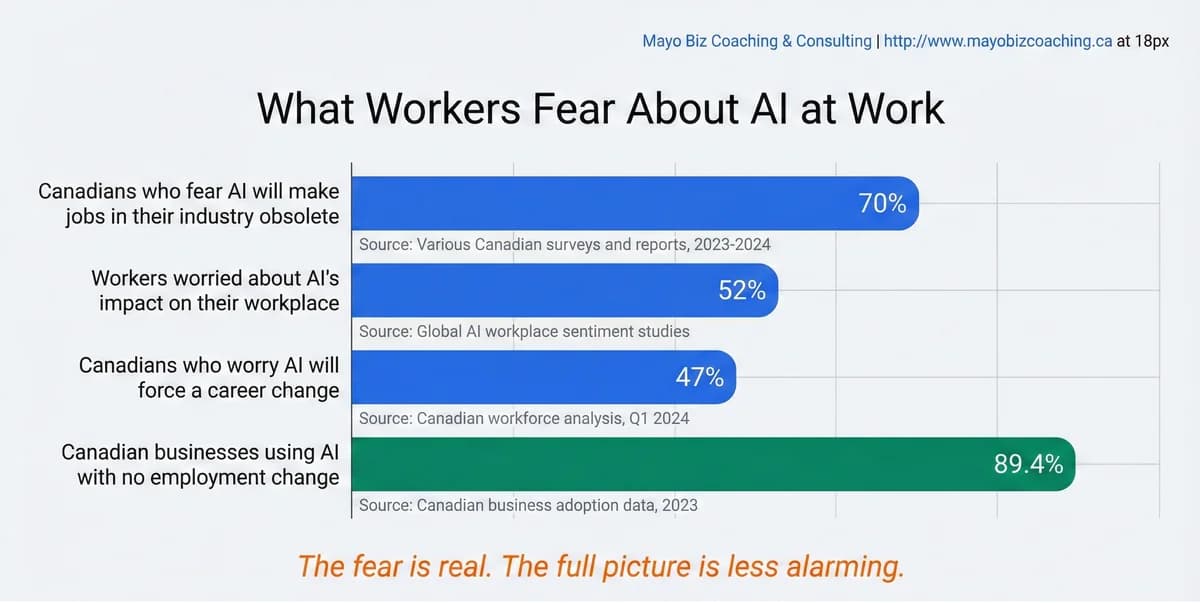
Here is what most of the headlines miss. Statistics Canada 5 reports that 89.4% of Canadian businesses using AI saw no change in employment levels. The Conference Board of Canada (2025) 6 found that 57.4% of Canadian jobs are highly exposed to AI. But more than half of those are augmenting roles where AI makes the human more effective.
The fear is real. The full picture is less alarming. Your team does not know that yet, and that gap is where leadership matters most.
The Leadership Vacuum
Here is the part that should concern you most. Your team is scared, and most of them have never heard you address it.
Mercer surveyed over 8,500 employees 7 across 10 countries in 2025. Fewer than 20% had heard from their direct manager about how AI would affect their job. Only 13% had heard from HR. The silence is not neutral. It is feeding the fear.
I worked with a professional services firm owner in Guelph who realized she had never once mentioned AI in a team meeting. It just never seemed urgent enough.
Meanwhile, three of her seven employees had been quietly browsing job postings. They did not want to leave. They wanted options if things went sideways.
One honest conversation changed the dynamic. She did not pretend to have answers. She said: "I know AI is changing our industry. I do not have a complete plan yet. But I want us to figure this out together, and nobody's role is disappearing without a real conversation first."
Two of those three people stopped their job searches within the month.
What made it work? BCG's 2025 research tells the same story at scale. Employee positivity about AI rises from 15% to 55% 8 when leaders actively support the transition. That is a 3.7 times multiplier. You are the single biggest factor in whether your team embraces AI or fears it.
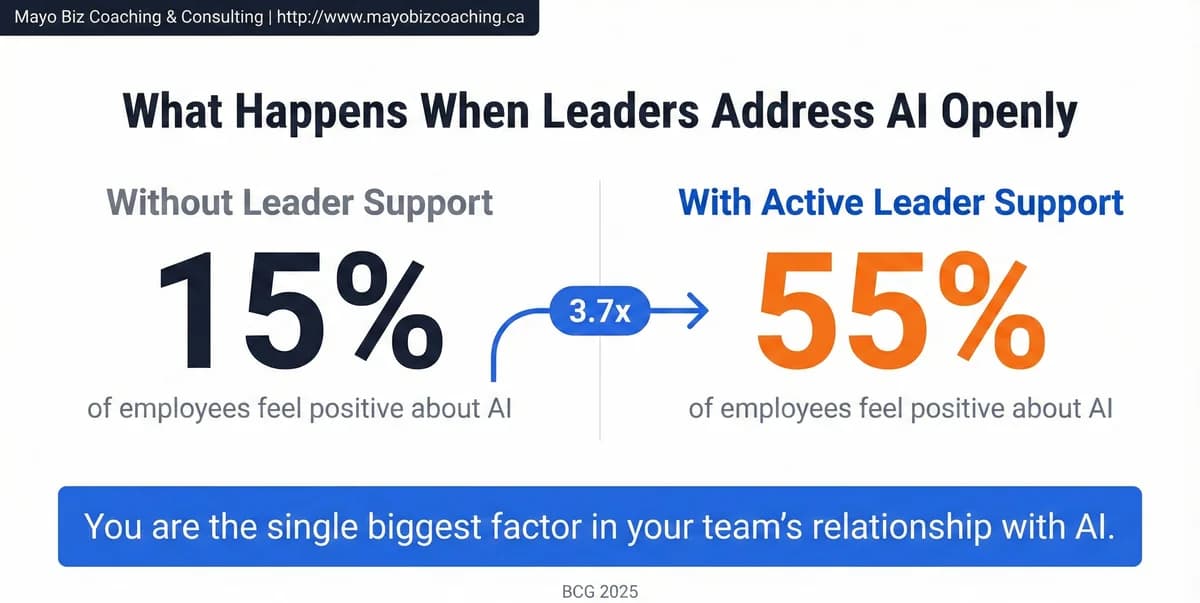
If your team does not know where you stand on AI, they are already filling the silence with their own conclusions.
What Makes FOBO Worse
Before talking about what helps, here is what makes it worse:
Toxic positivity. "AI is exciting! Think of all the possibilities!" Your team does not need cheerleading. They need honesty. When people feel exposed, forced enthusiasm reads as dismissal.
Tools without training. Handing your team a new AI platform and expecting them to figure it out signals you care about the output, not the person. Abacus Data (2025) found only 36% of employed Canadians report receiving any employer-provided AI training. The tools arrive. The support does not.
Ignoring it. Silence is the most common response and the most damaging. Your team fills the vacuum with worst-case assumptions, and those assumptions are always worse than reality.
"Just upskill." Telling someone to "learn AI" without providing time, budget, or psychological safety is like telling someone to "just be more confident." It puts the burden on the person without changing the environment. Gallup (2024) found that only 2% of CHROs believe their upskilling efforts build the skills employees actually need.
Every one of these responses treats FOBO as an individual problem. It is a leadership problem.
What Actually Helps
The leaders who navigate FOBO well share a few consistent habits.
Name it. Acknowledge the fear directly. Amy Edmondson coined the term psychological safety. In a February 2026 HBR article 9, she argues that AI is creating "far greater uncertainty" than most teams have experienced. The only way to maintain psychological safety is by making the anxiety discussable. Reframe the challenge as a learning opportunity. Make it safe to say "I am worried about this" by saying it yourself first.
Invite participation. Ask your team what they are seeing, what concerns them, and what ideas they have. This is not a survey. It is a genuine conversation.
Compare two questions: "What part of your work do you think AI could help with?" versus "How should we use AI to be more efficient?" The first centres the person. The second centres the output. Active listening matters more here than in almost any other leadership moment.
Create small wins. Do not roll out a company-wide AI strategy. Start with one person, one tool, one task. Let them experiment without stakes. When someone on your team uses AI to save an hour on a report, recognize the learning, not the time saved.
I coached a retail business owner who started by asking each team member to try one AI tool for one week and report back. No pressure, no evaluation. Just curiosity.
Within a month, the team had identified three workflow improvements he never would have found alone. The fear had shifted to interest. The technology was the same. The conversation was different.
When leaders name the fear, invite real participation, and create low-stakes opportunities to learn, FOBO loses its grip.
The Human Skills Premium
Here is the reframe your team needs to hear. AI does not make human skills less valuable. It makes them more valuable.
The World Economic Forum's 2025 Future of Jobs Report 10 identified the 10 fastest-growing skills globally. Seven are human skills: creative thinking, resilience, leadership, curiosity, systems thinking, talent management, and motivation.
Deloitte's 2024 workforce research found that jobs requiring creativity and emotional intelligence see wage growth nearly double that of purely technical roles. McKinsey (2025) calls coaching, negotiation, and interpersonal conflict resolution "uniquely human" capabilities AI cannot replicate.
Your team's ability to listen to a frustrated client, navigate a tense conversation, or mentor a new hire carries more weight as AI handles the routine work. The leaders who help their teams see this are the ones who keep their best people through the transition.
If you want to build a team that thrives alongside AI rather than fears it, invest in the skills AI cannot touch. That is where team leadership development makes the biggest difference.
Let's Build Brilliance Together
FOBO is real, and your team is feeling it whether they tell you or not. The research points the same direction: what your team hears from you matters more than what AI can do.
Maybe you are noticing quiet resistance, knowledge hoarding, or a general unease you cannot quite name. Reach out for a free consultation. No sales pitch. Just an honest conversation about what your team needs from you right now.
Research Notes & Sources
If you want to go deeper, these are the studies and reports behind the key points in this post.
- Cambridge Dictionary added it in January 2026(dictionaryblog.cambridge.org)
- peer-reviewed study of 402 employees(sciencedirect.com)
- Pew Research Center surveyed over 5,000 American workers(pewresearch.org)
- An Abacus Data survey(abacusdata.ca)
- Statistics Canada(www150.statcan.gc.ca)
- Conference Board of Canada (2025)(conferenceboard.ca)
- Mercer surveyed over 8,500 employees(mercer.com)
- Employee positivity about AI rises from 15% to 55%(bcg.com)
- February 2026 HBR article(hbr.org)
- World Economic Forum's 2025 Future of Jobs Report(weforum.org)
Category & Tags
Frequently Asked Questions
What is FOBO in the workplace?
FOBO stands for Fear of Becoming Obsolete. Cambridge Dictionary added the term in January 2026 to describe the worry that AI will make your role irrelevant. It shows up as knowledge hoarding, risk aversion, and quiet disengagement.
How do I know if my team has FOBO?
Watch for experienced people who stop sharing knowledge, resistance to new tools, declining volunteering, and a general sense of going through the motions. Pew Research found 52% of workers are worried about AI at work.
What should leaders say to a team anxious about AI?
Name the uncertainty honestly, share what you know and do not know, invite their input, and create low-stakes chances to experiment with new tools. BCG research shows leadership support raises AI positivity from 15% to 55%.
Does AI actually replace small business jobs?
Statistics Canada found 89.4% of Canadian businesses using AI reported no change in employment. The Conference Board found more than half of AI-exposed jobs are augmenting roles where AI makes the human more effective.
About the Author

About the Author
Mark Mayo
Head Coach, MBC
We get up each morning excited about sharing our 20-plus years of business acumen with small business owners and their teams. Collaborating with hard-working owners to achieve their personal and business goals brings rewards. When we develop you and grow your leaders, we create the momentum that moves you and your business forward. It starts with a first step. Then we can build brilliance together.
Related Articles

Why Your Best People Aren't Speaking Up
When your strongest contributors go quiet, they haven't become compliant. They're calculating whether it's worth the risk. Here is how to read the silence.
Read Why Your Best People Aren't Speaking Up
Quiet Cracking vs Quiet Quitting: Why Your Best People Break in Silence
54% of employees are quietly cracking at work. Learn how quiet cracking differs from quiet quitting, why leaders miss it, and what you can do about it.
Read Quiet Cracking vs Quiet Quitting: Why Your Best People Break in Silence
From Why to What: Set Goals People Actually Care About
Most goals fail because they skip purpose. Learn a practical framework to translate your team why into goals people commit to and actually finish.
Read From Why to What: Set Goals People Actually Care About