Executive Leadership & Career Coaching
Finite Targets, Infinite Mindset: Lead Without Panic
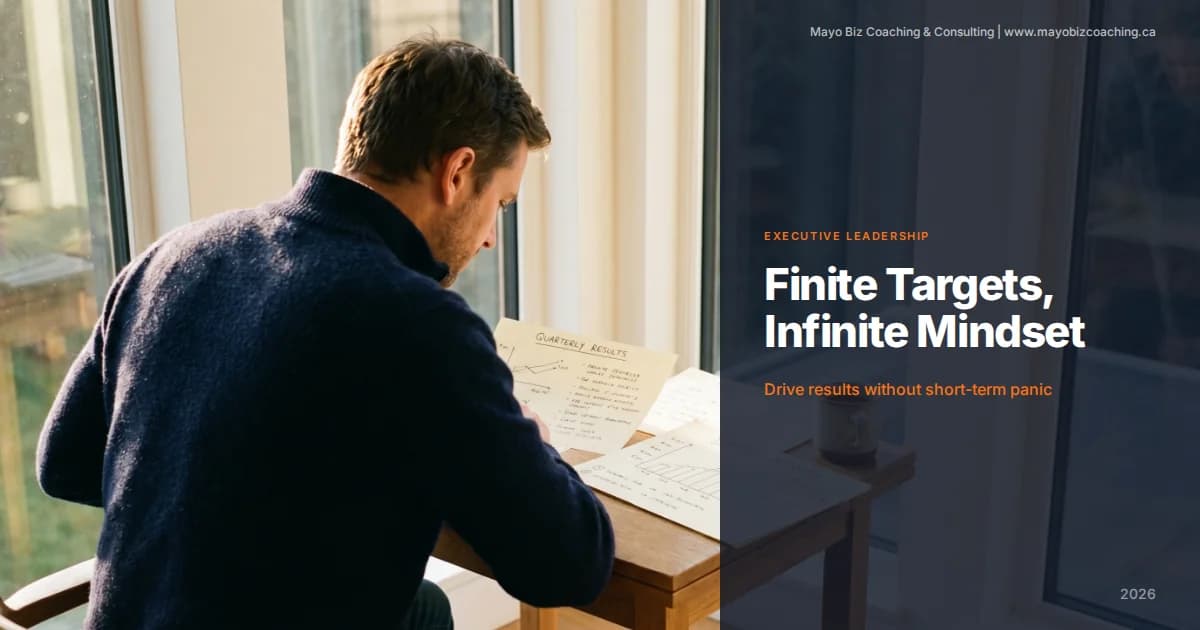
You're six weeks out from quarter close. The number isn't where it should be. Your CRM is open in one tab and a strategy doc you haven't touched in three weeks is in another. The doc gets smaller as the day goes on.
Most owners know this feeling. The work that builds the next ten quarters keeps losing to the work that closes this one. Infinite mindset leadership is the discipline that keeps both alive.
I hear this constantly in coaching, and it almost never sounds like a strategy problem. It sounds like a sequencing problem. Leaders are not choosing finite targets over the long view because they have stopped believing in the long view. They are choosing it because the quarter is loud and the long view is quiet, and the calendar rewards whatever is loudest.
The Quarter Is Real. So Is Everything After It.
Simon Sinek borrowed the language for this from a 1986 book by the philosopher James Carse. Carse drew a line between finite and infinite games. Finite games have known players, fixed rules, and a clear end. Infinite games keep changing, absorb new players, and continue indefinitely. Business is closer to the second.
Sinek's most useful sentence on the topic 1 is short. Finite games can be played within an infinite game, but an infinite game cannot be played within a finite game.
That is the load-bearing idea for owners under pressure. A quarter is a finite game. So is a sales campaign or a product launch. They are legitimate. They matter. The damage starts when a leader treats the quarter as the whole game instead of as one move inside a much longer one.
Infinite mindset leadership refuses to let the quarter become the only thing on your scoreboard. The quarter still gets played. It just stops being the whole game.
What Quarterly Panic Actually Costs
The numbers on this are clearer than you might expect.
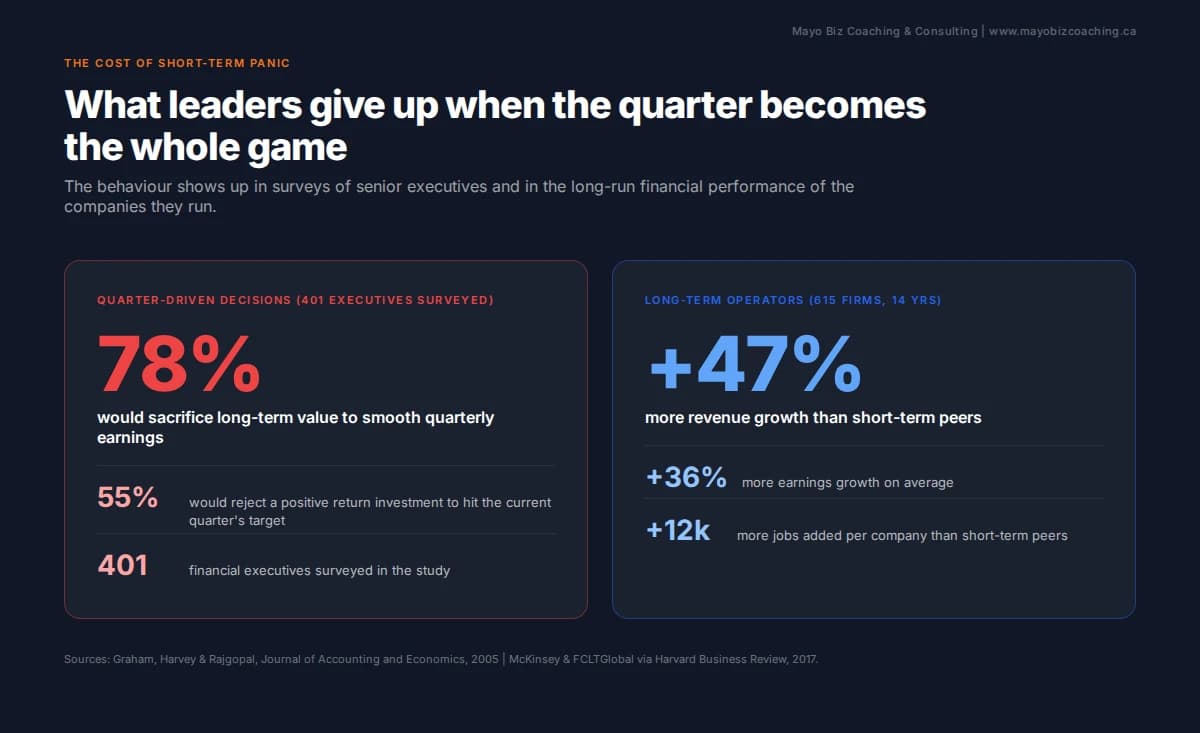
A widely cited 2005 study by Graham, Harvey, and Rajgopal in the Journal of Accounting and Economics surveyed 401 financial executives. Fifty-five percent said they would walk away from a positive return investment if it meant missing the current quarter's earnings target. Seventy-eight percent said they would sacrifice long-term economic value to smooth reported earnings 2.
These are senior leaders who already know what the right call is, choosing the wrong one because the quarter is in the room and the future is not. The problem is not knowledge. It is pressure design.
In 2017, McKinsey and FCLTGlobal published findings from 615 large companies tracked between 2001 and 2015, grouped by how long-term their behaviour actually was. The long-term group grew revenue 47 percent more, grew earnings 36 percent more, and added almost 12,000 more jobs 3 on average than their short-term peers. R&D investment grew at more than twice the rate.
For an owner-led business this lands hard. Quarter-by-quarter operators are not just morally tired. They are statistically slower. Companies that protect a long horizon outperform the ones that do not, and the gap compounds.
Both findings argue for refusing to run only for the quarter.
Why Pressure Makes Teams Quieter When You Need Them Loudest
There is a second cost owners feel before they see it on a profit and loss statement. When the quarter starts slipping and a leader gets visibly tense, the team gets quieter. Bad news takes longer to surface. Mistakes get hidden. People stop asking the questions that would have caught a problem early.
This is Amy Edmondson's territory. Her research on psychological safety 4, starting with a 1999 study and replicated in dozens of contexts since, points to a consistent pattern. Psychological safety lets people speak up when something is going wrong. It survives hard standards and tight deadlines. It does not survive blame and panic. Once those take over, nobody flags a problem until it is already a crisis.
The practical version is short. The way you talk in week six of a slipping quarter shapes whether week seven goes better or worse. Pressure language that signals "this is on you" closes mouths. Curiosity language that signals "what are you seeing?" opens them. The post on psychological safety covers the mechanics.
That is the link between Sinek's framing and your Tuesday morning. A finite-only mindset trains you to push harder when the team most needs you to listen better. The infinite mindset gives you a reason to slow down for ten minutes instead of speed up.
Infinite Mindset Leadership Is a Two-Track Operating System
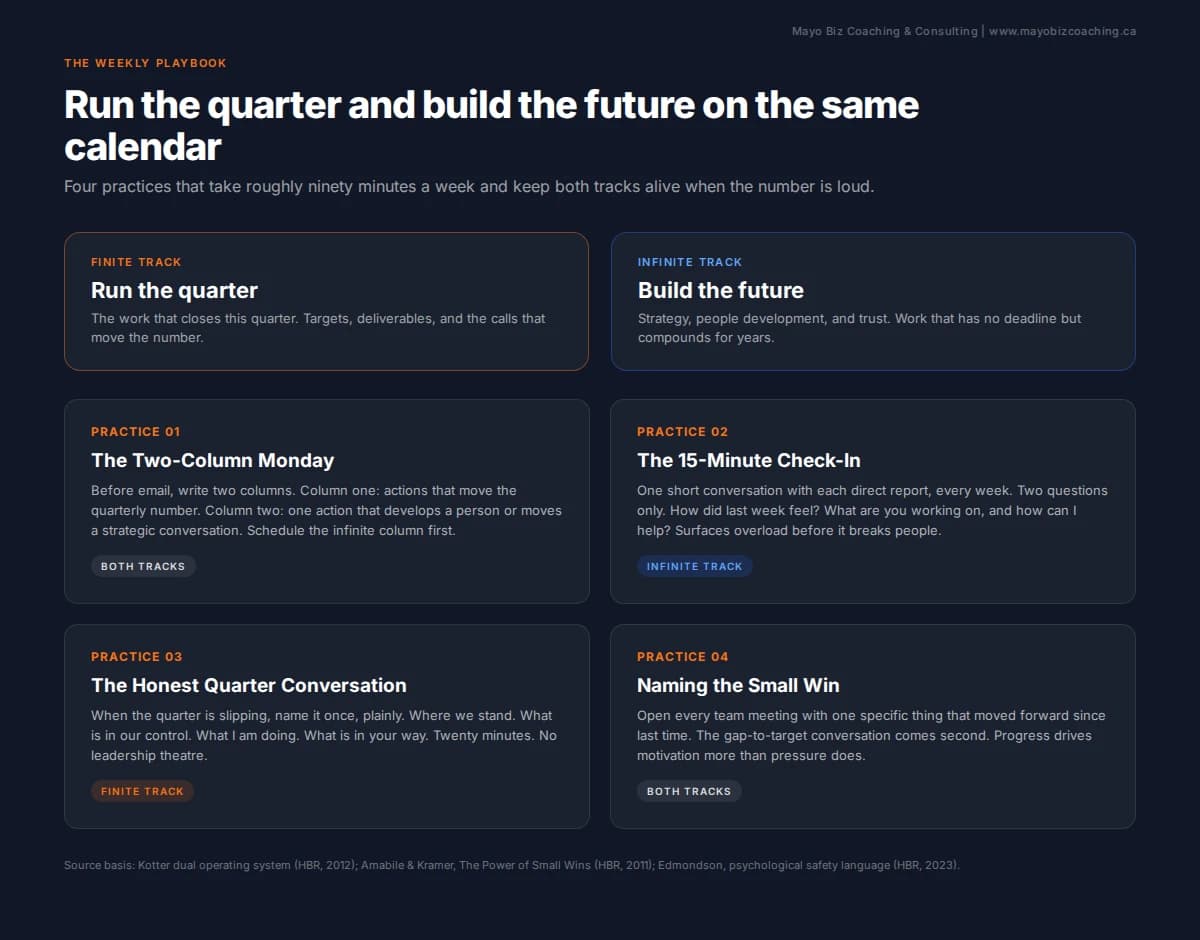
John Kotter's argument in HBR is that the traditional management hierarchy is well built for executing the current business and badly built for inventing the next one. He calls his alternative a dual operating system 5. One track runs the quarter. A second, smaller, parallel track keeps building the future. The two operate at the same time. They do not take turns.
That is the structural answer to the finite versus infinite tension. You do not choose. You separate.
For most owners I work with, this does not need to be elaborate. It needs to be visible. If "build the future" work lives only in your head, it loses every time. If it lives on a calendar with named owners and a weekly touchpoint, it survives the noise of execution.
The simplest version is a recurring 60-minute meeting on the same day every week, with two or three people, focused only on work that will not pay off this quarter. No status updates. No firefighting. One question. What did we move forward on the things that have no deadline? That meeting is the second track. Protecting it is the leadership job.
What This Looks Like on Monday Morning
These four practices, taken together, hold both tracks open through a hard week.
The Two-Column Monday
Before email, before standups, write two columns on a single sheet. Column one is finite: the two or three specific actions this week that move the number. Column two is infinite: one action this week that protects culture, develops a person, or moves a strategic conversation forward. Schedule both. Schedule the infinite column first. Whatever you book first is what you defend.
The Fifteen-Minute Weekly Check-In
Take fifteen minutes with each direct report, every week, individually. Two questions only. How did last week feel? What are you working on this week, and how can I help? It is not a status meeting. It is a clearing meeting. Under quarter-end pressure, it is also where you find out who is overloaded before they break.
The Honest Quarter Conversation
When a quarter is genuinely slipping, name it once, plainly, in front of the team. Not vague urgency. Not "everyone needs to step up," which implies they have not been. The shape that works is concrete. Here is where we actually stand. Here is what is in our control this week. Here is what I am doing to remove obstacles. What is in your way that I can help with? Then close the meeting in twenty minutes. Long crisis meetings are a form of leadership theatre, and teams know it. The post on the accountability conversation has more detail if this is hard for you.
Naming the Small Win
Teresa Amabile and Steven Kramer's 2011 research on what they call the progress principle 6 is one of the more practically useful findings in leadership psychology. They studied 12,000 daily diary entries from working professionals. The single strongest driver of motivation, engagement, and creative output was the experience of making meaningful progress on work that mattered.
In a hard quarter, the leadership instinct is to open every meeting with the gap to target. This is exactly backwards. The teams that close hard quarters open meetings with one specific thing that moved forward since the last meeting. The gap conversation comes second.
Together these four practices cost about ninety minutes a week. That is the difference between hitting the quarter and hitting it without burning the team you need next quarter.
When Infinite Mindset Leadership Becomes Naive
Owners under real pressure need this section to trust the rest of the post.
There are situations where the infinite framing is the wrong tool. If your cash runway is genuinely at risk, the infinite move and the finite move are the same move. Keep the company alive. A dead business plays no game at all. Cutting costs to survive a real cash crisis is not a betrayal of the long view. It is the precondition for one.
The same goes for genuine emergencies. If a major client just left, if a product failed, if a regulatory shift just rewrote your market, the right call is honest triage. Pause the strategic offsite. Suspend the development conversations for six weeks. Tell the team explicitly that you are in emergency mode, what you are suspending, why, and the date you return to normal rhythm. Naming the boundary is what makes it survivable.
The trap to avoid is dressing routine pressure up as existential pressure. Most quarters are not survival quarters. Treating them like they are teaches a team that every quarter is the last one, and that lesson is expensive to unteach.
The honest test is simple. Will this business still exist in twelve months without this short-term sacrifice? If yes, you are under normal pressure and the infinite track stays alive. If no, you have a different problem, and survival comes first. The post on grounded confidence covers how to hold standards steady when the ground keeps moving.
The Real Shift
Infinite mindset leadership is not softer than the alternative. It is more demanding.
It asks you to defend strategic time when nothing is demanding it. It asks you to keep the team's long-term trust intact while a near-term number is on fire. It asks you to make the harder communication call.
The reward is not abstract. It is the same team showing up next quarter willing to do the work. It is the people you cannot afford to lose choosing to stay. It is the quiet voice in the back of the room flagging a problem early enough to fix it.
The question is not whether to chase the finite target. You will. Of course you will. The question is whether the way you chase it leaves you with a stronger team or a thinner one when the next quarter starts.
I see this in coaching. The owners who hit numbers consistently over years are not the ones who push hardest in the worst weeks. They are the ones who refuse to let the worst weeks rewrite the rules of how they lead. They keep the second track alive even when the first track is loud. They run the quarter and build the future on the same calendar.
The calendar does not change. The way you read it does.
Let's Build Brilliance Together
Quarter pressure is real. So is the team you will need next year. If you are trying to hit a hard number without losing the people who got you here, reach out for a free consultation. No sales pitch, just an honest conversation about where you are and what you are working on.
Research Notes & Sources
If you want to go deeper, these are the studies and reports behind the key points in this post.
- The Infinite Game(simonsinek.com)
- The Economic Implications of Corporate Financial Reporting(nber.org)
- Finally, Evidence That Managing for the Long Term Pays Off(hbr.org)
- What Is Psychological Safety(hbr.org)
- Accelerate!(hbr.org)
- The Power of Small Wins(hbr.org)
Category & Tags
Frequently Asked Questions
What is infinite mindset leadership?
It is a way of leading that treats quarterly targets as one move inside a longer game, not the whole game. Finite goals stay legitimate, but they serve a longer-term cause instead of replacing it.
How do you hit short-term targets without burning out the team?
Run a two-track operating system. One track executes the quarter. A parallel track protects strategic and people-development work on a fixed weekly cadence so future-building does not get crowded out.
What does Simon Sinek say about quarterly pressure?
His core line is that finite games can be played within an infinite game, but not the reverse. Quarters are legitimate finite games. The damage starts when leaders treat the quarter as the whole game and sacrifice trust and culture for short-term metrics.
When should a leader prioritize short-term survival over long-term strategy?
When cash runway is genuinely at risk, the long-term move and the short-term move are the same: keep the business alive. The honest test is whether the company will still exist in 12 months without the short-term sacrifice.
About the Author

About the Author
Mark Mayo
Head Coach, MBC
We get up each morning excited about sharing our 20-plus years of business acumen with small business owners and their teams. Collaborating with hard-working owners to achieve their personal and business goals brings rewards. When we develop you and grow your leaders, we create the momentum that moves you and your business forward. It starts with a first step. Then we can build brilliance together.
Related Articles

Self-Awareness Is a Leadership Skill You Can Build
Most leaders think they're self-aware. Research says only 10-15% actually are. Here is how to close the gap and lead with clearer self-knowledge.
Read Self-Awareness Is a Leadership Skill You Can Build
Learning Agility: Why the Fastest Learners Lead Best
Learning agility predicts leadership success better than experience alone. Here is what it means for small business leaders and how to build it this month.
Read Learning Agility: Why the Fastest Learners Lead Best
Beyond IQ and EQ: Leadership Intelligences Nobody Taught You
IQ EQ XQ AQ leadership is not about choosing one quotient. Learn what each predicts, where each breaks down, and how small business leaders build all four.
Read Beyond IQ and EQ: Leadership Intelligences Nobody Taught You