Executive Leadership & Career Coaching
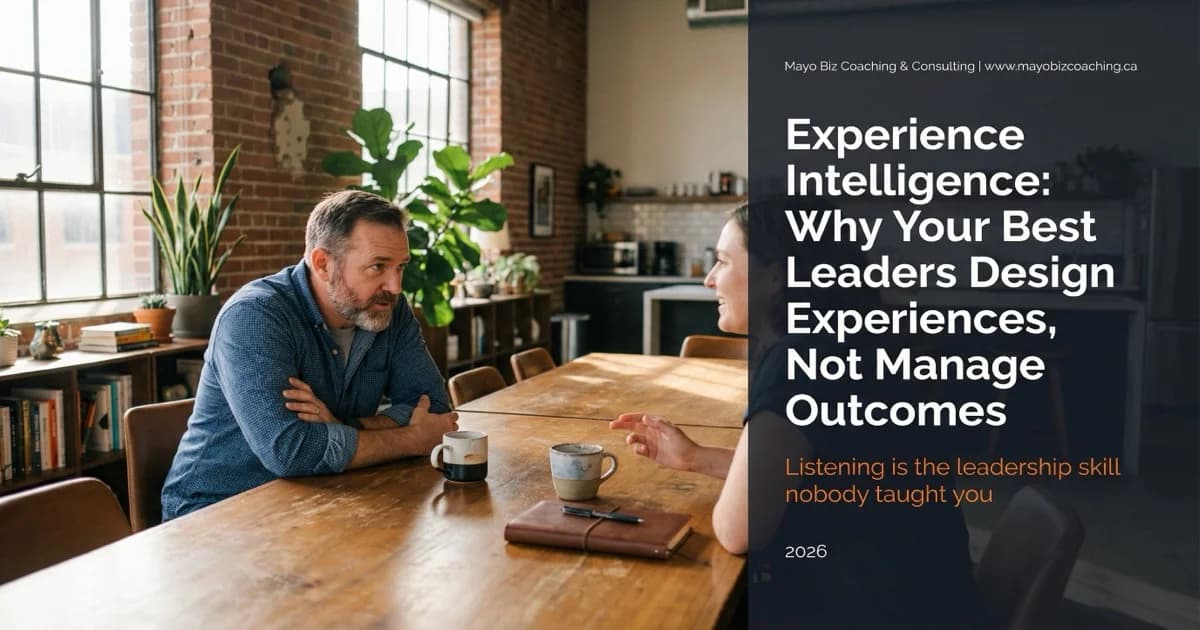
Experience Intelligence: Why Your Best Leaders Design Experiences, Not Manage Outcomes
Something shifted in the last year. Your team is still showing up, hitting deadlines, doing solid work. But the ideas dried up. Meetings feel like a formality. People answer "fine" when you ask how things are going, and you've stopped believing them.
You're not imagining it. Something has changed, and it isn't about your product, your market, or your team's capability. It's about how people experience working with you, every single day.
Marcus Buckingham calls the leadership skill behind this experience intelligence: the ability to read and shape how people feel in the moments that matter. It isn't about perks or programmes. It's about what happens in a five-minute conversation.
What experience intelligence actually means
Marcus Buckingham coined the term in a February 2026 Harvard Business Review article 1 about Disney's new CEO, Josh D'Amaro. He defines experience intelligence as "the ability to read and shape the human experience."
The core idea is straightforward. Traditional management tools (goals, feedback, rewards, pressure) produce short-term compliance at best. What actually drives lasting behaviour is how people feel during the experience itself.
Buckingham's research shows that on standard 1-to-5 satisfaction scales, only a "5" predicts future behaviour. Ratings of 1 through 4 are statistically indistinguishable. His analogy: the boiling point of water is 212 degrees. You either reach it or you don't. There's no meaningful middle ground between "like" and "love."
Think about your own team. An employee who "likes" their job enough to stay isn't the same as one who can't imagine working anywhere else. The second person brings discretionary effort. The first is waiting for a better offer.
Five feelings that drive everything
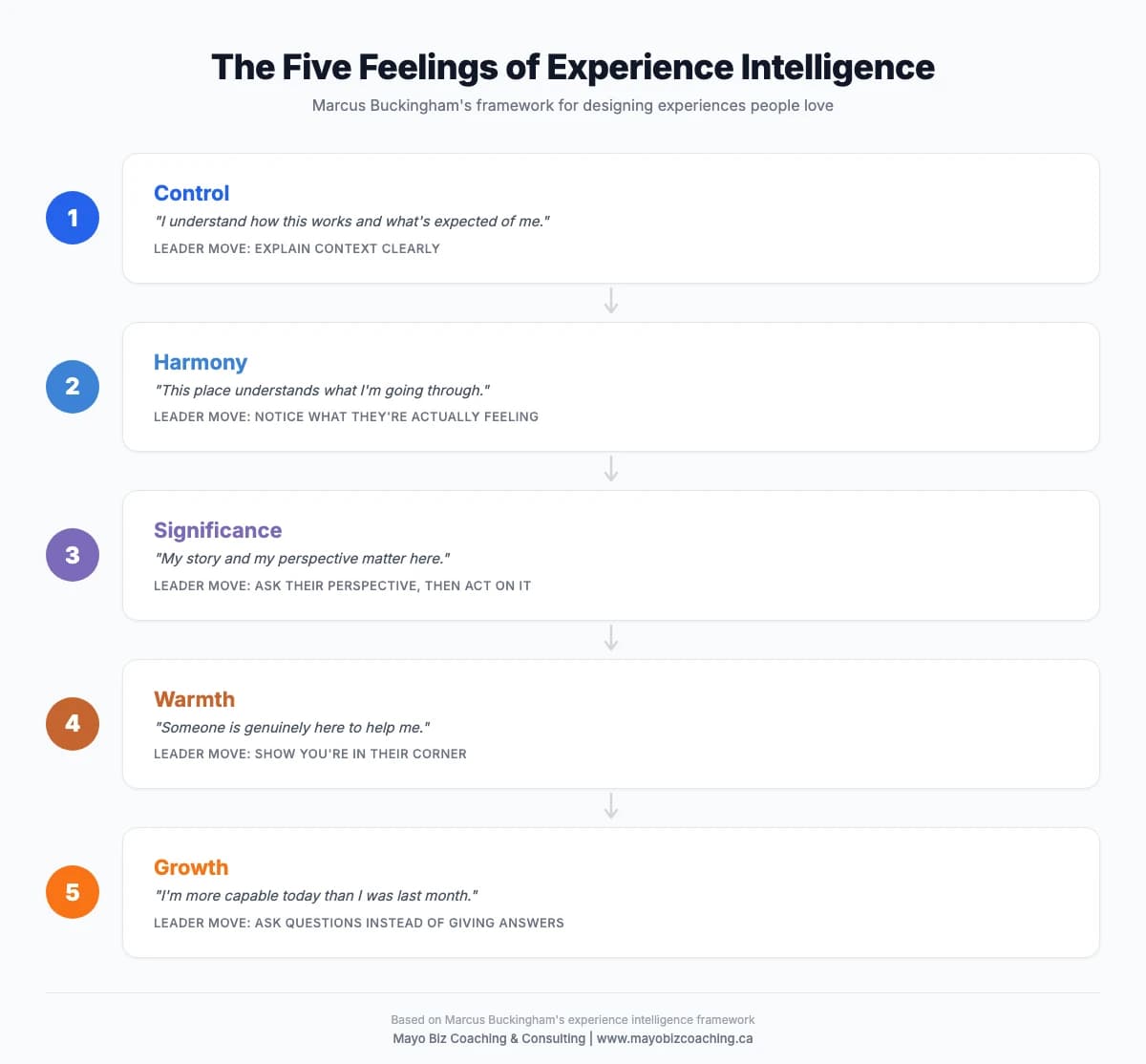
Buckingham's broader framework identifies five feelings that, experienced in sequence, create the kind of connection people describe as love. Not romantic love, but the professional version: "I can't imagine a world without this team."
- Control: "I understand how this works and what's expected of me."
- Harmony: "This place understands what I'm going through."
- Significance: "My story and my perspective matter here."
- Warmth: "Someone is genuinely here to help me."
- Growth: "I'm more capable today than I was last month."
If you run a business with 10 to 25 people, you don't need an employee experience platform to deliver these. You deliver them in every interaction: how you run a meeting, how you respond to a mistake, whether you ask about someone's weekend and actually listen to the answer.
Buckingham puts it simply: "The opposite of design is drift." You're already creating experiences for your team. The question is whether you're doing it on purpose.
The engagement crisis behind this
The timing matters. Gallup's 2025 State of the Global Workplace 2 report found employee engagement fell to 21% globally, only the second decline in 12 years. In the US and Canada, just 31% of workers are engaged. That's the lowest level in a decade.
The cost isn't abstract. Gallup estimates the 2024 engagement decline alone cost $438 billion in lost productivity worldwide.
For a small business owner, though, the cost shows up differently. It's the employee who used to bring ideas to every meeting and now just takes notes. It's the person who stayed three years and just accepted a job they weren't even looking for.
Gallup's meta-analysis of 183,806 business units found that 70% of the variance in team engagement comes from the manager. In a small business, you are that manager. Your daily behaviour, not your benefits package, determines whether your team is engaged or going through the motions.
The listening gap nobody talks about
This is where experience intelligence gets practical for a business your size.
Zenger Folkman studied 4,219 leaders 3 using 360-degree feedback and found that the two behaviours most strongly correlated with trust were both related to listening effectiveness. Leaders rated as poor listeners landed at the 15th percentile for trust. Excellent listeners reached the 86th percentile.
One finding should concern every business owner: listening effectiveness declines as people rise. Individual contributors scored at the 59th percentile. Top managers dropped to the 39th. The people with the most influence on their teams are, on average, the worst listeners in the building.
A 2021 UKG study of 4,000 employees across 11 countries 4 found that 86% feel people at their organization aren't heard fairly or equally. A third would rather quit or switch teams than voice their true concerns.
That's the gap. Most leaders think they listen well. Most employees disagree. And the employees who disagree don't say so. They leave.
What happens in the brain when someone feels heard
Being genuinely listened to activates the brain's reward centre. An fMRI study published in Social Neuroscience 5 found that perceiving active listening activates the ventral striatum, the same region that responds to food and social rewards. Listening isn't a social nicety. It registers neurologically as a reward.
The same study found that participants who spoke to active listeners reported more positive feelings about the experiences they'd shared, even when the experience was inherently negative, like the loss of a family member. The quality of listening changed how people felt about their own stories.
On the other side, when someone feels dismissed or unheard, the brain's threat centre fires. Elevated cortisol can persist for hours after a stressful interaction. The prefrontal cortex, where strategic thinking, empathy, and collaboration live, goes partially offline.
So when you check your phone during a one-on-one, you're not just being rude. You're triggering a neurochemical response that makes the person less able to think clearly and collaborate openly for the rest of the workday.
Active listening is experience intelligence at your scale
Buckingham describes experience intelligence as the ability to intentionally design experiences that make people feel control, harmony, significance, warmth, and growth.
At Disney, that means redesigning rides so every seat has agency, not just the pilot's. At Kroger, it means rebranding every associate as an "experience-maker." Those are enterprise-scale responses to the same problem.
At your business, it means listening.
Think about what happens in a genuine listening conversation mapped to Buckingham's five feelings:
- Control: You explain the context. The employee understands where things stand.
- Harmony: You notice what they're actually feeling, not just what they're reporting.
- Significance: You ask about their perspective, and it visibly shapes what happens next.
- Warmth: They leave knowing someone is genuinely in their corner.
- Growth: The conversation itself develops their thinking because you asked questions instead of giving answers.
All five feelings. One conversation. No platform, no programme, no budget line item.
I've written before about active listening as a core leadership skill and about how emotional intelligence starts with connection. Experience intelligence is what happens when you combine the two and make it intentional. You stop drifting through interactions and start designing them.
What this looks like in practice
A Harvard Business Review analysis of 607 experiments on feedback 6 found that feedback caused performance to decline in 38% of cases. The researcher's conclusion: "Whereas feedback is about telling employees that they need to change, listening to employees and asking them questions might make them want to change."
That's the shift experience intelligence asks you to make. Stop telling. Start listening. Then act on what you hear. I see this pattern constantly in my coaching work: the leaders who make this shift are the ones whose teams stop leaving.
-
Run weekly one-on-ones that are actually about the other person. Not status updates. Not your agenda. Start with "What's on your mind?" and let them lead. Ask follow-ups. Summarize before responding. Fifteen minutes of focused listening is more valuable than an hour of unfocused check-ins.
-
Name what you notice. "You seemed frustrated in that meeting. What's going on?" Most leaders avoid observations like this because they don't want to pry. But psychological safety research from Google and Harvard shows that people perform best when someone notices and names what's happening beneath the surface.
-
Close the loop. Research from the Center for Creative Leadership found that perceived listening increases significantly when leaders both listen and take action. It's not enough to hear someone. They need to see evidence that what they said mattered. "You mentioned last week that the handoff process was breaking down. Here's what I changed." That sentence is worth more than any engagement survey.
-
Admit what you don't know. Experience intelligence isn't omniscience. It's the willingness to say "I'm not sure what you need right now, tell me" and then sit with the answer. That vulnerability is what separates coaching from managing, and it's what creates the conditions for Buckingham's fifth feeling: growth.
The Canadian small business advantage
Most owners I coach don't realize this: you already have a structural edge for experience intelligence.
Industry data consistently shows that smaller organizations score higher on employee satisfaction and Net Promoter Scores than enterprises. The proximity between owner and team isn't a limitation. It's an experience design tool that large companies spend millions trying to replicate.
BDC's 2024 workplace culture study 7 of over 1,000 Canadian entrepreneurs found that 85% of small businesses that actively invest in workplace culture see concrete benefits including higher engagement and lower turnover. You don't need enterprise infrastructure. You need consistent, intentional daily interactions.
Canada also leads globally on workplace psychological health standards. CAN/CSA-Z1003, the national standard for psychological health and safety, includes listening and communication as core leadership competencies. The framework exists. What most owners lack isn't the tools. It's the habit of using them deliberately.
This approach has limits, of course. Listening alone won't fix systemic compensation gaps or unsustainable workloads. But it's the foundation that makes every other leadership investment stick.
One conversation this week
- Pick one person on your team. Someone you haven't had a real conversation with in a while, not about tasks, about them.
- Schedule 15 minutes. Ask one question: "What's one thing about your work right now that I might not see from where I sit?"
- Listen. Don't solve. Don't defend. Don't redirect. Summarize what you heard and ask what they'd want to happen next.
That's experience intelligence. One intentional conversation where someone walks away feeling heard, seen, and capable.
If you do it once and it changes something, do it again next week. With someone else. Within a month, you'll have reshaped the experience of working on your team without spending a dollar.
Let's Build Brilliance Together
Experience intelligence starts with one skill most leaders think they have but the data says they don't: listening. The good news is it's learnable, and the research shows it drives engagement, retention, and team performance more reliably than any other leadership investment.
If you're realizing your team might not feel as heard as you thought, reach out for a free consultation. No sales pitch, just an honest conversation about where you are and what you're working on.
Research Notes & Sources
If you want to go deeper, these are the studies and reports behind the key points in this post.
- Harvard Business Review on experience intelligence(hbr.org)
- Gallup State of the Global Workplace(gallup.com)
- Zenger Folkman on listening skills and performance outcomes(zengerfolkman.com)
- UKG research on feeling heard at work(ukg.com)
- Social Neuroscience study on active listening(pmc.ncbi.nlm.nih.gov)
- Harvard Business Review on listening and behavior change(hbr.org)
- BDC workplace culture study(bdc.ca)
Category & Tags
Frequently Asked Questions
What is experience intelligence in leadership?
Experience intelligence is a term coined by Marcus Buckingham in a 2026 Harvard Business Review article. It means the ability to read and shape how people feel during the interactions that matter. Leaders with experience intelligence design daily moments that make people feel seen, capable, and valued.
How does active listening improve employee engagement?
Zenger Folkman's study of 4,219 leaders found that listening effectiveness is the strongest predictor of trust, which drives engagement. Leaders in the top 10% of listening scored at the 76th percentile for engagement. An fMRI study confirmed that being listened to activates the brain's reward centre.
What are the five feelings in experience intelligence?
Buckingham's framework identifies five sequential feelings: Control (I understand how this works), Harmony (this place understands me), Significance (my story matters), Warmth (someone is here to help), and Growth (I'm more capable than yesterday). Leaders create these through intentional daily interactions.
How can small business owners design better employee experiences?
Start with weekly 15-minute one-on-ones focused on listening, not status updates. Name what you notice in your team members. Close the loop by acting on what you hear. BDC research found 85% of Canadian small businesses that invest in workplace culture see higher engagement and lower turnover.
About the Author

About the Author
Mark Mayo
Head Coach, MBC
We get up each morning excited about sharing our 20-plus years of business acumen with small business owners and their teams. Collaborating with hard-working owners to achieve their personal and business goals brings rewards. When we develop you and grow your leaders, we create the momentum that moves you and your business forward. It starts with a first step. Then we can build brilliance together.
Related Articles
Self-Awareness Is a Leadership Skill You Can Build
Most leaders think they're self-aware. Research says only 10-15% actually are. Here is how to close the gap and lead with clearer self-knowledge.
Read Self-Awareness Is a Leadership Skill You Can Build
Coaching Conversations: A Practical Framework for Leaders
A coaching conversation changes who does the thinking. The GROW framework, the neuroscience of self-generated insight, and four traps to avoid.
Read Coaching Conversations: A Practical Framework for Leaders
Learning Agility: Why the Fastest Learners Lead Best
Learning agility predicts leadership success better than experience alone. Here is what it means for small business leaders and how to build it this month.
Read Learning Agility: Why the Fastest Learners Lead Best