Team Leadership Development
How to Have Difficult Conversations Without Destroying Trust
You know there is a conversation you need to have. A team member keeps missing commitments. A peer shuts people down in meetings. A leader's blind spot keeps creating friction.
Putting it off feels easier in the moment. It rarely gets easier with time.
So you soften the message. You wait for a better moment. You hope the pattern resolves itself.
It usually does not. Silence creates rework, resentment, and uncertainty for everyone involved. Crucial Learning research 1 suggests unresolved crucial conversations can consume more than a week of productivity. In Canada, employees dealing with workplace conflict lose 55 workdays per year 2 on average (TELUS Health, 2023).
Difficult conversations do not have to damage relationships. Handled well, they strengthen trust. The research is clear on what works.
Why Leaders Avoid Hard Conversations
Avoidance is not a character flaw. It is usually self-protection.
In coaching sessions, leaders rarely say, "I am afraid of conflict." They say:
- "I do not want to damage the relationship."
- "I am worried this will blow up and derail the week."
- "I am not sure I handled my part perfectly, so I lose confidence going in."
That is the real friction. You care about the person. You care about standards. You are trying to protect both, and without a structure, silence feels safer than clarity.
One client said, "I keep replaying the conversation and every version sounds harsh." We worked from facts, named impact, and opened with a question instead of a verdict. The conversation lasted 30 minutes. The tension that had dragged on for months dropped within two weeks.
Another leader told me, "I do not want to crush her confidence." What he meant was, "I do not know how to be direct and supportive at the same time." That is a skill issue, not a character issue.
The research supports what shows up in the room. DDI assessed over 70,000 manager candidates 3 globally in 2024 and found that 49% failed to demonstrate effective conflict management. CCL found that almost 60% of first-time managers 4 receive no training when they step into leadership.
So if hard conversations feel difficult, you are not broken. You are undertrained. The good news is this: the skill is learnable, and the trust you are trying to protect is exactly what honest, well-structured feedback can build.
The Real Cost of Silence
Most leaders do not feel the cost of avoidance all at once. They feel it in small signals first: meetings get quieter, side conversations increase, and execution slows down.
In one team I coached, everyone described the culture as "fine." Deadlines still slipped. People stopped challenging weak ideas. The issue was not capability. It was one recurring behavior no one wanted to address directly.
Research maps to that pattern. Christine Porath and Christine Pearson studied more than 14,000 workers 5 in the U.S. and Canada. When incivility went unaddressed, 48% reduced work effort, 78% said commitment declined, 66% reported lower performance, and 80% lost work time worrying.
That matters because many leaders read this as a motivation problem. Often it is not motivation. It is unresolved tension.
I have seen this play out many times. A VP of operations at a mid-sized manufacturing company kept delaying a conversation with a regional manager whose micromanagement was driving turnover. By the time they addressed it, three strong contributors had left. The conversation took 40 minutes. The cost of avoiding it was six figures in recruiting and lost output.
The irony: employees want the feedback leaders withhold. Zenger Folkman surveyed over 2,500 employees 6 and found 57% prefer corrective feedback over praise. Yet only 5% say their managers deliver it 7.
That gap between what people need and what they receive is where trust starts to break. The practical takeaway is simple: honest feedback, delivered with care, is not a threat to trust. It is one of the ways trust grows.
Three Conversations Inside Every Difficult One
The Harvard Negotiation Project spent 15 years studying 8 what makes these conversations fail. Stone, Patton, and Heen found every difficult conversation contains three simultaneous layers:
The "what happened" conversation. Each person holds a different version of the facts. The common mistake is assuming yours is the complete picture. Replace certainty with curiosity.
The feelings conversation. Emotions are always present, even when both parties stay composed. Suppressing feelings does not remove them. They leak into tone, body language, and follow-up behavior.
The identity conversation. When someone receives hard feedback, they silently ask: Am I competent? Am I a good person? That internal dialogue shapes their response more than your actual words.
Understanding these three layers explains why conversations derail. You address the facts. The other person hears an identity threat. Naming these layers, even to yourself, helps you prepare for the full conversation rather than just the surface.
A Framework That Works: SBI
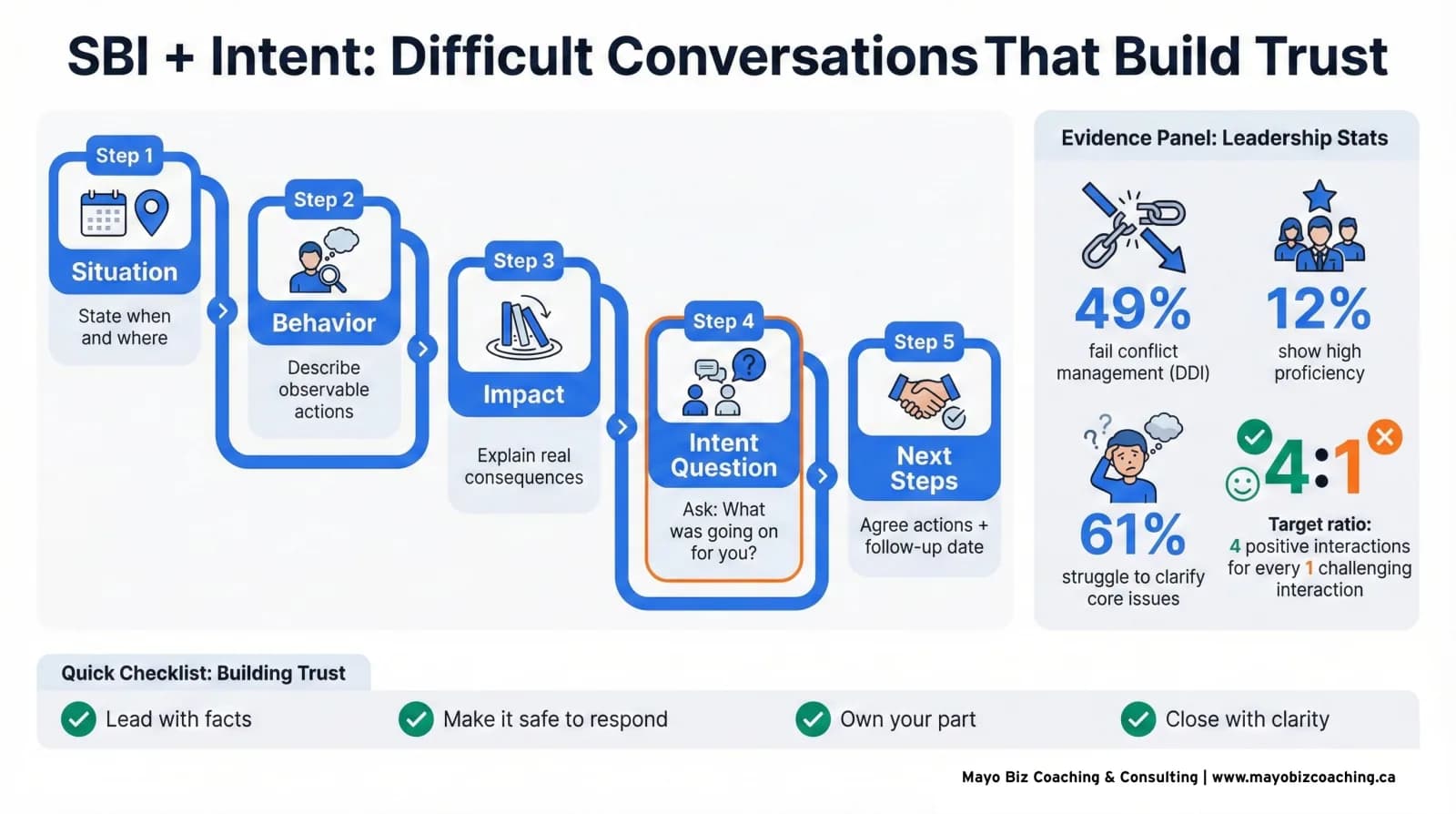
The Center for Creative Leadership developed the SBI feedback model 9 to bring structure to difficult conversations. CCL research shows SBI reduces anxiety for the person giving feedback and defensiveness in the person receiving it.
Three steps:
Situation. Anchor the conversation in a specific moment. "During yesterday's client call at 2 p.m." Not "you always do this."
Behavior. Describe only what you observed. "You interrupted the client three times during their presentation." Not "you were disrespectful."
Impact. Explain the effect. "The client paused, went quiet, and ended the meeting early. We may have lost their confidence."
CCL recommends adding a fourth step: inquire about intent 10. Ask "what was going on for you in that moment?" This shifts feedback from a monologue to a dialogue. Most of the time, the person's intention was different from the impact you experienced.
Here is how this looks in practice. I coached a director of engineering who needed to address a senior developer's pattern of dismissing ideas in code reviews. Instead of vague guidance, she used SBI:
"In Thursday's code review (situation), Priya suggested refactoring the auth module. You said 'that is not how we do things here' and moved on (behavior). Priya stopped contributing for the rest of the session. Two junior developers did not submit their pull requests this week (impact). Can you help me understand your thinking?"
The developer had no idea of the effect. He thought he was being efficient. The conversation led to a concrete change: he now asks "what problem are you trying to solve?" before evaluating a suggestion. That single shift changed the team dynamic within a month.
Five Principles for Conversations That Build Trust
1. Lead with facts, not stories
The Crucial Conversations framework 11 starts with observable facts because they are the least controversial entry point. Facts persuade. Judgments trigger defensiveness. "The last three deliverables arrived after the agreed date" lands differently than "you do not care about deadlines."
2. Make it safe to respond
Psychological safety is the foundation. If the other person does not feel safe, they comply, withdraw, or fight. None of those produce honest dialogue. Ask open questions. Listen without interrupting. Signal that you want to understand before you deliver a verdict.
3. Separate the person from the problem
This is where most conversations break down. When feedback feels like a personal attack, people stop listening. CCL research on the 4:1 ratio 12 shows people need roughly four positive interactions for every challenging one to avoid a threat response. If your only conversations with someone are corrective, they will brace every time you approach.
4. Own your part
Hard conversations are rarely one-sided. The leaders who build the most trust say "here is what I could have done differently." That is not weakness. It is emotional intelligence in practice. It gives the other person permission to be honest about their own contribution.
5. Close with clarity, not comfort
End with specific next steps and a timeline. "We will revisit this in two weeks" beats "I am sure it will work out." A coaching approach works well here. Clarify the goal together. Explore options. Agree on actions with a follow-up date.
When the Conversation Does Not Land
Not every difficult conversation succeeds on the first attempt. Sometimes people shut down, get defensive, or push back. That does not mean you failed.
CCL recommends pausing rather than escalating 13. "I can see this landed harder than I intended. Can we come back to this tomorrow?"
Give people time to process. The Harvard research shows identity conversations happen inside someone's head after you leave the room. The follow-up is often more productive than the first attempt.
If the pattern persists after multiple honest conversations, you are no longer coaching. You are managing performance. Standards need to be clear, documented, and enforced. If you want support building that system, Team Leadership Development coaching helps you set expectations, feedback rhythms, and accountability.
The Canadian Context
As of 2026, this challenge is very real in Canadian teams. Owners and leaders tell me they can feel tension rising, but they are unsure how to address it without making things worse.
TELUS Health 2 reports that 25% of Canadian employees are seeing increased workplace tension, and 34% say their organization offers no conflict training. If leaders are expected to handle difficult conversations without training, avoidance is predictable.
The Ontario Chamber of Commerce 2025 report 14 adds another signal: 71% of Ontario businesses say mental health matters to success, but only 41% have formal strategies. That gap shows up in day-to-day conversations leaders keep delaying.
Mental Health Research Canada 15 reports that 63% of Canadian managers want better training for difficult employee situations. The demand is clear. The skill development needs to catch up.
For business owners in Guelph and across Ontario, this is both a risk and an opportunity. Leaders who learn to have honest conversations keep their best people. Leaders who avoid them lose talent to silence.
Let's Build Brilliance Together
Difficult conversations are not a talent you are born with. They are a learnable skill backed by decades of research from Harvard, CCL, Gallup, and DDI. The leaders who practice them consistently build stronger teams, deeper trust, and better results.
If you keep putting off the conversation you know needs to happen, reach out for a free consultation. No sales pitch. Just an honest conversation about what you are navigating and how coaching can help you lead through it.
Research Notes & Sources
If you want to go deeper, these are the studies and reports behind the key points in this post.
- Crucial Learning research(cruciallearning.com)
- 55 workdays per year(telus.com)
- DDI assessed over 70,000 manager candidates(ddi.com)
- almost 60% of first-time managers(ccl.org)
- more than 14,000 workers(hbr.org)
- over 2,500 employees(hbr.org)
- 5% say their managers deliver it(hbr.org)
- 15 years studying(pon.harvard.edu)
- SBI feedback model(ccl.org)
- inquire about intent(ccl.org)
- Crucial Conversations framework(cruciallearning.com)
- 4:1 ratio(ccl.org)
- pausing rather than escalating(ccl.org)
- Ontario Chamber of Commerce 2025 report(occ.ca)
- Mental Health Research Canada(mhrc.ca)
Category & Tags
Frequently Asked Questions
How much does avoiding difficult conversations cost?
Costs vary by team and situation. Research suggests unresolved conflict drains significant time and focus, and TELUS Health (2023) reports major productivity loss tied to workplace conflict in Canada.
What is the SBI feedback model for difficult conversations?
The SBI model from the Center for Creative Leadership has three steps: Situation (when and where), Behavior (what you observed), and Impact (the effect). Research shows it reduces anxiety for the giver and defensiveness for the receiver.
Why do most leaders avoid giving negative feedback?
DDI assessed 70,000 manager candidates and found 49% fail at conflict management. Only 5% of managers deliver the corrective feedback employees want, despite 57% of employees preferring honest over positive feedback (Zenger Folkman).
How does psychological safety relate to difficult conversations?
Psychological safety makes honest conversations possible. Google Project Aristotle found it was the strongest predictor of team success across 180 teams. Teams with high safety exceeded sales targets by 17%.
About the Author

About the Author
Mark Mayo
Head Coach, MBC
We get up each morning excited about sharing our 20-plus years of business acumen with small business owners and their teams. Collaborating with hard-working owners to achieve their personal and business goals brings rewards. When we develop you and grow your leaders, we create the momentum that moves you and your business forward. It starts with a first step. Then we can build brilliance together.
Related Articles

Connection First: How Emotional Intelligence Builds Better Leaders
Discover how self-awareness, empathy, and the emotional bank account help leaders build trust, connect with teams, and unlock their full potential.
Read Connection First: How Emotional Intelligence Builds Better Leaders
The Accountability Conversation: How to Hold People to Standards and Keep Their Trust
Most leaders know they need accountability conversations but keep putting them off. Frameworks from Patterson, Scott, and Raymond that make them productive.
Read The Accountability Conversation: How to Hold People to Standards and Keep Their Trust
How to Build a Feedback Culture That Actually Works
Build a feedback culture where honest input is normal, not an event. Five practical rituals, backed by Gallup research, to make feedback a daily team habit.
Read How to Build a Feedback Culture That Actually Works