Executive Leadership & Career Coaching
Delegation Without Abdication: How to Let Go and Still Lead

You are doing too much. You know it. Your calendar is stacked, your inbox runs you, and the decisions that should take five minutes eat entire afternoons. You hired good people, but the work keeps landing back on your desk.
This is not a time management problem. It is a delegation problem.
Most business owners I coach are not trying to control people. They are trying to protect standards. The issue is not intent. The issue is a missing handoff method. When ownership, authority, and checkpoints are unclear, work boomerangs back to you. Delegation without abdication means your team owns execution while you stay connected to outcomes.
Why Smart Leaders Struggle to Delegate
The resistance is almost always emotional, not logical. You built this business. You know how things should work. When someone does a task differently than you would, the instinct is to take it back.
I've seen this pattern across dozens of coaching engagements. An owner hires a capable operations manager, then reviews every email the person sends for the first three months. A VP brings on a strong director, then sits in on meetings the director should run alone. The intent is quality control. The effect is erosion. The new hire stops trusting their own judgment, and the leader stays buried in tasks that should no longer be theirs.
Three forces drive this:
Identity. Many founders built their early success by doing everything. Delegation feels like giving away the thing that made them successful.
Speed. It is genuinely faster to do a task yourself than to teach someone else. The math changes over time, but the short-term pull is real.
Trust gaps. If a delegated task went wrong before, the default is tighter control rather than better structure. Harvard Business Review's 2024 research 1 on 2,478 participants found that poorly framed delegation creates interpersonal friction. People who received delegated decisions without context were less willing to help the same leader again. The problem was not delegation itself but how it was done.
The Business Case for Letting Go
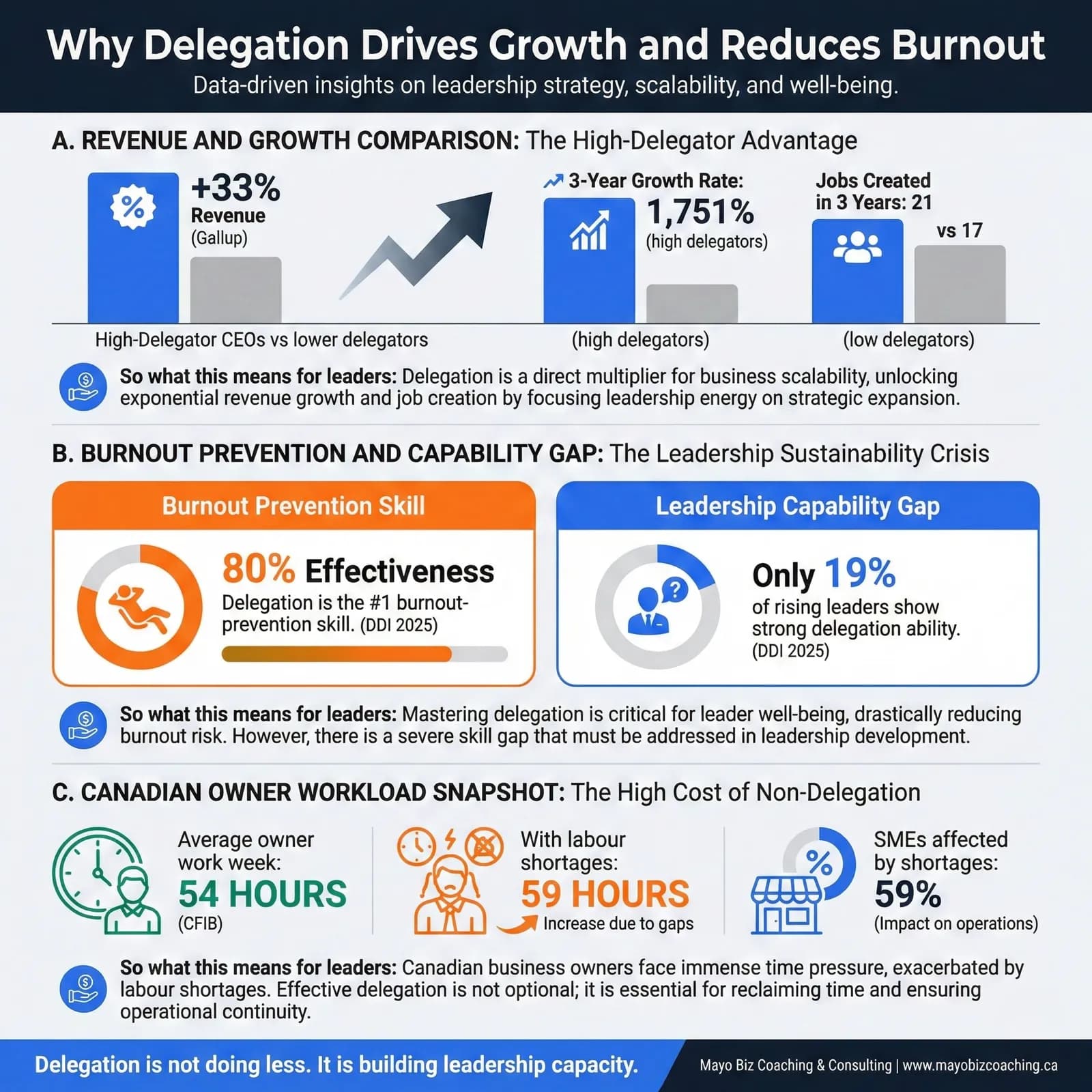
The data here is clear. Gallup studied 143 Inc. 500 CEOs 2 and found that those with high Delegator talent generated 33% more revenue than those with limited delegation ability. High delegators posted a three-year growth rate of 1,751%. They also created more jobs: 21 positions in three years compared to 17 for low delegators.
The broader study of 1,446 employer entrepreneurs revealed a wider pattern. High delegators were more likely to plan for significant growth (33% versus 21%) and more likely to expand their workforce. Only one in four entrepreneurs showed strong delegation talent.
For leaders inside larger organizations, the pattern holds. DDI's 2025 Global Leadership Forecast 3 found delegation is the single most effective skill for preventing leader burnout, at 80% effectiveness. Yet only 19% of rising leaders demonstrate strong delegation abilities. The skill that matters most is the skill leaders are least likely to have.
This is a development problem, not a character flaw. It's also one reason younger workers are opting out of management entirely. They see leaders drowning in tasks that should have been handed off.
Delegation Is Not Abdication
The word delegation carries baggage. Some leaders hear it as "stop caring about the outcome." That is abdication, not delegation.
Real delegation has three elements:
Clear ownership. The person knows the task is theirs and what success looks like.
Defined authority. They know which decisions they can make and which need your input.
Agreed checkpoints. You stay connected to progress without hovering over execution.
Without these three elements, delegation either collapses into micromanagement or drifts into abandonment. Both destroy trust.
Five Levels of Delegation
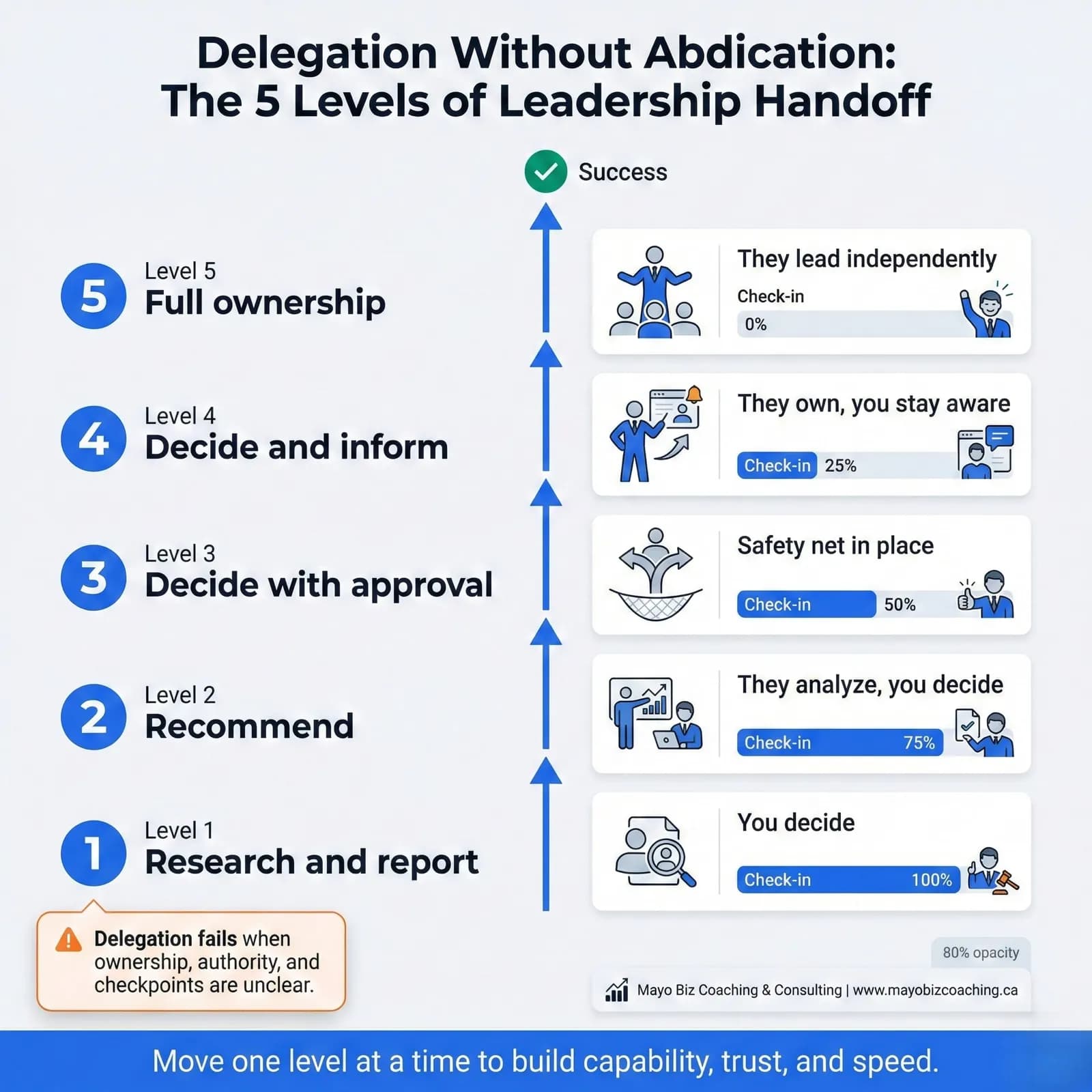
Not every task requires the same handoff. I use a five-level model with clients that scales authority based on readiness:
Level 1: Research and report. "Look into this and bring me what you find." You make the decision.
Level 2: Recommend. "Research this and recommend what we should do." You still decide, but they do the thinking.
Level 3: Plan and check in before launch. "Build the plan, then let's check in before you launch." They build decision muscle with support, without feeling second-guessed.
Level 4: Decide and inform. "Handle this and let me know what you decided." They own the decision. You stay aware.
Level 5: Full ownership. "This is yours. I trust your judgment." No check-in needed unless they want one.
Most leaders jump straight from Level 1 to Level 5 and wonder why it fails. The middle levels are where capability builds. Moving someone from Level 2 to Level 4 over a few months is how you develop leaders rather than simply assign tasks.
This connects directly to coaching versus managing. Delegation at Levels 1 and 2 looks like managing. Delegation at Levels 3 through 5 looks like coaching. Knowing which level fits each person and task is the leadership skill.
Common Mistakes That Kill Delegation
Delegating the task but not the authority. If someone needs your signature for every decision, they do not own the task. They are running errands. This is the fastest way to create a bottleneck you did not intend.
Delegating without context. People need to understand why a task matters, not the steps alone. Context shapes judgment. Without it, they will make decisions that follow your instructions but miss the point.
Taking it back at the first mistake. Mistakes are part of the learning process. If you reclaim a task the moment something goes wrong, you teach your team that delegation is temporary and conditional. The next time you hand something off, they will not fully commit.
Confusing delegation with dumping. Handing someone a task you dislike without support or resources is not delegation. It is abandonment with a pleasant label. True delegation includes the tools, context, and authority to succeed.
What This Looks Like in Practice
I worked with the owner of a 30-person manufacturing company in southern Ontario. She ran every customer complaint personally. Her reasoning was sound: she knew the product better than anyone and could resolve issues fast.
The cost was invisible at first. Her leadership team stopped developing judgment on quality issues. When she took a two-week vacation, three mid-size clients escalated directly to the VP because nobody felt authorized to make decisions. Response times tripled.
We mapped customer complaints into three categories: standard resolution, product-specific, and relationship-sensitive. Standard resolution moved to the operations manager at Level 4 (decide and inform). Product-specific issues went to the quality lead at Level 3 (plan and check in before launch). She kept relationship-sensitive cases for the first 60 days, then moved the operations manager to Level 4 on those as well.
Within three months, average resolution time dropped. The operations manager began identifying patterns she had missed because he was closer to the data. She reclaimed roughly eight hours per week for strategic work.
In another engagement, a founder running a professional services firm delegated project management to a senior associate but kept attending every client meeting. The associate had the title and the task list but no real authority. Clients still looked to the founder for decisions.
We restructured the handoff. The founder introduced the associate as the lead in a joint meeting, then stepped out of the next three client calls entirely. The associate stumbled on the first call, handled the second well, and ran the third with confidence. The founder listened to recordings of the first two calls so she could coach specific moments rather than shadow the work.
The Canadian Small Business Reality
These patterns hit harder for Canadian business owners. CFIB research 4 found the average small business owner works 54 hours per week. Those facing labour shortages, which affects 59% of Canadian small and medium businesses, work 59 hours. That is the equivalent of an eight-day workweek.
Nearly three-quarters of owners experiencing shortages compensate by working more hours themselves. Almost half have had to turn down sales or contracts.
When you are already stretched past capacity, delegation feels impossible. You cannot train someone when you barely have time to eat lunch. But that is exactly the trap. The less you delegate, the more you work. The more you work, the less time you have to delegate. The cycle only breaks when you start small and build from there.
Starting Small: A 30-Day Delegation Sprint
You do not need to overhaul your entire operation. Start with one meaningful task this week.
Week 1: Pick one recurring task. Choose something you do weekly that someone else could learn. Not your most critical task. Not a throwaway task. Something in the middle that takes at least two hours a month.
Week 2: Define the handoff. Write a one-page brief: what success looks like, what decisions they can make, and when to check in with you. Assign a delegation level.
Week 3: Support the first run. Let them do it. Resist the urge to correct in real time. Take notes on what you would coach afterward.
Week 4: Debrief and adjust. Have a real conversation about what worked, what did not, and what they need next. Move them up a delegation level if they are ready.
Active listening matters most in that debrief. If you listen to understand rather than to correct, you build the trust that makes the next handoff easier.
After one month, pick a second task. Then a third. Within a quarter, you will have reclaimed meaningful time for the strategic work only you can do.
Let's Build Brilliance Together
Delegation is not about doing less. It is about leading more. Every task you hand off with clear ownership and real authority is an investment in your team's capability and your own capacity.
If delegation has been a sticking point for you, Executive Leadership coaching helps you build a practical delegation system that fits your team and your business.
If you are curious whether coaching could help you let go without losing control, reach out for a free consultation. No sales pitch, just an honest conversation about where you are stuck and what might shift.
Research Notes & Sources
If you want to go deeper, these are the studies and reports behind the key points in this post.
Category & Tags
Frequently Asked Questions
What is the difference between delegation and abdication?
Delegation includes clear ownership, defined authority, and agreed checkpoints. Abdication hands off work without context, support, or follow-through. Effective delegation keeps you connected to outcomes while giving others real authority to act.
Why do leaders struggle with delegation?
Three main factors: identity tied to doing the work, short-term speed of doing it yourself, and past experiences where delegation went wrong. Gallup found only 1 in 4 entrepreneurs have high delegation talent.
How does delegation affect business growth?
Gallup found CEOs with high Delegator talent generated 33% more revenue and posted higher three-year growth rates. DDI research shows delegation is the top skill for preventing leader burnout at 80% effectiveness.
What is the best way to start delegating?
Start with one recurring task that takes at least two hours monthly. Write a brief defining success, decisions, and checkpoints. Let someone run it for a month, then debrief and assign a second task.
About the Author

About the Author
Mark Mayo
Head Coach, MBC
We get up each morning excited about sharing our 20-plus years of business acumen with small business owners and their teams. Collaborating with hard-working owners to achieve their personal and business goals brings rewards. When we develop you and grow your leaders, we create the momentum that moves you and your business forward. It starts with a first step. Then we can build brilliance together.
Related Articles

How to Measure the ROI of Business Coaching: What the Research Actually Shows
The ROI of business coaching backed by peer-reviewed research. Cut through inflated claims to see what 37 randomized controlled trials actually found.
Read How to Measure the ROI of Business Coaching: What the Research Actually Shows
Self-Awareness Is a Leadership Skill You Can Build
Most leaders think they're self-aware. Research says only 10-15% actually are. Here is how to close the gap and lead with clearer self-knowledge.
Read Self-Awareness Is a Leadership Skill You Can Build
Coaching Conversations: A Practical Framework for Leaders
A coaching conversation changes who does the thinking. The GROW framework, the neuroscience of self-generated insight, and four traps to avoid.
Read Coaching Conversations: A Practical Framework for Leaders