Executive Leadership & Career Coaching
Decision Paralysis: Why Leaders Freeze and How to Start Moving Again

You have six decisions waiting on your desk right now. You know which one matters most. You have been avoiding it for two weeks.
Instead, you reorganise your task list. You ask for one more report. You schedule another meeting to "align." The decision does not get easier. It just gets later.
This is decision paralysis. If you lead a team or run a business, you have felt it.
What Decision Paralysis Looks Like
Decision paralysis is the inability to choose when the stakes feel high and the options feel endless. Psychologist Barry Schwartz calls it the paradox of choice: more options create more anxiety, more regret, and less satisfaction with whatever you eventually pick.
The most famous demonstration is Sheena Iyengar's jam experiment. Shoppers who saw 24 varieties stopped to browse more often, but only 3% bought a jar. When the display dropped to six options, 30% made a purchase 1. Ten times more people acted when they had fewer choices.
For leaders, the jam table is your entire week. Which candidate to hire. Whether to restructure. How to respond to a competitor's move. When every option carries real consequences, the natural response is to stall.
Why Leaders Are Especially Vulnerable
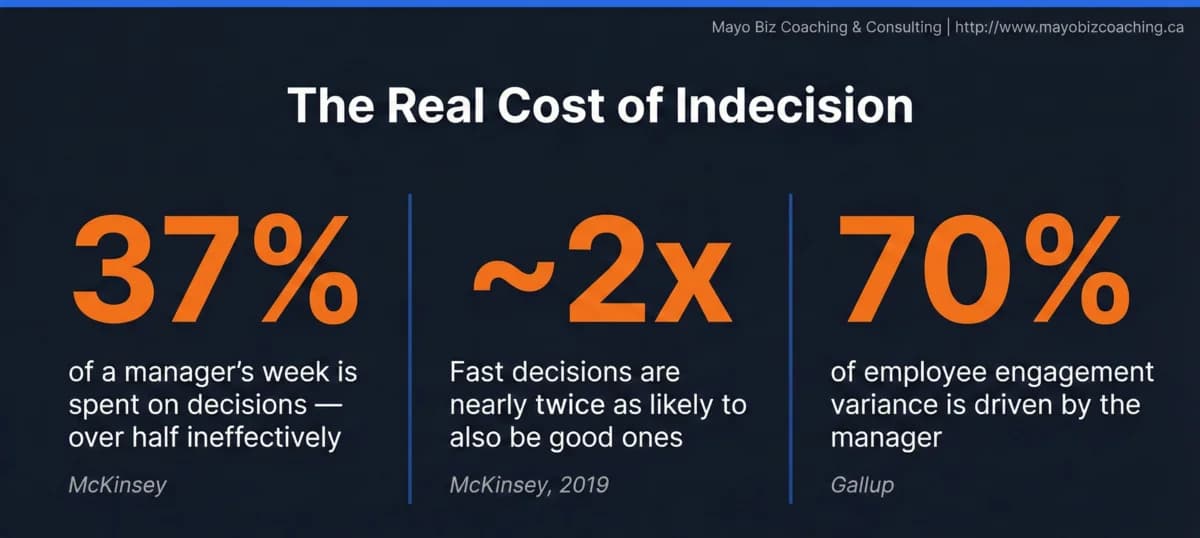
Leaders face more decisions, at higher stakes, with less support than almost any other role. McKinsey found in a 2019 survey that managers spend 37% of their working time deciding 2, and more than half of that time is spent ineffectively. That is a third of your week spent choosing, before you even open your inbox.
But volume is only part of it.
The stakes feel permanent. When a decision affects payroll, client relationships, or your team's careers, the weight of getting it wrong can freeze you. I have coached owners who delayed a critical hire for six months because the "wrong choice" felt catastrophic. In every case, the delay cost more than a mediocre hire ever would have.
The higher you go, the fewer people you can think out loud with. Board members want confidence. Your team wants direction. Saying "I do not know yet" can feel like a leadership failure, even when it is honest.
The ground keeps shifting. Canadian business owners are feeling this acutely right now. Ontario's long-term business confidence recently hit an all-time low of 23.4 on the CFIB Business Barometer 3. That is lower than during the pandemic or the 2008 financial crisis. When the environment is this uncertain, every choice feels riskier than it probably is.
What Happens in Your Brain When You Stall
Decision paralysis is not a character flaw. It is a biological event.
In 2022, researchers at the Paris Brain Institute tracked what happens inside the brain during a full day of demanding cognitive work. They found that sustained decision-making causes toxic glutamate to accumulate in the lateral prefrontal cortex 401111-3), the region responsible for planning and complex reasoning. As glutamate builds up, the brain shifts its preference toward easier, short-term options.
You do not run out of willpower. Your brain's decision centre becomes chemically expensive to operate.
This explains a pattern most leaders recognise. You start the day sharp and decisive. By mid-afternoon, you are deferring choices, defaulting to the safe option, or avoiding the difficult conversation you know needs to happen.
A 2011 study by Danziger et al., published in PNAS, showed this dramatically. Favourable parole rulings dropped from roughly 65% to nearly zero within each session, then reset after a food break. The study has drawn debate about alternative explanations. But the core pattern matches what physicians, air traffic controllers, and executives all report: decision quality drops as the day wears on.
Protect your best cognitive hours for the decisions that matter most. Do not let 30 small choices consume the energy you need for the one that counts.
The Real Cost of Not Deciding
Indecision feels safe, but it costs you.
McKinsey's 2019 survey of 1,200+ global executives found something counterintuitive: fast decisions are nearly twice as likely to also be high-quality decisions. Speed and quality move together. The organisations that decide quickly also decide well, because they have clear processes and empowered people.
The team cost is just as real. Gallup's research (2024) shows managers account for 70% of the variance in team engagement 5. When a leader stalls, teams stall. People stop proposing ideas because they know nothing will move forward. If your team has gone quiet, psychological safety is likely part of the picture.
The best performers leave first because they have options. What starts as one delayed decision becomes a pattern your best people notice.
I see this play out regularly in coaching. One client, a CEO, knew his head of sales was underperforming. He spent two years trying to coach and support the person through it.
When he finally made the change, the team's response was not grief. It was relief. They had seen the problem long before he acted, and the delay had been burning everyone out.
Another common pattern is the founder bottleneck. An owner I worked with was making every decision in the business, from strategic hires down to which vendor supplied their office coffee. The team had stopped offering opinions entirely, and the owner was heading toward burnout.
When we mapped his decisions using a delegation framework, more than half belonged to someone else. Within a month of shifting those decisions down, his calendar opened up and his team started contributing again. If this sounds familiar, delegation without abdication walks through a practical five-level framework.
Five Frameworks That Break Decision Paralysis
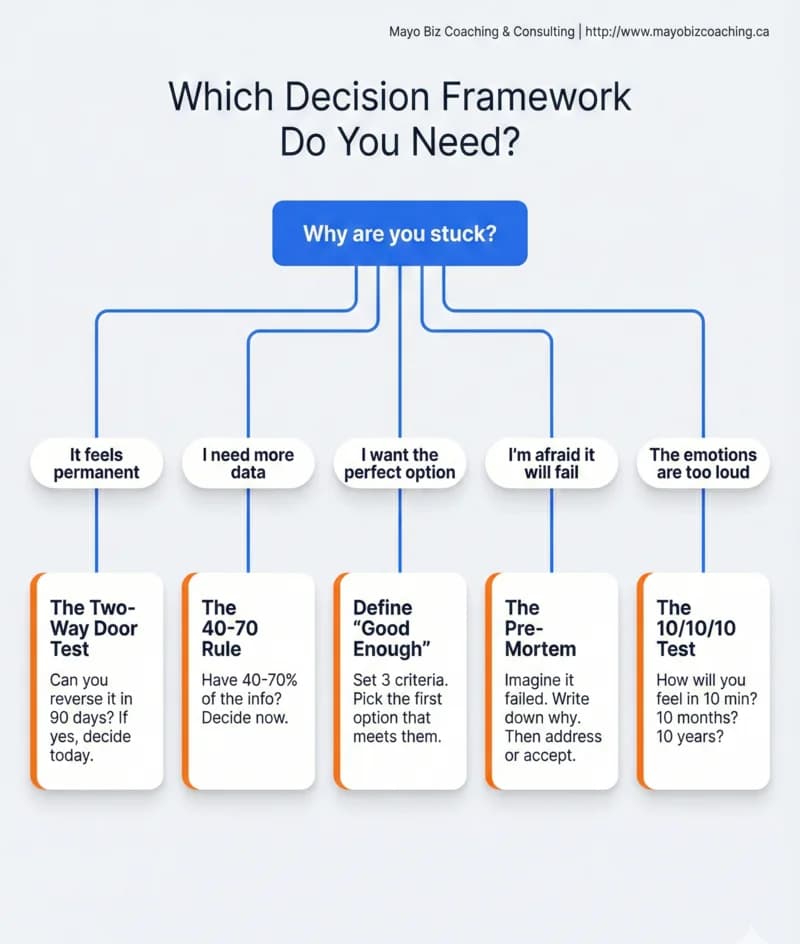
You do not need more information. You need a better filter for the information you already have.
1. The Two-Way Door Test
Before spending another hour deliberating, ask one question: is this decision reversible?
Jeff Bezos classifies every decision 6 as either a one-way door (irreversible, deliberate carefully) or a two-way door (reversible, decide quickly). Most leadership decisions are two-way doors. You can change a vendor. You can restructure a team. You can adjust a pricing model. Companies become slow when they use the one-way-door process for every decision.
If this does not work, can you reverse it within 90 days? If yes, decide today.
2. The 40-70 Rule
General Colin Powell's principle is simple: if you have between 40% and 70% of the available information, decide now. Below 40% is reckless. Above 70% means you waited too long.
I use this regularly with clients. One executive kept requesting additional market research before launching a new service line. When I asked what percentage of the needed information she felt she had, she said "about 65%."
I asked what additional data would actually change her decision. After a long pause, she said nothing would. The research was not due diligence. It was avoidance.
3. Define "Good Enough" Before You Look
Herbert Simon won the Nobel Prize for a practical insight: humans cannot optimise perfectly. We operate with limited time, incomplete information, and finite cognitive capacity. The people who thrive under these constraints are satisficers. They define their criteria for "good enough" and choose the first option that meets them.
Barry Schwartz's research confirmed the payoff. Satisficers are consistently happier with their decisions than maximisers who chase the absolute best option. Before evaluating any options, write down three to five criteria that would make this decision successful. Then stop searching once something meets them all.
4. The Pre-Mortem
Psychologist Gary Klein developed this technique and published it in Harvard Business Review 7. Before finalising a decision, imagine it is 12 months from now and the decision has failed. Write down every reason why.
It works because it gives your fears a name. Naming specific failure modes is easier to act on than vague anxiety about getting it wrong.
Research on prospective hindsight, the practice of imagining a future outcome and reasoning backward, supports this. Mitchell, Russo, and Pennington (1989) found in Organizational Behavior and Human Decision Processes that the technique improves outcome prediction by 30%. Once you can see the risks clearly, you can either address them or accept them and move forward.
5. The 10/10/10 Test
Business journalist Suzy Welch created this filter for emotionally charged decisions. Ask yourself three questions:
- How will I feel about this choice in 10 minutes?
- How will I feel about it in 10 months?
- How will I feel about it in 10 years?
Most leaders who are stuck are over-weighting the 10-minute anxiety. The difficult conversation, the bold hire, the strategic pivot: in 10 minutes it feels risky. In 10 years, the only regret is usually not acting sooner.
Pick the framework that matches your pattern. If you treat every decision as permanent, use the Two-Way Door Test. If you keep asking for more data, try the 40-70 Rule. If fear of failure is the root, run a Pre-Mortem. The right tool depends on why you are stuck, not what you are deciding.
One caveat: these frameworks are built for the 90% of decisions where speed matters more than perfection. Truly irreversible, high-consequence decisions (a merger, a safety-critical system, a legal commitment) still warrant deeper analysis and wider input.
Let's Build Brilliance Together
Decision paralysis is a process problem, not a character problem. You do not need more thinking time. You need a better filter.
If you are noticing these patterns, reach out for a free consultation. That might mean executive leadership coaching or a single session to work through one specific decision. If you are not sure whether coaching is the right fit, here is how to tell. Either way, the goal is clarity. Let's talk about what you are working through.
Research Notes & Sources
If you want to go deeper, these are the studies and reports behind the key points in this post.
- 30% made a purchase(pubmed.ncbi.nlm.nih.gov)
- McKinsey found in a 2019 survey that managers spend 37% of their working time deciding(mckinsey.com)
- an all-time low of 23.4 on the CFIB Business Barometer(cfib-fcei.ca)
- toxic glutamate to accumulate in the lateral prefrontal cortex(cell.com)
- Gallup's research (2024) shows managers account for 70% of the variance in team engagement(gallup.com)
- Jeff Bezos classifies every decision(sec.gov)
- published it in Harvard Business Review(hbr.org)
Category & Tags
Frequently Asked Questions
What causes decision paralysis in leaders?
Three main forces: stakes that feel permanent, isolation at the top, and cognitive overload from constant decisions. Perfectionism and fear of failure turn healthy caution into chronic avoidance.
How do you overcome analysis paralysis at work?
Classify the decision as reversible or irreversible. Set a time limit. Define three criteria for good enough, then commit to the first option that meets them. Fast decisions are nearly twice as likely to also be good ones.
Is decision fatigue a real thing?
Yes. A 2022 study in Current Biology found sustained cognitive work causes glutamate buildup in the brain's decision centre, making complex thinking biologically harder as the day progresses.
When should a leader get coaching for decision-making?
When patterns repeat: delayed hires, avoided conversations, strategies stuck in draft. A coach provides structured frameworks and an honest thinking partner outside your stakeholder circle.
About the Author

About the Author
Mark Mayo
Head Coach, MBC
We get up each morning excited about sharing our 20-plus years of business acumen with small business owners and their teams. Collaborating with hard-working owners to achieve their personal and business goals brings rewards. When we develop you and grow your leaders, we create the momentum that moves you and your business forward. It starts with a first step. Then we can build brilliance together.
Related Articles

Self-Awareness Is a Leadership Skill You Can Build
Most leaders think they're self-aware. Research says only 10-15% actually are. Here is how to close the gap and lead with clearer self-knowledge.
Read Self-Awareness Is a Leadership Skill You Can Build
Learning Agility: Why the Fastest Learners Lead Best
Learning agility predicts leadership success better than experience alone. Here is what it means for small business leaders and how to build it this month.
Read Learning Agility: Why the Fastest Learners Lead Best
Beyond IQ and EQ: Leadership Intelligences Nobody Taught You
IQ EQ XQ AQ leadership is not about choosing one quotient. Learn what each predicts, where each breaks down, and how small business leaders build all four.
Read Beyond IQ and EQ: Leadership Intelligences Nobody Taught You