Team Leadership Development
Coaching vs. Managing: Why Great Leaders Master Both
If you've read any leadership content in the past decade, you've probably heard some version of this: stop managing, start coaching. The implication is that managing is outdated, that good leaders ask questions instead of giving directions, and that "command and control" belongs in the past.
There's truth in that. But it's incomplete.
Coaching vs managing is not a slogan war. It is a timing decision.
The leaders I've worked with who get the best results from their teams aren't purely coaches or purely managers. They're both, and they know when to use each approach. A new employee on their first week needs something different than a ten-year veteran who's temporarily stuck on a problem.
What the research makes clear is that managers matter enormously. Gallup's research 1 spanning two decades and 27 million employees found that managers account for at least 70% of the variance in employee engagement scores. That number surprised me when I first saw it, but it matches what I've observed: the same team can feel completely different under different leadership.
Coaching vs Managing: The Real Difference
Managing is about directing work. You assign tasks, set expectations, monitor progress, and ensure things get done correctly and on time. When someone is new or the stakes are high, clear direction prevents costly mistakes.
Coaching is about developing people. Instead of providing answers, you ask questions that help someone think through problems themselves. You build their capabilities so they can handle similar challenges without you next time. It requires emotional intelligence to read what someone needs in a given moment.
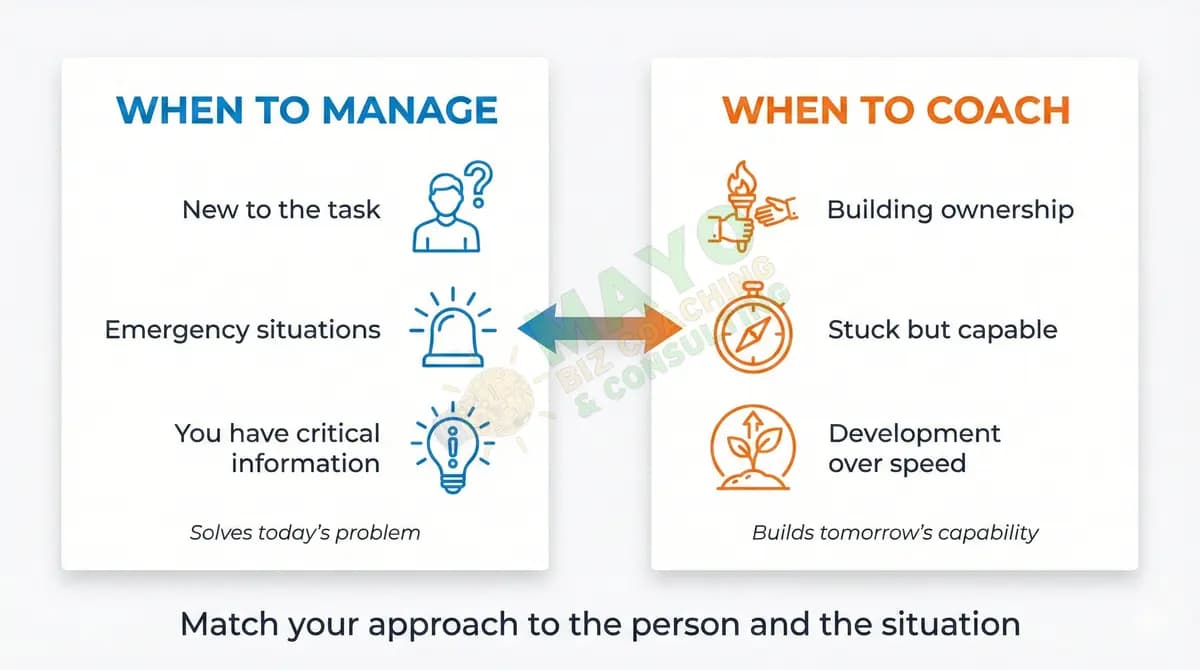
Here's a simple way to think about it: managing solves today's problem. Coaching builds tomorrow's capability.
Consider a team member who keeps missing deadlines on client deliverables. A managing response is simple: send Monday and Thursday updates so issues surface early.
A coaching response starts with two prompts on blockers and support. Both responses are valid.
Both responses are valid. The right choice depends on context.
Why Coaching Has Become So Important
The business case for developing coaching skills is strong, and it's worth understanding why.
Harvard Business Review reports 2 that 70% of employee learning and development happens on the job, not through formal training programs. That means every interaction between a manager and their team member is either a learning opportunity or a missed one.
Organizations are catching on. According to ICF research 3, the median return on investment for coaching is 7 times the initial investment. Companies that build strong coaching cultures report 27% faster revenue growth year over year.
The challenge is that most managers aren't actually good at coaching, even when they believe they are.
A study of 3,761 executives cited in Harvard Business Review found that 24% significantly overestimated their coaching abilities 2. They rated themselves above average while colleagues ranked them in the bottom third. HBR summarized the risk clearly: leaders who overrate coaching skill often underperform in real coaching conversations.
When managers try to coach, they often default to consulting instead, giving advice and sharing what worked for them. That's not coaching. It's still directing, just with a gentler tone.
When to Manage: The Case for Direction
Coaching isn't always the answer. Sometimes people need clear direction, and providing it isn't a failure of leadership.
Direct when someone is new to a task. A first-week employee needs clear steps and examples. They do not need a broad question about approach. Withholding guidance in the name of coaching creates confusion and frustration.
Direct in emergencies. When a customer issue is escalating or a deadline is in jeopardy, this isn't the moment for exploratory questions. Take charge, make decisions, and debrief later.
Direct when you have information they don't. If you know something critical that changes the equation, share it. Watching someone struggle toward a conclusion you could have helped them reach faster is not development. It wastes time.
The Situational Leadership model 4 makes this practical. The model was developed by Paul Hersey and Ken Blanchard and refined over 40 years.
Match your approach to the person's development level on the specific task at hand. High direction works for enthusiastic beginners. It backfires with experienced contributors who need autonomy.
When to Coach
Coaching becomes powerful when someone has enough foundation to think through problems, but needs help seeing clearly or building confidence.
Coach when you want them to own the solution. If you solve every problem for your team, you become the bottleneck. Every answer you give is an answer they didn't have to find themselves. Coaching builds people who can handle the next challenge without needing you in the room.
Coach when they're stuck but capable. Sometimes people have the skills but lose perspective. A few good questions can help them see what they already know. This is faster than giving advice they'll resist because it's not their own idea.
Coach when development matters more than speed. If taking an extra fifteen minutes now means they'll handle similar situations independently for years, that's a worthwhile trade. The 70% of learning that happens on the job 2 only works if you create space for it.
Coach when you don't actually have the answer. Leaders sometimes feel pressure to know everything, but the person closest to the work often has insights you don't. Asking genuine questions when you're genuinely curious isn't a sign of weakness. This is where active listening becomes essential.
The GROW Model: Coaching in Practice
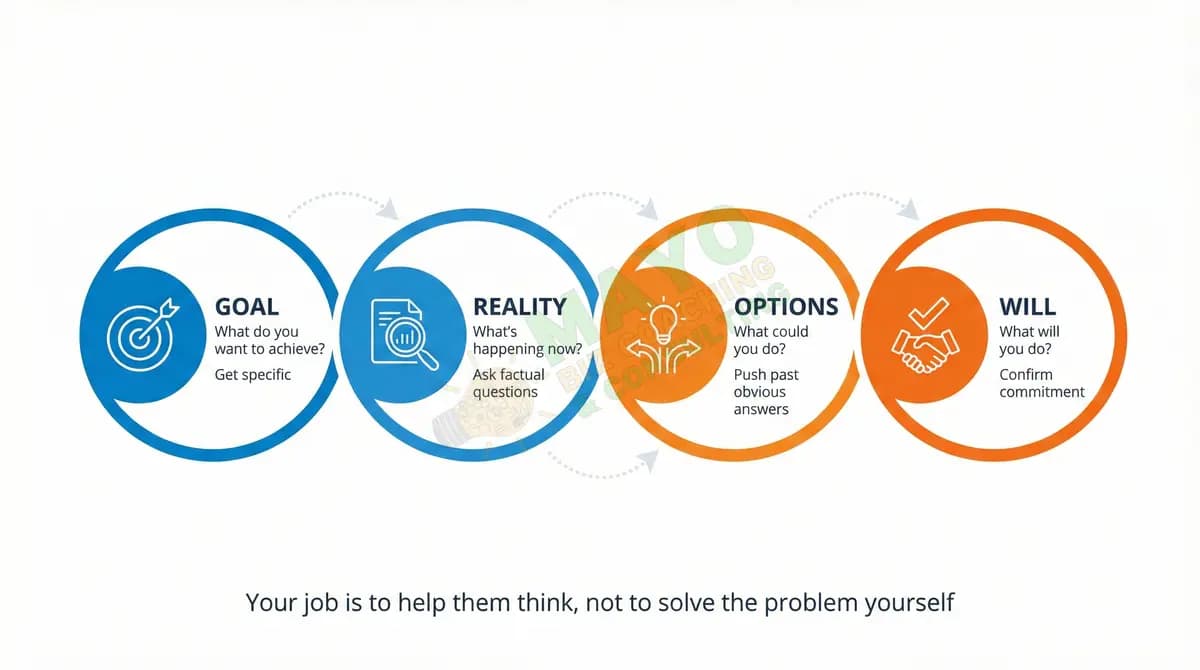
If coaching feels abstract, the GROW model provides structure. Developed by Sir John Whitmore and widely adopted in leadership development, it gives you a practical flow for coaching conversations.
Goal: Define a clear target with a measurable result.
Reality: Review what is happening now, what has been tried, and what constraints are real.
Options: Generate several actions before judging trade-offs.
Will: Choose one concrete commitment, timeline, and follow-through plan.
The key to GROW is that you're asking questions at each stage rather than providing answers. Your job is to help them think, not to solve the problem yourself.
Why Most Managers Default to Directing
Understanding why coaching is hard helps you get better at it.
Managers get promoted because they're good at solving problems. When someone brings you a challenge, your brain immediately starts generating solutions. Staying curious instead of helpful feels unnatural.
Coaching also takes longer in the moment. Telling someone what to do takes thirty seconds. Helping them figure it out themselves might take fifteen minutes. When you're busy, the shortcut is tempting.
What that math misses is the compound effect. The fifteen minutes you invest in coaching pays off every time that person faces a similar situation in the future. The thirty-second answer? They'll be back in your office next week with the same type of problem.
Gallup's research on manager effectiveness 5 found coaching-trained managers improved both performance and wellbeing. When managers improve, team outcomes usually improve with them.
Building Your Capability in Both
The goal isn't to become a coach instead of a manager. It's to expand your range so you can choose the right approach for each situation.
Start by noticing your default. Most leaders lean one direction under pressure. Notice whether you jump to solutions too fast or ask questions when clear direction is needed.
Practice the pause. When someone brings you a problem, resist the urge to respond immediately. Take a breath. Ask yourself: does this person need direction, or would a question serve them better?
Get feedback. Ask your team what they need more of in real work situations. Some need clearer guidance, while others need more space to solve problems.
Observe leaders you admire. Watch how they shift between directing and coaching. Notice the cues they respond to. Leadership is partly learned through observation.
Many managers step into leadership roles without formal coaching training, so they repeat whatever style they inherited. That default often misses what the current team actually needs. With younger workers increasingly declining management roles, the leaders who do step up need coaching skills from day one.
What Changes When You Get This Right
I've watched leaders make this shift, and the difference shows up in small ways first. Fewer people lining up outside their office with questions. Team members starting to solve problems together before escalating. Meetings where the leader talks less and listens more.
Over time, the bigger changes emerge. People develop faster because you're building their capabilities instead of doing their thinking for them. You spend less energy solving the same types of problems because your team can handle more on their own. And honestly, the work becomes more interesting when you're helping people grow instead of just keeping the trains running.
In one client team of 16, a new manager tried coaching in every situation, including first-week onboarding. Error rates climbed, and handoffs slowed. We switched to direct guidance for the first 30 days, then moved to coaching questions in weeks five to eight. Rework dropped, and the manager recovered about three hours each week.
In another coaching engagement with a 12-person service team, leaders used one rule: direct for urgent client risk, coach for development decisions. Escalations decreased within a month, and decision speed improved across supervisors.
Let's Build Brilliance Together
Learning to read situations and choose the right approach takes practice. It gets easier when someone can watch you in action and offer honest feedback. That's part of what coaching provides.
If you want structured support for this shift, Team Leadership Development helps your managers build both coaching skill and execution discipline.
If you're curious whether working with a coach could help you develop as a leader, reach out for a free consultation. No sales pitch, just a conversation about where you are and what you're working on.
Research Notes & Sources
If you want to go deeper, these are the studies and reports behind the key points in this post.
- Gallup's research(news.gallup.com)
- Harvard Business Review reports(hbr.org)
- ICF research(coachingfederation.org)
- Situational Leadership model(situational.com)
- Gallup's research on manager effectiveness(gallup.com)
Category & Tags
Frequently Asked Questions
What is the difference between coaching and managing?
Managing sets direction, priorities, and standards for execution. Coaching develops judgment by asking questions and building capability. Strong leaders switch between both based on task risk, urgency, and skill level.
When should a leader coach vs manage?
Manage directly when risk is high, urgency is real, or someone is new to the task. Coach when the person has baseline skill and needs better ownership, confidence, or decision quality.
Why do managers struggle with coaching?
Many managers were promoted for fast problem-solving, so they default to advice. HBR reported 24% of executives overestimated their coaching skill. Coaching requires curiosity, patience, and questions before solutions.
About the Author

About the Author
Mark Mayo
Head Coach, MBC
We get up each morning excited about sharing our 20-plus years of business acumen with small business owners and their teams. Collaborating with hard-working owners to achieve their personal and business goals brings rewards. When we develop you and grow your leaders, we create the momentum that moves you and your business forward. It starts with a first step. Then we can build brilliance together.
Related Articles

Why Your Best People Aren't Speaking Up
When your strongest contributors go quiet, they haven't become compliant. They're calculating whether it's worth the risk. Here is how to read the silence.
Read Why Your Best People Aren't Speaking Up
The Five Dysfunctions Hiding in Your Team
Patrick Lencioni's Five Dysfunctions model shows why capable teams underperform. Here is how to spot each dysfunction and what to do about it this week.
Read The Five Dysfunctions Hiding in Your Team
The Multiplier Effect: Are You Making Your Team Smarter or Smaller?
Liz Wiseman found multiplier leaders get twice the capability from their teams. Most diminishing is accidental. Here is how to spot it and shift.
Read The Multiplier Effect: Are You Making Your Team Smarter or Smaller?