Work-Life Integration & Purpose
Burnout Is a Leadership Problem, Not a Personal One
You have tried wellness perks and a team retreat, and maybe you even rolled out a meditation app company-wide. People still seem tired. Your best contributor just gave notice, and two others are coasting.
You wonder if something is wrong with their resilience, but the research points somewhere else. Burnout is not a character flaw but a workplace condition, and the evidence shows leadership and workplace design are major drivers.
Three takeaways for leaders:
- Burnout is primarily a workplace design issue, not an individual weakness.
- Manager behavior strongly shapes the conditions that increase or reduce burnout risk.
- Sustainable improvement comes from workload, clarity, support, and delegation changes, not one-off wellness perks.
What Burnout Actually Is
The World Health Organization classified burnout in 2019 1 as an occupational phenomenon. Not a medical condition. Not a personal failing. A workplace syndrome resulting from chronic stress that has not been successfully managed.
Christina Maslach, the researcher behind the Maslach Burnout Inventory 2, defines three dimensions: exhaustion, cynicism, and reduced professional efficacy. In The Burnout Challenge 3, she argues burnout reflects defective workplaces rather than defective workers.
Maslach uses a direct metaphor. If the canary stops breathing in the coal mine, you do not blame the canary. You check the air in the mine 4.
The Data Points to Leadership
As of 2026, Gallup's 2025 report 5 shows global engagement at 21%. Gallup estimates this costs $8.9 trillion in lost productivity each year.
One critical finding is where burnout risk often rises fastest. Gallup's research shows managers account for at least 70% of the variance 6 in team engagement scores. That number has held across 27 million employees and more than two decades of data.
Gallup's burnout research points to the same pattern. Burnout risk rises when people face unfair treatment, unmanageable workload, unclear communication, low manager support, and unreasonable time pressure.
These are not soft numbers. They point directly to leadership behavior and workplace design.
Five Causes Managers Can Influence
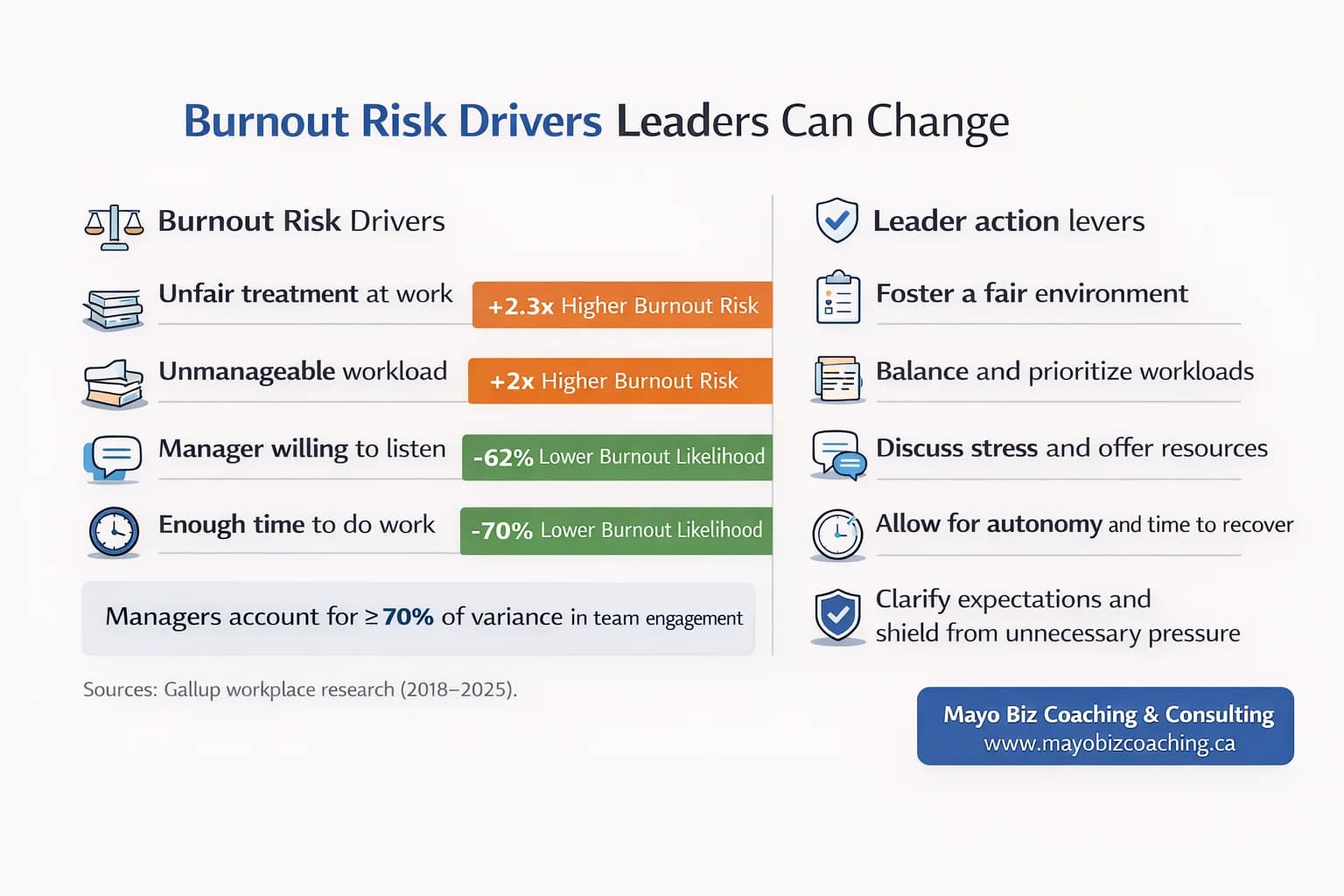
Gallup identified five root causes of burnout 7. All five are strongly shaped by management decisions and work design.
Unfair treatment at work. Employees who feel treated unfairly are 2.3 times more likely 7 to experience high burnout.
Unmanageable workload. These employees are twice as likely 7 to burn out.
Unclear communication from managers. People cannot sustain effort when expectations shift without explanation.
Lack of manager support. Employees whose manager is willing to listen are 62% less likely 8 to burn out.
Unreasonable time pressure. Employees with enough time to do their work are 70% less likely 7 to experience burnout.
Look at that list again. None of these are about individual weakness. None are fixed by a wellness app. Every one is a leadership behavior.
What Leaders Get Wrong
The default response to burnout is personal. Offer resilience training. Add a gym benefit. Suggest people take more breaks. This approach treats the symptom while ignoring the system.
A 2023 meta-analysis 9 found that individual interventions produce temporary relief, while organizational interventions create more durable change. Combined approaches had the strongest effect size at -0.54.
Jennifer Moss put it plainly in the Harvard Business Review: "Burnout is about your workplace, not your people." 10.
Eagle Hill Consulting 11 found that 42% of burned-out employees who told their manager received no action. That gap between speaking up and seeing change is where trust breaks down.
I see this pattern in coaching engagements regularly. A leader notices low energy and responds with a team-building event or a survey. Six months later, nothing has changed. The root issue was unclear priorities, inconsistent feedback, or workload that no one redistributed.
Leaders Are Burning Out Too
This issue hits teams and leaders alike, because leaders themselves are running on fumes.
DDI's 2025 Global Leadership Forecast 12 surveyed 10,796 leaders across 50 countries. Seventy-one percent report significantly higher stress since stepping into their role. Forty percent have considered leaving leadership entirely to protect their wellbeing.
As of 2026, Gallup's 2025 analysis 13 shows manager engagement dropped from 30% to 27% in one year. Young managers under 35 dropped five points. Women managers dropped seven.
When leaders burn out, the effect cascades. A depleted leader cannot coach, cannot listen, cannot hold space for honest conversations. Teams lose their primary source of clarity and support.
In one client team of 16, the general manager handled operations, sales support, and HR issues for over a year after a departure went unfilled. Performance reviews stopped. One-on-ones disappeared. By the time we started working together, two strong contributors had left, and a third was interviewing. The GM was not failing at leadership. The GM was drowning in tasks that should have been distributed.
The Delegation Gap
This connects to one of the most practical findings in the research. DDI found 14 that delegation is the single most effective skill for preventing leader burnout, at 80% effectiveness. That makes it 5 times more impactful than any other burnout mitigation skill.
Yet only 19% of rising leaders demonstrate strong delegation abilities. DDI based this on assessments of more than 70,000 manager candidates.
The gap is clear. The skill that matters most for burnout prevention is the skill leaders are least likely to have. This is a development problem, not a willpower problem. It connects directly to coaching versus managing. Leaders who develop others, set clear expectations, and release tasks can sustain their own energy while building team capacity.
In another coaching engagement, a founder running a 22-person service business worked 60-hour weeks and handled client escalations personally. We mapped every recurring task and identified eight that could move to others with clear ownership and a weekly check-in. Within two months, the founder reclaimed roughly a day per week and reported sleeping better for the first time in over a year.
What Actually Works
The Job Demands-Resources model 15 by Bakker and Demerouti explains the mechanism. When demands outstrip resources, burnout follows. When leaders provide resources like autonomy, feedback, support, and development, those resources buffer the impact of high demands.
Leaders who invest in their people's capacity can protect teams even when work is intense. The issue is not hard work. The issue is hard work without support.
Practical moves the research supports:
Listen on purpose. Gallup's manager research 8 shows frequent, meaningful manager conversations are strongly linked to lower burnout risk. Fifteen to thirty minutes about goals, progress, and wellbeing can make a measurable difference. Active listening is the core skill here.
Build inclusion and fairness. Gallup's burnout research highlights unfair treatment 7 and low manager support 8 as key burnout accelerators. Improve access to resources, direct-manager support, and psychological safety to lower risk.
Create psychological safety. Teams surface issues earlier when leaders respond with curiosity, follow-through, and consistency. Psychological safety turns hard conversations into solvable operational problems.
Invest in organizational change alongside individual support. The WHO estimates a $4 return for every $1 16 invested in workplace mental health. Stanford and Harvard researchers found workplace stress costs $125 to $190 billion 17 in additional U.S. healthcare spending each year.
The Canadian Picture
As of 2026, Canadian business owners are still feeling this acutely.
CFIB's 2022 survey 18 of 4,001 members found 66% of small business owners were close to burnout.
BDC's 2025 annual survey 19 of 1,510 Canadian business owners found 36% say mental health challenges interfere with work at least once per week. For owners under 40, that number jumps to 60%.
Robert Half Canada 20 reported 47% of Canadian professionals feel burned out, up from 33% in 2023.
The pattern is consistent. Burnout among Canadian leaders and workers is rising, and the data matches the global research: this is a structural issue, not a personal one.
A 60-Day Leadership Reset
You do not need a culture overhaul. You need focused leadership changes with clear follow-through.
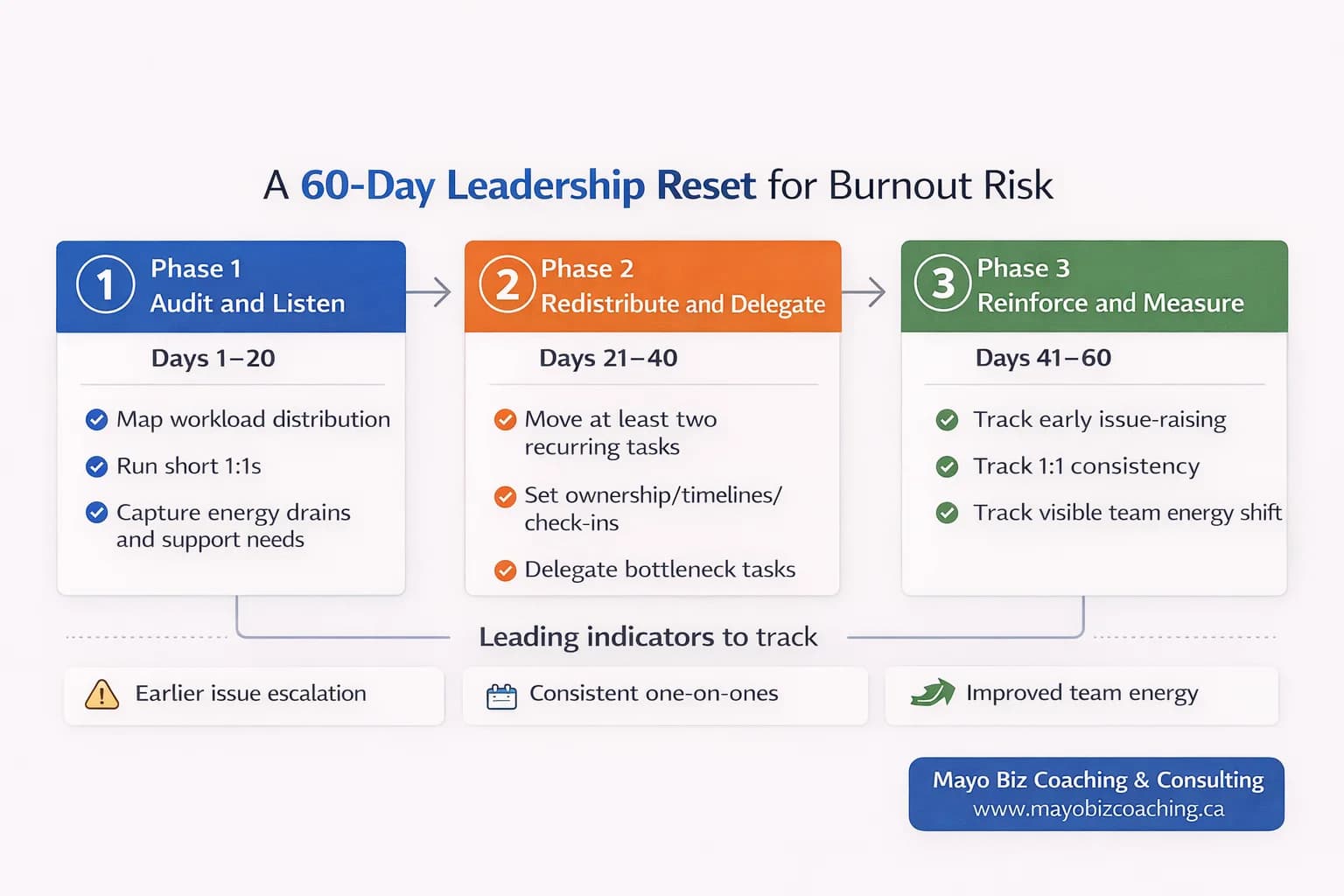
Days 1 to 20: Audit and listen. Map workload distribution across your team. Identify who is overloaded and which tasks can shift. Run three short one-on-ones with each direct report using two prompts. First: what is draining your energy right now? Second: what support would make the biggest difference? Listen without defending. Write down what you hear.
Days 21 to 40: Redistribute and delegate. Move at least two recurring tasks from overloaded people to others with capacity. Set clear ownership, timelines, and check-in dates. If you are the bottleneck, identify your own delegation targets. Use emotional intelligence to read how the shift is landing with your team.
Days 41 to 60: Reinforce and measure. Track three signals: Are people raising issues earlier? Are one-on-ones happening consistently? Is the energy in the room shifting? These leading indicators appear before engagement scores or turnover data change.
In one Ontario team, this cycle revealed that three people carried the equivalent workload of five. The owner had not seen the imbalance because weekly reports focused on output, not capacity. After redistribution and two new delegation agreements, overtime dropped and two at-risk employees decided to stay.
Let's Build Brilliance Together
Burnout is not a sign that your people are weak. It is a signal that something in the system needs to change. The research is clear: leadership behavior, workload design, and team culture are among the strongest levers for reducing burnout risk.
If you are seeing the signs and want structured support, Work-Life Integration coaching helps you redesign how your team works without losing performance.
If burnout is showing up in your team or in yourself, reach out for a free consultation. No sales pitch, just an honest conversation about what is happening and what to change first.
Research Notes & Sources
If you want to go deeper, these are the studies and reports behind the key points in this post.
- classified burnout in 2019(who.int)
- Maslach Burnout Inventory(mindgarden.com)
- The Burnout Challenge(openlibrary.org)
- check the air in the mine(vcresearch.berkeley.edu)
- Gallup's 2025 report(gallup.com)
- at least 70% of the variance(news.gallup.com)
- five root causes of burnout(gallup.com)
- 62% less likely(gallup.com)
- 2023 meta-analysis(pubmed.ncbi.nlm.nih.gov)
- "Burnout is about your workplace, not your people."(hbr.org)
- Eagle Hill Consulting(eaglehillconsulting.com)
- DDI's 2025 Global Leadership Forecast(ddi.com)
- Gallup's 2025 analysis(gallup.com)
- DDI found(ddi.com)
- Job Demands-Resources model(pubmed.ncbi.nlm.nih.gov)
- $4 return for every $1(who.int)
- $125 to $190 billion(gsb.stanford.edu)
- CFIB's 2022 survey(cfib-fcei.ca)
- BDC's 2025 annual survey(bdc.ca)
- Robert Half Canada(press.roberthalf.ca)
Category & Tags
Frequently Asked Questions
Is burnout caused by the workplace or the individual?
The WHO classifies burnout as an occupational phenomenon, not a medical condition. Maslach's research identifies six organizational causes: workload, control, reward, community, fairness, and values. All six are structural factors.
How much do managers affect employee burnout?
Gallup found managers account for at least 70% of the variance in team engagement. Gallup also links five major burnout drivers to manager and workplace practices: fairness, workload, communication, support, and time pressure.
What is the most effective way to prevent leader burnout?
DDI's 2025 Global Leadership Forecast found delegation is the top skill for preventing burnout at 80% effectiveness, yet only 19% of rising leaders demonstrate strong delegation abilities.
Does investing in burnout prevention pay off?
The WHO estimates a $4 return for every $1 invested in workplace mental health. Stanford and Harvard researchers found workplace stress costs $125 to $190 billion in U.S. healthcare spending annually.
About the Author

About the Author
Mark Mayo
Head Coach, MBC
We get up each morning excited about sharing our 20-plus years of business acumen with small business owners and their teams. Collaborating with hard-working owners to achieve their personal and business goals brings rewards. When we develop you and grow your leaders, we create the momentum that moves you and your business forward. It starts with a first step. Then we can build brilliance together.
Related Articles
The Manager Burnout Crisis No One Is Talking About
Managers are the most burned out group at work, yet they support everyone else first. Research reveals why they crack in silence and what actually helps.
Read The Manager Burnout Crisis No One Is Talking About
Purpose Driven Leadership: Why Putting People First Drives Results
Purpose driven leadership improves engagement and retention. See Hubert Joly's Best Buy turnaround, and why putting people first drives results.
Read Purpose Driven Leadership: Why Putting People First Drives Results
What Can A Business Coach Help With?
Business coaches help with leadership, strategic planning, team building, and transitions. Discover where coaching makes the biggest difference.
Read What Can A Business Coach Help With?