Executive Presence & Influence
Building Executive Presence: Command a Room Without Saying a Word

You have seen it happen. Someone walks into a meeting and the room shifts. People sit up and side conversations stop.
There is no dramatic announcement. The shift comes from how that person carries themselves.
You have also seen the opposite. A leader with strong credentials, solid results, and good intentions who keeps getting passed over. People respect the work but do not follow the person. The gap is presence, not competence.
Executive presence is the difference between being known for your work and being trusted to lead. Coqual research 1 surveyed nearly 4,000 professionals and found that presence accounts for 26% of what it takes to get promoted. This is a career metric that shapes promotion decisions.
What Executive Presence Actually Is
Most people get this wrong. They picture a tall, charismatic extrovert commanding attention with a booming voice and firm handshake. That image is outdated and misleading.
When Coqual asked 268 senior executives what drives executive presence, the answers were clear:
Gravitas (67%): How you act under pressure. Your composure, decisiveness, and depth of knowledge.
Communication (28%): How clearly and concisely you speak. Your ability to read a room and adjust.
Appearance (5%): How polished you look. Important, but far less than most people assume.
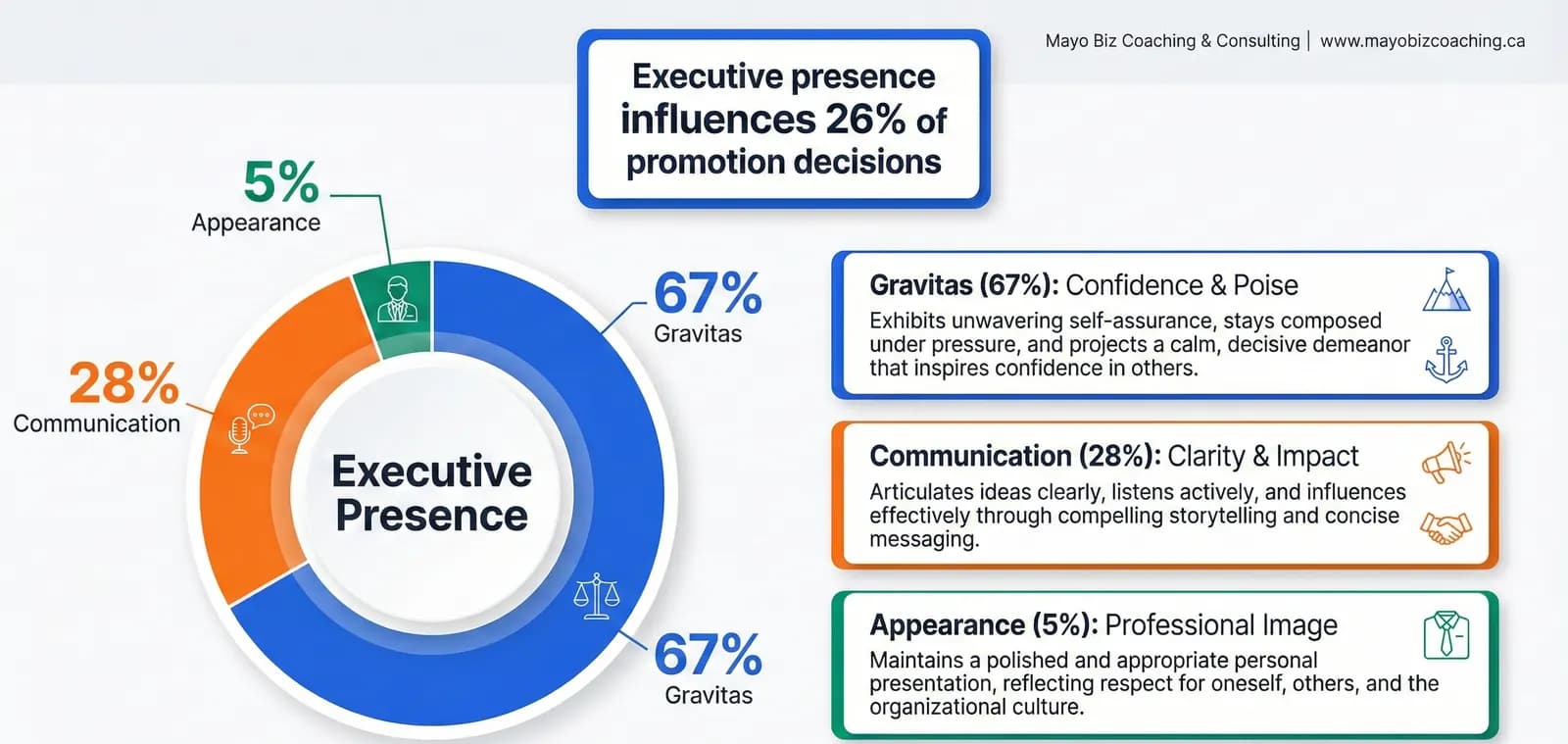
Two-thirds of executive presence is substance. Style and charisma matter less than most people think. Leaders earn trust by staying grounded under pressure. They make clear decisions with incomplete information and communicate with precision.
This mirrors Jim Collins's Level 5 Leadership 2 concept from Good to Great: personal humility paired with professional will. Collins and his research team reviewed 1,435 Fortune 500 companies and found only 11 that made a sustained leap from good to great. The leaders who drove that shift were not theatrical personalities. They were disciplined, grounded, and clear when the stakes were high.
Collins first introduced this model in Harvard Business Review's Level 5 Leadership article 3, framing it as humility plus fierce resolve.
I coached a VP of operations who had been passed over twice for a C-suite role. His technical skills were the strongest on the leadership team. His quarterly reviews were flawless. But in executive meetings, he deferred to louder voices, hedged his recommendations, and waited for consensus before stating a position.
His CEO told me privately: "I trust his analysis completely. I just cannot tell if he trusts it himself."
We worked on one behaviour for three months: stating his recommendation first, then presenting the data. That single shift changed how the room responded to him. He was promoted within the year.
The Quiet Power of Listening
Most leaders are surprised by this: the skill most tied to trust is listening, not speaking.
Zenger Folkman analysed 360-degree feedback 4 from over 4,000 leaders and found that poor listeners ranked at the 15th percentile in trust. Leaders who excelled at listening reached the 86th percentile. That gap is huge. It often marks the difference between a leader people tolerate and one they follow.
In coaching, I see the same pattern every week. The leaders with the strongest presence are rarely the ones talking the most. They ask one sharp question and then wait.
They reflect back what they heard before adding their view. They create space for others to think out loud.
When people feel heard, they attribute competence and confidence to the listener. Silence, used well, signals that you are processing, not scrambling. That patience is a form of gravitas most leaders underestimate.
If you want to build this skill systematically, the guide on active listening for leaders breaks down the behaviours that make listening visible.
Why Introverts Often Have Stronger Presence
The loudest person in the room is not always the most present. Research challenges the assumption that executive presence requires extroversion.
Leadership style interacts with team behaviour. Introverted leaders can perform strongly when teams are proactive. They tend to listen first and use team input instead of dominating the conversation.
The CEO Genome Project 5 analysed 17,000 C-suite assessments over a decade. Introverted CEOs were slightly more likely to exceed board expectations than extroverted ones.
Leadership teams include both quieter and louder voices. But development programs often reward louder behaviours such as quick answers, high airtime, and constant verbal presence. That mismatch creates a false standard many leaders measure themselves against.
I worked with a founder who built a 40-person engineering consultancy. She described herself as "not a natural leader" because she was quiet in large groups. Her team told a different story.
In one-on-ones, she asked better questions than anyone they had worked for. She remembered details about their projects and challenges. People stayed at her company because they felt genuinely known.
Her presence was real. It just did not look like the TED talk version of leadership. If you lead from reflection and depth rather than volume, that is not a deficit. It is a different and often more durable form of presence.
Behaviours That Erode Presence
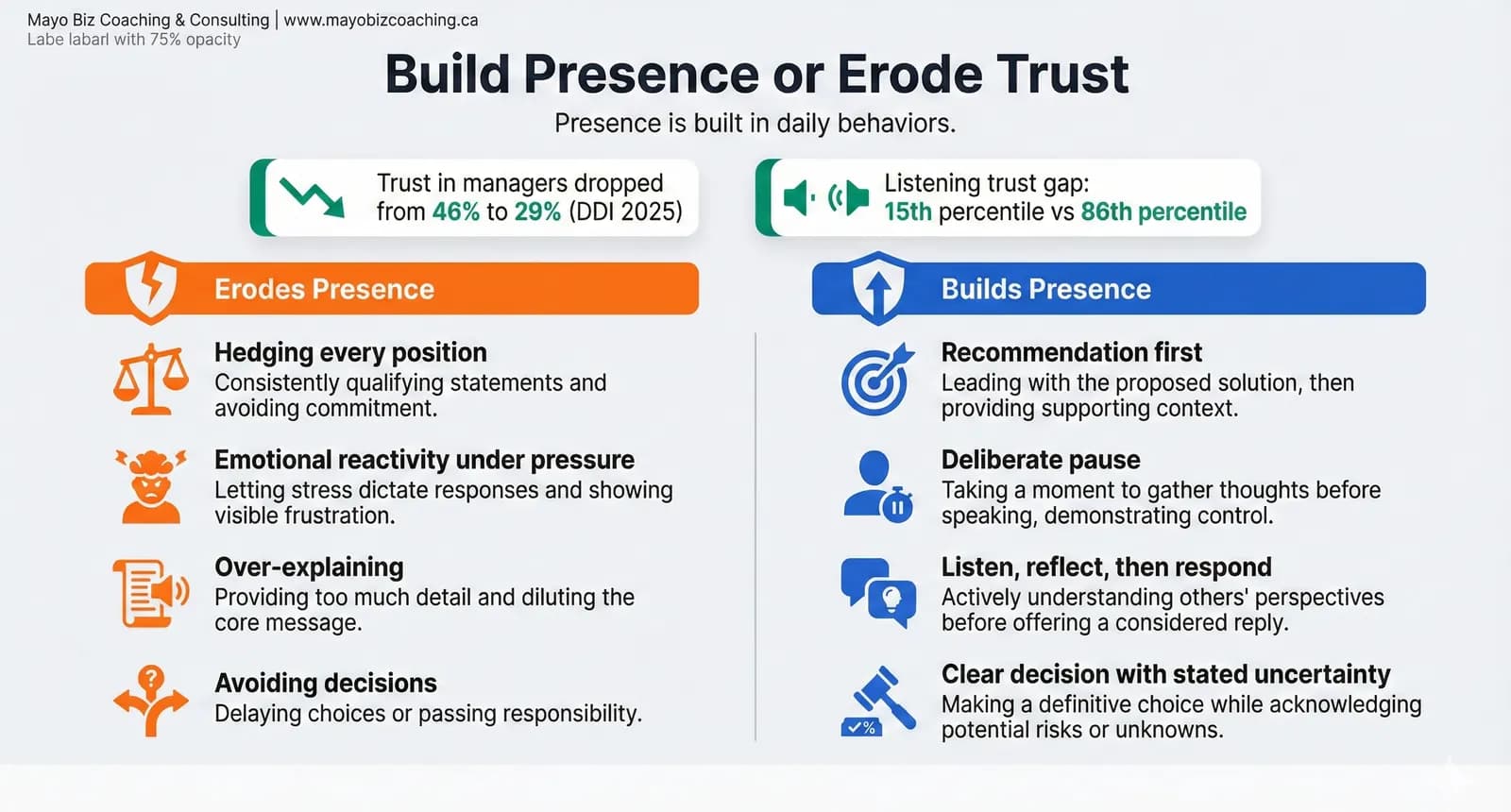
Executive presence builds slowly and can disappear quickly. Senior leaders consistently name the same behaviours that undermine it.
Hedging every position. Qualifiers like "I might be wrong, but..." and "This is just my opinion..." signal uncertainty even when your analysis is sound. State your view. Then invite challenge.
Reacting emotionally under pressure: Visible frustration, sarcasm, or defensiveness tells the room you have lost composure. People stop sharing hard truths because the cost of your reaction is too high. DDI's 2025 Global Leadership Forecast 6 found that trust in managers dropped from 46% to 29% in just two years. The report does not assign one cause.
In coaching work, emotional reactivity is one pattern that can accelerate trust loss.
Talking too much. Explaining past the point of clarity makes you appear less confident, not more. When you have made your point, stop. The urge to fill silence weakens the message you already delivered.
Mismatched words and body language. When verbal and non-verbal signals conflict, people trust the non-verbal. Saying "I am confident in this plan" while avoiding eye contact sends a contradictory message. Alignment between what you say and how you carry yourself is the foundation of credibility.
Avoiding decisions. Constantly seeking more data, more opinions, or more time before committing signals that you are not ready to lead. Decisiveness does not mean rushing. It means being clear about what you know, what you do not know, and what you recommend anyway.
Building Presence Through Daily Practice
Executive presence is a set of observable behaviours you can practice. You are not stuck with whatever habits you started with. Here is where to start.
Speak With Conviction
Lead with your recommendation, not your caveats. Structure your input in three parts: what you recommend, why it matters, and what you need from the room. This framework forces clarity and projects confidence even when the situation is uncertain.
Practice this in low-stakes settings first. Your next team meeting is a good starting point. Commit to offering your view within the first five minutes rather than waiting to see where the conversation lands.
Use Silence Deliberately
A strategic pause after making a point gives your words weight. It also gives the room time to process. Most leaders rush past their own best ideas because the silence feels uncomfortable.
Try this: after stating a key point in your next meeting, count to three before continuing. Watch what happens. People lean in when you give them space to absorb.
Match Your Body to Your Message
Stand or sit with open posture. Make consistent eye contact when speaking and listening. Keep gestures deliberate rather than anxious. These signals are small but they shape how people experience your confidence before you say a word.
Prepare for Moments, Not Presentations
The moments that define executive presence are rarely scheduled. They happen in hallway conversations, unexpected questions, and tense meetings. Preparation means knowing your three priorities well enough to speak about them without slides.
I coach leaders to keep a "presence prep" list: three current priorities, two potential challenges, and one clear position on each. Review it for five minutes before any meeting where visibility matters. That small investment compounds over weeks.
Build Feedback Loops
You cannot see your own presence. Ask two trusted colleagues for honest input on how you show up in meetings.
Specific questions work better than general ones. Ask, "What landed in last Tuesday's meeting?" Then ask, "What missed?"
This is also part of building your personal brand as a leader. Presence and brand reinforce each other when they align.
Presence in Virtual Settings
Remote and hybrid work changed what executive presence looks like. A strong in-person presence does not automatically translate to a screen.
Virtual meeting fatigue is common, and camera pressure can drain engagement over time. The leaders who maintain presence virtually do a few things differently.
They look at the camera when speaking, not at gallery images. On video, the camera is eye contact. They keep their background clean and their frame well-lit, because visual clarity reduces cognitive load for others. They speak slightly more slowly and pause more deliberately, because audio compression flattens vocal tone.
In virtual settings, they compensate for reduced body language by being more explicit. In person, a nod can confirm understanding.
On a call, you need words: "I hear your concern. Here is what I think we should do." Virtual presence requires more intentional communication, not less.
I coached a sales leader who came across as confident in person but rushed and distant on video. We made two changes: camera-level eye contact and one deliberate pause before every key recommendation. Within a month, her team said her direction felt clearer and calmer in virtual meetings.
What This Means for Canadian Business Owners
In Canadian businesses, leadership development often slips when schedules tighten. One-on-ones get shortened, coaching time disappears, and development plans stall. That gap between intention and execution creates real cost.
Canadian leadership culture tends toward collaboration and consensus. That is a strength. But it also means leaders who avoid stating a clear position can be mistaken for lacking direction rather than building alignment. The balance is having a view, sharing it clearly, and then genuinely listening to what others add.
For small business owners already working long hours, executive presence can feel like one more item on an overloaded list. The better frame is this: presence is how you do the work you already do. The same meeting, the same one-on-one, and the same client call, with more intention in how you show up.
Let's Build Brilliance Together
Executive presence is about making your strengths visible and consistent. You do not need a new personality to build it. Gravitas, clarity, and composure are skills you can build through practice and honest feedback.
If you recognise yourself in these patterns, Executive Presence and Influence coaching gives you a structured way to build these behaviours with real-time feedback.
If you are curious whether coaching could help you lead with more confidence and clarity, reach out for a free consultation. No sales pitch, just an honest conversation about where you are and what could shift.
Research Notes & Sources
If you want to go deeper, these are the studies and reports behind the key points in this post.
- Coqual research(coqual.org)
- Level 5 Leadership(jimcollins.com)
- Harvard Business Review's Level 5 Leadership article(hbr.org)
- Zenger Folkman analysed 360-degree feedback(zengerfolkman.com)
- CEO Genome Project(hbr.org)
- DDI's 2025 Global Leadership Forecast(ddi.com)
Category & Tags
Frequently Asked Questions
Can you build executive presence or is it innate?
Executive presence is a learnable skill, not a fixed trait. Effective leaders build their presence through deliberate practice, feedback, and coaching over time.
What is the most important part of executive presence?
Gravitas accounts for 67% of what senior leaders look for, according to Coqual research of 268 executives. Communication accounts for 28%, and appearance only 5%.
Do introverts have executive presence?
Yes. Introverted leaders can have strong executive presence, especially when they listen first and use team input. The CEO Genome Project found introverted CEOs slightly outperformed extroverts against investor expectations.
How does executive presence affect career advancement?
Coqual research found executive presence accounts for 26% of what it takes to get promoted. 60% of senior executives would promote a leader with strong presence over one with a better track record.
About the Author

About the Author
Mark Mayo
Head Coach, MBC
We get up each morning excited about sharing our 20-plus years of business acumen with small business owners and their teams. Collaborating with hard-working owners to achieve their personal and business goals brings rewards. When we develop you and grow your leaders, we create the momentum that moves you and your business forward. It starts with a first step. Then we can build brilliance together.
Related Articles
Your Team Says Everything Is Fine. It Isn't.
Managers think engagement is improving. Their teams disagree. Here's how to spot the leadership perception gap and start hearing what's real.
Read Your Team Says Everything Is Fine. It Isn't.
How to Build a Personal Brand That Reflects Your True Leadership
Personal branding for executives: build a research-backed audit, narrative, and visibility plan that strengthens trust, executive presence, and career growth.
Read How to Build a Personal Brand That Reflects Your True Leadership
The Power of Active Listening: A Leadership and Life Skill
Active listening goes beyond hearing words. Learn how this essential leadership skill builds trust, strengthens relationships, and drives team success.
Read The Power of Active Listening: A Leadership and Life Skill